UNSW RoboCup@Home SPL Team Description Paper
C. Sammut, M. Pagnucco, G. Castro, C. Flannagan, M. Gratton, B. Hengst, D. Rajaratnam, C. Schwering, M. Thielscher, M. Velonaki, T. Wiley
School of Computer Science and Engineering & Creative Robotics Lab, The University of New South Wales, Sydney, Australia
Abstract At the time of submission, we are still waiting for delivery of the Toyota HSR robot. It took a long time to settle legal issues around the contract, but this has finally been concluded and we hope the robot is shipping now. This team description paper is accompanied by a video demonstrating some of our capabilities on a makeshift platform, put together specifically for this demonstration. The video also includes demonstrations on a variety of other platforms, showing what we intend to integrate into the HSR.
Preamble
At the time of submission, we are still waiting for delivery of the Toyota HSR robot. It took a long time to settle legal issues around the contract, but this has finally been concluded and we hope the robot is shipping now.
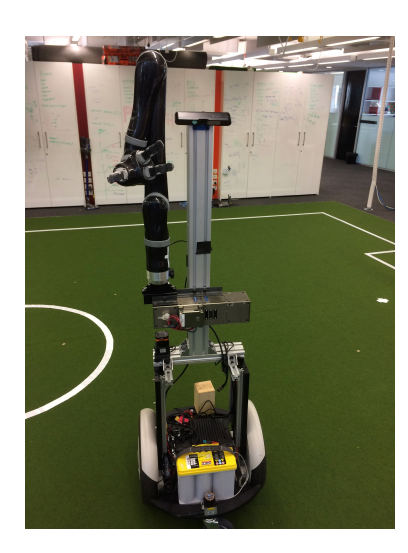
This team description paper is accompanied by a video demonstrating some of our capabilities on a makeshift platform, shown in Figure 1, put together specifically for this demonstration. The video also includes demonstrations on a variety of other platforms, showing what we intend to integrate into the HSR.
The demonstration platform consists of a Segway RMP base, with a torso mounted on top, supporting a Jaco arm and an Asus Xion RGB-D camera. Navigation uses to Hokuyo laser rangefinders, one mounted low for obstacle detection and one mid-way up. The robot is controlled by an onboard laptop running ROS. The system includes the following ROS nodes:
- A SLAM module, base on our system for rescue robots
- Speech recognition and text-to-speech
- Moveit for controlling the arm
- simple object detection with the Asus
- A planner
Introduction
The University of New South Wales (UNSW) has a long history in RoboCup soccer and rescue leagues. Our main research focus in all of our participation in RoboCup has been on the AI underpinning intelligent behaviours. RoboCup@Home SPL with the Toyota HSR robot fits very well with our research focus, as the @Home competition demands more high-level reasoning and learning than any other league. The research conducted in the School of Computer Science and Engineering and the Creative Robotics Lab spans many areas including: cognitive architectures, machine learning for perception and robot behaviours, humanrobot interaction (including conversational and multi-modal interaction), SLAM, and cognitive robotics. The diversity of our research gives us a good understanding of how to build a complex robot and we are experienced in integrating systems ready for competition, and in releasing our code as open source software. We also have unique expertise in the Creative Robotics Lab, which is dedicated to research in human-robot interaction and social robots.
UNSW has a distinguished record in RoboCup, winning the RoboCupSoccer 4-Legged League in 2000, 2001 and 2003, and the RoboCupSoccer SPL in 2014 and 2015. Overall, our teams have ranked in the top three places in 70% of the competitions in which we have participated. In RoboCupRescue, we won the best-in-class autonomy division in 2009 - 2011. We also received a special award for human-robot interaction in 2009 and won the mobility challenge in 2010.
Much of the software developed for RoboCupRescue is also applicable to @Home, as it combines sensing, locomotion, manipulation, navigation, decision making and learning. It shares many of the same problems as RoboCup@Home, but @Home adds much more human-machine interaction and social robotics, which is where our current research is directed. Interaction between the rescue and @home leagues can be bidirectional as there is also potential for research in @Home to feedback into rescue, particularly if the rescue competition adds mixed teams of humans and robots.
A standard platform for @Home SPL is attractive because of the advantages to be gained from sharing software. Experience in the soccer SPL, in which teams publicly release there code each year, is that progress across the league is accelerated through code sharing.
Background
We have a substantial code base inherited from the RoboCupRescue Real Robots competition and other research. The software is built around ROS and has been ported to run on a variety of platforms including robots with different drive mechanisms, sensors and arms. The existing software includes SLAM and autonomous navigation; multi-modal interaction for conversational agents; and software for object recognition and simple grasping. We will also incorporate our current research in cognitive hierarchies and resource constrained planning and reasoning. The remaining components, such as inverse kinematics for manipulation, and face recognition will be derived from existing open source software.
SLAM and Navigation
Our GPU accelerated 3D SLAM software for mapping and navigation [1] has been ported to our own experimental @Home platform and will be ported to the HSR. The SLAM system was developed to handle the complex terrain of urban search and rescue, such as going up and down stairs and navigating over uneven flooring. It avoids temporary obstacles, such as human occupants moving around. Some adaptation is required to deal with furniture, glass and mirrors. The navigation system includes exploration for mapping, as well as path planning [2]. This will be adapted to handle path planning that arises from interactions with humans.
Conversational Agent
A conversational agent was originally developed as part of a project to create a "smart home" [3]. The occupants interacted with devices in the home by speech and gestures. The system was also equipped with cameras to track motion, which was used to detect falls. Occupants were able to talk to the room and ask for devices to be turned on and off and to control television sets, audio systems, ask questions answered from the web, etc. The system consists of a scripting language for the dialogue and interacts with devices through a blackboard system. Each device is controlled by its own software agent that interacts with other agents, including the dialogue manager, through a blackboard. This system has been ported to robots in our lab, adding planning agents and other components needed for robot control. Agents interact with ROS nodes through the blackboard mechanism.
Robot Control and Reasoning
Our team includes experts in knowledge representation and reasoning (KRR), action logics, teleo-reactive programming, epistemic reasoning, and belief revision. This research is relevant, not only because of the planning required for the robot, but also because it must also be able to cope with incomplete or inaccurate statements from humans. For example, the human may ask for the red cup on the table when, in fact, there is a red plate and a blue cup. What should it do? We have worked to bring the theory of KRR to practice, helping develop ROSoClingo [4], an adaptation of a high-performance Answer Set Programming reasoner for use in ROS. We are implementing high-level reasoning and task planning in ROSoClingo.
Object Recognition
We have developed model-based approaches to 3D object recognition using RGB-D cameras. The vision system extracts shape primitives (e.g. planes and cylinders) from the point cloud. A relational learning system then builds a description of the object class based on the relationships between the shape primitive [5].
This method has been used in the rescue environment to recognise staircases and other terrain features. Once a model of the object is created, it is imported into a simulator, like Gazebo, which allows the robot to "visualise actions" before executing them in the real world. We investigating similar approaches to 'logical vision" for object detection and modelling approach in the @Home SPL.
Authors Suppressed Due to Excessive Length
(Section header only, no additional text content)
Externally available components
Other components are derived from existing open source software. As we work in the ROS framework, we can readily incorporate open source packages that are also built in ROS. We use the MoveIt or GraspIT ROS packages for calculating inverse kinematics and performing manipulation tasks. For face recognition and person tracking we use tools in OpenCV 3.0, and the OpenNI/NiTE skeleton tracking library.
Research
One of our main research foci is on combining high-level reasoning with real-time low-level sensing and control to improve the capabilities of autonomous robots. Our long-term aim is to develop general-purpose intelligent systems that can learn and be taught to perform many different tasks by interacting with their environment. In the course of our research, we have created software that can be ported to the Toyota HSR for the RoboCup@Home competition. Below, we highlight the current focus of our research, and our key innovative technologies and scientific contributions.
Cognitive Architecture
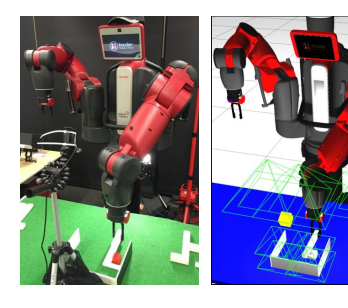
We wish to better understand how a variety of software components should be integrated in a robot. We have developed a novel meta-model for formalising cognitive hierarchies [6]. A cognitive hierarchy consists of a set of nodes connected in a hierarchical graph. Every node in the hierarchy has a world model and behaviour generation at a particular level of abstraction, with the lowestlevel node as a proxy for the external world. Cognitive hierarchies described using this model are modular in design and allow the integration of symbolic and sub-symbolic representations in a common framework. The model has been demonstrated on several platforms including a Baxter robot, which incorporates a simulator as its world model, allowing the system to "visualise" the effects of actions before executing them in the real world. For the TMC HSR RoboCup@Home SPL robot we will use this system, implemented over ROS, as the basis for integrating the different components in a single architecture, from SLAM and robot navigation through to high-level behaviour generation.
Human-Robot Interaction and Trust
Human-robot interaction may include speech, sound, music, gestures, body movements, proximity, facial expressions, body language and touch. Poorly designed interactions decrease the willingness of a human to use the robot. Our research aims to improve human-robot interaction by studying two areas, physical elements of human-robot interactions and the ability of the robot to learn from and adapt to new dynamics of the interaction.
The physical components of human-robot interactions we study are touch, gesture, and recognising human emotions through micro and macro human expressions, and the manner in which a robot approaches a human. [7] The goal is to prevent the human from being surprised or fearful of a robot's actions. We use machine learning to alter how the robot behaves and interacts so that the human can teach the robot how they wish to interact, explaining aspects of the interaction they prefer or dislike, find uncomfortable or confronting.
An associated concern is how trustworthy humans regard a robot, especially when they can learn and adapt to new situations. We are studying the change in trust for a mixed initiative task under varying degrees of transparency of the adaptation process. The cognitive architecture mentioned above includes the ability for the robot to adapt to a change. It is implemented on a Baxter robot for a mixed initiative problem solving task where the environment changes, requiring the robot to adapt on the job. This also requires modelling and evaluating the evolving human-robot trust relationship as the robot learns.
For our research in Human-Robot Interaction we are constructing a National Facility for Human-Robot Interaction Research, due to open in early 2017. It will be a state-of-the-art facility for non-intrusive real-time measurement of the properties that are linked to human affect and intent.
Position Tracking and SLAM
We developed our own robust position tracking and SLAM algorithms [2], originally for RoboCupRescue, but which are also used on robots in our office space. A recently completed PhD student improved and re-implemented these algorithms to make use of a GPU using full 3D information to produce correctly aligned and accurate 3D maps [1]. Much of this work carries across to RoboCup@Home, since accurate 3D position tracking and mapping for navigation and obstacle avoidance through the home. Combined with our work on spatial reasoning, this also assists in planning and model-based object recognition.
Robot Learning
UNSW was known for its work in machine learning well before we began working in robotics. In fact, one of the main motivations for entering robotics is that it is such a rich source of data and problems that can be solved by learning. We have developed methods for learning how to traverse difficult terrain by learning from demonstration and through trial-and-error [8]. We combine learning abstract qualitative models with reinforcement learning, where the abstract layer constrains search in the lower-control layer to greatly, reduce the number of trials required. As mentioned earlier, we also make extensive use of machine learning in perception.
General Game-Playing Robots
Our group also has a history of success in General Game-Playing (GGP) competitions, and this expertise extends to robotics. Many domestic robot tasks have game-like properties, requiring the robot to reason about the goals of other agents as well as adapting to unexpected changes in the environment [9]. For example, a domestic robot tasked with fetching an item has to consider the possibility that the item may not be where it expects, or that the human operator may change locations after issuing the request. Viewing such a task as a game can provide a framework for improving robot behaviours.
Experiments and Results
In lieu of results obtained using the Toyota HSR, we briefly list some experiments conducted on other platforms
Human-Robot Interaction
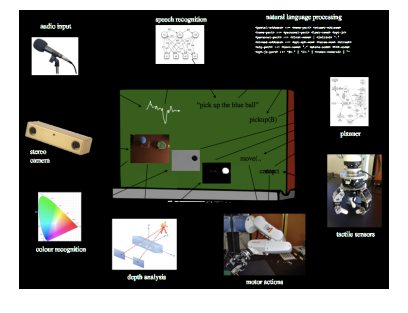
Several conversation agent systems have been developed to interact with smart homes and robots. The system shown in Figure 2 is a speech operated robot arm that can be instructed to pick up objects of different colours and shapes. Each device is controlled by its own software agent, which posts messages to and reads from a blackboard.
The same conversational agent architecture has been used to control a smart home (demonstrated in the accompanying video). Here, the agents attached to the blackboard control devices such as lights, the TV set, a radio and the home PC. Sensors include cameras and microphones monitoring a space. The system is capable of multi-modal interaction, combining gesture recognition with speech and can also perform safety monitoring, e.g. fall detection.
The conversational agent has been deployed in Sydney's Powerhouse Museum as a guide to its display on computing technology and its history. This installation was a valuable lesson in developing robust systems for the public. We learned that as long as visitor are cooperative and interested in learning about the museum, the system works well. However, we did not anticipate that the majority of visitors to the museum are school children whose main intent is to break the system! Thus, the system must be able to recover from unexpected interactions. Following that experience, the later software (FrameScript) provides mechanism for building recovery modes into the interaction.
Position Tracking and SLAM
Crosbot is the name of the SLAM system that has been under development for many years for the rescue robot competition. The UNSW team received the "best-in-class" award for autonomy three time, largely due to the accuracy of the maps. Most recently, these algorithms have been redeveloped to run on GPUs to speed up execution and to relieve the CPU of this work, enabling it to be used for other computations.
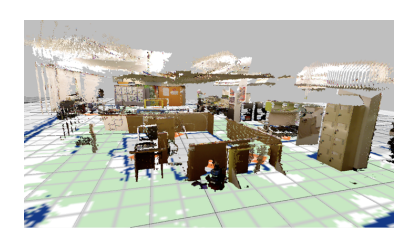
The original 2D SLAM was extended to create 3D maps, fusing information from LIDAR and RGB-D cameras, as shown in Figure 3.
Robot Learning
Much of the research conducted by the UNSW team is focussed on robot learning. As described above, there has been a significant amount of work done on learning how to traverse irregular terrain, including climbing stairs [8].
Another current project gives the robot the ability to learn how to use objects as tools [10]. This uses symbolic machine learning methods to build theories of how objects of different shapes interact with other objects and reasoning about how to position and move them so that the object selected as a tool can allow the robot to complete a task that that it could not otherwise do, .e.g. using an object as a hook to pull another object out of a narrow space. The perceptual system builds models that are imported into a physics simulator, which is used to "visualise" actions before they are executed, thus extending the robot's planning capabilities.
Conclusion and Future Work
As our RoboCupSoccer SPL teams have done over many years, we will make our software available to other research groups and teams competing in @Home. We are in the process of making our recently developed GPU-accelerated 3D SLAM publicly available as a ROS package. In addition, as a part of our involvement in @Home, we intend to publicly releasing the software (CrosBot) that we have developed in ROS for RoboCupRescue and which will be extended for use in RoboCup@Home.
All our research and development uses real robots. We have recently begun a collaboration with Fuji Xerox in Japan to investigate how intelligent social robots could be introduced into the workplace. The investigation will focus on the benefits that social robots could provide to employees, such as improving office well-being and productivity. Aspects of the investigation include studying human-robot interaction as the robot must understand and respond to requests in a manner that is comfortable for each user, incorporating real-time learning capabilities in the robot so that workers can teach the robot how they wish to interact with them or the ability for workers to teach the robot how to perform new tasks.
References
- A. Ratter and C. Sammut. Local Map Based Graph SLAM with Hierarchical Loop Closure and Optimisation. In 2015 Aust. Conf. on Robotics and Automation, 2015.
- A. Milstein, M. McGill, T. Wiley, R. Salleh, and C. Sammut. A Method for Fast Encoder-Free Mapping in Unstructured Environments. Journal of Fields Robotics, Special Issue on Safety, Security, and Rescue Robotics, 28(6):817–831, 2011.
- M. W. Kadous and C. Sammut. InCA: A Mobile Conversational Agent. In 8th Pacific Rim Int. Conf. on Artificial Intelligence, pages 644–653, 2004.
- B. Andres, D. Rajaratnam, O. Sabuncu, and T. Schaub. Integrating ASP into ROS for Reasoning in Robots. In 13th Int. Conf. on Logic Programming and Nonmonotonic Reasoning, Lexington, USA, 2015.
- R. Farid and C. Sammut. Plane-based object categorisation using relational learning. Machine Learning, 94(1):3–23, 2013.
- K. Clark, B. Hengst, M. Pagnucco, D. Rajaratnam, P. Robinsion, C. Sammut, and M. Thielscher. A Framework for Integrating Symbolic and Sub-symbolic Representations. In 25th Int. Joint Conf. on Artificial Intelligence, New York, USA, 2016.
- D. Silvera-Tawil, M. Velonaki, and D. Rye. Human-Robot Interaction with Humanoid Diamandini Using an Open Experimentation Method. In 24th IEEE Int. Symp. on Robot and Human Interactive Communication, pages 425–430, 2015.
- T. Wiley, C. Sammut, B. Hengst, and I. Bratko. A Planning and Learning Hierarchy using Qualitative Reasoning for the On-Line Acquisition of Robotic Behaviors. Advances in Cognitive Systems, 4:93–112, 2016.
- D. Rajaratnam and M. Thielscher. Execution Monitoring as Meta-Games for General Game-Playing Robots. In 24th Int. Joint Conf. on Artificial Intelligence, Buenos Aires, Argentina, 2015.
- H. Wicaksono and C. Sammut. Relational tool use learning by a robot in a real and simulated world. In Australasian Conference on Robotics and Automation, 2016.