DSPL Pumas@Home 2019 Team Description Paper
Jesus Savage, Edgar Vazquez, Edgar Silva, Jesus Hernandez, Adrian Sarmiento, Angelica Nakayama
Bio-Robotics Laboratory, School of Engineering National Autonomous University of Mexico
http://biorobotics.fi-p.unam.mx
Abstract This paper describes the current research topics and main findings of Pumas Team as well as the efforts to implement all the developed software into the Toyota Human Support Robot (HSR). Pumas Team has participated in several national and international robotics competitions that have influenced our architecture for the development of better systems for our service robots. Current research topics include facial detection through multiple images using RGB cameras, creation of RGB-D representations of the environment and action planning using state space representations, among others. In our robotics architecture, the VIrtual and Real roBOt sysTem (VIRBOT), the operation of service robots is divided into several subsystems, each of them has a specific functionality that contributes to the final operation of the robot. By combining symbolic AI with digital signal processing techniques a good performance of a service robot is obtained. We consider that our robotics arquitecture, VIRBOT, will be transfered successfully into the Toyota Human Support Robot (HSR).
Introduction
A service robot is a robot that can assist humans to perform common daily tasks in a common environment, such as houses, offices or hospitals. With this in mind, the final goal of service robot must be make the life of humans easier and more comfortable. Also, a robot can be an excellent companion, in example for elderly or lonely people, making their life better and happier.
To achieve this, a service robot must be capable of understanding spoken and visual commands in a natural way from humans, navigate in known and unknown environments avoiding static and dynamic obstacles, recognize and manipulating objects, detect and identify people, among several other tasks that a person might request.
The team Pumas has participated in national and international competitions. In this year, in the Robocup 2018, our team obtenied the second place in the categoty DSPL@Home with the robot "Takeshi" and we were finalist in World Robot Summit(WRS) 2018.
The paper is organized as follows: section 2 enumerates the software components of our robot "Takeshi"; section 3 presents overview of the latest research developments in our laboratory; and finally, in section 5, the conclusions and future work are given.
Takeshi's Robotics Architecture
Hardware Configuration
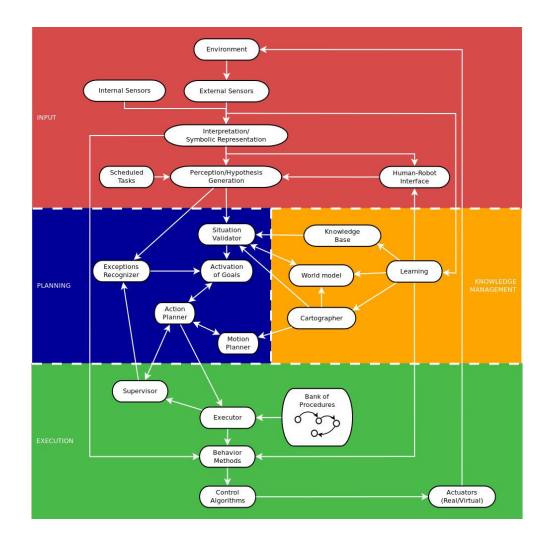
Our service robot "Takeshi" is an HSR Toyota robot, has the following software configuration that it is based on the VIRBOT architecture [1], which provides a platform for the design and development of software for general purpose service robots, see figure 1. The VIRBOT architecture is implemented in our robots through several modules that perform well defined tasks [2], with a high level of interaction between them. The principal framework used for interaction is ROS, where a module is represented by one or several ROS's nodes. Also, for modules using the Microsoft operating system, we use our own middleware called Blackboard to link them with ROS nodes running on Linux. In the following sections are explained each of the layers of the VIRBOT system.
Inputs Layer
This layer process the data from the robot's internal and external sensors, they provide information of the internal state of the robot, as well as, the external world where the robot interacts. Some of onboard sensors are a laser scanner, a RGB-D camera, an array of microphones, one stereo camera and two cameras with wide-angle lens. Digital signal processing techniques are applied to the data provided by the internal and external sensors to obtain a symbolic representation of the data, as well as, to recognize and to process voice and visual data. Pattern recognition techniques are used to create models of the objects and the persons that interact with the robot. With the symbolic representation this module generates a series of beliefs, that represent the state of the environment where the robot interacts.
Planning Layer
The beliefs generated by the perception module are validated by this layer, it uses the Knowledge Management layer to validate them, thus a situation recognition is created. Given a situation recognition, a set of goals are activated to solve it. Action planning finds a sequence of physical operations to achieve the activated goals.
Knowledge Management Layer
This layer has different types of maps for the representation of the environment, they are created using SLAM techniques. Also in this layer there is a localization system, that uses the Kalman filter, to estimate the robot's position and orientation. A rule based system, CLIPS, developed by NASA, is used to represent the robot's knowledge, in which each rule contains the encoded knowledge of an expert.
Execution Layer
This layer executes the actions and movements plans and it checks that they are executed accordingly. A set of hardwired procedures, represented by state machines, are used to partially solve specific problems, finding persons, object manipulation, etc. The action planner uses these bank of procedures and it joins some of them to generate a plan.
Current research
In this section is presented the current research developed in our laboratory to improve the performance of our service robots.
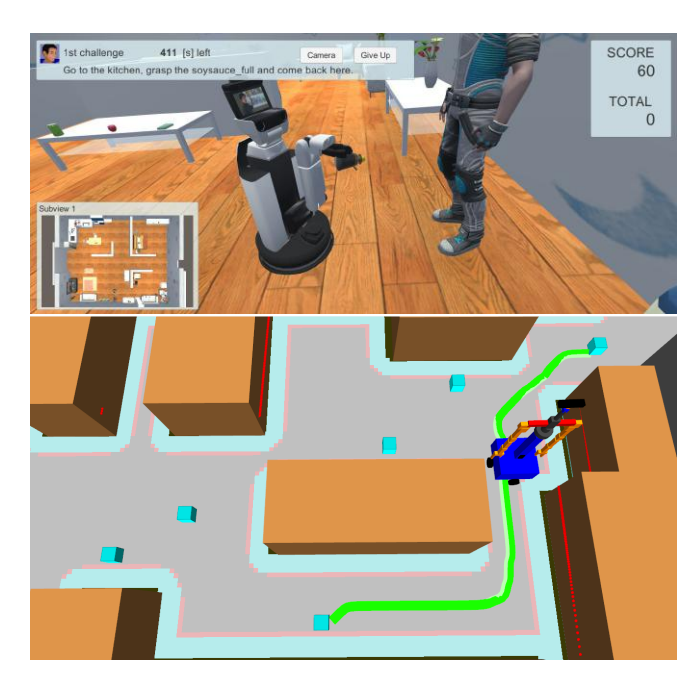
Implementing ViRBot into the Toyota HSR Simulator
The ViRBot architecture has been succesfully tested and implemented in Justina, a domestic service robot developed at the Biorobotics Laboratory of the National Autonomous University of Mexico. Implementation is made using the ROS plattaform running on Ubuntu 16.04. For speech recogniton and synthesis, we use the Microsoft SAPI running on virtual machine inside the Ubuntu computer.
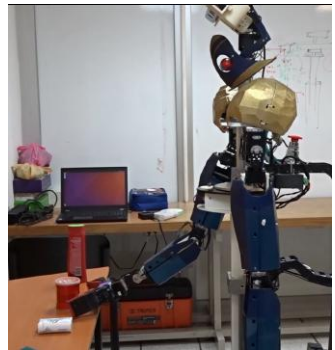
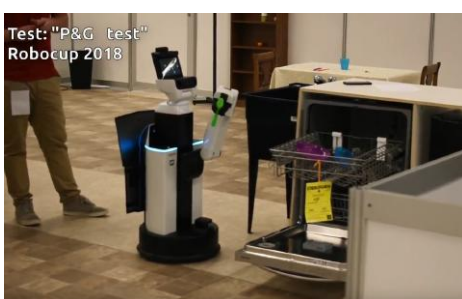
Currently we are working on the implementation of all the Justina's software on the Toyota HSR Simulator. Since we use the ROS code development guidelines, our programas are plattaform-independent enough and the only change should be the low-level sensor reading and actuator control. Figure 2 shows the robots Justina and HSR performing an object manipulation task, both running the same programs under the ViRBot architecture.
High level task planning using conceptual dependency
This year, a new knowledge based system for high level task planning has been developed. This system is designed to interpretate a command in a natural language format and for generating a sequence of high level actions that have to be completed for accomplishing the command. With this system, the robot can generate behaviors to build his own world representation, similarly to a human being.
The system is composed by two principal modules:
Communication Module In this module, the grammar structure of the commands is defined. Performs a syntactical analysis and a semantic interpretation using inferences and Conceptual Dependency, in order to find a meaning for the command. Finally, this module returns a formal expression that describe a sequence of high level actions that the robot have to execute.
Facial detection through multiple images using RGB cameras
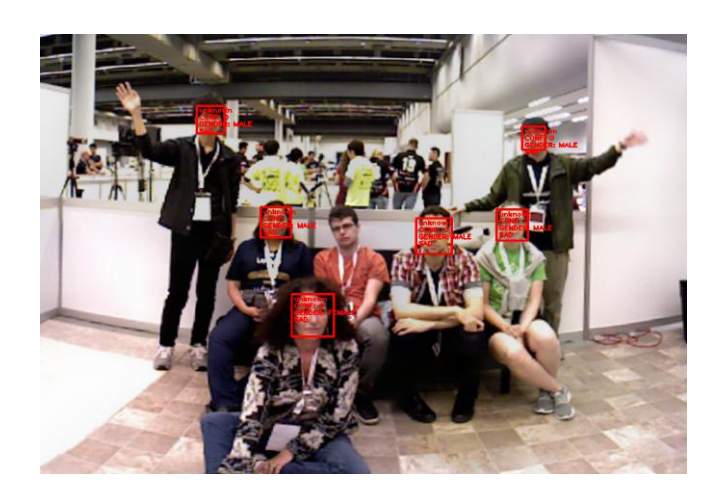
The facial detection is one of the most important tasks that a service robot must be able to perform. In the last RoboCup@Home, there was a test that involves stating the number and characteristics of several persons with different heights, gender and ages, aligned in different rows. The people can be standing, siting or even lying down. This task can be difficult to solve with a single image capture, due the size of the crowd: if the robot is too close, it can not see all the people in the crowd. If the robot is too far, details of the picture can be lost.
We solved this test by moving the head of the robot in order to take several pictures with different angles, merging them into one single large picture, and then detecting faces in the large picture. An example of this is shown in figure 4.
For merging, we extract SURF [7] features for every picture. Then, we match the features using FLANN [8] in order to obtain the maximum and minimum distances of the paired points. We later found the holography matrix using RANSAC [9] and perform a transformation to one of the pictures, and paste it together. All this process is done iteratively, were in every step we obtain a larger picture. After, this, a global color equalization is performed.
Low or null texture objects recognition using RGB-D cameras
Currently, several robust techniques based on feature extraction and description exist for object recognition. However, if the objects are low textured, only a few number of features can be extracted, making the matching process unreliable. For these cases, we developed a method that combine three characteristics of the objects: color, size and shape, after a 3D detection and segmentation in a plane for each object.
Color information is extracted from the HSV space of the object's RGB pixels and it is represented by the histogram of the Hue components.
The size and shape is estimated from the object's point cloud, which are obtained using an oriented bounding box (OBB) of the points cloud. The shape is characterized using the Hu Moments [5] of the convex hull calculated from the points projected over the plane below them. Thus, with these representations an histogram is obtained for each of the objects and for the recognition process we compare the object's histograms with the histogram of the object to be recognized.
The histograms are compared using histogram intersections, [6]:
$$H(I,M) = \frac{\sum_{j=1}^{n} \min(I_j, M_j)}{\sum_{j=1}^{n} M_j}$$
Where I is the histogram of the object to be recognized, M represents one of the stored object's histograms and n is the number of bins in the histograms.
This method has been tested experimentally, showing fast and robust results for changes in light, scale, and rotation in a plane parallel to the plane below the object. Figure 5 shows an example of object's recognition on a shelf (multiple planes).
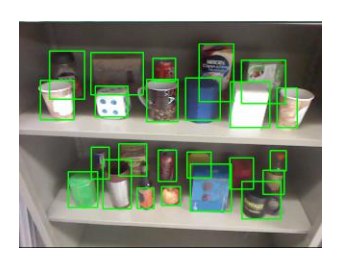
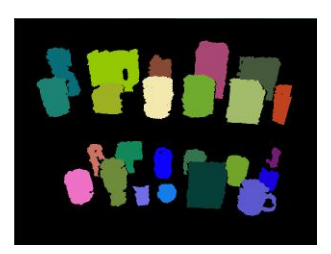
Table 1: Comparison of recognition of objects using color, size and shape histograms and SIFT.
| System | % Recognized | % No recognized |
|---|---|---|
| Proposed | 91.333 | 7.666 |
| SIFT | 22.333 | 77.666 |
As we can see for the results on table 1 this technique outperforms the SIFT one.
Conclusions and future work
It is clear, that during the 13 years in which our team Pumas has been participated in the RoboCup, 2 years in the Rockin [10] in the category @Home and World Robot Summit 2018, the performance and research developed, in the service robot area, in our laboratory has been improved considerably. Our service robot architecture, the VIRBOT, has been evolving according to the requirement that these robotics competitions asked each year. In terms of software, we have change the way of conceiving the tests of the competition: from static state machines to inferred action planning generated by a rule based system. As for future work, the computer vision algorithms will be improved by using Hidden Markov Models (HMM) to have a better recognition of objects and persons. Also, it will be explored fault tolerant systems to help the robot to recover from failures.
References
- ViRbot: A System for the Operation of Mobile Robots, Savage, Jesus and et al, RoboCup 2007: Robot Soccer World Cup XI, pp 512-519, Springer Berlin Heidelberg, 2007.
- The Design of Intelligent Agents: A Layered Approach, Muller, Jorg P,Springer-Verlag New York, Inc.1997.
- Parallel implementation of roadmap construction for mobile robots using rgb-d cameras, Marco Negrete, Jes´us Savage, Jes´us Cruz, and Jaime M´arquez, OGRW2014, pages 184–187, 2014.
- Conceptual dependency and its descendants, Steven L. Lytinen, Computers & Mathematics with Applications, 1992.
- Visual pattern recognition by moment invariants, Ming-Kuei Hu, IRE Transactions on Information Theory, 8(2):179–187, 1962.
- Color indexing, Michael J Swain and Dana H Ballard, International journal of computer vision, 7(1):11–32, 1991.
- Surf: Speeded up robust features,Herbert Bay and Tinne Tuytelaars and Luc Van Gool, In ECCV, pages 404–417, 2006.
- Fast Approximate Nearest Neighbors with Automatic Algorithm Configuration, Marius Muja and David G. Lowe, International Conference on Computer Vision Theory and Application VISSAPP'09, pages 331-340, 2009.
- Random Sample Consensus: A Paradigm for Model Fitting with Applications to Image Analysis and Automated Cartography, Fischler, Martin A. and Bolles, Robert C., Commun. ACM, 24(6):381–395, 1981.
- http://rockinrobotchallenge.eu/home.php