Donaxi@HOME Project
Héctor S Vargas, Edson Olmedo, Daniel Martínez, Víctor Poisot, Agustin Perroni, Andres Rodriguez, Omar Granillo, Carlos Merino, Wesli Antonio, Carlos Carbonel, Anais Portillo
Universidad Popular Autónoma del Estado de Puebla, Department of Enginnering 21 Sur 1103 CP. 72410 Puebla, Puebla México
Abstract Donaxi has become a new prototype to improve their different capacities in the area of service robotics. This paper describes the functional architecture design and the different modules that integrate it of the service robot Donaxi of UPAEP. Novel results are presented here in the area of face recognition; we propose the "Hybrid Algorithm to Human-Face Detection and Tracking Unrestricted" and "Identification of People on the Floor Due to a Fall or Other Accident". The robot Donaxi is used as a vehicle for research in control of movement and human-robot interaction. The at Home League of RoboCup provides an ideal tested for such aspects of dynamic in motion indoor, skills to manipulate objects, aptitudes to intergesticulate with the persons in natural language and more. A modular software architecture as well as further technologies have been developed for efficient and effective implementation and test of modules for sensing, planning, behavior, and actions of service robots.
1 Introduction
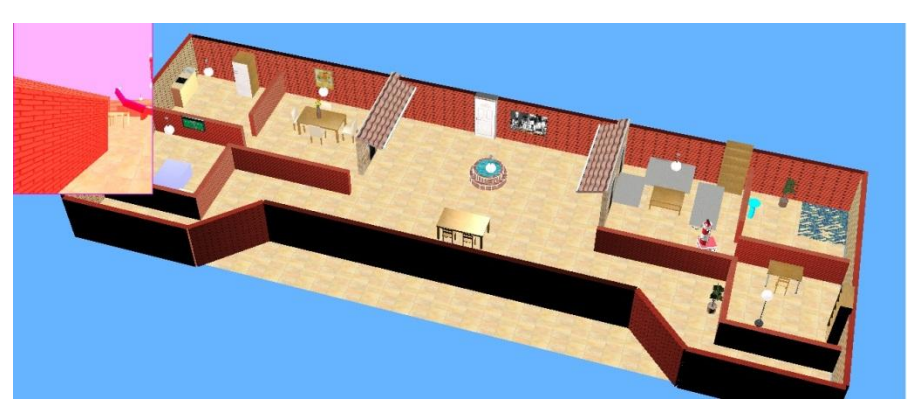
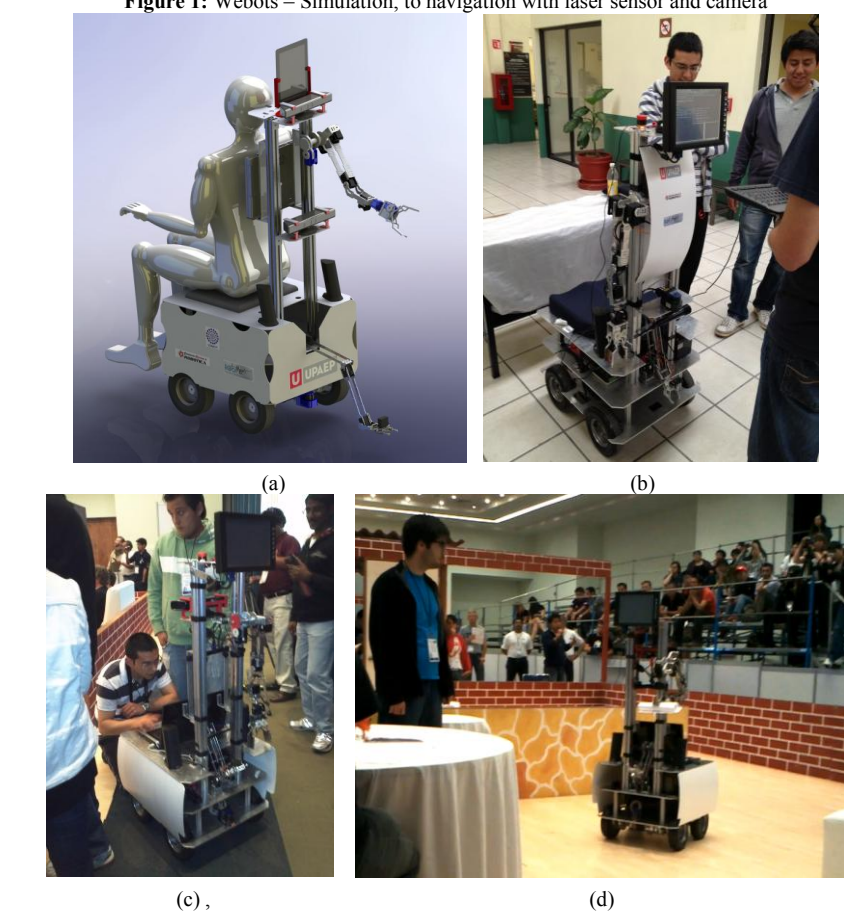
Donaxi has participated in RoboCup 2009, 2010 and 2012, has gradually improved some skills and has changed its structure to better interact with their environment in the RoboCup tournament. Donaxi integrates different software modules of the robot in ROS, improved algorithms for natural language processing, vision, handling and navigation. Also distributed sensor processing and their analysis in embedded systems, and there was communication with network protocols. Four systems will be used to support embedded vision systems, handling, performance and learning. Electromechanical design was improved; it was considered the inclusion of two arms to carry out operations in object manipulation. We designed the exterior structure of the robot according to their main activity: assistance for the elderly. Software elements are tested in parallel in the Webots simulation system as shown in Figure 1.
2 Control Architecture
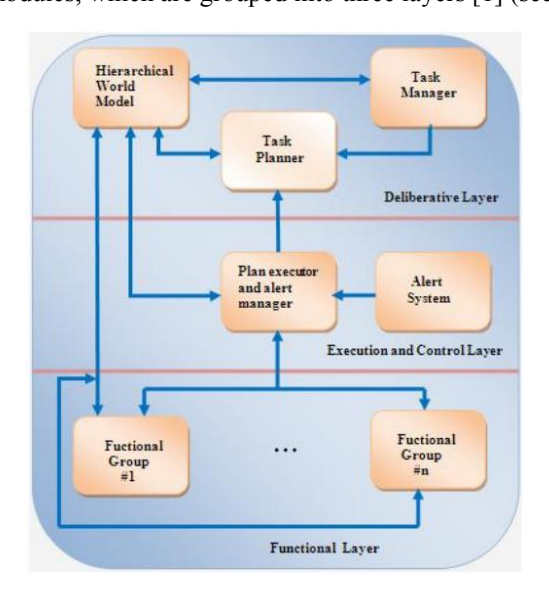
Donaxi use the architecture that is based on a hybrid scheme made up of a number of elements, called modules, which are grouped into three layers [1] (see Fig. 3).
- Deliberative layer maintains and reasons about a symbolic and hierarchical representation of the environment. Such an internal world model is used to produce plans (sequence of human/robot actions to solve a goal) as well as to facilitate human–robot communication.
- Execution and control layer sequences and supervises the execution of plans taking into account the information collected from the functional layer and the robot's sensors. According to such information, it may tune the behavior of certain modules, i.e., reducing the vehicle speed when dangerous situations are identified.
- Functional layer comprises a number of groups of skills, called functional groups, which physically perform actions, like navigation, manipulation, etc. Each functional group may entail different ways to accomplish a particular type of action. For example, the robot can traverse between two spatial points either by a reactive algorithm, by tracking a computed path, or by the user manual guidance.
To support the all-level human integration we claim in this paper, we have used the common module structure shown in Fig. 3 for all the modules in the architecture. The common module structure integrates human and robot abilities through the so-called skill units. Each common module structure may contain a variety of (human or robotic) skill units that materialize a particular type of ability, like producing a plan, checking for risky situations, moving between two locations, manipulating objects.
3 Programming dynamics and kinematics of the arms
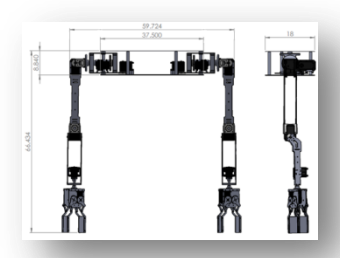
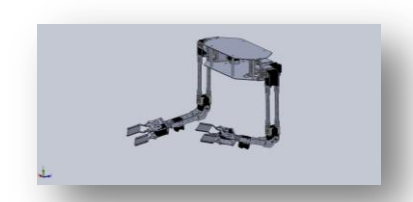
Donaxi has a pair of robotics arms with six degrees of freedom each one. Six Robotis Dynamixel motors were used per arm for this purpose. Every motor has a considered appropriate torque for its specific task. This is a list of the used motors with the position and function subsequently detailed.
The assembly of the armas consists on the union of both arms (left and right) along with a base wich is at the same time provides one more degree of freedom a arm. This assembly is shaped mostly by aluminum elements and with some steel pieces (e.g. the steel gears). Each arm has a calculated weight of 1450 grams and the base assembly weights aproximetly 1600 grams, so the total weight is about 4500 grams.
These are the main arms dimensions.
The movements of arms that Donaxi will have, will be made by controlling its servomotors. Given that servomotors will be Dynamixel's, a practical way to do it is with the CM-700 board, also from Dynamixel, which will ensure a good match and flexibility to program sequences of movements. With respect to dynamics and kinematics, we are programming with help from OROCOS libraries.
4 Human-Face Detection and Tracking Unrestricted
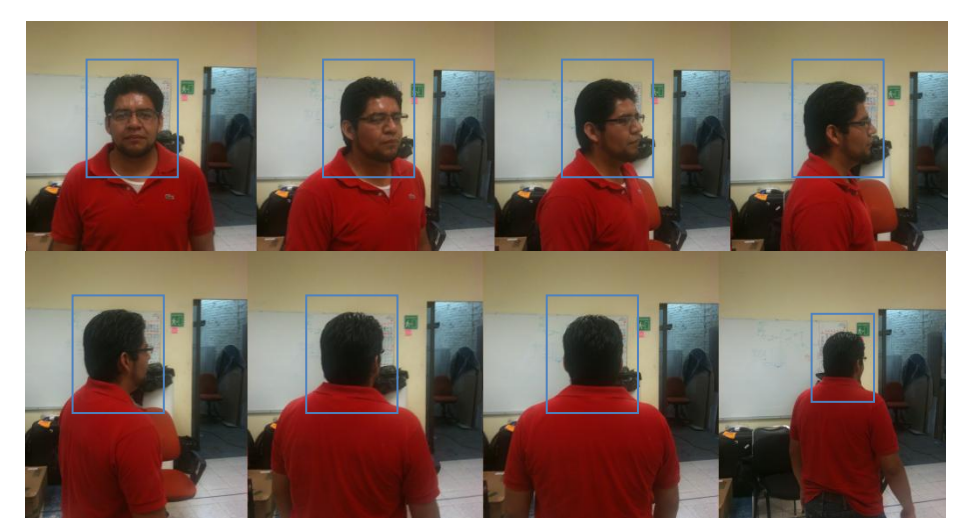
The tools used for face detection and tracking are: face detection, face recognition, contour of face detection, face detection position, a priori knowledge of the next transition state for tracking, a priori knowledge of the contour of the face without detection, processing time interval and additional features of the dress of the person.
The idea of the algorithm is as follows, the situation is normal when there is a face in the image and corresponds to someone you know, so we can label and follow the sequence of images with a priori knowledge that the face does not disappear or change position drastically, that is, remains in the vicinity and if it disappears due to small perturbations in that vicinity. When the person turns around, we know that the boundary in that vicinity belongs to the person recognized and so we can follow the contour, ensuring with some other features of the dress of the person. Clearly, there are many processes running concurrently so that execution times can be altered, however we have an estimated processing time for the proposed algorithm, for which the parameters can be altered if the processing times change, it is where we must change the behavior of face tracking.
5 Identification of People on the Floor Due to a Fall
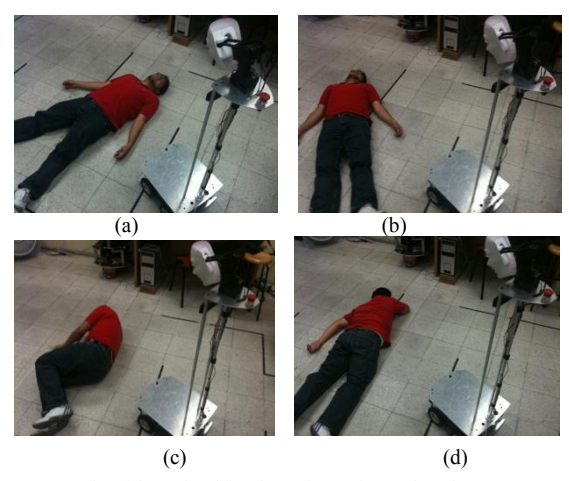
The elderly people are routinely fall for normal atrophy of muscles and bones and if not assisted promptly may have serious complications. Unfortunately, a considerable population stands alone at home, this leads to non-assisted promptly and thus suffer serious injuries. One solution is that the person has a service robot to assist him in any situation, particularly when suffering from a fall. The robot must know that there a person on the floor and background knowledge the robot determines that it was due to a fall, and assisting the person with two activities in parallel, that is, the robot tries to talk to the person to determine the health status and to send a message with a short report to the doctor and when the robot has more information sent.
For the service robot can determine that it is a person on the floor and was due to a fall or accident, you need to consider the following: associating data to the virtual map (a priori knowledge of what was in that place ), seeking a face, recognize faces, to recognize features of the dress of the person, locate a point of care, talk to the person and send the person's condition.
6 Conclusions
The paper presents two novel approaches for assisting elderly people, and to redesign the service robot Donaxi. Principally the problem of the navigation has been improved by the use of the laser sensor and kinect, in dynamic environments, the recognition of objects and human we are working with OpenCV and PCL. Our group of work continues investigating on: navigation in dynamic environments using PCL, object recognition and object manipulation with PCL, recognition of humans and human robot interaction with kinect, speech recognition, gesture recognition, robot applications, and ambient intelligence.
7 Acknowledgment
We want to thank to the Mexican Robotics Federation (FMR) and Robotics and Mechatronics Network of Mexico (RobMec) for the support provided to carry out this work. Also at the National Council of Science and Technology (CONACYT) of Mexico for push forward technological development in the area of service robotics in Mexico.
References
- Aldo Martinez, Hector Vargas, and Jose Perez, "An Evolutionary Software Engineering Approach Applied to a Hybrid Algorithm for Face Recognition", October 2012 Brazilian Robotics Symposium and Latin American Robotics Symposium, published by IEEE Computer Society.
- Hector Vargas, Esperanza Medina, Daniel Martinez, Edson Olmedo, Gerson Beristain, "Hybrid Algorithm to Human-Face Detection and Tracking Unrestricted", published by Springer Verlag in Advances in Soft Computing Series.
- Hector Vargas, Esperanza Medina, Daniel Martinez, Edson Olmedo, Gerson Beristain, "Human-Robot Interface using Face Detection and Recognition, for the Service Robot, "Donaxi"", 1st International Workshop on Intelligent Domestic Robots, 26th-27th of June 2012 Guanajuato, Mexico.
- Cipriano Galindo, Javier Gonzalez, and Juan-Antonio Fernández-Madrigal, Control Architecture for Human–Robot Integration: Application to a Robotic Wheelchair, IEEE Transactions on Systems, Man, and Cybernetics—Part B: Cybernetics, Vol. 36, No. 5, October 2006, pp. 1053 – 1067.
- Chairit Wuthishuwong, Chaiyaporn Silawatchananai, Manukid Parnichkun, Navigation of an Intelligent Vehicle by using Stand-alone GPS, Compass and Laser Range Finder, Proceedings of the 2008 IEEE International Conference on Robotics and Biomimetics Bangkok, Thailand, February 21 - 26, 2009.
- R.C.Arkin, Behavior-based robotics, MIT Press, Cambridge, Massachusetts,1998.
- T.Laue,T.Rofer, A behavior architect for autonomous mobile robots based on potential fields, Lecture note in artificial intelligent, Springer, 2005.
- S.Shimoda, Y.Kuroda, and K.Iagnemma, Potential Field Navigation of High Speed Unmanned Ground Vehicles on Uneven Terrain, IEEE International Conference on Robotics and Automation, Apr 2005, pp 2839-2844.
- P. Viola and M. J. Jones, "Robust real-time face detection," Int. J. Comput. Vision, vol. 57, no. 2, pp. 137–154, 2004.
- R. Lienhart and J. Maydt, "An extended set of haar-like features for rapid object detection, in Proceedings of the 2002 International Conference on Image Processing (P. of the 2002 International Conference on Image Processing, ed.), vol. 1, pp. 900–903, 2002.
- H. Meng, C. Wai, and R. Pieraccini, "The use of belief networks for mixed-initiative dialog modeling, IEEE Trans. Speech Audio Process., vol. 11, no. 6, pp. 757–773, Nov. 2003.
- J.-H. Hong and S.-B. Cho, "A two-stage Bayesian network for effective development of conversational agent, in Intelligent Data Engineering and Automated Learning, vol. 2690. New York: Springer-Verlag, 2003, pp. 1–9.
- E. Horvitz, J. Breese, D. Heckerman, D. Hovel, and K. Rommelse, "The lumiere project: Bayesian user modeling for inferring the goals and needs of software users, in Proc. 14thConf. Uncertainty Artif. Intell., 1998, pp. 256–265.