UChile HomeBreakers 2013 Team Description Paper
Mauricio Correa, Fernando Bernuy, Daniel Herrmann, Gonzalo Olave, Matias Pavez, Carlos Tampier, Cristian Retamal, Patricio Loncomilla, Wilma Pairo, Ivan Castro, Rodrigo Verschae, Javier Ruiz-del-Solar
Department of Electrical Engineering - Advanced Mining Technology Center Universidad de Chile
http://www.robocup.cl/athome.htm
Abstract The UChile HomeBreakers team is an effort of the Department of Electrical Engineering of the Universidad de Chile. The team participates in the RoboCup @Home league since 2007, and its social robot Bender obtained the @Home Innovation Award in 2007 and 2008. In 2012 the team obtained the 6th place in the RoboCup competition. As a team with strong expertise in robot vision, object recognition, and human-robot interaction, we believe that we can provide interesting features to the league, such as: general-purpose object recognition, face analysis tools and human-robot interfaces. This year we have three important improvements in our social robot: the design and construction of new arms for objects manipulation, the full use of ROS as library and middleware for the communication of all internal modules (vision, speech, manipulation, navigation, etc.), and the use of state of the art visual tracking algorithms for allowing the robot to follow humans. It is also worth to mention the use of our robot in educational activities with school children.
1 Introduction
The UChile robotics team is an effort of the Department of Electrical Engineering of the Universidad de Chile in order to foster research in mobile robotics. The team is involved in RoboCup competitions since 2003 in different leagues: Four-legged 2003- 2007, @Home in 2007-2012, Humanoid in 2007-2010, and Standard Platform League (SPL) in 2008-2012. UChile's team members have served RoboCup organization in many ways (e.g. TC member of the @Home league, Exec Member of the @Home league, and co-chair of the RoboCup 2010 Symposium). One of the team members is also one of the organizers of two Special Issue on Domestic Service Robots of the Journal of Intelligent and Robotics Systems. The group has also developed several educational activities with children using robots [3][4].
As a RoboCup research group, the team believes that its contribution to the RoboCup community is not restricted to the participation in the RoboCup competitions, but that it should also contribute with new ideas. In this context, the team has published a total of 25 papers in RoboCup Symposia (see table 1); in addition to many other publications about RoboCup related activities in international journals and conferences (some of these works are available in [1]). Among the most important scientific achievements of the group are obtaining three RoboCup awards: RoboCup 2004 Engineering Challenge Award, RoboCup 2007 @Home Innovation Award, and RoboCup 2008 @Home Innovation Award.
The team has a strong interest in participating in the RoboCup 2013 @Home League competition. As a team with expertise in robot vision, object recognition and human-robot interaction (see section 2), we believe that we can provide interesting features to the league, such as: general-purpose object recognition, face analysis tools (face detection, recognition and tracking), hand-gesture detection and recognition, human-robot interfaces, and robust self-localization.
This year we will continue using our social robot, Bender, which obtained the RoboCup @Home Innovation Award in 2007 and 2008. For the 2013 competitions, the main improvements in Bender hardware and software are: the design and construction of new arms for objects manipulation, the full use of ROS as library and middleware for the communication of all internal modules (vision, speech, manipulation, navigation, etc.), and the use of state of the art visual tracking algorithms for allowing the robot to follow humans.
UChile articles in RoboCup Symposia
| RoboCup Articles | 2003 | 2004 | 2005 | 2006 | 2007 | 2008 | 2009 | 2010 | 2011 | 2012 |
|---|---|---|---|---|---|---|---|---|---|---|
| Oral | 1 | 2 | 1 | 1 | 2 | 3 | 2 | 2 | - | - |
| Poster | 1 | 1 | 1 | - | 3 | 2 | - | - | 2 | 1 |
2 Team's Areas of Interest and Expertise
The areas of interest of our team are mainly related to mobile robotics, robot vision and human-robot interaction. Information about our main publications and projects can be found in [1][2].
3 Hardware
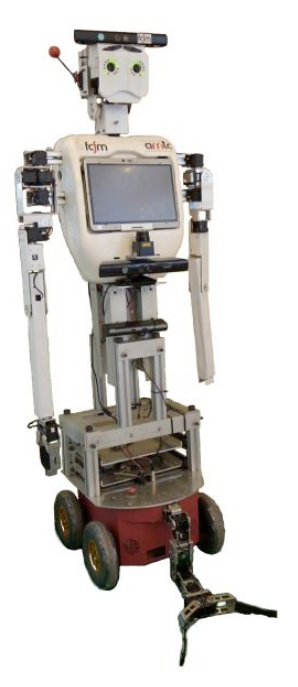
We have improved our robot Bender for participating in the RoboCup @Home 2013 competition. The main idea behind its design was to have an open and flexible platform for testing our new developments. We have kept that idea in our improvement. The main hardware components of the robot are (see Figure 1):
- Mobile Platform. The whole robot structure is mounted on a mobile platform. The platform is a Pioneer 3-AT, which has 4 wheels, provides skid-steer mobility, and is connected to 2 Hokuyo URG-04LX lasers for sensing. This platform is endowed with a Hitachi H8S microprocessor. Two notebooks (Dell Alienware) are placed on the top of the mobile platform with the task of running the navigation, speech, vision, and manipulation modules. An Ethernet network connects these 2 notebooks with a third computer placed in the robot's chest.
- Chest. The robot's chest incorporates a tablet PC as processing platform; an HP 2710p, powered with a 1.2 GHz Intel Core 2 Duo with 2 GB DDR II 667 MHz, running Ubuntu 12.04. The tablet includes 802.11bg connectivity. The screen of the tablet PC allows: (i) the visualization of relevant information for the user (a web browser, images, videos, etc.), and (ii) entering data thanks to the touch-screen capability.
- Head. The robot's head incorporates two cameras, one standard CCD Camera (Philips ToUCam III - SPC900NC) in the position of the left eye, and one thermal camera (FLIR TAU 320 thermal camera [17]) in the position of the right eye. The head is able of pan-tilt movements and has the capability of expressing emotions. This is achieved several servomotors that move the mouth, eyebrows, and the antennas-like ears, and RGB LEDs placed around each eye. The head movements and expressions are controlled using a dedicated hardware (PIC-based), which communicates with the Tablet PC via Ethernet. The cameras are connected to the Alienware notebooks using USB ports. The head's weigh is about 1.6 Kg.
- 3D Vision. The robot is powered with two Kinect sensors, one placed below the robot chest and one over its head (see Figure 1). This allows using this device for detecting persons and also for object detection while grasping.
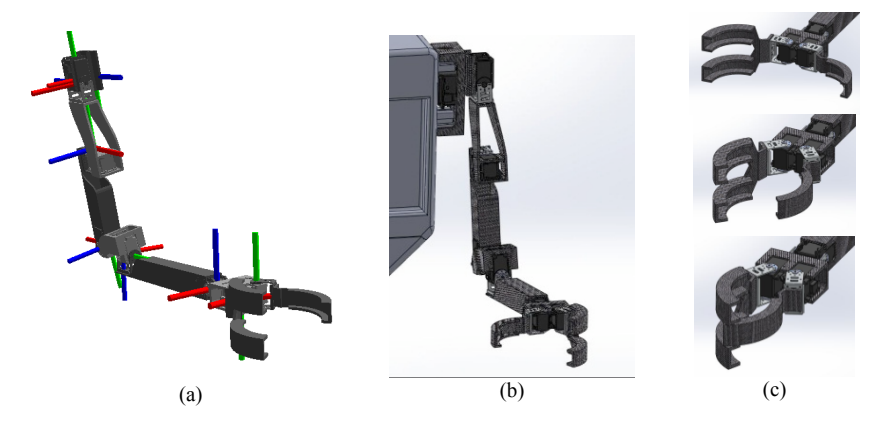
- Arms. The new arms of the robot are designed for the robust manipulation of objects. They are strong enough for raising a large glass with water or a coffee cup. Each arm has seven degrees of freedom, three in the shoulder, two in the elbow, one for the wrist, and one for the gripper. The actuators are 8 servomotors (3 MX-106, 2 RX-64 and 3 RX-28). The arms are controlled directly from one Alienware notebook via USB. The arm's weight is about 1 kilogram. The new arms are lighter because they are made with carbon fiber (see Figure 2). The arm's weight is about 1.8 Kg.
- Gripper-Arm. A gripper-arm is designed to allow the robot to manipulate objects at the floor level (see Figure 1). The gripper-arm has five degrees of freedom two in the shoulder, one in the elbow, one for the wrist and one for a dual opening gripper. The actuators are 5 servomotors (3 RX-64 for the shoulder and elbow and 2 RX-28 for the wrist and the gripper). The gripper-arm is also controlled directly from one Alienware notebook via USB. The arm's weight is about 1.2 Kg.
4 Software Architecture
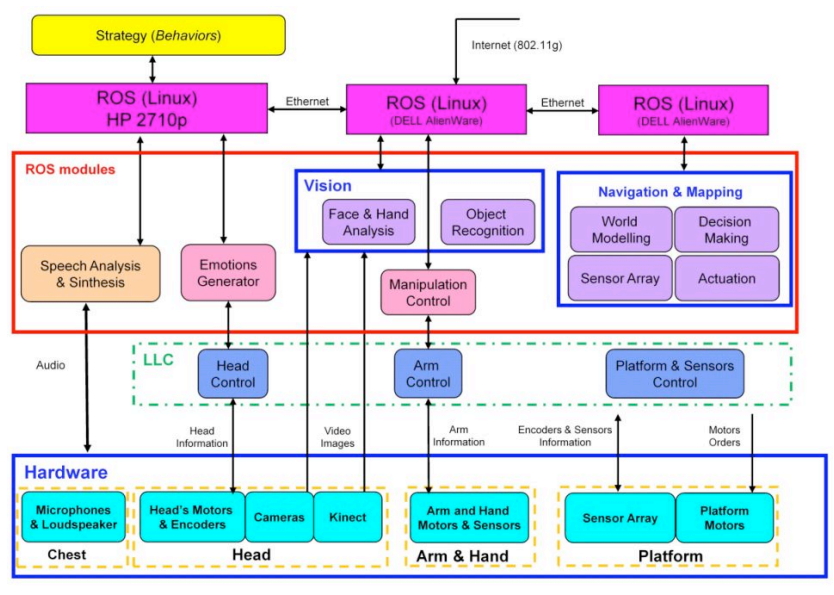
The main components of our software architecture are shown in Figure 3. Speech synthesis and analysis, as well as vision tasks (general object recognition, face, hand and gesture recognition), take place in one Alienware notebook , while the Navigation and Mapping module run on the second Alienware notebook. Both notebooks use Ubuntu 12.04, and they communicate with each other using ROS [16] (see Figure 3). ROS is also used to implement the functionalities required by the Navigation and Mapping module, among them localization, collision avoidance and logging, map building, and SLAM. The high-level modules running in the HP 2710p are also controlled through ROS. The low-level control modules run in dedicated hardware (head and arm control).
The Speech Analysis & Synthesis module provides a speech-based interface to the robot. Speech Recognition is based on several languages models and dictionaries used together to improve the accuracy of the recognition. These functionalities are provided by PocketSphinx [10] and a plugin for GStreamer [11][12]. To implement Speech Synthesis the Festival software [13] is used. All modules are implemented as ROS nodes. For speech recognition we use a node which communicates via services to select the dictionaries and language models. This node publishes the recognition results. For speech synthesis a second node is used (from a package called sound_play) to make the text to speech synthesis.
Similarly, the Vision module is also implemented in ROS. A ROS node is used to manipulate image sources, this node send images only when other node requires them. Another ROS node is implemented to make available the following functionalities: Face Detection, Face Recognition, Hand Analysis, Object Detection and Object Recognition. These nodes are implemented using our own algorithms [5][7][8][9]. The latest addition to this Module is the robust detection and recognition of faces/persons using a thermal camera [8][9].
5 Person following by using Visual Tracking Algorithms
Most of the teams in the RoboCup @Home community used range sensors to implement the tracking functionalities used in @Home competitions (e.g. follow me test). We think that visual tracking algorithms can be more robust than range-based algorithms in these tasks.
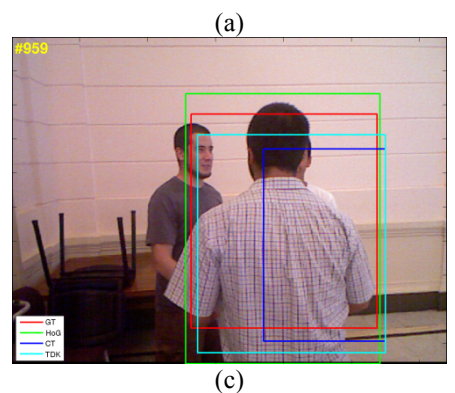
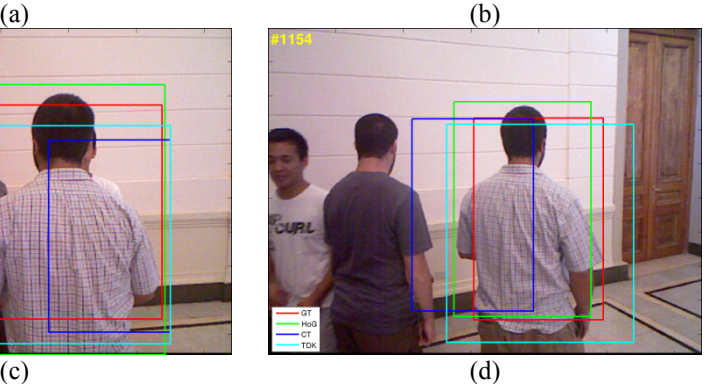
In order to validate this hypothesis, our team carried out a comparative study of state of the art visual tracking algorithms with range algorithms. All selected methods are suitable for working in unconstrained environments, which include domestic setups with variations in illumination as well as occlusions. The analyzed methods were selected by considering their performance in former comparative studies, and being real-time. Thus, in the study five methods are analyzed: visual tracking using a HOG person detector [20], visual tracking using the Tracking-by-Detection with Kernel algorithm [19], visual tracking using the Compressive Tracking algorithm [18], person's tracking using Kinect, and person's tracking using a laser sensor.
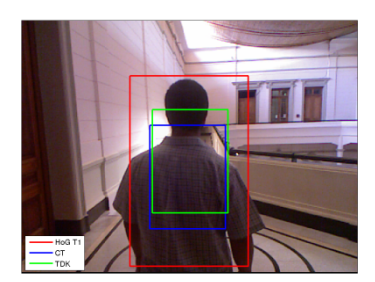
The methods were analyzed and compared using a database especially built to test the algorithms in a person-following setting (see Figure 4). The use of this database allows evaluating the methods in real-world conditions that include natural variations in illumination, pose, clothes, occlusions, and dynamic background. The results of this comparative study are intended to be a guide for developers of person following applications that should be of interest to the RoboCup community, in particular in the RoboCup @Home community. The results of this study will be presented during the RoboCup Symposium 2013 [21].
![Examples of tracking sequences. In red the ground truth, in blue *Compressive Tracking* algorithm [18], in light blue the *Tracking-by-Detection with Kernel* algorithm [19], and in green the Visual tracking using a HOG person detector [20].](/tdps/athome_open__2013__UChile_Homebreakers/_page_5_Picture_0.jpeg)
6 Reusability and applicability in the real-word
Bender can be defined as a personal/social robot, designed to be used for the RoboCup @Home league. However, the main idea behind its design was to have an open and flexible testing platform that can be used in other application domains. Bender has been used as a lecturer for children [4], as a robot referee for humanoid robots [6], and a natural interface for Internet access [14].
Using Bender outside a laboratory environment requires natural and robust humanrobot interaction, an aspect on which our team has put great emphasis. Bender's abilities have been tested on a public space setting: we have left the robot alone (under long-distance surveillance) in different places of our university campus and let people freely interact with him and evaluate its ability to express emotions (happy, angry, sad and surprised). The recognition rate of the robot's facial expressions was 70.6% [15]. Public demonstrations of Bender's abilities also include face detection and recognition (using only one face sample from a passer-by), and static gesture recognition applied to playing a game (rock, paper and scissors).
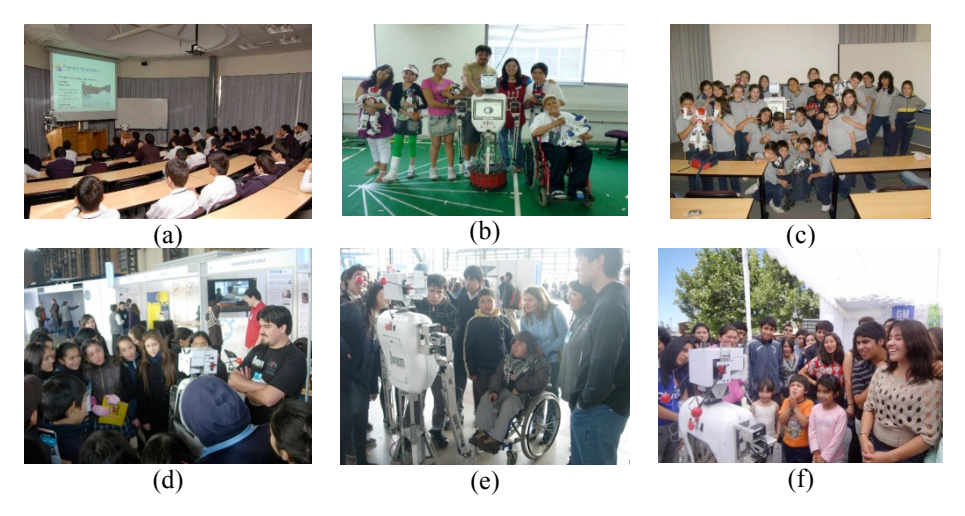
Finally, it is worth to mention that during the last 5 years Bender has given talks to more than 2,000 school children. The talks have been given in classrooms and laboratories to groups of 20-25 children, and in a big auditorium to more than 200 children in one session. Also Bender frequently participates in public technology trade fares and events for promoting technology among children and the general public (see pictures in Figure 5). Bender participates at least once every three months in outreach activities with children, inside and outside our university.
7 Conclusions
In this TDP we have described the main developments of our team for the 2013 RoboCup competitions. As in the last RoboCup competition, this year we will participate with Bender our personal robot, which has been developed in our laboratory. This year we have three important improvements in Bender: the design and construction of new arms for objects manipulation, the full use of ROS as middleware for the communication of all internal modules (vision, speech, manipulation, navigation, etc.), and the use of state of the art visual tracking algorithms for allowing the robot to follow humans.
It is also worth to mention that our robot has been successfully used in other realworld applications (for educational purposes with school children and as referee of robot soccer games).
Acknowledgements
This research was partially supported by FONDECYT (Chile) under Project Number 1130153.
References
[1] Bender Official Website: http://bender.li2.uchile.cl [2] Computational Vision Lab (Universidad de Chile) Website: http://vision.die.uchile.cl/ [3] Ruiz-del-Solar, J., and Aviles, R. (2004). Robotics Courses for Children as a Motivation Tool: The Chilean Experience. IEEE Trans on Education, Vol. 47, Nº 4, 474-480, 2004. [4] Ruiz-del-Solar, J. (2010). Robotics-Centered Outreach Activities: An Integrated Approach. IEEE Trans. on Education, Vol. 53, No. 1, pp. 38-45, 2010. [5] Ruiz-del-Solar, J., Verschae, R., Correa, M. (2009). Recognition of Faces in Unconstrained Environments: A Comparative Study. EURASIP Journal on Advances in Signal Processing (Recent Advances in Biometric Systems: A Signal Processing Perspective), Vol. 2009, Article ID 184617, 19 pages. [6] Arenas, M., Ruiz-del-Solar, J., Norambuena, S., Cubillos, S. (2009). A robot referee for robot soccer. Lecture Notes in Computer Science 5399 (RoboCup Symposium 2008) pp. 426-438. [7] Correa, M., Ruiz-del-Solar, J., Verschae, R., Lee-Ferng, J. Castillo, N. (2010). Real-Time Hand Gesture Recognition for Human Robot Interaction. Lecture Notes in Computer Science 5949 (RoboCup Symposium 2009), pp. 46-57. [8] Correa, M., Hermosilla, G., Verschae, R., and Ruiz-del-Solar, J. (2012). Human Detection and Identification by Robots using Thermal and Visual Information in Domestic Environments, Journal of Intelligent and Robotic Systems, DOI 10.1007/s10846-011- 9612-2 (in press). [9] Hermosilla, G., Ruiz-del-Solar, J., Verschae, R., and Correa, M. (2012). A Comparative Study of Thermal Face Recognition Methods in Unconstrained Environments, Pattern Recognition, (in press). [10] http://cmusphinx.sourceforge.net/ (Web Page of the CMU Project Sphinx). [11] http://cmusphinx.sourceforge.net/wiki/gstreamer (Method to implement GStreamer with Pocketsphinx). [12] http://gstreamer.freedesktop.org/ (Web Page of the open source Project GStreamer). [13] http://festvox.org/ (Web Page of CMU Project dedicated to speech synthesis and the software Festival). [14] Ruiz-del-Solar, J. (2007). Personal Robots as Ubiquitous-Multimedial-Mobile Web Interfaces, 5th Latin American Web Congress LA-WEB 2007, pp. 120 – 127, Santiago, Chile, Oct. 31 – Nov 2, 2007. [15] Ruiz-del-Solar, J., Mascaró, M., Correa, M., Bernuy, F., Riquelme, R., Verschae, R., (2010). Analyzing the Human-Robot Interaction Abilities of a General-Purpose Social Robot in Different Naturalistic Environments. Lecture Notes in Computer Science 5949 (RoboCup Symposium 2009), pp. 308–319. [16] ROS website: http://www.ros.org/wiki/ [17] FLIR TAU 320 thermal camera. Information available on Dec. 2010 in http://www.flir.com/cvs/cores/uncooled/products/tau/ [18] Zhang, K., Zhang, L., and Yang, M.H. (2012). Real-time compressive tracking, Proc. of the 12th European Conf. on Computer Vision - ECCV 2012, Florence, Italy, Oct. 7-13, 2012. [19] Henriques, J.F., Caseiro, R. Martins, P., Batista, J. (2012). Exploiting the Circulant Structure of Tracking-by-Detection with Kernels. Proc. of the 12th European Conf. on Computer Vision - ECCV 2012, Florence, Italy, Oct. 7-13, 2012. [20] Felzenszwalb, P.F., Girshick, R.B., McAllester, D., Ramanan, D. (2010). Object Detection with Discriminatively Trained Part-Based Models. IEEE Trans. on Pattern Analysis and Machine Intelligence, Vol.32, No.9, pp.1627-1645. [21] Pairo, W., Ruiz-del-Solar, J., Verschae, R., Correa, M., Loncomilla, P. (2013). Person Following by Mobile Robots: Analysis of Visual and Range Tracking Methods and Technologies. RoboCup Symposium 2013, 1 July 2013, Eindhoven, Holland (CD Proceedings).