The Reem@LaSalle 2014 Robocup@Home Team Description
Chang L. Zhu, Roger Boldú, Cristina de Saint Germain, Sergi X. Ubach, Jordi Albó, Sammy Pfeiffer
La Salle, Ramon Llull University, Barcelona, Spain; PAL Robotics, Barcelona, Spain
http://blog.pal-robotics.com/robocup-2014
Abstract This paper describes the Reem@LaSalle team for the participation at Robocup@Home 2014 competition. This team uses the robot REEM, a commercial service robot used mainly as information point in meetings, exhibitions and hotels.
In our research, special emphasis is devoted to safe navigation in human environments, and in Human-Robot Interaction, in the fields such as guidance or cooperation. Therefore, open challenges tests and finals will show results of our investigation.
1 Introduction
The Reem@LaSalle teams consists of a group of professionals, researchers and students from two different partners: PAL Robotics and La Salle.
PAL robotics is a company based in Barcelona dedicated to the construction of Service Robots that work in dynamic human environments. PAL Robotics already participated at the 2006, 2007 and 2012 Robocup competitions, at two different leagues, Large Humanoids size, and the Robocup@Home with the robots REEM-A, early REEM-B and REEM, earning a winner place at the humanoids speed test of 2006, second place at the penalty kick test of 2006, and the same award at the 2007.
The Robotics Laboratory of La Salle is a quite new research lab started on 2008, although it is having strong presence in social robotics and application to service, education and health.
The robot used for this competition is the commercially available REEM robot. The purpose of using such robot for this competition is two sided. First, state-of-the-art algorithms for robots are tested on a complex robot on a stressing environment. Second, the robot learns new skills allowing him to stretch its field of application.
2 Focus of research and research interests
From the research point of view, several interests based on human robot interaction interests drive our participation at the @Home League. In the last two years we have done field studies about Robot-Human Spatial Relationships during Guidance, Teaching assistant, and Meeting people in public areas [?]. We are interested in the service applications that can be applied into a humanoid robot in order to enhance the human robot cooperation: 1) The social presence, 2) the acceptance of the robot, and 3) the interaction items as speech recognition [?, ?], face recognition, collect and delivering objects, and navigation in human spaces.
Future outcomes will be motion control algorithms to improve a more natural human robot interaction.
It is very important for us to create a robot that can freely and safely move over all type of situations that can be encountered in a home environment. This includes different types of ground, many types of static and dynamic obstacles, and also other robots that may interfere the normal functioning of ours. REEM robot has already shown its navigation abilities in crowded dynamic environments, but many perception and obstacle avoidance problems when navigating in human environments still remain unsolved [?]. More challenging is the detection of all possible obstacles that the robot might encounter, the classification of those obstacles as dynamic or static, and the detection of stuck/crash when information is not available from the sensors [?]. The @Home environment is the perfect scenario to test the navigation skill of the robot.
3 Robot platform
For this competition, the robot that will be used is the REEM robot, a robot built by PAL Robotics company, which has showcased its capabilities in real events. The purpose of this robot is to work as a Service Robot in real human environments, making the Robocup@Home a perfect test bed for it.
Mechanically, REEM is composed of three different parts: a differential mobile base that runs on two motor wheels, a torso equipped with two 6 degree-of-freedom arms with hands, and head equipped with multiple sensors and with two degrees of freedom for pan and tilt motions.
The robot base is able to move the body of the robot inside a building, even over small obstacles of less than 2.0 cm, such as cables, notebooks, pens, etc. It is also able to move over ramps of less than 4 degrees of inclinations. The base is also equipped with a laser sensor that scans the ground in order to avoid pitfalls. Additionally, the base has a special shape that allows the robot to carry stuff on its back, up to 5 Kg, like a suitcase, box, etc.
The torso is composed of two arms with hands and two DOF at the hip that allow the robot pan and tilt the torso. This feature is specially required when trying to access difficulty located objects over a table, or to equilibrate the robot under certain conditions. It also provides more expressiveness to the movements of the robot. Hands have three degrees of freedom divided in three different fingers.
The head contains several sensors that allow the robot perceive the world in the direction it is looking at, by using cameras microphones and sonars. It also has a pair of round LEDs that show the power status of the robot. As a special feature for the Robocup competition, the head of the robot has been equipped with a depth sensor using a special structure that adapts the sensor to the head on a fashionable way.
The robot has several sensors in order the perceive the environment:
- Laser range finders: One slick laser and one Hokuyo laser for obstacle avoidance and SLAM.
- Sonar ring: Located at the base of the robot, a ring of sonar sensors all around the robot are used, in combination with the laser for obstacle avoidance.
- Stereo camera pair: Located at the head, two wide angle cameras are used to person detection and tracking, and object recognition.
- Stereo microphone: Used to speech recognition and speech synthesis.
- RGBD camera: Asus Xtion Pro Life sensor that delivers registered color and depth. Located at the head of the robot is used for object recognition.
Finally, the robot has a touch screen that can be used to command orders to the robot or display information about the current situation, in order to help understand what the robot is doing or tries to do. Additionally, it has three speakers, two in the front and on in the back, to broadcast sound from the touchscreen, or the robot voice when speaking.
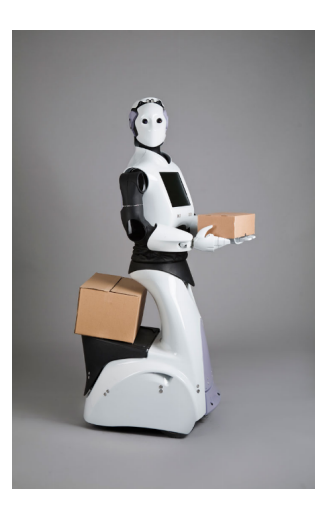
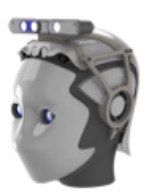
Table 1: Main characteristics of the REEM Robot
| Weight | 90 Kg |
|---|---|
| Height | 1.70 m |
| Battery autonomy | 8 hours |
| Degrees of Freedom | 26 |
| Payload | 30 Kg (Mobile base) 3 Kg per arm |
| Speed | 4 Km/h |
| Computers | i7 + ATOM |
4 Software architecture
The Software is divided in two different main layers: the task planner and the complex actions. The communication between these two layers are implemented using the Robot Operating System (ROS) framework. When possible, standard ROS messages are used between them, as it easily allows comparing and substituting state-of-art algorithms by our proposals, and vice-versa, and thus creating a basis for comparison. For that reason it is important to use standard messages not only in its syntactics, but also in its semantics.
The task planner layer contains all the modules used to solve complex tasks. For the Robocup@Home competition this includes at least all the planners for the different tests. These modules are constructed to combine different skills. Planners are designed to take into account explicitly the uncertainty on perceptions and actions.
The complex actions layer contains subsystems that represent behaviors of the robot. Sometimes they can be complex and require the coordination of different robot skills, e.g. safe navigation, deformable object grasping, coordinated speech and motion, and some can be simpler. This layer is subdivided into 4 different domains: skills, filtering/fusion, perception, and action.
Perception and action domains treat interaction with sensors and actuators respectively. Action modules are considered complete and they include all the configuration and knowledge about transformations between working and configuration space. Perception modules are less smart, so we designed a filtering/fusion domain that contains some intelligence that permit operation on one unique sensor data, or allows the fusion and coordination of different sources of information. We have developed a fusion method that handles specifically the difference in refreshing rate of every data source.
Actions and perceptions, might be before filtering/fusion, are combined into skills. This unit constitutes the minimum unit that is used later for planning.
Robot Navigation
Due to the special characteristics in the sensoring of the robot base, a special algorithm for obstacle avoidance has been developed. The reason is that the robot has not a round form, and its rotation center is not located on the physical centre of the robot. The algorithm developed is based on Nearness Diagram one, and divides the space in several security areas. This algorithm has been integrated into ROS navigation pipeline.
People detection and tracking
Different people detectors are used: with the images from the wide angle color cameras we use a face recognition algorithm based on Verilook libraries, and person detector based on appearance models; using the horizontal laser on the base we have trained a leg detector that estimates pairs of legs. These different estimators are fused in a particle filter framework that keeps tracking each person on the robot's field of view.
Object recognition
For object recognition we are using the Object Recognition Kitchen package, which integrates different object recognition algorithms in one single package. The ORK takes care of all the non-vision aspects of the programming, such as database management, input/output handling or robot/ROS integration.
Manipulation
Object manipulation is essential in the real world environment. The object manipulation with robots has mainly relied on precise, expensive models and deterministic executions. Our goal is to explore if it is possible to achieve rather complex goals through a simple and inexpensive set of actions and perceptions. For this reason, after developing for own resources several algorithms for object manipulation, we have encountered the package MoveIt!, which is easily integrated in the ROS software. It is a state-of-the-art software for mobile manipulation, that incorporates the latest advances in motion planning, manipulation, 3D perception, kinematics, control and navigation.
Human Robot Interface
Human robot interface (HRI) is based on the integration of state-of-the-art algorithms. Speech recognition is based on Sphinx free software and speech synthesis is based on the Acapella TTS software. We have considered that HRI constitutes a unique action that integrates not only speech recognition/synthesis but also generation of gestures of the robot. Gestures provide expressiveness and clarifies what the robot is saying. It can also generate a feeling of comfort in the person that is interacting with it. Robot gestures are generated by moving mainly hands and torso.
To control HRI we use message composed by (speech, motion, expression), that currently is used also in other of our robots.
Simulator
Development of the robot skills is first done on the simulated robot. We use the Gazebo simulator integrated with ROS framework to test our development before testing on the real robot. Our robot is freely available to simulate.
5 Real world applicability
The goal of the REEM robot is to be used in real environments serving and helping people in their needs. REEM and some of its abilities have been already applied in real world applications (such as navigation, speech synthesis, people detection.). However, by using only those abilities, as of now, REEM can only be used as an information point because of its lack in object interaction, speech recognition, and people tracking. By adding these features required by many of the Robocup tests, REEM will be used in a wider number of tasks, allowing it to enter into other environments that remained closed for it, like for example, delivering at hospitals, performing house keeping tasks or acting in commercials.
Furthermore, it can be used as a standard platform for research experiments of any kind, either by programming its skills or by using the ones embedded.
6 Conclusions
Having presented the REEM@LaSalle team and the REEM robot, explaining its use in real applications at hotels and meetings, we are now developing new skills to improve interaction with humans in new scenarios.
In the development we use different robotics platforms in different conditions. Standardization efforts in algorithms and their interfaces are performed to be able to transfer skills developed in laboratory conditions with different hardware to real scenario applications. We pursue to develop safe and secure robot motion in crowded environments. In the case of human-robot interaction, we are planning to showcase the advances of human and natural interaction.
This is the second time that REEM takes part in the Robocup@Home contest.
References
- Marta Díaz, et. al "A week-long study on Robot-Visitors Spatial Relationships during Guidance in a Sciences Museum".In Human-Robot Interaction (HRI), 2014 9th ACM/IEEE International Conference on IEEE, 2014.
- Monzo, Carlos, Ignasi Iriondo, and Joan Claudi Socorró. "Voice Quality Modelling for Expressive Speech Synthesis." The Scientific World Journal 2014 (2014).
- Planet, Santiago, Ignasi Iriondo Sanz, Joan Claudi Socorró, Carlos Monzo, and Jordi Adell. "GTM-URL contribution to the INTERSPEECH 2009 emotion challenge." In INTERSPEECH, pp. 316-319. 2009.
- Albo-Canals, Jordi, et al. "Robot guiding with obstacle avoidance algorithm for uncertain enviroments based on DTCNN." Neural Networks (IJCNN), The 2010 International Joint Conference on. IEEE, 2010.
- Badalov, Alexey, Xavier Vilasis-Cardona, and Jordi Albo-Canals. "Visual learning with cellular neural networks." Cellular Nanoscale Networks and Their Applications (CNNA), 2012 13th International Workshop on. IEEE, 2012.