Sun - RoboCup@Home 2015 Team Description Paper
Zhang Qizhi, Zhou Yali, Zhang Wanjie, Xu Xinxin, Lv Ye, Wang Yalong
School of Automation, Beijing Information Science & Technology University
http://robocupathome.bistu.edu.cn/
Abstract The paper describes the Sun team and presents the approach and novel scientific achievements embodied in our 2015 RoboCup@Home team. Our team builds on School of Automation. Since 2009, we are focused on service robot research, and participated in the 2011 Robocup China Open competition @Home leagues, and the 2013 Robocup @Home league in Eindhoven. We have improved our robot (including hardware and software) for 2015 international RoboCup @Home. In the team description paper, we will introduce the most relevant components of our current system and the changes we have made to make our system more robust.
Introduction
The Sun team consists of researchers from School of Automation, Beijing Information Science & Technology University. The team consists of a group of bachelor and master students, advised by two professors and two engineering. The students are participating in the robot design through the bachelor program in robotics, by doing a graduation project in the robot control and computing vision. Our team has participated in three of the leagues under the RoboCup umbrella: the RoboCup@Home league in 2011, the RoboCup Humanoid and RoboCup middle size leagues since 2009 (all in the Robocup China Open competition). Our team clinched 2th place in two individual competitions in Robocup China Open Competitions 2011 and clinched 2th place in Robocup China Open Competitions 2014, Our team clinched 16th place in the RoboCup @Home league 2013 in Eindhoven.
Our RoboCup@Home team builds on the navigation, object recognition and planning capabilities which we have developed as part of our previous efforts in middle size leagues. RoboCup@Home team will also incorporate our recent research results on human tracking, face recognition, scene perception, methods to improve the perception of human behavior and interaction with humans using "natural" language and gesture modes of communication, etc. The following sections describe the key components of our team.
Robot Platform
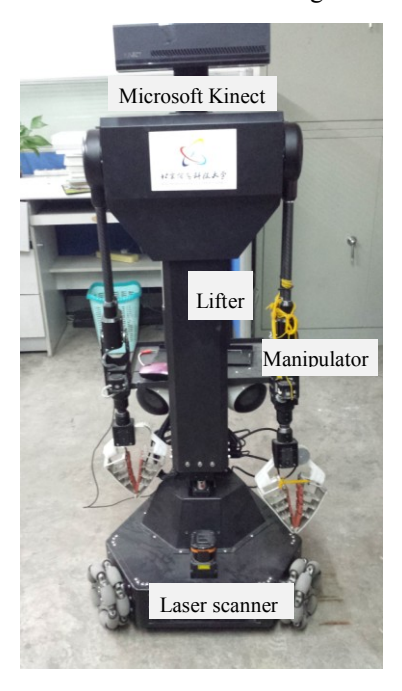
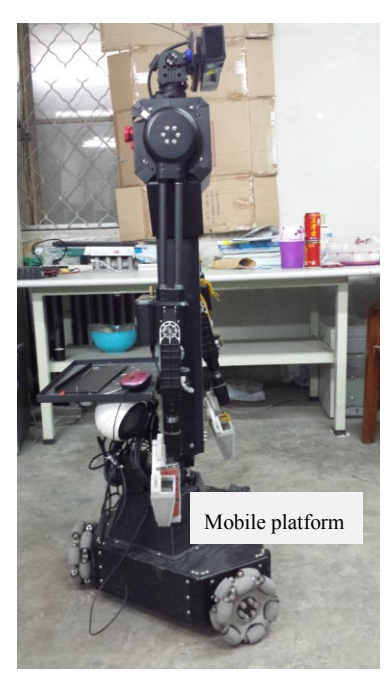
The platforms are improved from our three wheel mobile platform, the hardware and software are redesigned according to the demands of RoboCup@Home league. Our platform consists of a three wheel mobile platform for moving, a pair of manipulators are designed for object grasping. A Microsoft Kinect 2 for windows cameras and a UTM-30LX laser scanner are selected as the sensors. The constructed service robot platform is depicted in Figure 1. The mobile platform size is 0.5m0.5m in length and width. The distance between two Shoulders is 0.6m. The minimum height of our robot is 1.2m and its maximum height can reach 1.6m by driving the lift platform. So, the minimum size of our robot is 0.5m1.20m in width and height, and its maximum size is 0.6m1.60m in width and height.
Mobile platform
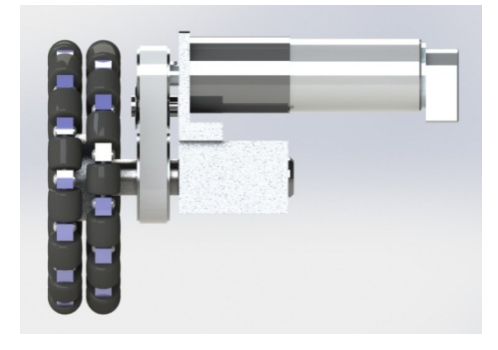
The mobile platform is shown in the bottom of figure 1. The mobile base has three driven omni-wheels which are uniformly distributed on the base. Three maxon RE40 motors are selected to drive the omni-wheels. A synchronous belt transmission is inserted to absorb the shock noise between the wheel and the ground. The designed entity relationship diagrams are shown in figure 2. Our design idea is that the service robot mobile platform should be conveniently moving in a domestic environment, and should be accurate, robust to the input commands. The reason is that reliable motion of the service robot is the backbone of almost all the robot's behaviors.
Lifting platform and manipulators
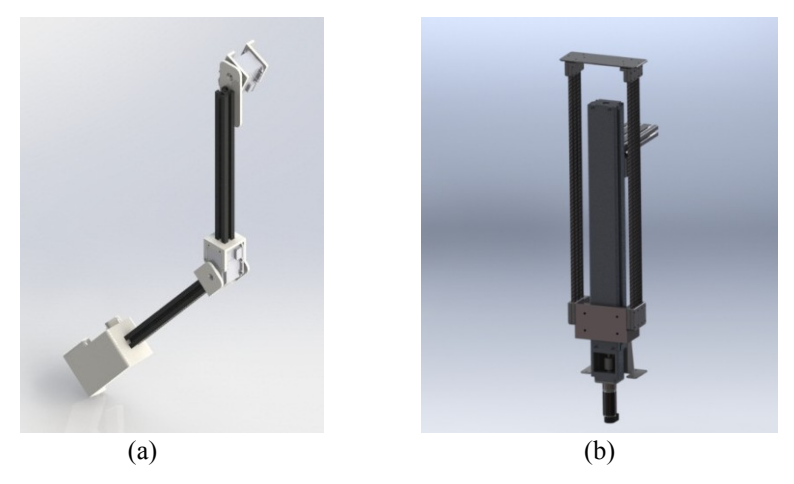
Object manipulation is a basic function of the domestic service robot, so the manipulator is necessary equipment for the robot. The 6D industry manipulator need complex inverse kinematics programming, and it is too heavy to apply for the domestic service robot. We design a new 2D manipulator which has a shoulder joint and an elbow joint. The joints are driven by two RX-64 Dynamixel Robot Servo Actuators. Obviously, only using a 2D manipulator, the end-effector cannot reach the entire workspace. We design a drive system which can lift the shoulder joint to appropriate position in the vertical direction and the mobile base can locate the position and direction of the shoulder joint in horizontal plane. The designed entity relationship diagrams of the manipulator and the ball-screw lifting platform are shown in figure 3.
sensors
We have used two sensors on the robot platform to perceive its environment:
- A Hokuyo UTM-30LX Laser Range finder has been placed on the mobile base for mapping, location, navigation and obstacle avoidance.
- A 3D Ranging Camera: Microsoft Kinect 2 for windows has been installed on the top of the robot platform for scene perception.
The positions of the sensors are shown on figure 1.
Software architecture
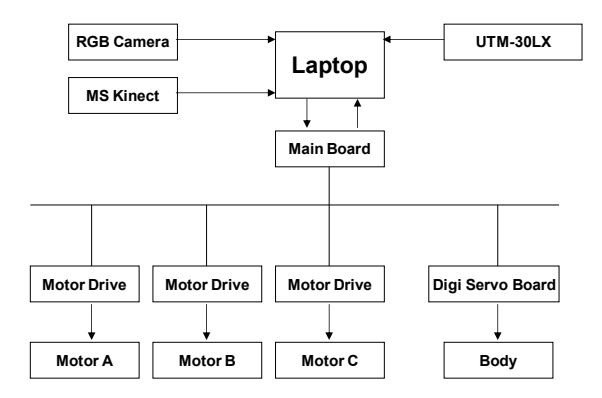
The software of our robot platform is designed by C++ based on the Microsoft VS2010. The control software architecture is shown in figure 4.
SLAM
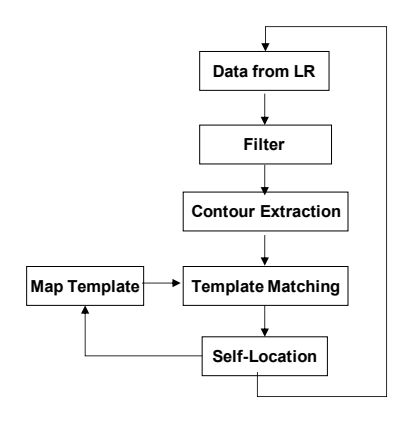
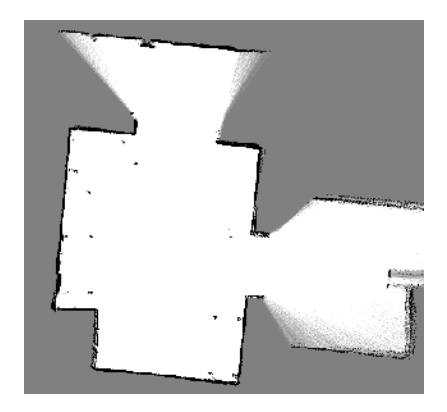
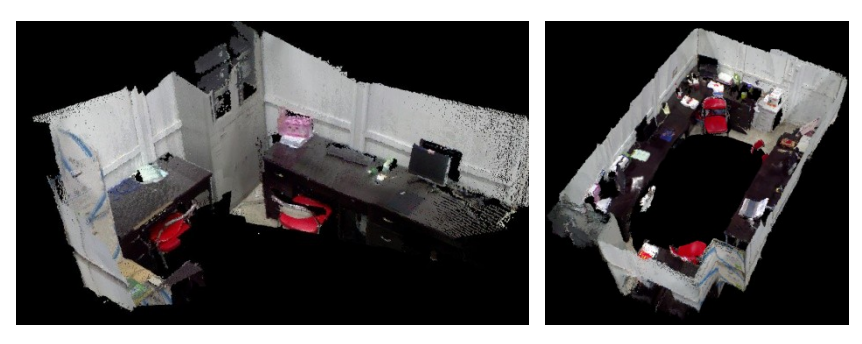
The planar Slam module is shown in figure 5. Only the data of Laser Range finder is used in our Slam approach, and the odometry is not needed[1]. Scan matching is performed between two laser scans to determine the relative positions from which the scans were obtained. We have implemented the Real-Time Correlative Scan Matching algorithm proposed by Edwin B. Olson[2]. It is robust to initialization error and can find the global maximum of the cost function of scan match. The effect of this method is shown in figure 6, a comparison of the actual lobby environment of our lab to what is mapped by the robot is shown. The bright points represent free region, the black points represent occupy region, and the grey points represent unknown region. There are three tables in the lobby, and the footprints of the table's legs are clear shown in the map. The map is the base of robot location and navigation.
Path planning algorithm
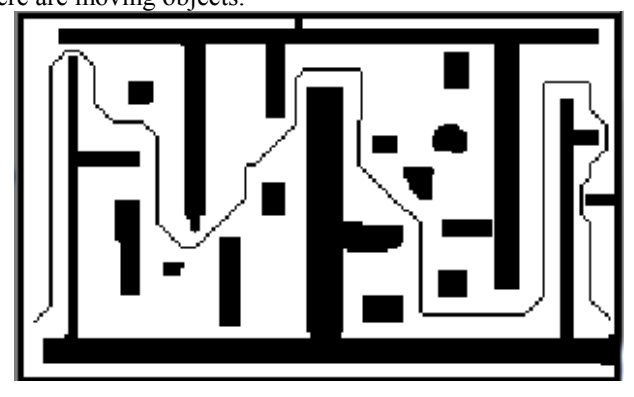
We present a path-planning algorithm for mobile robot platform based on Cellular Automata(CA) and artificial potential field,and the algorithm have been implemented by a 4-layer cellular automata model. Firstly, an expanded occupancy grid map is constructed so that the mobile robot can be simplified as a point in the planning algorithm. Secondly, a digital obstacles artificial potential field map is obtained to include the local influence of the obstacles. Then, a distance propagation map is generated by a CA model. Finally, the optimal collision-free path from start point to goal is extracted by following the minimum valley of the potential hyper-surface. The simulation result is shown as figure 8. The result shows that the optimal collision-free paths can be found by the proposed algorithm. The optimal paths are smooth enough and have larger safety distance from the obstacles. So the optimal paths are convenient to track by our mobile robot platform. Our navigation method can make our robot to track the optimal paths, and in the same time, perform local obstacle avoidance when there are moving objects.
Vision system
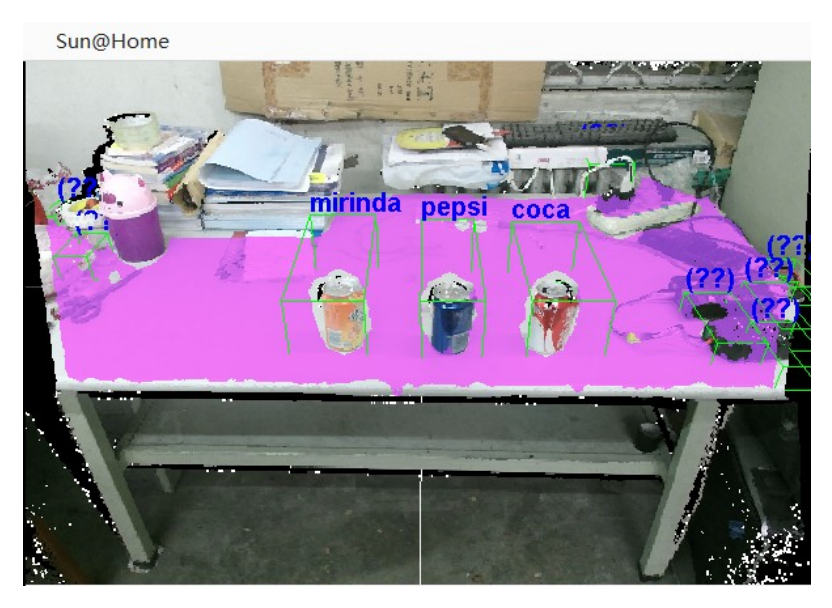
The vision module is developed to allow our robot to localize, to manipulate unknown objects in unstructured environments. The key problem in 2D camera is that the depth information is lost. So we use a Microsoft Kinect as vision sensor, it is very robust to large illumination change. The planes are first extracted from the 3D Point Clouds which are acquired from the unknown scene by Kinect[3]. We have implemented the planes segmented by surface normal's clustering which is proposed by Dirk Holz in Bonn University, and had been verified on his RoboCup@Home platform[4]. The graspable objects in table top are segmented by projecting all points onto the planes they belong to. For the recognition of objects, we use combination of color, local features and the 3D shape information. Figure 9 shows the extracted table surface and graspable object by the vision system. The known object's on the table are segmented and their names are shown on the top of the contain boxes. The unknown object's on the table are also segmented and A symbol '??' is labeled on the top of every unknown object's. The graspable object's pose can localized by our system, the position error is less than 1cm.
Manipulation
Using the simplified arm described in section 2.2 and the proposed vision system in section 4, the robot platform can performs basic object manipulation tasks such as grasping objects from table top. Our robot first roughly localizes the shoulder joint to appropriate position by driving lifter in the vertical direction and the mobile base in horizontal plane, then the arm performs fine tuning to locate the end-effector at an appropriate position, and the end-effector is closed to grasp the object. The object is lifted up from the table top by the lifter, and then the robot moves to the target position by driving mobile base.
Conclusion and future work
In this paper, we have introduced our team Sun, and our robot platform for the Robo-Cup@Home 2015 competition. We have also introduced our robot's ability to grasp unknown objects firmly, to perform SLAM, navigation, and object recognition. A new Manipulator will be made to perform grasp before the RoboCup@Home 2015 competition.
References
- Zhang Qizhi , Zhou yali ,A Hierarchical Iterative Closest Point Algorithm for Simultaneous Localization and Mapping of Mobile Robot, Proceedings of the 10th World Congress on Intelligent Control and Automation, Beijing, China, 2012.
- Edwin B. Olson, Real-Time Correlative Scan Matching, 2009 IEEE International Conference on Robotics and Automation Kobe International Conference Center Kobe, Japan, May 12-17, 2009.
- Zhang Qizhi, Zhou yali, Scene cognition for object grasping based on kinect, Journal of Beijing Information Science & Technology University, 2012,27(5):11-16
- Dirk Holz, Stefan Holzer, Radu Bogdan Rusu, and Sven Behnke, Real-Time Plane Segmentation using RGB-D Cameras, In Proceedings of the 15th RoboCup International Symposium, Istanbul, July 2011.