UChile HomeBreakers 2015 Team Description Paper
Luz Martínez, Matías Pavez, Gonzalo Olave, Mauricio Correa, Loreto Sánchez, Patricio Loncomilla, Javier Ruiz-del-Solar
Department of Electrical Engineering - Advanced Mining Technology Center Universidad de Chile
http://www.robocup.cl/athome.htm
Abstract The UChile HomeBreakers team is an effort of the Department of Electrical Engineering of the Universidad de Chile. The team has participated in the RoboCup @Home league since 2007, and its social robot Bender obtained the @Home Innovation Award in 2007 and 2008. As a team with strong expertise in robot vision, object recognition, and human-robot interaction, we believe that we can provide interesting features to the league. This year our main research focus is object recognition and its manipulation, because one of the principal abilities of a service robot is the interaction with objects. For this reason the team incorporated a new manipulation system, using the ROS package MoveIT!, and carried out a comparison among object recognition methods. Another important improvement in our social robot is a new face that allows it to more easily display emotions. Additionally, a long-term memory to store non-redundant information about people and objects with which the robot has interacted, as well as places and dates where sessions have been carried out, was implemented.
1 Introduction
The UChile robotics team is an effort of the Department of Electrical Engineering of the Universidad de Chile in order to foster research in mobile robotics. The main motivation of the team is working on the continuous development of technologies for service robots and thus participate in international competitions of robotics, in which the team can acquire and share knowledge with other research groups, and test the quality of technology developed. In addition to testing and showing progress achieved in competitions, the team conducts industrial projects, publishes papers and provides educational activities with children.
2 Background
The team is involved in RoboCup competitions since 2003 in different leagues: Four-legged 2003-2007, @Home in 2007-2014, Humanoid in 2007-2010, and Standard Platform League (SPL) in 2008-2014. UChile's team members have served RoboCup organization in many ways (e.g. TC member of the @Home league, Exec Member of the @Home league, and co-chair of the RoboCup 2010 Symposium). One of the team members is also one of the organizers of two Special Issue on Domestic Service Robots of the Journal of Intelligent and Robotics Systems.
As a RoboCup research group, the team believes that its contribution to the RoboCup community is not restricted to the participation in the RoboCup competitions, but that it should also contribute with new ideas. In this context, the team has published a total of 30 papers in RoboCup Symposium (see table 1); in addition to many other publications about RoboCup related activities in international journals and conferences. Among the most important scientific achievements of the group are obtaining three RoboCup awards: RoboCup 2004 Engineering Challenge Award, RoboCup 2007 @Home Innovation Award, and RoboCup 2008 @Home Innovation Award.
This year we will continue using our social robot, Bender, which obtained the RoboCup @Home Innovation Award in 2007, 2008 and in 2012 obtained the 6th place in the RoboCup competition. For the 2015 competitions, the main improvements in Bender hardware and software are: a new object manipulation system, a new face that shows emotions better and a long-term memory.
Table 1. UChile articles in RoboCup Symposia.
| Robocup 2003 Articles |
2004 | 2005 | 2006 | 2007 | 2008 | 2009 | 2010 | 2011 | 2012 | 2013 | 2014 |
|---|---|---|---|---|---|---|---|---|---|---|---|
| Oral | 1 | 2 | 1 | 1 | 2 | 3 | 2 | 2 | - | - | 1 |
| Poster | 1 | 1 | 1 | - | 3 | 2 | - | - | 2 | 1 | 2 |
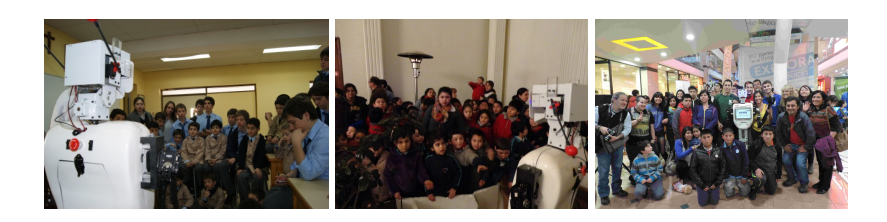
Bender has been used as a lecturer for children [1], as a robot referee for humanoid robots [2], and a natural interface for Internet access [3]. Finally, it is worth to mention that during the last 8 years Bender has given talks to more than 2,000 school children. Also Bender frequently participates in public technology trade fares and events for promoting technology among children and the general public (see Figure 1).
3 Research
(Section contains subsections below)
3.1 Object Recognition for manipulation task
The recognition and manipulation of objects is of paramount importance in service robotics. Recent approaches used in service and/or domestic robots are mainly based on a pipeline that first detects horizontal surfaces (e.g., a table or the floor) for restricting the search area of the possible object's positions, and then it computes features in order to recognize the objects.
In this context, we believe that it is important to analyze the performance of these different approaches in domestic setups by considering real conditions. Those conditions must include variability on the typical objects to be manipulated in domestic contexts, variable illumination, dynamic backgrounds, and occlusions, among others. A comparative study of object recognition methods was performed. The results of this study will be outlined in section 4.1.
3.2 Long-Term Memory
An important aspect of human-robot interaction is the capability of the robot to acquire, store, and update its knowledge of a working environment. This includes the ability to remember places and dates, recognize people from previous interactions, and identify objects that it had manipulated in the past. Furthermore, the robot should be able to use this information in order to maintain a relationship with humans.
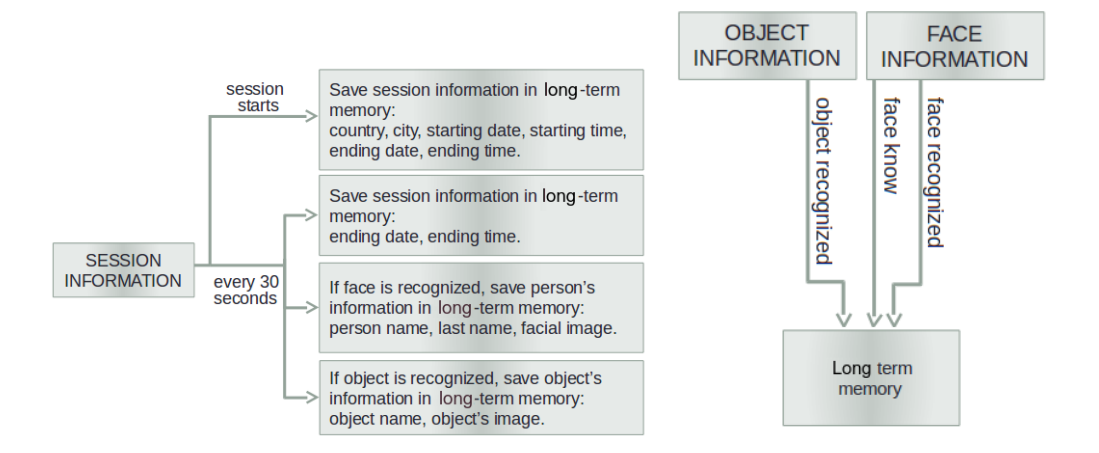
For this purpose an episodic long-term memory model has been developed. This model enables the robot to collect, in a database, autobiographical memories in order to improve its capabilities in social behavior based on past experiences, since they can be stored and retrieved.
4 Experiments and results
(Section contains subsections below)
4.1 Object Recognition for manipulation task
Different setups are used for evaluating the performance of the different object recognition methodologies under comparison [4]. The possible setups differ in the following conditions: (a) image background: white(S1,S2,S5) / brown(S3) / different backgrounds(S4); (b) illumination: normal(S1,S3,S4,S5) / low(S2); and (c) occlusion: no occlusion(S1,S2,S3,S4) / 50% occlusion(S5).
Recall/Precision results are shown in Table 2. The mean of the results of recognition of one object shows that VFH is the method with the highest recall, but L&R SIFT is the best visual method by having a good recall and an excellent precision. Methods obj rec surf and obj rec surf seg require a considerable processing time and have a limited precision, then the L&R SIFT variants perform better.
Table 2. Recall and Precision of object detection on a table.
| SIFT | SURF | SIFTseg | SURFseg | OR-SURF | OR-SURFseg | VFH | OUR-Hist. SIFT CVFH | VFH | |
|---|---|---|---|---|---|---|---|---|---|
| S1 | 0.76/0.96 | 0.39/1 | 0.53/0.98 | 0.24/1 | 0.84/0.72 | 0.82/0.51 | 0.63/0.58 | 0.64/0.65 | 0.45/0.56 |
| S2 | 0.36/0.97 | 0.09/1 | 0.21/1 | 0.06/1 | 0.29/0.70 | 0.27/0.41 | 0.67/0.58 | 0.69/0.65 | 0.29/0.53 |
| S3 | 0.31/0.96 | 0.12/0.91 | 0.21/1 | 0.04/1 | 0.19/0.57 | 0.25/0.40 | 0.72/0.75 | 0.67/0.69 | 0.02/0.27 |
| S4 | 0.22/0.92 | 0.03/1 | 0.21/0.94 | 0.05/1 | 0.17/0.75 | 0.29/0.53 | 0.67/0.72 | 0.67/0.70 | 0/1 |
| S5 | 0.58/0.98 | 0.31/1 | 0.44/0.99 | 0.21/1 | 0.57/0.77 | 0.65/0.43 | 0.29/0.25 | 0.22/0.21 | 0.22/0.31 |
| Mean | 0.45/0.96 | 0.19/0.98 | 0.32/0.98 | 0.12/1 | 0.42/0.70 | 0.46/0.46 | 0.6/0.58 | 0.58/0.58 | 0.20/0.53 |
4.2 Long-Term Memory
Regarding to the long-term memory storage system, it allows the robot acquire, filter, store and update episodic knowledge of its working environment. In particular, the robot is able to store in a database non-redundant information about people and objects with which it has interacted, as well as places and dates where sessions have been carried out. Figure 2 shows the block diagram of the storage system for the long-term memory.
5 Conclusions and future work
In this TDP we have described the main developments of our team for the 2015 RoboCup competitions. As in the last RoboCup competition, this year we will participate with our personal robot, Bender, which has been developed in our laboratory. In order to succeed in the RoboCup@Home league, we provided Bender with capabilities such as speech recognition, object recognition, face detection and recognition, navigation and obstacle avoidance, map-generation and self-localization, and object manipulation, among others. With these abilities and an improved set of hardware, Bender will hopefully have a good demonstration at the 2015 @Home competitions. This year, we have three important improvements in Bender: a new manipulation system, a new face that shows emotions better, and a long-term memory storage system. In addition, improvements were made in people detection using HOG, and the former device used, RGB-D (kinect and a camera), was exchanged for an Asus Xtion Pro Live.
For future work, we are conducting research on the following topics:
- The development of a high-level behavior system for the robot that uses the stored information in the long-term memory. This will allow the robot a better interaction with people, where long term relationships can be established.
- Incorporation of HARK library for sound preprocessing before performing recognition, with the PocketSphinx module, in order to locate the voice source, therefore providing robustness against noise.
Robot Bender Hardware Description
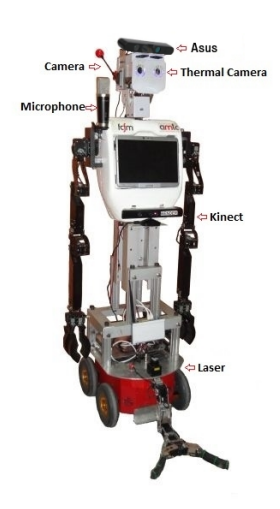
We have improved our robot Bender for participating in the RoboCup @Home 2015 competition. The main idea behind its design was to have an open and flexible platform for testing our new developments. We have kept that idea in our improvement. The main hardware components of the robot are (see Figure 3). Specifications are as follows:
- Base: The whole robot structure is mounted on a mobile platform. The platform is a Pioneer 3-AT, which has 4 wheels, provides skid-steer mobility, and is connected to 2 Hokuyo URG-04LX lasers for sensing. This platform is endowed with a Hitachi H8S microprocessor. Two notebooks Dell Alienware are placed on the top of the mobile platform with the task of running the navigation and vision modules.
- Chest: The robot's chest incorporates a tablet PC as processing platform; an HP 2760p, powered with a Core i5-2520M Processor (2.50 GHz, 3 MB L3 cache, 2 cores/4 threads) and 4 GB DDR3 PC3-10600 SDRAM (1333 MHz). The tablet includes 802.11bg connectivity. The screen of the tablet PC allows: (i) task of running the speech and manipulation modules and (ii) visualization of relevant information for the user.
Robot's Software Description
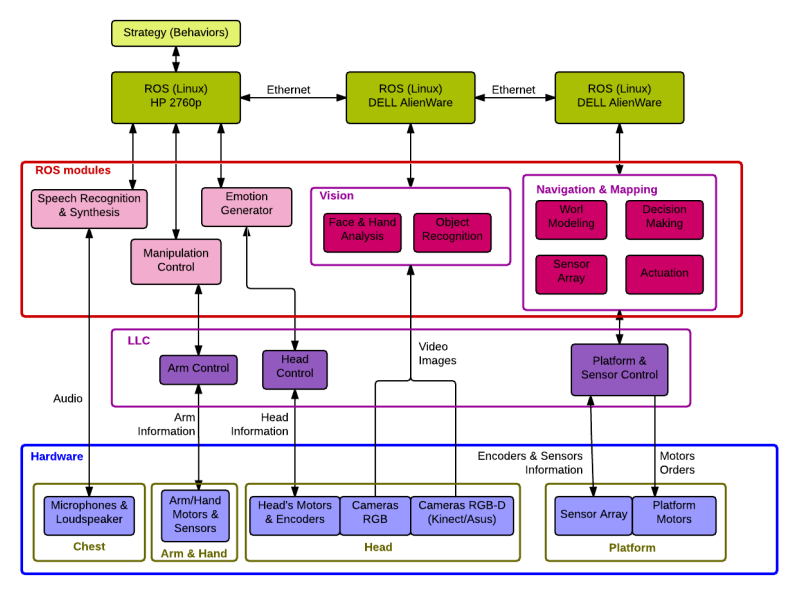
The main components of our software architecture are shown in Figure 3. Vision tasks (object, face and gesture recognition), take place in one Alienware notebook, while the Navigation and Mapping module run on the second Alienware notebook. Both notebooks use Ubuntu 14.04, and they communicate with each other using ROS Indigo [6] (see Figure 4). The Speech, Manipulation and Head modules are running in the HP 2760p are also controlled through ROS.
References
- Javier Ruiz-del Solar. Robotics-Centered Outreach Activities: An Integrated Approach. IEEE TRANSACTIONS ON EDUCATION, 53(1):38–45, FEB 2010.
- Matías Arenas, Javier Ruiz-del Solar, Simón Norambuena, and Sebastián Cubillos. A robot referee for robot soccer. In Luca Iocchi, Hitoshi Matsubara, Alfredo Weitzenfeld, and Changjiu Zhou, editors, RoboCup, volume 5399 of Lecture Notes in Computer Science, pages 426–438. Springer, 2008.
- Javier Ruiz-del Solar. Personal robots as ubiquitous-multimedial-mobile web interfaces. In Virgílio A. F. Almeida and Ricardo A. Baeza-Yates, editors, LA-WEB, pages 120–127. IEEE Computer Society, 2007.
- Luz Martínez, Patricio Loncomilla, and Javier Ruiz del Solar. Object recognition for manipulation tasks in real domestic settings: A comparative study. In RoboCup 2014, 2014.
- FLIR TAU 320 thermal camera. information available on dec. 2010 in. http://www.flir.com/cvs/cores/uncooled/products/tau/.
- ROS website. http://www.ros.org/wiki/.
- Javier Ruiz-del-Solar, Mauricio Mascará, Mauricio Correa, Fernando Bernuy, Romina Riquelme, and Rodrigo Verschae. Analyzing the human-robot interaction abilities of a general-purpose social robot in different naturalistic environments. In Lecture Notes in Computer Science (RoboCup Symposium 2009), volume 5949 of Lecture Notes in Computer Science, pages 308–319, 2010.
- Mauricio Correa, Gabriel Hermosilla, Rodrigo Verschae, and Javier Ruiz-del Solar. Human detection and identification by robots using thermal and visual information in domestic environments. Journal of Intelligent and Robotic Systems, 66, 2012.
- Gabriel Hermosilla, Javier Ruiz-del Solar, Rodrigo Verschae, and Mauricio Correa. A comparative study of thermal face recognition methods in unconstrained environments. Pattern Recognition, 45(7):2445–2459, 2012.
- Web page of the CMU Project Sphinx. http://cmusphinx.sourceforge.net/.
- Method to implement GStreamer with Pocketsphinx. http://cmusphinx.sourceforge.net/wiki/gstreamer.
- Open source project gstreamer. http://gstreamer.freedesktop.org/.
- CMU project (speech synthesis and the software Festival). http://festvox.org/.