Team Robotics and Circuits: RoboCup @Work 2024 Team Description Paper
Ayush Sarkar, Ahona Rakshit, Poonguzhali Sivakumar, Nilay Nishant, Anirudh Agarwal, Aditya Wadgaonkar, Gnana Sai Pendyala, Akshay Prabhu Gopathi, Sarthak Landge
Manipal Institute of Technology, MAHE, Manipal, Karnataka, India
Abstract This paper details Team Robotics & Circuit's approach to the problem statement described for RoboCup Industrial @ Work League. Our bot, the Multipurpose Universal Chassis (M.U.C.), is a self-designed and self-made robot for navigation, perception and manipulation in a warehouse environment to minimize manual labour. This paper introduces the Team, the project/bot, as well as outlines the hardware and software used for perception, navigation and manipulation tasks performed by the bot.
1 Introduction
In the rapidly evolving warehouse management and logistics landscape, the demand for efficient, flexible, and scalable automation solutions has never been greater. Meeting these demands head-on, Team Robotics & Circuits introduces the Multipurpose Universal Chassis (M.U.C.), designed to revolutionise warehouse setup and streamline operations.
The M.U.C. is the brainchild of interdisciplinary collaboration — advanced robotics, intelligent control systems, and versatile design principles — offering a comprehensive solution for various warehouse automation tasks.
At its core, MUC embodies the principles of modularity and adaptability. Designed to effortlessly handle a payload of 50 Kg, M.U.C.'s scalable design allows warehouse operators to further customize configurations according to specific requirements and operational workflows.
2 The Team
Team Robotics and Circuits, nicknamed as RnC, founded in 2010 is an interdisciplinary team of engineering students who focus on research and development in the field of robotics in Manipal Institute of Technology, India. RnC deals with the latest trends in robotics, automation, computer vision, embedded systems and other allied fields. Throughout the year, the Team is deeply involved in major research projects involving innovation in home automation, industrial automation, biomedical applications; as well as actively participating in national competitions such as TechnoXian World Robotics Championship for line-following and micromouse bots; and even international competitions such as Virtual RobotX Competition — thus showcasing our expertise in creating precise and efficient automation solutions.
This is RnC's first year participating in the RoboCup Industrial @ Work League. Despite financial constraints hindering access to specialized platforms like the KUKA YouBot, the team persevered, opting for a resourceful approach to address the challenge at hand. M.U.C. is thus a self-designed and self-made bot, built not only to meet RoboCup's problem statement but also for versatile warehouse operations, capable of handling heavy payloads with finesse.
Team Structure.
| Name | Branch | Domain/Designation in the Team |
|---|---|---|
| Ayush Sarkar | Mechatronics Engineering | Team Leader/ Mechanical Head |
| Ahona Rakshit | Electronics & Communication Engineering | Technical Head |
| Poonguzhali Sivakumar | Biomedical Engineering | Electronics Head |
| Nilay Nishant | Computers & Communication Engineering | Coding & Simulations Head |
| Anirudh Agarwal | Computers & Communication Engineering | Coding & Simulations |
| Aman Agarwal | Computer Science – AI/ML Engineering | Coding & Simulations |
| Aditya Wadgaonkar | Computers & Communication Engineering | Coding & Simulations |
| Gnana Sai Pendyala | Computers & Communication Engineering | Coding & Simulations |
| Akshay Prabhu Gopathi | Electrical and Electronics Engineering | Electronics |
| Daya Sagar A.J | Electronics and Communication Engineering | Electronics |
| Sarthak Landge | Mechanical Engineering | Mechanical |
Team RnC consists of a passionate group of undergraduate students, in their 2nd and 3rd year of engineering. The Team has been broadly divided into three main domains: Mechanical, Electronics, Coding & Simulations. Such a team structure allows for collaboration among people from a multitude of fields, each with their own expertise.
3 Hardware Description
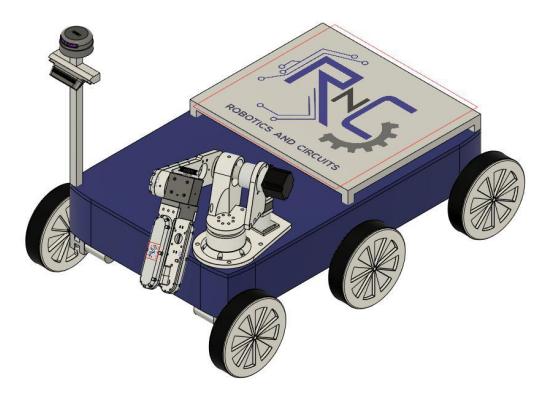
M.U.C. is built on a modular framework, enabling swift assembly, disassembly, and reconfiguration to accommodate various operational needs. This modularity facilitates easy upgrades and expansions, ensuring long-term scalability and future-proofing investments. The current iteration is a 50cm x 80cm chassis, for a 50 Kg payload, and a manipulation system that can lift load up to 750g. Though the chassis is made in-house, a 6DoF robotic arm has been outsourced from a regional supplier for manipulation purposes.
3.1 Actuation
Motors and Gearbox. Four RS775 DC motors paired with 19:1 planetary gearbox, enable the bot to manage a payload of 50 kg. These high RPM motors are optimized with the reduction gearbox to boost torque, increasing it by a factor of 19 while reducing motor speed to 500 RPM, allowing the bot to move heavy loads efficiently. Despite introducing mechanical losses, the system's efficiency remains high, enhancing productivity. These motors are controlled by the MDD20A Cytron motor driver. Overall, this actuation system has 4 powered wheels of 25 cm diameter, and 2 dummy wheels in the middle for support.
Encoders. The OE-37 Hall Effect Magnetic Encoders provides precise feedback on the rotational position and speed of the motors, enhancing control and navigation accuracy of the bot. Utilizing Hall Effect technology, it detects changes in magnetic fields generated by a magnet attached to the motor shaft. By integrating the OE-37 encoder into our system, we ensure the bot's movements are accurately monitored and controlled, allowing for autonomous operation through feedback.
3.2 Navigation
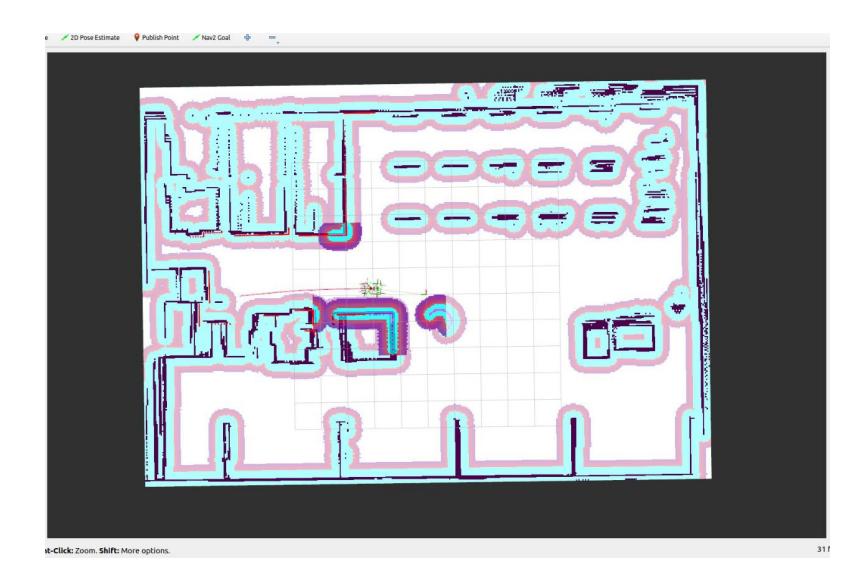
LiDAR. M.U.C. uses the 360° 2D Slamtec RPLiDAR A2M12 to scan the warehouse environment systematically. This sensor emits laser beams and measures the time it takes for the beams to bounce back from surrounding objects. This LiDAR data, crucial for real-time navigation and path planning, constructs a detailed 2D map of the warehouse. The LiDAR enables the bot to detect obstacles and plan alternative paths to avoid collisions, thus efficiently manoeuvring through narrow aisles, navigate around dynamic obstacles, and precisely reach its pick-and-place destinations. The placement of the LiDAR on the bot is at a height, such that its 360° range is not obstructed by any of the other peripherals on the bot. For simulation purposes, a 180° 2D LiDAR is used.
Ultrasonic Sensor. Multiple ultrasonic sensors are placed on the sides of the chassis, complementing the LiDAR system by detecting objects below its scanning plane. The LiDAR has limitations in detecting objects beneath the mapped plane. The sensors hence enhance the bot's ability to detect and avoid obstacles at ground level, ensuring safe and efficient navigation throughout the warehouse environment.
3.3 Perception
Depth Camera. The Intel RealSense Depth Module D435 is used for object recognition and perception. Object recognition by this camera is then followed by manipulation by the robotic arm. The camera is placed on the bot near the manipulator in such a way that perception and manipulation can go hand in hand.
3.4 Manipulation
Robotic Arm. A 6DoF robotic arm, equipped with servo motors, performs pick-and-place tasks. With a torque rating of 30kg-cm, a 360° range of motion at the base, and a total extended length of 1m, the arm adeptly handles loading and unloading of objects from containers for up to 750g payload. This system can precisely locate and manipulate objects through object recognition using the depth camera. The setup enhances efficiency, reduces manual labour, and optimizes inventory management processes by automating the handling of goods in the warehouse. For simulation purposes, we are using the ros2 control 6DoF robotic arm.
3.5 Control System
Raspberry Pi. The Raspberry Pi 4 serves as the control system for motors and sensors. Acting as the brain of the operation, the RPi coordinates motor movements and sensor data processing. It communicates with motor controllers to regulate the motion of the automated warehouse bot, ensuring precise navigation (wheel motors) and pick-and-place operations (arm motors). The RPi's flexibility and computational power make it an effective control hub for the autonomous functions of the bot.
PC. The RPi on its own would not be sufficient to control the entire system. Hence the bot has an onboard laptop using Intel i5 Gen11th processor. Its high processing speed can process the lidar scans in real time and aid in SLAM. Additionally, the depth camera is connected to the PC for object perception.
3.6 Power
Power Supply Unit (PSU). The entire system is powered with a 22.2V Li-Ion battery pack. A custom-made PSU board takes input from this battery and utilises buck & boost converters to provide standard voltage outputs. This board ensures consistent power supply to the various system components. Additionally, a safety switch is incorporated for emergency situations, allowing for immediate power cut-off, if necessary. The PSU board hence ensures uninterrupted warehouse automation operation, while maintaining safety protocols.
4 Software Description
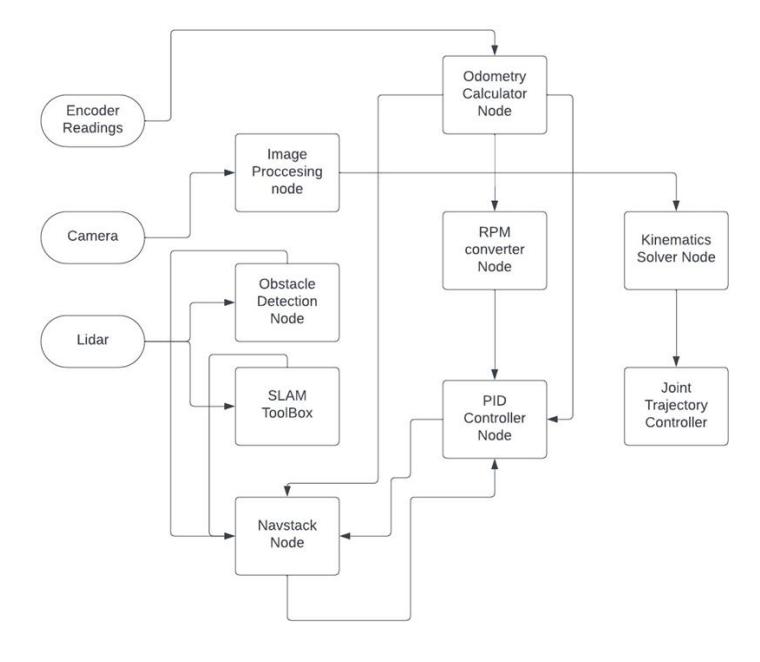
In this section, we describe the main software components and how they interact. We use the Robotics Operating System 2 (ROS-2) in the Humble version running on Ubuntu 22.04.4 LTS. The main advantages are the communication abstraction and the great number of easy-to-use debug tools. For simulation purposes, the ROS environment worked on was the AWS RoboMaker Small Warehouse World.
4.1 Base Platform
RPM Converter Node. This node receives velocity commands from higher-level planning modules and converts them into motor control signals in revolutions per minute (rpm), ensuring precise control of the robot's movement speed.
Odometry Calculator Node. By processing encoder readings from OE-37 encoder, this node computes odometry, which is crucial for accurately estimating the robot's position and orientation relative to its starting point.
4.2 Laser Scan
SLAM Toolbox Node. This component integrates Simultaneous Localization and Mapping (SLAM) techniques, using data from the LiDAR sensor to build a map of the environment while simultaneously localizing the robot within it. This enables the robot to navigate autonomously and avoid obstacles.
Obstacle Detection Node. Utilizing point cloud data generated by the LiDAR sensor, this node identifies obstacles in the robot's path in real-time, allowing for immediate navigation adjustments to avoid collisions.
4.3 Moving Base
Navigation Stack Node. This component utilizes the ROS Navigation Stack, which includes algorithms for global path planning and map localization. It enables the robot to navigate autonomously by planning a path from its current position to a goal location while avoiding obstacles.
SLAM Integration Node. Integrates SLAM-generated maps with navigation planning, ensuring that the robot's position estimation is aligned with the map, thus enabling accurate localization during navigation.
4.4 Camera
Camera Driver Node. This node interfaces with the camera hardware to capture high-resolution images, providing visual data for analysis and perception tasks.
Image Processing Node. Using deep learning models such as YOLOv8, this node performs image processing tasks like feature extraction and object detection, enabling the robot to recognize and interact with objects in its environment.
4.5 Perception Control
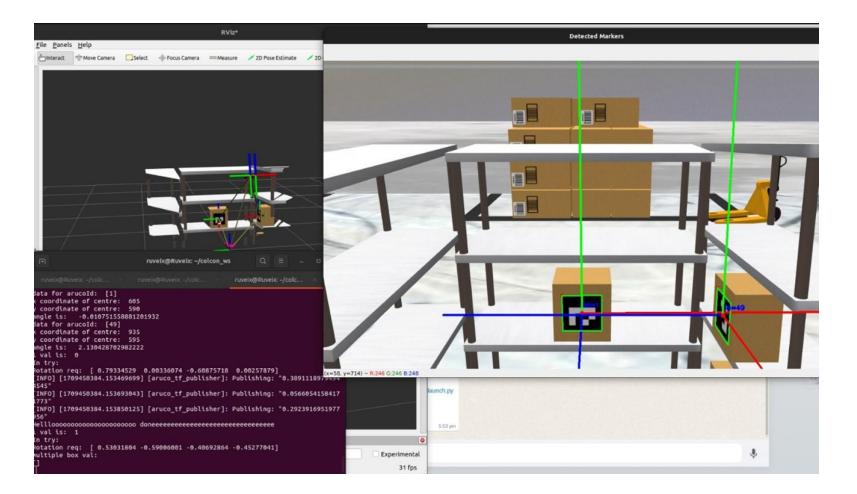
ArUco Marker Detection Node. Leveraging advanced computer vision techniques and ArUco markers integrated with OpenCV, this component enhances the robot's perception by accurately detecting and localizing objects adorned with ArUco markers. It enables precise interaction and navigation based on marker cues.
Joy Control: Teleop Joy Node. This node interfaces with a Logitech controller, providing a manual control interface for teleoperation tasks, allowing human operators to navigate and control the robot manually.
Mapping Node. Facilitating manual mapping tasks, this component allows users to manually control the robot's movement while simultaneously mapping its surroundings, useful for environment exploration and map generation purposes.
4.6 Pose Approach
PID Controller Node. This node implements a Proportional-Integral-Derivative (PID) controller to regulate the robot's motion and achieve precise positioning at predefined locations.
Path Planning Node. Using techniques such as local planner MPPI and Adaptive Monte Carlo Localization (AMCL) with EKF cost mapping, this node calculates optimal paths based on localized map data and target positions, facilitating efficient and obstacle-aware navigation.
Robotic Arm Control: Kinematics Solver Node. This component computes inverse kinematics solutions to determine the joint angles necessary to position the robotic arm end effector accurately.
Robotic Arm Control: Grasping Algorithm Node. Utilizing algorithms for object grasping and manipulation, this node enables the robot to interact with and manipulate objects within its workspace.
5 Conclusion and Future Scope
In conclusion, RnC's participation in the RoboCup Industrial @ Work League marks a significant milestone in our journey towards innovation and excellence. Despite challenges, our team's perseverance has led to the development of M.U.C., a robotic solution for industrial applications. Our project leverages advanced technologies such as robotic arm, camera systems for object perception, and power distribution boards to streamline operations and enhance efficiency. By automating pick-and-place tasks and optimizing inventory management processes, we have significantly improved productivity and reduced reliance on manual labour. Through this effort, we've not only met RoboCup's standards but also showcased the effectiveness of utilizing locally available components and talent to develop competitive robotics solutions.
In the future, we aim to enhance the performance of our project and make it more suitable for real-world industrial scenarios by implementing upgraded specifications for key components such as the LiDAR sensor and the processing unit. Additionally, we plan to explore advancements in object recognition algorithms to enhance speed and accuracy in identifying and handling items. By continuously embracing technological innovation, we aspire to further optimize efficiency and reliability in warehouse operations.
Furthermore, our participation in events like RoboCup provides a platform for knowledge sharing and collaboration among peers in the robotics community. By engaging with fellow competitors and experts, we can not only broaden our understanding of robotics but also contribute to the collective advancement of the field.
Team Robotics & Circuits looks forward to the upcoming RoboCup season, hopefully in person!
5.1 Video Submission
Navigation:
Perception:
Robotic Arm:
References
- RoboCup @ Work Website, https://atwork.robocup.org/
- Leander Bartsch, Marco Masannek, Asad Norouzi, Lucas Reinhart, Martin Sereinig and Christoph Steup, "RoboCup@Work 2023 - Rulebook," 2023 https://atwork.robocup.org/rules/
- Z. Xuexi, L. Guokun, F. Genping, X. Dongliang and L. Shiliu, "SLAM Algorithm Analysis of Mobile Robot Based on Lidar," 2019 Chinese Control Conference (CCC), Guangzhou, China, 2019, pp. 4739-4745, doi: 10.23919/ChiCC.2019.8866200.
- Moore, Thomas O., and Daniel W. Stouch. "A Generalized Extended Kalman Filter Implementation for the Robot Operating System." Advances in intelligent systems and computing, 2015, pp. 335–48, doi:10.1007/978-3-319-08338-4 25.
- Aws-Robotics, "GitHub aws-robotics/aws-robomaker-small-warehouse-world: This Gazebo world is well suited for organizations who are building and testing robot applications for warehouse and logistics use cases.," GitHub. https://github.com/aws-robotics/aws-robomaker-small-warehouse-world
- Nav2 Nav2 1.0.0 documentation. https://navigation.ros.org/
- Model Predictive Path Integral Controller Nav2 1.0.0 documentation. https://navigation.ros.org/configuration/packages/configuring-mppic.html
- Welcome to Aruco Ros 2's documentation! Aruco Ros2 documentation. https://aruco-ros2.readthedocs.io/en/latest/
- Pac, "ros2 control demos/example 7/doc/userdoc.rst at full-example-tutorial · pac48/ros2 control demos," GitHub. https://github.com/pac48/ros2_control_demos/blob/full-example-tutorial/example_7/doc/userdoc.rst