RoboCup Rescue 2009 - Robot League Team iRAP_Pro (Thailand)
Kathawut Uschin, Surachet Inteam, Nuttakorn Sae-eaw, Artid Trakultongchai, Praphan Klairith, Wisanu Jitviriya, Pramuk Jenkittiyon
Department of Production Engineering Faculty of Engineering King Mongkut's University of Technology North Bangkok (KMUTNB)
http://www.thailandrescuerobot2008.org · http://www.raytek.com
Abstract This paper describes construction and operation of the robot of iRAP_Pro team. The iRAP_Pro team has joined three times competition in Thailand Rescue Robot Championship (2006-2008). In 2008, they were success to win in the national competition that invited Iran and Japan team to join in. As a result, the Thailand Robotic Society (TRS) decided to send the team as the representative of Thailand for participation in the RoboCup Rescue 2009 in Graz, Austria. Team has two teleoperative robots and one autonomous robot. Teleoperative robots have front arms which driven by caterpillar with synthetic rubber. As a design, they excel in rough terrain. Besides this, they can identify victims very well with commodity sensors. The autonomous robot has good mobility to move up the incline surface and identify victims by using vision system with image processing and thermal sensor. The three robots are able to create map automatically. The team is prepared for difference scenarios presented in the world Robocup Rescue.
Introduction
Rescue robot contest is very popular in Thailand. In 2008, there were more than 77 national teams and 3 foreign teams competed in the Thailand National Rescue Robot Contest, sponsored by Siam Cement Group (SCG) and organized by Thailand Robotic Society (TRS). The design of robots competing in the last contest shows very high level of diversity (please referred to http://www.thailandrescuerobot2008.org). From rigorous tournaments, our team won the national championship. Most of our members are undergraduate students from the department of Production Engineering. Some members in our team have strong practical background for designing, metal works, electrical works, and programming. We have an access to well equipped workshop in Bangkok. After working on many prototypes, we finalized on two similar teleoperative robots and one autonomous robot. Our robots have high proficiency in roaming around rough terrain by using caterpillar wheel. We designed stable cameras mounting arm on our robots and on body of robot to help identifying possible victim(s). Full sets of affordable sensors are put on to the system to measure temperature, co2, distance, and to create map. After the national competition, the practice arena was made available for our team to practice. The robot operator is well experienced in navigating the robot(s) under limited scene.
1. Team Members and Their Contributions
The iRAP_PRO has seven members. The names and contribution of each member are listed as follows:
Kathawut Uschin Electronics design and operator
Surachet Inteam Mechanical design
Nuttakorn Sae-eaw Mechanical design and controller development
Artid Trakultongchai Sensors and mapping
Praphan Klairith Software and controller development 6. Wisanu Jitviriya Electronics design and Sensors
Asst. Prof.Pramuk Jenkittiyon Team Advisor
2. Operator Station Set-up and Break-Down (10 minutes)
From the experience we have gained from the competitions in Thailand, the speed of the set-up and break-down process for each task is very crucial. We realize that the faster we set-up and break-down, the more time we have for other tasks. Our team uses aluminum case as the station. When needed, just open this aluminum case and turn on the switch. The operations can be started within 5 minutes. Inside this aluminum case consists of computer monitor, notebook, access point, printer and UPS. Once all the tasks are completed, the report and the generated map can be quickly printed out.
3. Communications
There are two communication systems used between the iRAP_PRO operator and robots. The first one is wireless LAN based on IEEE 802.11a standard which uses as the main communication system: for controlling robots, receiving video streaming from cameras on robots, and getting sensors feedback for locating the status of robots on computer monitor as well as for the automatic map generation. The second one is the RC controller with radio frequency of 72 MHz as the backup communication system for emergency situation. The range of the working distance is within 200 m for outdoor and 100 m in the building.
Rescue Robot League - iRAP_Pro (THAILAND) Communication Frequencies
| Frequency | Channel/Band | Power (mW) |
|---|---|---|
| 5.0 GHz - 802.11a | Adjustable | 50 |
| 72 MHz | N/A | 1,000 |
4. Control Method and Human-Robot Interface
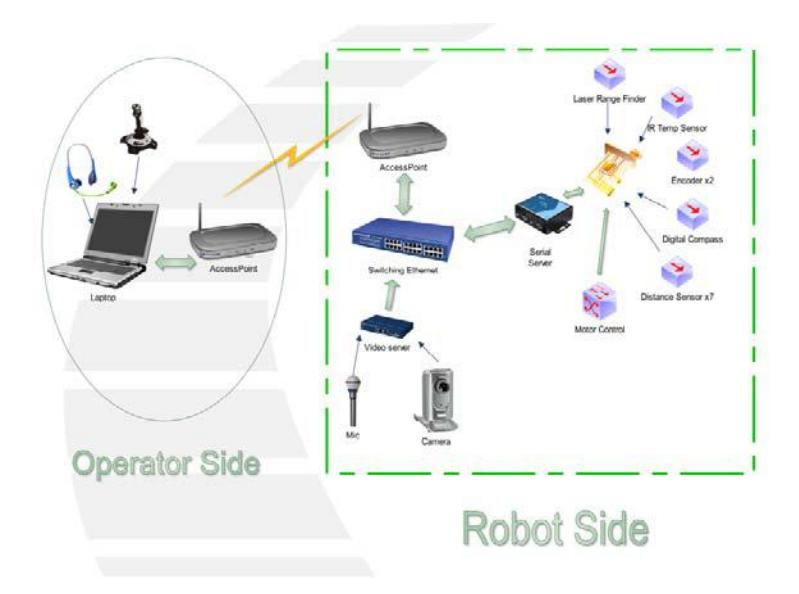
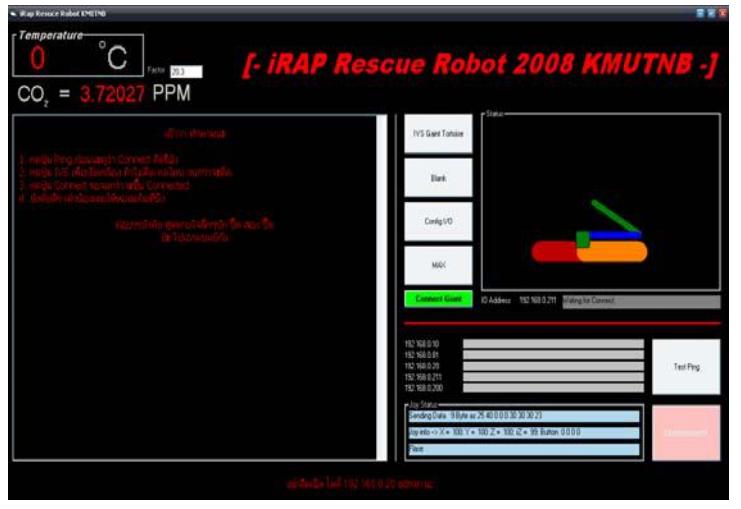
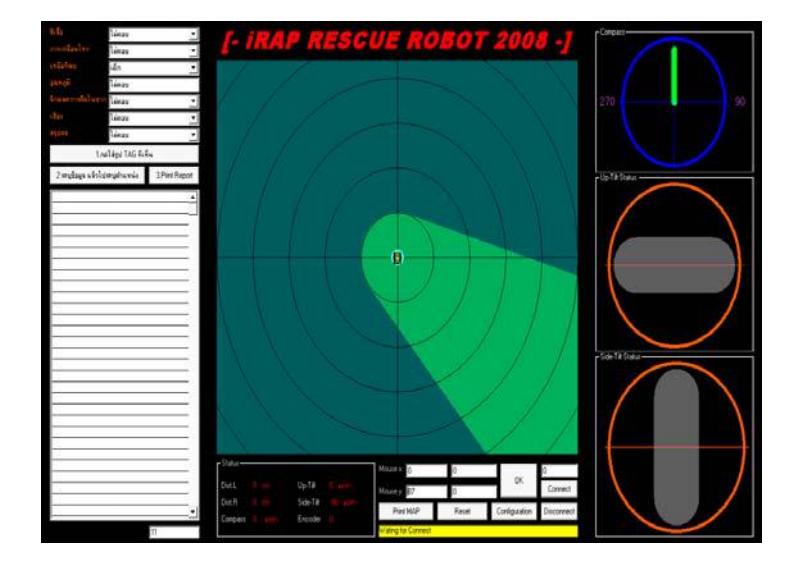
The robots main control is based on one CPU (PIC microcontroller 80 pins). Figure 1 depicts the schematic of the control system which has two main tasks as follows:
- 4.1 Used for receiving data for identifying status of the robots as shown in Figure 2 and create map automatically as shown in Figure 3. This information will be shown to the robot operator via a computer monitor.
- 4.2 Used for sending data for controlling the movement by sending the signal to the drive control for controlling DC motor at various locations on the robots
The RS-232 communication system will be used for sending and receiving data of CPU. Therefore, there must be a serial server to translate RS-232 system to Ethernet system.
5. Map generation/printing
Many kinds of sensors are installed on each robot in order to gain the data for processing and creating the 2-D map automatically on the computer monitor. The map is generated by using the information from the distance the robot moved from encoders, inclination of the robot measured by 3-axis accelerometer, direction of the robot sensed by digital compass, and distance between the robot and obstacles from IR displacement sensors and laser range finder. However, when the robot move on different kind of surface, the slipping problem can't be avoid. This slipping is major problem for designing and constructing the robot. Therefore, SLAM algorithm [1,2] used utilized to help generate the map in addition to the information from the encoders.
6. Sensors for Navigation and Localization
Sensors, used for guiding the robot movement and identifying the location of the robots, are described as follows:
- 6.1 Encoders: Use to measure the distance that the robot moved and use this information to plot on the software along with other kind of sensors.
- 6.2 3-axis Accelerometer: Use to measure the inclination of the robot and utilize this data in addition to the information received from encoders (the map is generated in the top view)
- 6.3 Digital compass module: Use to measure the direction of the robot and use this data to plot along with the distance measured from the encoders.
- 6.4 IR Displacement sensors [3]: Use to measure the distance between the robot and obstacles and use this information to plot on the software.
- 6.5 Laser range finder: Use to measure the distance of the obstacles in the vicinity of the robot and again use this information along with data received by other kinds of sensors to generate the map.
- 6.6 Video cameras with wide-angle lens
7. Sensors for Victim Identification
On each robot, there are four types of sensors for checking and analyzing the victim found by the robot. These sensors are listed as follows:
7.1 IR temperature sensor [4]: Use for checking the temperature of victim found for further analyzing whether the victim still alive or not. The temperature value measured by this kind of sensor will be sent back to computer monitor of the operator.
- 7.2 CO2 sensor: Use for measure CO2 of victim found for checking the aspiration of the victim.
- 7.3 High quality microphone: Use for detecting sound of the victim found.
- 7.4 Real-time video cameras: Use for investigating of the victim found and send pictures back to the operator for further analyzing the victim.
8. Robot Locomotion
iRAP_PRO team has total of 3 robots. One of which is autonomous robot and the other two are teleoperative ones.
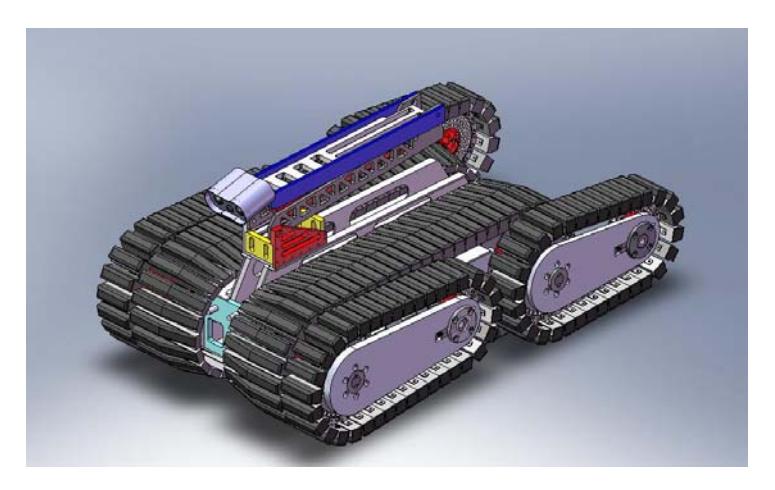
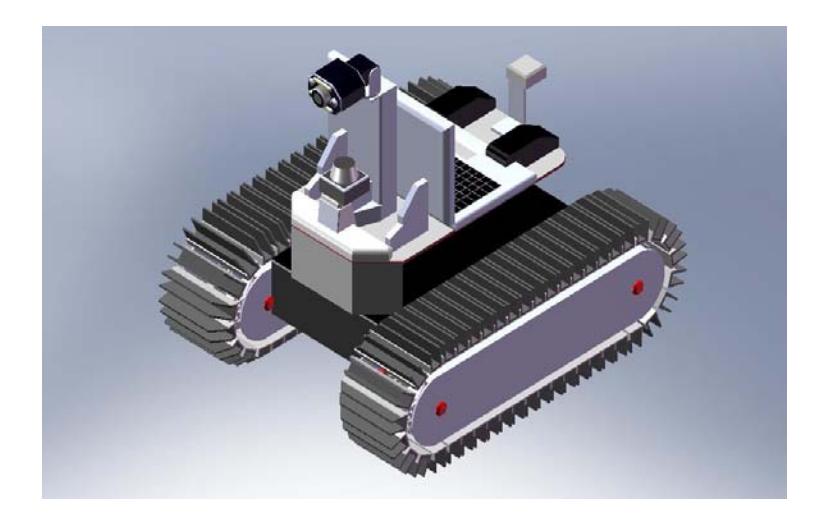
The teleoperative robots are identical robots, as shown in Figure 4. The drive system of these robots is made use of the conveyer belt system which can be used on different types of terrain. Each drive system consists of two of 24V, 95 rpm DC motor for the movement on the left and right. The structure of the drive system is made of aluminum. The belt is made of synthetic rubber. The robots have two pairs of flipper (front and back). Each pair of flipper can be rotated 360 degree and work independently of each other. Therefore, the robots have good terrain adaptability for moving through disaster area. The size of each robot is 500 x 650 x 450 mm.
Another robot is autonomous one. This robot also uses conveyor belt system for the drive system which can also be used on rough terrain and incline surface. It consists of four of 24V, 130 rpm DC motor. The structure of the drive system is made of aluminum. The belt is made of synthetic rubber. The robot can avoid the obstacles and find victim by itself. The size of robot is 450 x 550 x 320 mm.
9. Other Mechanisms
The manipulator of the robot arm which has video camera and sensors installed has high mobility. It can be rotate 360 degree and can be extended closer to the victim, if necessary, to increase visualization. Also there is gripper at the edge of this manipulator which capable of moving objects which weight less than 5 kg.
10. Team Training for Operation (Human Factors)
The iRAP_PRO has competed in Thailand Rescue Robot since 2006. We have learned and continuously developed our skills from 2006. Finally, we succeed in the Thailand Rescue Robot 2008 and became the Thailand Rescue Robot champion. We received the best training through the experiences from real competition round in round out since in each task given in the competition requires not only skills of robot operator but the operator has also to withstand the pressure in the competition environment.
11. Possibility for Practical Application to Real Disaster Site
The iRAP_PRO has high proficiency robots which can move into different terrains. In the case of applying for the practical application, it might require more development on some parts in order to be used at its maximum efficiency. For example, we need to increase the level of Industrial Protection such as using the water-proof and dust-protection parts, extending the effective range of signal further, increasing the toughness of some parts for using in the real application.
12. System Cost
iRAP_PRO team has three robots. Two of which are teleoperative robots and the other one is autonomous robot. The cost of parts on each robot is listed as follows:
System Cost Breakdown for iRAP_PRO Robots
| Item | Cost |
|---|---|
| Structure of robot and drive train | $1,300 |
| Encoders x 2 | $120 |
| Digital compass module | $100 |
| 3-axis Accelerometer | $105 |
| Laser range finder | $2,100 |
| Temperature sensor | $350 |
| IR Displacement sensors x 2 | $50 |
| High quality microphone | $45 |
| Video cameras x 4 | $320 |
| Controller and electronics | $350 |
| Access point IEEE 802.11a | $180 |
| Internet video server | $185 |
| Serial server | $200 |
| Total Cost | $5,405 |
13. Lessons Learned
We have participated in Rescue Robot since 2006. We have learned a lot from the experiences in competing each year. We have seen what other did and we have learned how improve our robot every year. More importantly, we have learned that we cannot be successful without the cooperation of every team member.
Acknowledgement
The iRAP_Pro team was supported in parted by grants from the Siam Cement Group, Thai Robotic Society, Department of Production Engineering, Faculty of Engineering, King Mongkut's University of Technology North Bangkok. Most of the works were machined at the technology service center, King Mongkut's University of Technology North Bangkok, Thailand.
The final menuscript of this paper was prepared by Chatchai Sermpongpan and Supat Ieamsupapong.
References
- R. Siegwart, I, Nourbakhsh: Introduction to Autonomous Mobile Robots (2004)
- Sebastian Thrun, Dieter Fox, Wolfram Burgard: Probabilistic Robotics (1999-2000)
- Sharp Corp: Distance measuring sensors notes (2003)
- Thermalert manual Raytek Corp., Available: http://www.raytek.com