RoboCupRescue 2010 - Robot League Team NuTech-R (Japan)
Tetsuya KIMURA, Isam AIDA
Nagaoka University of Technology, 1603-1 Kamitomioka, Nagaoka, Niigata, Japan, ZIP:940-2188; Nexis-R NBIC room Lab-D annex, 2085-16 Fukasawa, Nagaoka, Niigata, Japan, ZIP:650-0047
http://www.axiscom.co.jp/prod/camsrv/prodgd_ptzdome.htm
Abstract Our robot NuTech-R4 had achieved remarkable results in RRRL, e.g., champion in Japan Open 2007-8 and 4th place in WC 2008. A new robot, NP-01, has been developed as a commercialized product based on NuTech-R4 by our team member and will be used in this RRRL-WC 2010. NP-01 has comparable performances to NuTech-R4 and several ideas learned from NuTech-R4's developments are condensed into it. We believe NP-01 can be a good research platform for robotic researchers, and we also hope NP01 will accelerate rescue robot development.
Introduction
In 2004, CHUETSU great earthquake of M6.8 had occurred in our home town with 100,000 refugees, 90,000 collapsed house, and 30 billion dollar financial damage, which depress the local area. Nagaoka Univ. of Technology, a local university, and a NAGAOKA-TEKKOU-SEIKEN(SEIKEN for short), a group of about 60 local metal manufactures, had decided to establish a joint Robocup Rescue Robot League(RRRL) team, NuTech-R, in order to develop rescue robots and participate RRRL in order to cheer up home town. They had achieved remarkable results in several RRRL competitions, e.g., champion of Japan Open 2007 and 2008, 4th place of the world championship 2008, 1st run-up and the best mobility of Thailand Open 2008. These RRRL results had been welcome to local area people and NuTech-R was awarded the Nagaoka City Mayer Award in 2008.
The team NuTech-R will participate for RRRL WC2010 with the new robot, NP-01, which is a commercialized product of NuTech-R4, where NuTech-R4 is the latest robot of the team NuTech-R. The price of NP-01 is approx. 10,000 US dollars for the mechanical parts. The commercialization has been carried out by Nexis-R. Nexis-R is a spin-off organization from SEIKEN composed of about 10 local companies, aiming to achieve Rescue Robot innovation in Nagaoka.
Comparing to NuTech-R4, NP-01 is simplified for cheaper price and has better expandability with slight degradation (heavier weight and bigger size). Several ideas learned from NuTech-R4's developments are condensed into NP-01. Thus, we believe NP-01 can be a good research platform for robotic researchers, and we also hope NP01 will accelerate rescue robot development.
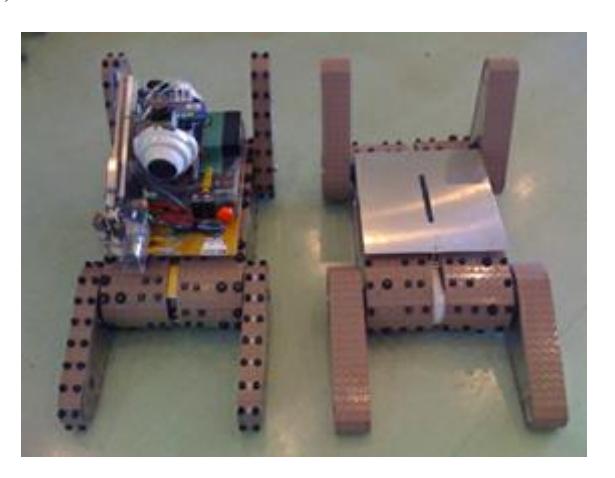
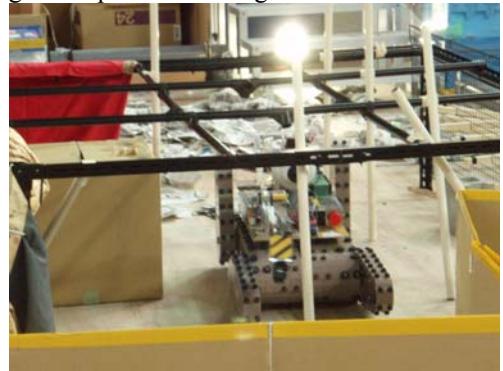
The main body of NP-01 has been completed, see Fig.1, but system integration with the additional parts, e.g., sensors and arm-camera, are not completed. Therefore, the explanations of this TDP is mostly based on NuTech-R4. (NP-01 will have similar performance.)
1. Team Members and Their Contributions
• Tetsuya KIMURA Manager • Masahiro DOGOME Mechanical design • Sei TAKEYABU Mechanical design • Tsutomu SAITOH Electrical circuit design and programming • Tohru NAKAYA System integration • Saonoi GOSON Controller design • Wong Chon Vie programming • Nexis-R Manufacturer
2. Operator Station Set-up and Break-Down (10 minutes)
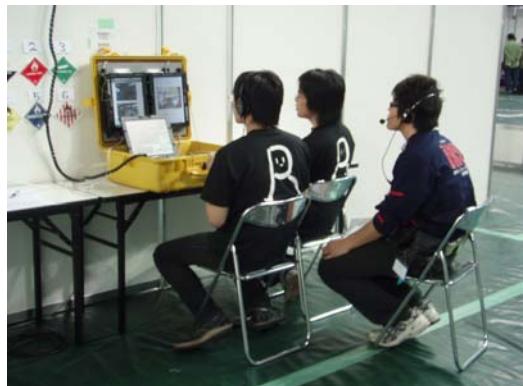
No OS is used inside the robot, so robot start-up is very short time and robust. All operational units are installed into one PELLICAN Box, thus the operational system is easy to move. In addition, due to the lessons from RRRL competitions, e.g., cable configuration, we can start our robot within two minutes in average (with hotstart of PCs).
3. Communications
A commercially available W-LAN router with 802.11-A is used . Passive tether is also used when W-LAN condition is bad.
Rescue Robot League NuTech-R (Japan) Communication Frequencies
| Frequency | Channel/Band | Power (mW) |
|---|---|---|
| 5.0 GHz - 802.11a | J52,W52,W53(34ch、36ch、38ch、40ch、42ch、44ch、46ch、48ch、52ch、56ch、60ch、64ch) | Unclear but not so big (within Japanese regulation) |
| 2.4 GHz - 802.11b/g | None | None |
| 2.4 GHz - Bluetooth | None | None |
| 2.4 GHz - Other | None | None |
| 1.2 GHz | None | None |
| 900 MHz | None | None |
| 40 MHz | None | None |
| 27 MHz | None | None |
4. Control Method and Human-Robot Interface
Control Method
The robots are remote tele-operated by an operator. No automatic control is used.
Human Robot Interface
A standard note PC with a game pad is used for the interface.
5. Map generation/printing
No map generation.
6. Sensors for Navigation and Localization
A good resolution camera with 120 degree view angle is used for navigation. A 2D scanning laser range finder(HOKUYO product) is also used for navigation. No sensors for localization.
7. Sensors for Victim Identification
The followings are used for victim identification:
- Arm camera for narrow area search.
- Microphone for sound.(installed arm camera)
- Heat sensor for victim heat identification.
8. Robot Locomotion
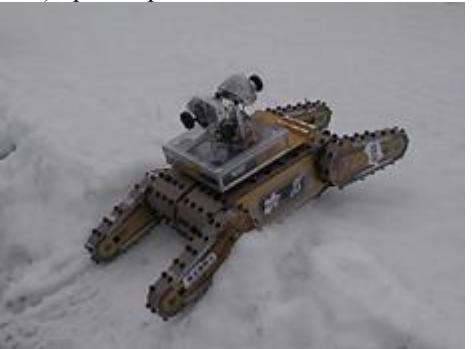
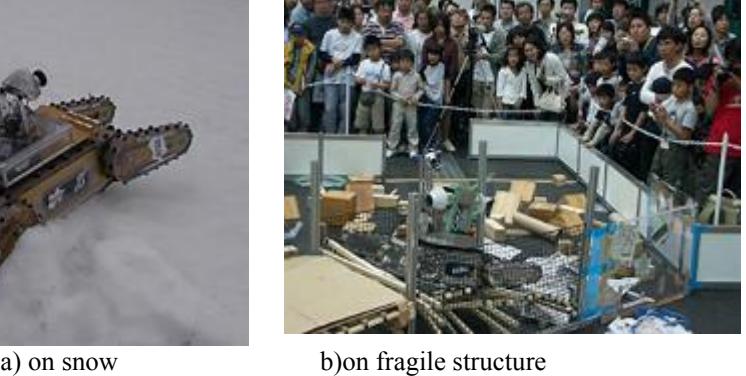
A standard crawler system with front and rear flippers is used. Though this system is widely used for mobile rescue robots, our system has been polished up (crawler size, grouser pattern) through RRRL competitions and our laboratory evaluations(See Fig. 3). According this, we have found good stability (good grip, no slip, no slide) is essential for sustainable good locomotion. In other words, an aggressive behavior for mobility, e.g., slip, may provide short-term good locomotion but it will fail sooner or later. In addition, aggressive behavior would cause a second disaster, e.g., robot falling down to victim, which is not good for the rescue robot. We believe "Safety first" provide good locomotion.
In order to achieve good stability, we had proposed a dot-type grouser pattern, IBO grouser (Isotropic Bumping and touching Object). The IBO grouser has several design parameters, e.g., dot size, location and stiffness, and we are trying to find
(Pareto-) optimal pattern.
The "Safety first" concept is also used in the path planning.
9. Team Training for Operation (Human Factors)
20 hours training(two hours/day and 10 days) with severs condition rather than RRRL is our routine for a beginner operator. See Fig.4.
10. Possibility for Practical Application to Real Disaster Site
Some parameters (camera view angle, grouser pattern) will be useful for particular application to the real site.
Risk assessments are carried out in our laboratory works by referring some technical standards, e.g., ISO 14121 and ISO 14971. This could be useful for risk management in real site.
11. System Cost
- Camera (200,000 yen) : Two AXIS 212 PTZ (http://www.axiscom.co.jp/prod/camsrv/prodgd\_ptzdome.htm)
- Laser range finder (150,000 yen): HOKUYO Co.
- NP-01 (1,000,000 yen for academic, 3,000,000 yen for non-academic): Nexis-R
- Arm camera (200,000 yen) : hand made
- Electrical components (100,000 yen): hand made
- Control system(800,000yen) : two PCs and W-LAN.
Total : approx. 2,450,000 yen