RoboCupRescue 2010 - Robot League Team YRA (IRAN)
MohammadReza jenabzadeh, Seid Ali Makkinezhad
Islamic Azad University of YAZD, Computer Department; Islamic Azad University of YAZD, Power Department
Abstract In the present article members of YRA team from Islamic Azad University, Yazd, Iran are introduced and some brief explanation on Rescue robot such as mechanical parts, pieces and electronic boards, applied sensors, intermediate softwares, the quality of control and communication between operator and robot are discussed.
Introduction
YRA robotic team, after getting various honors in different country's competitions, and enjoying university authorities' support, took part in IRANOPEN2009 , CHINA 2008 and GRAZ 2009 robocup competitions. In the IRANOPEN2009, concerning experience achieved through the previous round of the game, YRA, among other participants, could achieve a third-rank position in "Rescue Real" field, and a second-rank degree in "best mobility" field. Now, the YRA is accomplishing robot-promotion program comprising adjustment of deficiencies observed at previous competitions, in a challenge to have an active and successful presentation in the IRANOPEN2010 competition on "Rescue Real" field. In continue, a more description of members would be presented and a more detail about our robot and how it works would be revealed.
1. Team Members and Their Contributions
- MohammadReza Jenabzadeh Team Leader,Advisor
- Seid Ali Makkinezhad Electronic engineering and Mechanical design
- Seid Amir Makkinezhad Operator and Network programmer
- Mohammadmehran Lesansedgh Minimum system design and Microcontroller programmer
- Hadi Zare Mechanical design and Power supply design
- Mohammad Golresan Power electronics and implementation
- Mohsen Mollahoseini Bajgani Software developer
- Mehdi Taghavi Mechanical design and Power supply design
- Jamal Beheshti Electronic engineering and Mechanical design
2. Operator Station Set-up and Break-Down ( 10 minutes )
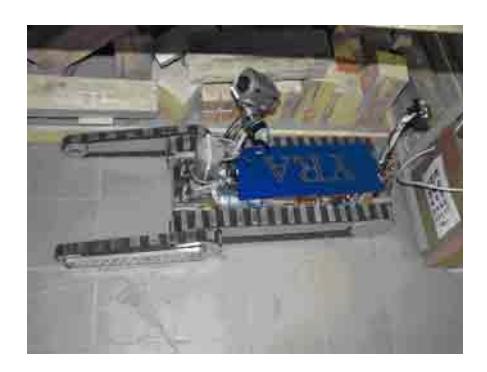
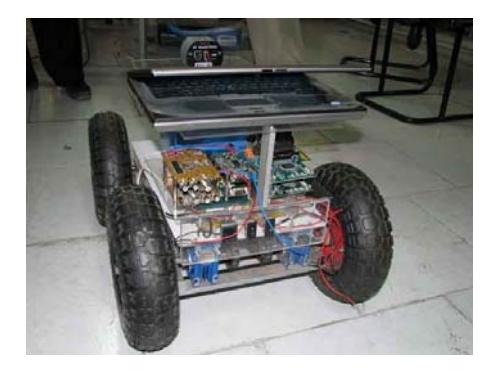
Our robot is started by an operator, through a remote control device, and is ready to operate after passing 4 minutes (it is needed for AP to initiate a safe communication with computer). The weight of robot is relatively high (about 30 KG) therefore it is difficult to be repositioned by only a single operator. However, we hope, reducing the weight within the due time before starting-time of the competition, by applying some modification in such a manner it can be handled by an individual person. With respect to intermediatory circuits and other parts and instruments used in the device, it is less likely to face a difficulty or fault during the contests; however, in case of any problem there are ready- spare parts to be replaced quickly.
3. Communication
To achieve a robot-operator controllable communicative environment, and get pictures, maps, and control signs in an accepted manner, we use competition-site-approved standards.
The employed AP is a product of Dlink co, capable of using all wireless LAN channels of A, B, and G; therefore upon the day of competition its frequency and channel would be set according to the guideline of holding committee (Appendix A shows AP technical information). Moreover, a remote control key with frequency of 45KHZ and a 16 digit code is being used to ensure the correctness of data. Remote control key is tested in a real environment and is sufficiently persistent and reliable.
Table 1. Frequencies and channels required by team
| Rescue Robot League YRA (IRAN) | |||
|---|---|---|---|
| 5.0 GHz – 802.11a | All Channel | 63 mW | |
| 2.4 GHz – 802.11b/g | All Channel | 63 mW | |
| 45 KHz | - | 100mW |
4. Control Method and Human-Robot Interface
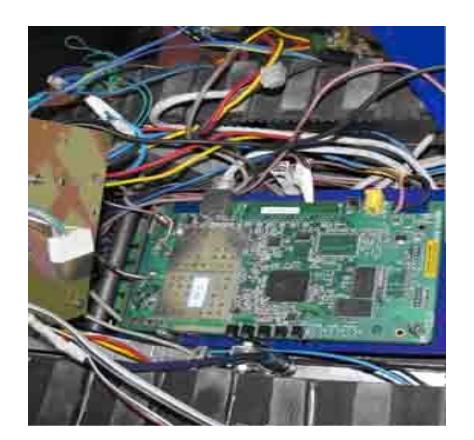
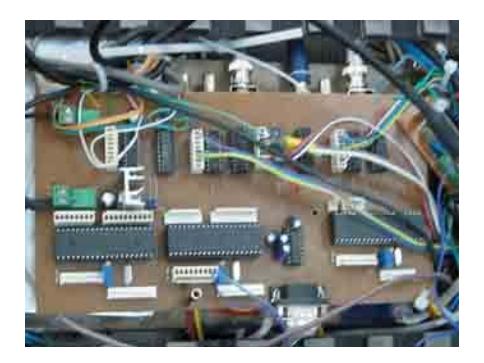
Robot is controlled by a joystick connected to operator's computer. Next, controlled data are sent in a form of data package to AP sensor by using intermediated designed software. AP transfers data to a PICbased microcontroller system, where after processing; necessary signals are passed for control of robot's moving motors, arms and cameras motors.
Robot's various activities are controlled by operator which include: back and forth and turning motion, arm movement, and cameras' rotation. Recognition of injured persons, vital signs investigation like temperature, CO2, injured movement and his/her voice, label reading by sending sensors' data, and pictures of installed cameras on robot through AP are sent to two operator controlled laptops therein we may produce related lists easily.
5. Map generation/printing
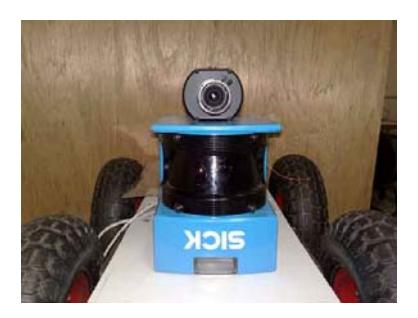
A laser scanner is used for production of map, capable of determining walls and other materials on the ground and therefore is able to draw the way map correctly in such a manner that the place of injured persons would be defined by operator. Application of an accelerometer to assess amount of repositioning, and level difference in the environment would cause better and exact recognition of way-map and injured position. At the end of composition, all exploited signs of injured-persons and way-map would be printed.
6. Sensors for navigation and Localization
Following sensors are being used in our application: compass sensor for drawing of map (HMC1052), accelerometer sensor ADXL330 and ADXL212 for estimating amount of repositioning, ultrasonic sensor for determining robot distance from walls and injured-persons, and finally laser scanner sensor for specifying way-map.
7. Sensors for Victim Identification
Infrared and CO2 sensors are used for determining injured-persons temperature and quantity of CO2 in environment respectively. Moreover, robot's installed microphones are used to determining possible sound of injured-persons. In order to define injured-person(s) status (including movement, situation, being over the surface or under debris and …) as well as reading the assigned label, an installed camera on robot with zoom capability would be used.
8. Robot Locomotion
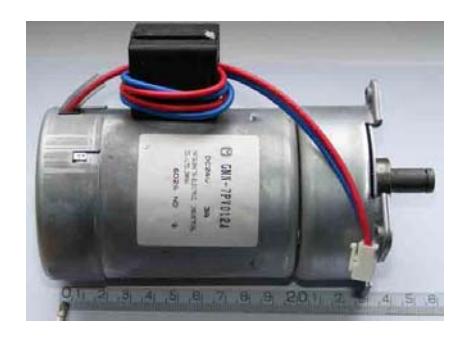
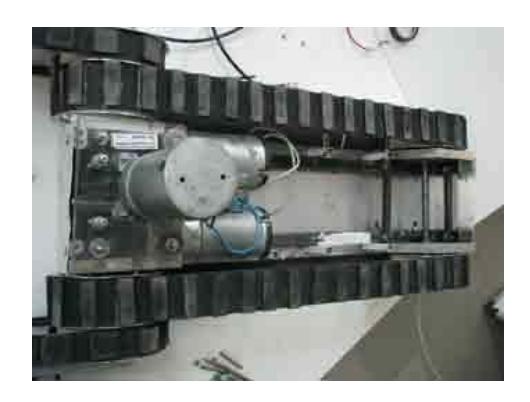
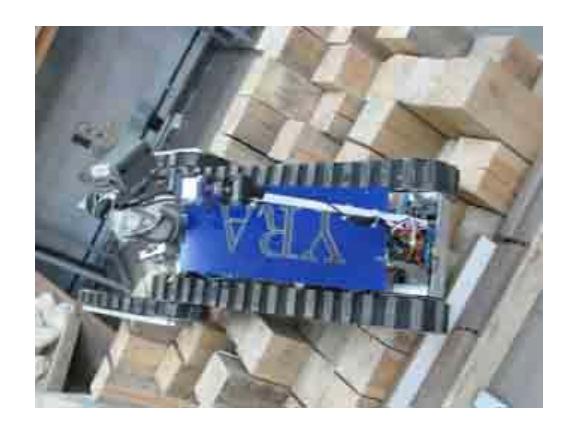
Robot propellant force is maintained by motors, that their power for reinforcement is given to the gearbox and gearwheels of robots, and that these gearwheels will move the straps and lead to the mobility of robot. Movement of robot's arms is empowered by separate motor and gearbox. Appendix B covers more complete information on the subject.
9. Other Mechanisms
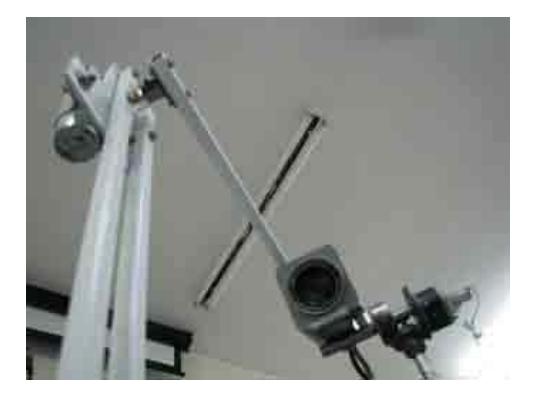
A 5DOF arm is used for camera up and down motion capability and maintains more complete domination upon environment. It can set camera 90 centimeters higher than robot level. In addition a Hall Effect sensor is used for determining arms situation and better control of robot.
10. Team Training for Operation (Human Factors)
For better utilization of robot and acquiring enough skills, a site similar to the competition ground according to current standards, should be built and the operator should also enjoy enough practice to guide robot in appropriate environment and encounter related problems as well. By doing so and continuing our exercises, YRA team tries its best to prepare itself for the competition. Beside, it experienced two participation practices in IRANOPEN competitions and maintained a very good advantage up to now.
11. Possibility for Practical Application to Real Disaster Site
With respect to accomplished exercises in the experimental filed, our robot possess a high maneuver power in passing various obstacles and cameras and some sensors that should be installed over robot would only be damaged upon falling over a high position (like stairs) or collapse of debris on it in a real environment. Therefore, if it might be protected against theses dangerous situations, a better practical application would be revealed in a real environment.
12. System Cost
All-over cost of robot construction operation is about 10000 US$. , and the integrated parts are as follows:
System Cost Components
| Component | Cost |
|---|---|
| LG Camera 27x | 400 US$ |
| Vivotek video server | 348 US$ |
| Dlink Switch | 30 US$ |
| HOKUYO URG-04LX Laser scanner | 2375 US$ |
| Battery sonic cell | 538 US$ |
| Dell latitude Laptop D620 | 1600 US$ |
| Sick Laser Scanner | 9000 US$ |
The rest of boards, chassis and arms are built by the team members.
APPENDIX A: Access Point Information
D-LINK DWL-7100AP Wireless Access Point
Manufacturer: D-LINK
Mfg Part#: DWL-7100AP, DWL 7100AP, DWL7100AP
Product Id: 20634
Dimensions: 11.00" X 8.50" X 2.75"
Weight: 1.98 lb.
Product Description
Up to 108Mbps and fully compatible with 802.11a/b/g D-Link, the industry pioneer in wireless networking, introduces a performance breakthrough in wireless connectivity The D-Link AirPremier AG DWL-7100AP Access Point, designed for multimode network deployments capable of up to delivering 15x faster data rates than standard 802.11b in both 802.11a and 802.11g bands. The DWL-7100AP is an ideal solution for creating a wireless backbone infrastructure or for extending an existing wireless network. For advanced configuration, network administrators can deploy multimode operation such as using the DWL-7100AP as a 5GHz 802.11a wireless bridge while simultaneously providing Access Point functionality for 2.4GHz 802.11b/g networks. The DWL-7100AP can operate as an Access Point, Point-to-Point Bridge, Point-to-Multipoint Bridge, and Repeater. For compatibility with other D-Link AirPremier AG hardware, the DWL-7100AP uses Wireless Distribution System (WDS) technology when running in Repeater mode. The DWL-7100AP provides maximum wireless security by supporting WPA (Wi-Fi Protected Access), 802.1x, and three levels of WEP Encryption (64/128/152-bit). Other security features include MAC Address Filtering, Wireless LAN segmentation, Disable SSID Broadcast, and support for Advanced Encryption Standard (AES) Encryption. The DWL-7100AP delivers extremely fast wireless performance with maximum wireless signal rates reaching up to 108Mbps* when set in Turbo mode for both 802.11g and 802.11a networks, while still remaining backwards compatible to 802.11b. With the ability to deliver blazing transfer speeds, network administrators have ample bandwidth to distribute amongst multiple workgroups and avoid network bottlenecks. Network administrators can manage the DWL-7100AP settings via its Web-based configuration utility or though Telnet. For advanced network management, administrators can use D-Link's AP Manager or D-View SNMP management module to configure multiple access points from a single location. With versatile dualband operation modes, solid security features, and extremely fast data transfer speeds, the D-Link AirPremier AG DWL-7100AP Wireless Access Point offers a high return on investment and provides SMB and Enterprise network administrators an ideal solution for establishing a new wireless network or for extending the range of an existing one.
Product Features
- Up to 108Mbps
- Enhanced Security Features
- 802.11g, 802.11b, 802.11a Compatible
- 4 operational modes
APPENDIX B: Robot Locomotion information
(No introductory text for this appendix section)
Motor gearbox information
(Specifications provided in table)
Table3. About DC 24V 150-250RPM Gear Motor
| Specifications | |
|---|---|
| Horse Power Cont. | 72 W |
| Gear ration | 1:12 |
| Voltage & Current | 24 V DC |
| RPM | 150-250 |
| Reversibility | Reversible |
| Length of Motor (including spindle) | 130 mm |
| Diameter of Motor (D) | 70 mm |
| Length of Motor Body(excluding spindle) (BL) | 100.0mm |
| Full Length of Spindle (SL1) | 58.0mm |
| Length of Spindle (SL2) | 18.0mm |
| Length of Spindle Flat(SL3) | 40.0mm |
| Diameter of Spindle (SD) | 10.0mm |