RoboCupRescue 2011 - Robot League Team CIT Pelican (JAPAN)
Eiji Koyanagi, Takeshi Nishimura
Chiba Institute of Technology Future Robot technology center 2-17-1 Tsudanuma Narashino Chiba 275-0016 Japan; Chiba Institute of Technology The department of advanced robotics, Chiba institute of technology 2-1-1 Shibazono Narashino Chiba 275-0023 Japan
Abstract This paper describes our team organization and our tracked vehicle 'Quince'. Quince is built of two main-crawlers and four sub-crawlers like as Kenaf. It will not stick on the rubble because its body is covered by wide maincrawlers. Also it can move freely over the rubble like the "random step field" by changing posture of the four sub-crawlers. We've done much on-site training of our robot with people from fire depot, and found flaws to be improved. The Quince is the answer to it. We will also improve the ability of map construction, and object manipulation.
Introduction
This paper describes our team organization and our tracked vehicle 'Quince'. Quince is equipped with two main-crawlers and four sub-crawlers like as Kenaf [1]. It will not stick on the rubble because its body is covered by wide main-crawlers. Also it can move freely over the rubble like the "random step field" by changing posture of the four sub-crawlers.
We've done much on-site training of our robot with people from fire depot, and found flaws to be improved. The Quince is the answer to it. We will also improve the ability of map construction, and object manipulation. The details of multi robot mapping are described in [2].
1. Team Members and Their Contributions
Our team "CIT Pelican" is organized with members from Chiba Institute of Technology.
1 Eiji Koyanagi Mechanical design
2 Takeshi Nishimura Operator and General Maintenance
3 Kazuki Ogihara Machinery maintenance
2. Operator Station Set-up and Break-Down (10 minutes)
The operator station is packed in one middle size Pelican case, and the robot is also packed in two middle size Pelican cases. Total weight will not exceed 150kg, and considering that the pelican cases are equipped with wheels and handles, it is possible to carry by one person.
Most time consuming step of the set-up process in the operator station is to boot up the PCs , and establish wireless connection between the station and the robot. We will save a map data as some electrical data, and will submit it. It is easy for Robocup stuffs to share the victim's information.
We will plan that the number of operator is only one. The operator will control some robots during the competition.
3. Communications
We use IEEE 802.11a (5.2GHz Band) for both control and sensing (including video, Laser Ranger Finder etc) communications. In Japan, all WLAN RF power is restricted to 10mW. Therefore our robots and operator station are also use 10mW of RF power.
Frequency bands and power settings for CIT Pelican
| Rescue Robot League | ||
|---|---|---|
| CIT Pelican (Japan) | ||
| MODIFY TABLE TO NOTE ALL FREQENCIES THAT APPLY TO YOUR TEAM | ||
| Frequency | Channel/Band | Power (mW) |
| 5.0 GHz - 802.11a | 36-64 | 10mW |
| 2.4 GHz - 802.11b/g | ||
| 2.4 GHz – Bluetooth | - | |
| 2.4 GHz – Other | - | |
| 1.2 GHz | - | |
| 900 MHz | - | |
| 40 MHz | - | |
| 27 MHz | - |
4. Control Method and Human-Robot Interface
We will control our tracked vehicles in remote tele-operation.
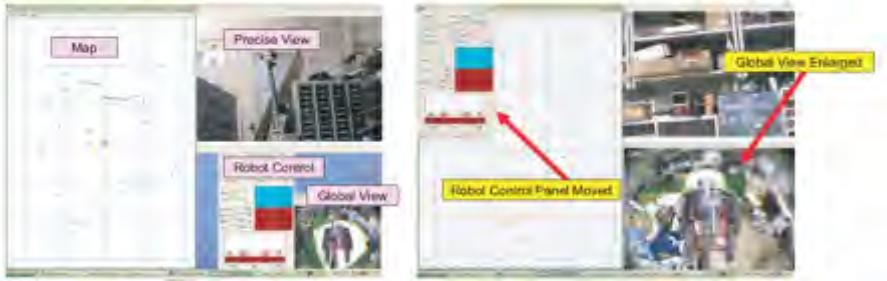
For tele-operation, the locomotion of the robot is controlled with single popular joypad equipped with 2 analog stick and 12 digital bottoms. The operator recognizes a surrounding environment of the robot trough video information of a bird view camera and range data from laser range scanners.
A pan-tilt-zoom camera on the robot will be controlled using touch panel on the video display. The touch panel seems very handy than usual pointing device such as mouse or trackball, especially when the operator is not sit down on a chair.
Information expected to be shown are video from several cameras, range data, gradient sensor readings. We organize these information to fit with two LCD panel, and built such operator station.
5. Map generation/printing
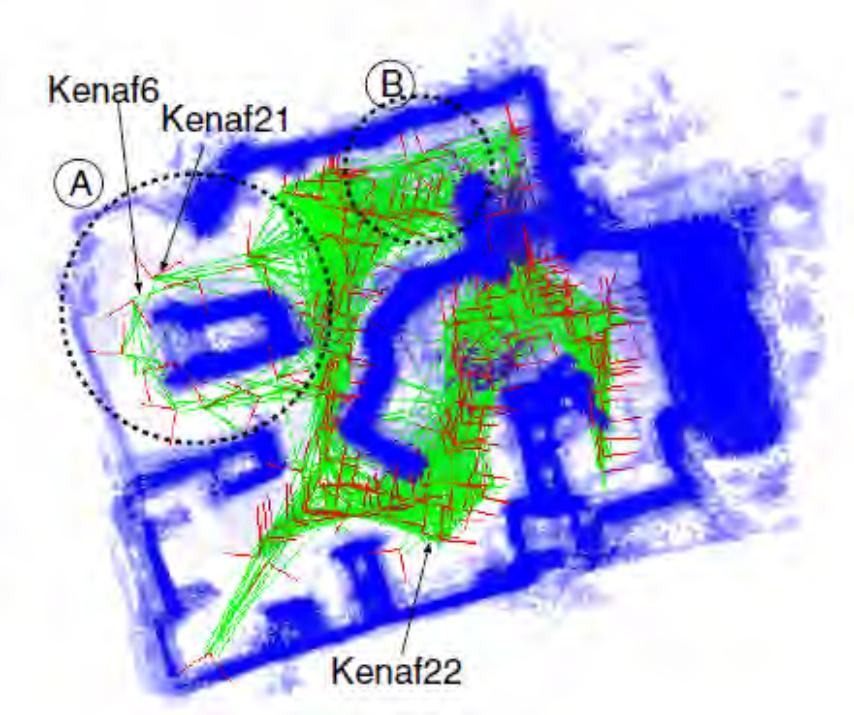
The robots can measure 3-D shape using a 3-D laser scanners or one fixed 2-D laser scanner. Using range data from such laser scanners and robot's position and posture estimated from odometry and IMU such as gyro sensors and gradient sensors, our robots will build a semi-automatic 2D/3D hybrid map. In last RoboCupRescue competition, we tried to build such multi-robot SLAM. It works well in basic experiment. However, it did not work in real competition. We will improve our method and build maps.
6. Sensors for Navigation and Localization
We will use gyro-based odometry for position estimation. For odometry based navigation, each motor is equipped with incremental encoder. Also, 3-axis gyro sensor, 3 axis gravity sensor are placed inside the robot. To recognize environment by the operator, a bird-view camera, and pan-tilt-zoom camera is used. The configuration of these cameras is almost same as last year model.
7. Sensors for Victim Identification
A pan-tilt-zoom camera is used for victim identification. For supplemental use, a thermal camera and CO2 sensor are also mounted on top of the robot. Bi-directional audio communication will be implemented until the competition.
8. Robot Locomotion
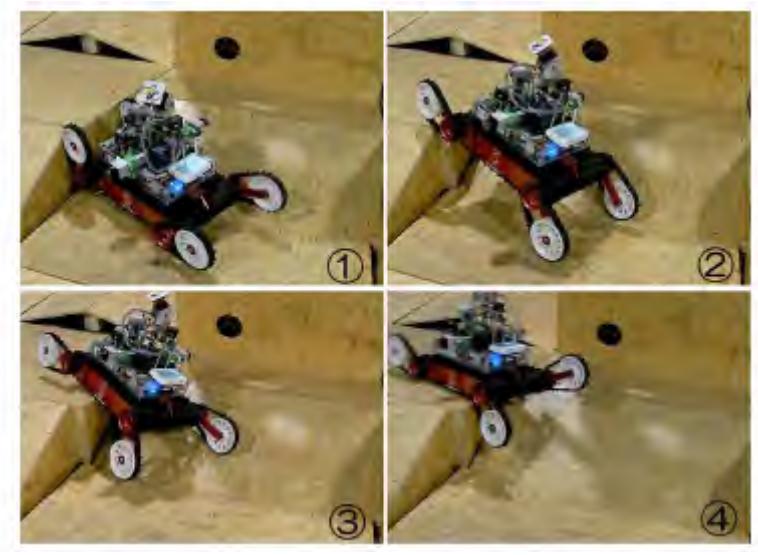
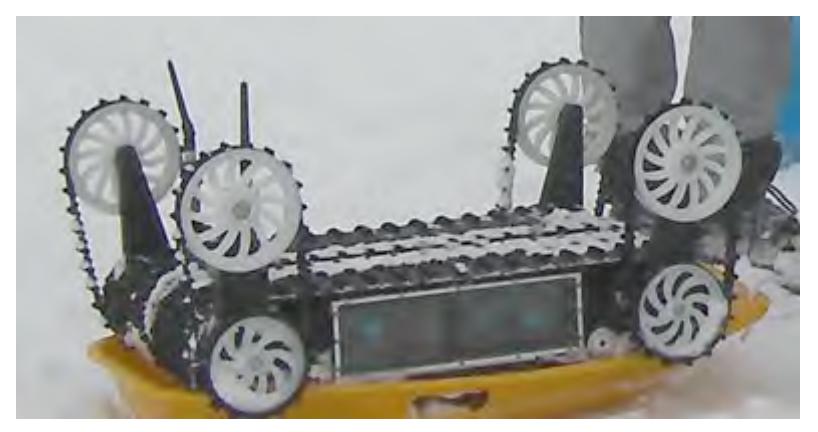
Quince is built of two main-crawlers and four sub-crawlers.
It will not stick on the rubble because its body is covered by wide main-crawlers. Also it can move freely over the rubble like the "random step field" by changing posture of the four sub-crawlers.
Quince has a waterproof and dustproof structure and it can operate in the rainy or snowy environment. Battery capacity of Quince is about 350 [Wh]. It lasts more than two hours.
9. Other Mechanisms
The structure of our robot is designed the maintenance task in mind. We use safe and powerful batteries for the Quince, which can be carried by airplane.
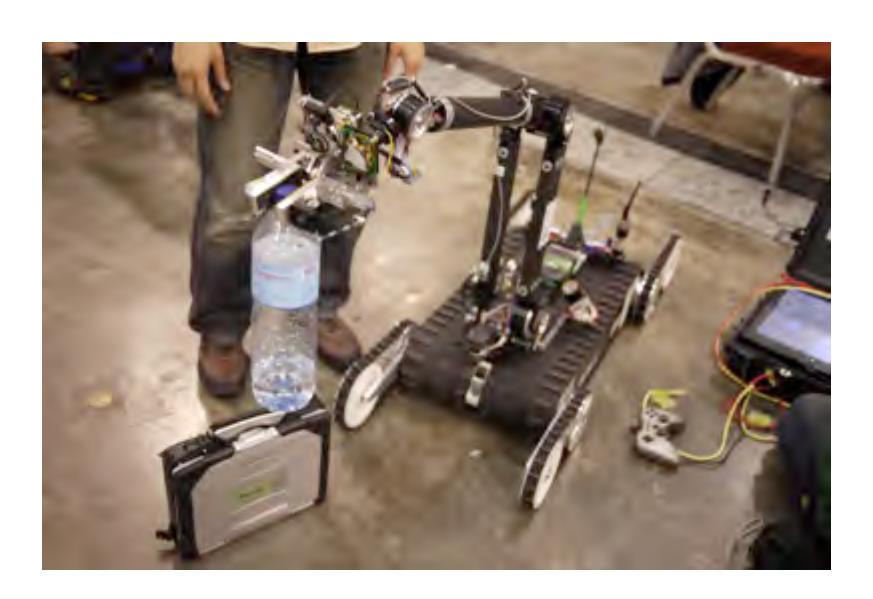
Quince is equipped with a 6-DOF manipulator.
The manipulator is operated by master-slave manipulation system.
The operator station has a working master-arm for the slave-arm. It is similar in shape to the slave-arm. Operator to directly manipulate the master-arm posture.
It is lightweight as 5kg and it can be folded. Thus it does not compromise the mobility of Quince.
10. Team Training for Operation (Human Factors)
Our operator is trained on the training facility of fire depot. In such event, volunteers from fire depot also operate our robot. They operate our robot well, with a few minutes instruction. The fact shows our robot requires almost no training to operate.
11. Possibility for Practical Application to Real Disaster Site
We've already used a base model of our robot on the site at the Mid Niigata Prefecture Earthquake in 2004. Our robot was used to check damages of underground pipe from inside of it.
12. System Cost
We sold a base system of Kenaf at about $22000(US) for Japanese researchers in JAPAN. Quince making cost is about $ 38000(US)
13. Lessons Learned
In the last competition, we modified our hardware and software to meet detailed requirements shown at the site. It was important that both hardware and software were designed modular and flexible.
References
- Tomoaki Yoshida, Eiji Koyanagi, Satoshi Tadokoro, Kazuya Yoshida, Keiji Nagatani, Kazunori Ohno, Takashi Tsubouchi, Shoichi Maeyama, Itsuki Noda, Osamu Takizawa, Yasushi Hada, "A High Mobility 6-Crawler Mobile Robot 'Kenaf'," Proc. 4th International Workshop on Synthetic Simulation and Ro
- Keiji Nagatani, Yoshito Okada, Naoki Tokunaga, Kazuya Yoshida, Seiga Kiribayashi, Kazunori Ohno, Eijiro Takeuchi, Satoshi Tadokoro, Hidehisa Akiyama, Itsuki Noda, Tomoaki Yoshida, Eiji Koyanagi, "Multi-Robot Exploration for Search and Rescue Missions. -A Report of Map Building in RoboCupRescue 2009-,"Proc. of 2009 IEEE International Workshop on Safety, Security, and Rescue Robotics, 2009.