RoboCupRescue 2013 - Robot League Team UC Irvine RoboEaters (USA)
Grant Moe
Team RoboEaters 393 Social Science Lab, University of California, Irvine, Irvine, CA USA 92697
http://www.rhworkshop.com/2012/09/open-source-info-fortipic.html
Abstract In this paper we outline the strategies developed by Team RoboEaters for participation in RoboCup 2013. The team has created a homogenous, collaborative swarm of economical search and rescue robots using. We have adapted biologically-inspired algorithms for autonomous action selection and mapping, which are well suited to the task environment. We have developed group behavioral strategies that enable the swarm to search large, complicated environments efficiently.
Introduction
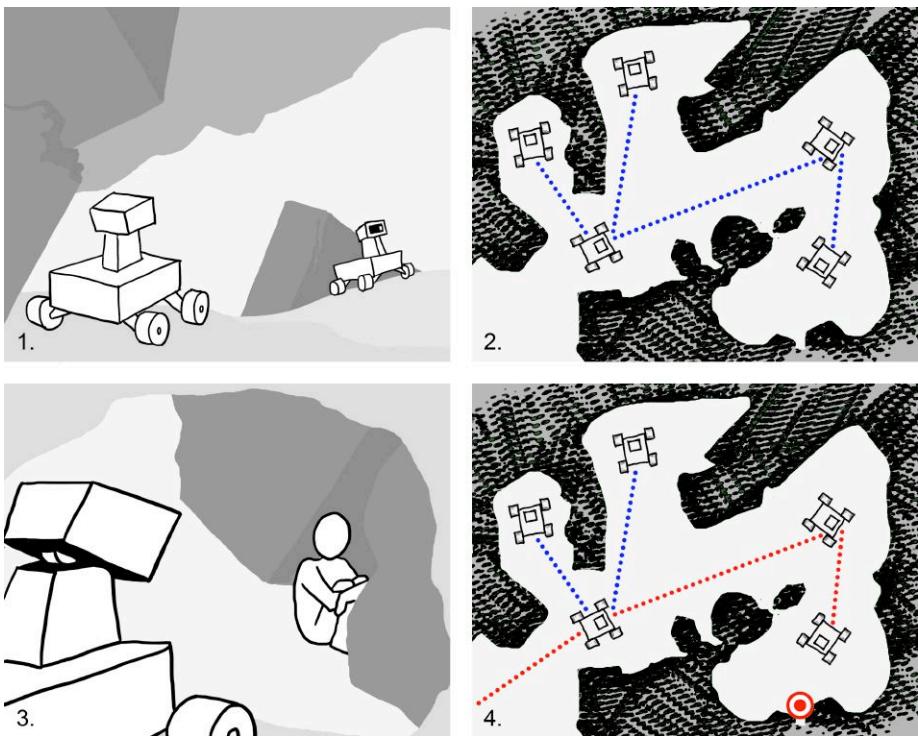
Team RoboEaters was formed at the University of California, Irvine in the spring of 2012. It is made up of mostly undergraduate students from the schools of biology, computer science, engineering, and social sciences working under the guidance of Dr. Jeffrey L. Krichmar, an Associate Professor in Cognitive Sciences and Computer Science. The overall team strategy is to create a small team of autonomous, homogenous agents each capable of mapping and identifying victims in the RoboCupRescue arena (see Figure 1, left). In a typical search and rescue scenario, the robots leave a base area and spread out over the disaster area (see Figure 1.1). The robots form an ad-hoc network using the phone's point-to-point networking (see Figure 1.2). Each robot shares their local map with other members of the team to create a global map. The map also contains information about the environment gathered by the sensing capabilities of the robots present at each location. Based on this information, the appropriate search robots are sent to find victims (see Figure 1.3). The victim's location is relayed through the network and the appropriate rescue robot is sent out for assistance based on the victim's needs and the available resources (see Figure 1.4).
1. Team Members and Their Contributions
Undergraduate Team Members
• Kyle Boos programming • Terri Chang multi-agent strategies • Zoe Tzu-Yu Chao mechanical engineering • Brian Chen mechanical engineering
• Joshua Ferguson programming • Randy Harper programming
• Brian Hoover mechanical Engineering
• Kevin Jonatis programming • Richard Lee programming
• Camille Macalinao RatSLAM integration
• Grant Moe intelligent-agent design principles
• Veronica Swanson mechanical engineering • Wells Tsai mechanical engineering
Graduate and Postdoctoral Mentors
• Nicholas Oros cognitive robotics researcher • Emily Rounds cognitive robotics researcher
Faculty Sponsors
• Jeffrey L. Krichmar principle faculty sponsor
• James Bobrow faculty sponsor • Ian Harris faculty sponsor • Michael McCarthy faculty sponsor
2. Operator Station Set-up and Break-Down (10 minutes)
Individual robots will be transported in durable, stackable containers. Each box includes spare parts and batteries for one robot. Robots are transported in ready-to-run condition. Swarm deployment is as simple as removing the robots from their containers and placing them in the task environment. Operation of the swarm is accomplished via a single laptop computer carried in the operator's pack.
3. Communications
To enable communication in the swarm, we will set up a peer-to-peer/client server network with each robot's phone and a laptop. The laptop will be to send continuous information to the swarm about each robot's current state, along with a shared map to calculate trap states and the proximities of each robot. While each robot will not be in direct contact with one another, the laptop will act as a medium for shared info in the swarm.
4. Control Method and Human-Robot Interface
We are using a general-purpose algorithm, based on principles of the brain's neuromodulatory systems, for action selection in robots that takes contextual sensory cues (light changes, visual and tactile objects, obstacles, etc.) into consideration [4]. The neurally inspired algorithm has demonstrated the ability to adapt to changes in the environment by: 1) increasing sensitivity to sensory inputs, 2) responding to unexpected or rare events, and 3) habituating or ignoring uninteresting events. It showed several important features for autonomous robot control in general, such as, fluid switching of behavior, gating in important sensory events, and separating signal from noise. We are able to define specialized roles within our collaborative swarm by assigning different weights between various sensory inputs and behavioral states.
Our lead robot will be the explorer. Its action selection algorithm will be heavily weighted towards open-space exploration, to the near exclusion of wall following or other behaviors. If the lead robot gets stuck or is in a trap region, the rear robots will take the lead. The two middle robots will focus more on details and mapping. They will focus on keeping proximity to the leader and will attend to walls for mapping and victim identification. If they detect a victim they'll mark it on the shared experience maps. The rear robot functions as something of an anchor. If the lead robot finds itself trapped in a corner of a maze, this rear robot will switch behaviors with the lead robot, and continue exploration away from the trap, leading the middle robots away. The robot furthest away from the new lead robot becomes the rear robot.
Since the robots are morphologically identical, their ability to switch roles will be unhindered by physical limitations. They will demonstrate behavioral variability and division of labor; by focusing on one specific aspect of the exploration, the robots will be able to more efficiently map and explore the environment and be able to identify victims more effectively. Should one robot malfunction, the other robots will possess the flexibility to assume different but necessary roles without costing time or money. Given the fully autonomous nature of the swarm, the operator's duties will focus more on observation than control. The operator will be able to select between any robot or robots' video feeds. The operator will be able to send reset signals and victim detection acknowledgements to the robots as necessary.
5. Map generation/printing
We will utilize established path planning algorithms to execute routes, and the Rat-SLAM algorithm to generate accurate maps [8]. RatSLAM will be used because it was inspired by the rodent navigation system, but more importantly, because its data structure is amenable to the addition of meta-data and manipulation by a neural model. Moreover, RatSLAM has been demonstrated in both indoor and outdoor environments over a wide range of scales. RatSLAM is a biologically inspired, visionbased mapping and navigation system [6, 7, 8]. The system uses an extended computational model of the rodent hippocampus to solve the SLAM problem. The world representations produced by RatSLAM are coherent but differ in several respects from the maps produced by probabilistic methods. RatSLAM maps are locally metric but globally topological, and are not directly usable for higher-level tasks such as goal navigation. An algorithm known as experience mapping, which creates spatiotemporal-behavioral maps from the RatSLAM representations, complements Rat-SLAM. Experience maps are used to implement methods for exploration, goal navigation, and adaptation to environment change. Experiments on a range of robot platforms have demonstrated the system's ability to autonomously explore, SLAM, navigate to goals, and adapt to simple environment changes.
These experience maps include salient, novel features as detected by the robots. Each robot's individual experience map, including landmarks and victim locations, will be sent back to the operator. The data will be combined in realtime.
6. Sensors for Navigation and Localization
Smartphone camera: used for basic navigation and visual data for RatSLAM algorithm.
Smartphone accelerometers: determines orientation/acceleration of robot.
Hall Effect sensor: detects small magnets attached to drive train. Used to generate odometry data, which is used by the RatSLAM algorithm to estimate robot's pose.
Infrared sensors: five sensors per robot, arrayed to cover a 180 degree arc around the front and sides of the agent.
Tactile sensors: provide redundancy for visual and infrared sensors. Arrayed in a "whiskers" configuration similar to the IR sensors.
7. Sensors for Victim Identification
Smartphone camera: Since the team is leveraging the Android SDK and the OpenCV libraries that are supported by the SDK, many face and people detection algorithms are readily available. These visual object recognition algorithms, which work with the smartphone's camera, will be used in conjunction with other sensory cues.
Smartphone microphone: used to detect sound emitted by victims.
Thermal imagining: utilizing recently-developed open-source hardware and software for smart phones [http://www.rhworkshop.com/2012/09/open-source-info-fortipic.html].
Carbon-dioxide sensor: used to help diagnose victims' conditions.
8. Robot Locomotion
Our robots are based on HP Cars Demon Crusher 1/10th scale radio-control fourwheel-drive monster trucks. We have stiffened the suspensions significantly to cope with the added weight of the sensors, phones, and servos. We have also locked the front and rear differentials to prevent immobilization if one wheel loses traction.
9. Other Mechanisms
Smartphones are mounted on a central post with two degrees of servo-controlled freedom. This gives the robot far wider scanning abilities than would otherwise be possible with the robots' basic maneuverability.
10. Team Training for Operation (Human Factors)
Robot construction and maintenance requires hobby-level amateur electronics abilities. Operation of the autonomous swarm will demand minimal specialized training; our interface program will leverage Android's inherent ease of use. Ideally, operation of the swarm will be no more complex than everyday use of a standard handheld mobile device.
11. Possibility for Practical Application to Real Disaster Site
Our robots, in their current configuration, are not well suited for deployment to a real disaster site. The agents' small size allows greater access to confined areas, but it also hinders mobility over larger obstacles. Additionally, the robots' chassis and components are not hardened against damage or heat, and they are not sealed to dust or water. However, our methodologies could be easily adapted to more capable platforms as they become available. Quad-rotor helicopter and hobby-level legged platforms are increasingly affordable even as their capabilities increase. Integrating these new elements, and creating a heterogenous swam would increase overall adaptability to more challenging environments.
12. System Cost
13. Lessons Learned
References
- Krichmar, J.L.: Design principles for biologically inspired cognitive robotics. Biologically Inspired Cognitive Architectures 1 (2012) 73-81
- Pfeifer, R., and Bongard, J.: How the Body Shapes the Way We Think: A New View of Intelligence. MIT Press, Cambridge (2007)
- Klinghammer, E., and Murie, A., eds:. The behavior and ecology of wolves. Garland STPM Press, New York (1979)
- Krichmar, J.L.: A Biologically Inspired Action Selection Algorithm Based on Principles of Neuromodulation. Paper presented at: IEEE World Congress on Computational Intelligence, Brisbane, June 10-15 2012
- Oros, N., and Krichmar, J.L.: Neuromodulation, Attention and Localization Using a Novel Android™ Robotic Platform. In: ICDL-EpiRob 2012 : IEEE Conference on Development and Learning and Epigenetic Robotics, San Diego, November 2012
- Milford, M., and Wyeth, G.: Persistent Navigation and Mapping using a Biologically Inspired SLAM System. Int J Robot Res 29 (2010) 1131-1153
- Milford, M.J., and Wyeth, G.F.: Mapping a Suburb With a Single Camera Using a Biologically Inspired SLAM System. Ieee T Robot 24 (2008) 1038-1053
- Wyeth, G., and Milford, M.: Spatial Cognition for Robots Robot Navigation from Biological Inspiration. Ieee Robot Autom Mag 16 (2009) 24-32