RoboCup Rescue 2019 Team Description Paper SHINOBI
Miyake Masato, Fukao Yuto, Ikemura Shohei, Hirai Tomoaki, Yamaguchi Kaiyo
MatsunoLab, Kyoto University
http://www.mechatronics.me.kyoto-u.ac.jp/
Abstract This paper explains details of the robot FUHGA2 which was designed to participate in RoboCup 2019 competition. The SHINOBI rescue robotics team consists of students that are studying in Matsuno Laboratory, Kyoto University, Japan.
I. INTRODUCTION
THE SHINOBI rescue robotics team consists of Doctor and Master's degree students that are studying in Matsuno Laboratory, Kyoto University, Japan and Tadokoro Laboratory's Tadakuma team, Tohoku University, Japan. It consists of ten members. SHINOBI has developed several robots in the past and tested its robots in both real disaster areas and competitions.
• RoboCup 2002 (Japan,Korea) : 2nd • RoboCup 2004 (Portugal) : 5th • Robocup 2005 (Japan) : Best Design Award / Advanced Mobility 2nd • RoboCup 2006 (German) : Rescue Robot League Locomotion Challenge 1st • RoboCup 2007 (USA-Atlanta) : Locomotion Challenge 2nd • Robocup 2009 (Austria) : 4th /Best In Class Mobility 3th • World Robot Summit 2018 (Japan) : STM 1st place
SHINOBI's previous robots have been innovative in the area of rescue robotics. For example FUHGA is a robot that has two body crawlers, two flippers and a six degrees of freedom manipulator. The concept of FUHGA is " high mobility ". To achieve this, we mainly focused on two characteristics; arm and full body sponge crawler. PIAP GRYF [1] is an explosive ordnance disposal robot, which is characterized by its manoeuvrability. Because of its light body and relatively large arm, the robot can overcome the step higher than its height using its arm. However, PIAP GRYF's main body is not fully covered by body crawler. This may cause it to get stuck in uneven fields. Full body crawler is known to have good performance for traverse rough terrain, since the crawler can touch to the ground. Now, a rescue robot called Quince [2] which has body crawlers, is used for inspection of nuclear power plants after Great East Japan Earthquake. For our robot, we designed a strong arm with a passive wheel to help mobility and full body sponge crawler for better travelling performance. In addition, we use sponge for crawler rather than rubber. Sponge can adaptively fit to obstacles and rough terrains and increases the traction.
The aim of the SHINOBI team for this competition is to build a robot, FUHGA2 that can be both tele-operated and autonomous, that can be used for search and rescue missions, has higher mobility than FUHGA and good understanding of its environment. The main tasks were to make the robot durable and modular in the sense that it can move in many different terrains, good manipulation ability and was to generate a map of its environment and understanding the dangers around it. To achieve these tasks, the robot has been equipped with several sensors and the mechanical design was built accordingly. The sensors for understanding the environment are: cameras, CO2 sensor, thermal camera. The mechanics of the robot consists of three categories. One is the mobility. Two people from the SHINOBI Team has been assigned to design the mobility. The aim of the Mobility Team was to make the main body of the robot highly mobile, as light as possible and very durable. The robot has four flippers and two body crawlers to move. The second category was the Arm. The Arm group consisted of three people and their task was to build the lighter manipulator than the manipulator of FUHGA. The arm team has built a six degrees of freedom manipulator. The third category was the gripper. The gripper team was to make a gripper to be attached to it as an end-effector.
In conclusion, SHINOBI Team has built a robot that has high mobility and has a good sense of its environment. Over ten years, SHINOBI Team has the experience of building rescue robots caring for real disasters. This experience helped us predict the possible problems beforehand and helped us avoid unexpected results. We have been inspired with our previous robots and integrated our new ideas into the new robot FUHGA2.
II. SYSTEM DESCRIPTION
A. Hardware
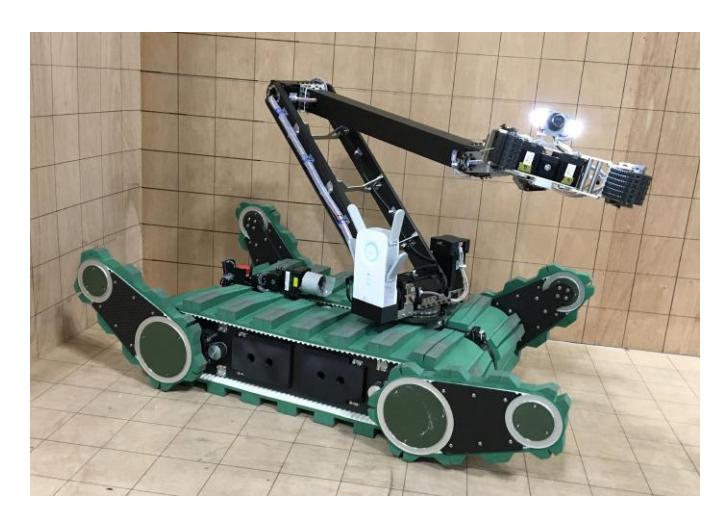
The hardware structure is shown in Fig 1.
Locomotion
FUHGA2 has high mobility realized by using its body crawlers and flippers. Each body crawler driven by a DC motor (Maxon, 24V, 200W) is approximately 520 mm in width, which reduces the possibility of getting stuck. They are made of sponge that makes FUHGA2 robust against impacts. The 4 flippers will help overcoming obstacles. Now, we are trying to make flippers longer, so that FUHGA2 can overcome larger obstacles. The flipper angle is driven by a powerful servo motor on each flipper (Dynamixel, 24V, 200W).
Manipulation
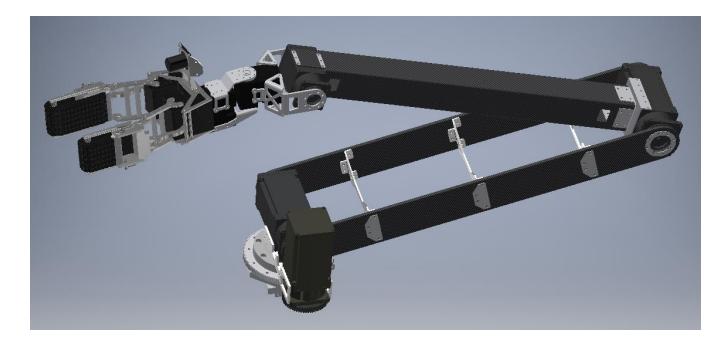
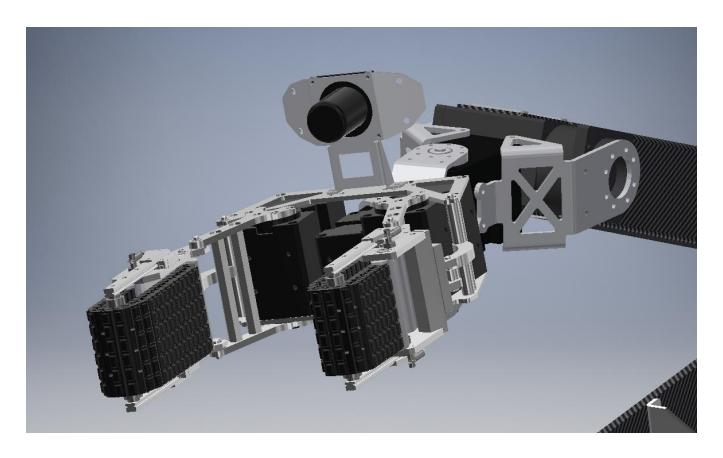
In order to manipulate objects, FUHGA2 has a jamming gripper which are greated by Tohoku Univ. By using this, FUHGA2 can grasp many king of objects. Links are created by CFRP, so it is enough hard to work in rescue field.
B. Software
Refer to Table IV in the Appendix.
Both the PC installed in the robot and the PC of the operator station use Ubuntu 14.04.
Meanwhile, ROS Indigo is used as to manage the messages of sensors and controllers. MCUs are installed in each module on the robot, and each MCU performs local processing. For example, the MCU on the motor driver unit acquires and processes sensor values from the encoder and potentiometer, and controls so that the angular velocity of the motor converges to the target value. Based on information gathered from each module and device, the main PC in the robot creates a 3D CG model of the robot and a 3D map. The manipulator calculates and controls the joint angle that realizes the target position of the gripper using inverse kinematics.
C. Communication
Communication between the operator station and robot is done using wireless LAN. For this communication, Tp-Link Archer C3150 and RE650 which are radio equipments conforming to IEEE 802.11ac/n/a has been used. Archer C3150 is used for the master unit antenna, and RE650 is used for the slave unit antenna.
D. Human-Robot Interface
To input tele-operation, DELL Inspiron and touch screen are used. Three fisheye cameras are mounted on the robot, and operators can switch images to be displayed larger if necessary. Since the position of the tip of the manipulator is controlled by inverse kinematics, the operator can operate with intuitive input. We create a 3D map with SLAM using Intel RealSense Depth Camera and UST-20LX-H01, and display it for remote operation. The 3DCG model reflecting the posture of the robot, the angle of the flipper, and each joint angle of the arm is displayed. It also displays information on thermal camera, microphone, and CO2 sensor.
To get used to the robot, the operator conducted basic training of manoeuvring using simulations and then practised using real machine. In particular, we practised by reproducing slalom, stairway, and random step environments.
III. APPLICATION
A. Set-up and Break-Down
In order to shorten the time of Set-up and Break-Down, we put together a laptop PC, sub display, game pad, antenna etc in one case. You can build an operator station by carrying a single case and opening it.
B. Mission Strategy
For the mobility task, we aim for stable running by utilizing the body crawler and flipper. For the dexterity task, we utilize arms to practice dexterous operation. For the search task, selfposition estimation and mapping are performed using SLAM and image recognition to recognize the QR code.
C. Experiments
We have tested the robot 's mobility on smooth surfacs, random step, and stairs, and the robot' s manipulation by graspping two types valves on World Robot Summit 2018. We have learned from our test that rigidity is important to manipulate something accurately.
D. Application in the Field
We have developed several rescue robots previously and some of them have been used for inspection in buildings affected by huge earthquakes. We have gathered information from disaster areas which were too dangerous for humans to enter. Our new robot, FUHGA2, has higher performance in mobility than our previous ones due to the fact explained above. Actually, we made disaster response in Okayama prefecture. We will improve our robot for better use by improving gripper , changing or adding robot parts for better sandproofing.
IV. CONCLUSION
In conclusion, as a team with a background of more than 10 years, we believe that we have built a robot that is better than previous ones in the case of mobility and sensing its environment. Learning from previous experiences, failures and talking to previous members of the SHINOBI, we had a good understanding of what to do from the beginning and we worked hard for it.
Until now, we still have not finished the whole robot. We still have improvements to do about SLAM, programming, manipulation and dsigning the robot. After these improvements, robot will be ready to compete in RoboCup 2019. This is also the reason for the lack of detailed experiments. Therefore, we would like to work hard and finish the robot as soon as possible.
APPENDIX A TEAM MEMBERS AND THEIR CONTRIBUTIONS
• Takemori Tatsuya programming, electronics, control, manipulator design, operator, team leader • Xixun Wang interface, sensors • Hirai Tomoaki mobility design • Miyake Masato mobility design • Yamaguchi Kaiyo manipulator design • Ikemura Shohei communication, interface, sensors • Fukao Yuto manipulator design • Hardik Parwana interface, sensors • Tadakuma Kenjiro gripper • Fujimoto Toshiaki gripper
APPENDIX B CAD DRAWINGS
APPENDIX C LISTS
A. Systems List
Systems list are shown in FigI, FigII.
B. Hardware Components List
TABLE I MANIPULATION SYSTEM
| Attribute | Value |
|---|---|
| Name | FUHGA2 |
| Locomotion | tracked |
| System Weight | 35kg |
| Weight including transportation case | ? |
| Transportation size | 0.7 x 0.5 x 0.4 m |
| Typical operation size | 1.0 x 0.5 x 1 m |
| Unpack and assembly time | 30 min |
| Startup time (off to full operation) | 10 min |
| Power consumption (idle/ typical/ max) | ?/ ? / ? W |
| Battery endurance (idle/ normal/ heavy load) | 45 / 30 / 15 min |
| Maximum speed (flat/ outdoor/ rubble pile) | 2 / 1 / - m/s |
| Payload (typical, maximum) | / ? kg |
| Arm: maximum operation height | 150 cm |
| Arm: payload at full extend | 2kg |
| Support: set of bat. chargers total weight | 1.3kg |
| Support: set of bat. chargers power | 500W (10.5-29V DC) |
| Support: Charge time batteries (80%/ 100%) | ? / 150 min |
| Support: Additional set of batteries weight | ? kg |
| Cost | 4,800,000 Yen |
TABLE II OPERATOR STATION
| Attribute | Value |
|---|---|
| Name | FUHGA2-OP |
| System Weight | 5kg |
| Weight including transportation case | 10kg |
| Transportation size | 0.7m |
| Typical operation size | 0.5 x 0.4 x 0.4 m |
| Unpack and assembly time | 1 min |
| Startup time (off to full operation) | 1 min |
| Power consumption (idle/ typical/ max) | 20 / 25 / 30 W |
| Battery endurance (idle/ normal/ heavy load) | 8 / 5 / 3 h |
| Cost | 2500 USD |
TABLE III HARDWARE COMPONENTS LIST
| Component | Brand&Model | Unit Price(USD) | Num. |
|---|---|---|---|
| Drive motors | Maxon RE50 200W | 1,200 | 2 |
| Drive gears | Maxon Planetary Gearhead GP52C | Including Up | 2 |
| Drive encoders | Maxon Encoder HEDS 5540 | Including Up | 2 |
| Flipper motor | Dynamixel H54-200-S500-R | 2,800 | 2 |
| Shoulder motors | H54-100-S500-R | 1,000 | 1 |
| Shoulder, elbow motors H54-200-S500-R | — | 1,000 | 2 |
| Batteries | Energizer (XP18000) | 30 | 1 |
| Batteries | LIPO (24.5 Volt 7c) | 50 | 1 |
| Computing Unit | ZOTAC, ZBOX-MI549NANO | 500 | 1 |
| WiFi Adapter | TP-Link Archer C3150 | 100 | 1 |
| IMU | LPMS-CU2 | 300 | 1 |
| Cameras | MCM-4350FISH | 200 | 3 |
| infrared Cameras | 20320H092-9PAAX | 1700 | 1 |
| CO2 Sensor | CDM7160 | 100 | 1 |
| Battery Chargers | EOS 720 | 230 | 1 |
C. Software List
For software list, please refer to Table IV.
TABLE IV SOFTWARE LIST
| Name | Version | License | Usage |
|---|---|---|---|
| Ubuntu | 14.04 | open | |
| ROS | indigo | BSD | |
| OpenCV | 2.4.10 | BSD | Haar: Victim detection |
| Application for FUHGA2 | 1.0 | closed source |
ACKNOWLEDGMENT
The authors would like to thank machine shop of Kyoto University Katsura Campus for their help in machining the parts we need. We also would like to thank the previous members of SHINOBI Team.
References
[1] PIAP, http://www.antiterrorism.eu/ [2] Keiji Nagatani, S. Kiribayashi, Y. Okada, et al., "Redesign of rescue mobile robot Quince," Proc. IEEE Int. Symp. Safety, Security Rescue Robot., 2011. [3] Tetsushi Kamegawa, T. Yamasaki, H. Igarashi and F. Matsuno, "Development of the Snake-Like Robot "KOHGA"," Proc. IEEE Int. Conf. on Robotics & Automation., 2004.