RoboCup Rescue 2019 Team Description Paper - Sroewground Robot
Sanga Taechersai, Wiwat Puyati, Somsakkayapong Tunsura, Naree Inram, Prawit Saengsil
Buriram Technical College
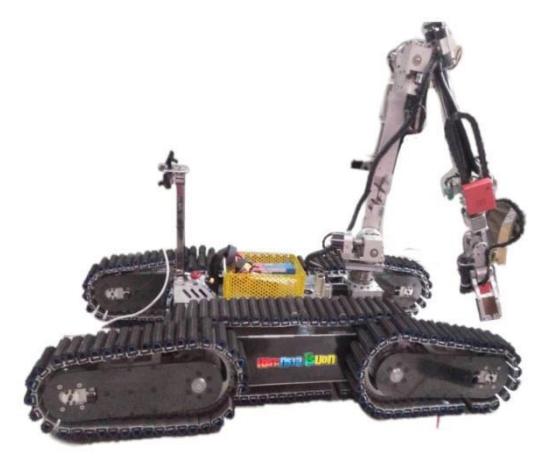
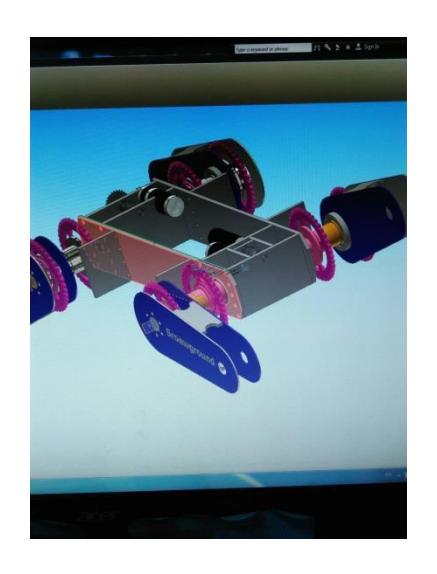
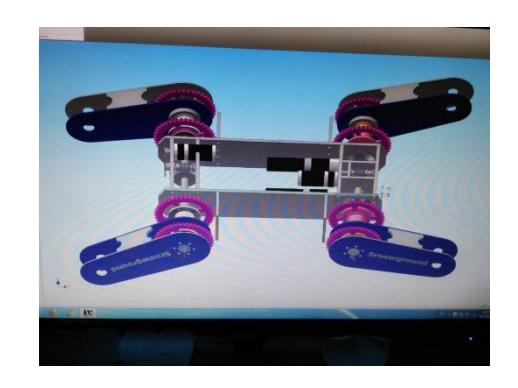
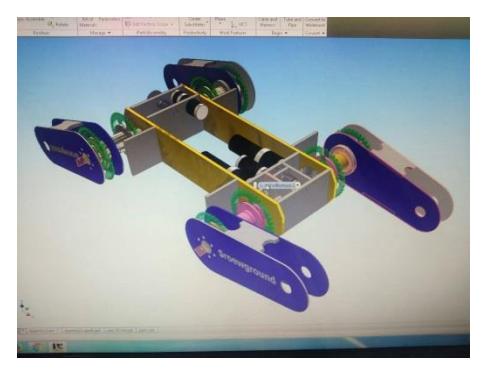
Abstract "Sroewground Robot" developed by Buriram Technical College's Robot Team is a state of the art Robot designed for fire rescue operations. The team has implemented the industry's latest hardware and software. Even though Sroewground Robot was originally conceived as a low cost robot with simple algorithmic programming, it incorporates artificial intelligence and has been redesigned with continuous upgrades as shown in Fig.1. Its strengths are its amphibian qualities which allows to pass over rugged terrain like gravel, sand or hazarded conditions. Apart from it live video communication by the ground crew with every individual victim allows an effective allocation of rescue missions. Both features render the Sroewground Robot unique in comparison with other robots of it's genere.
I. INTRODUCTION
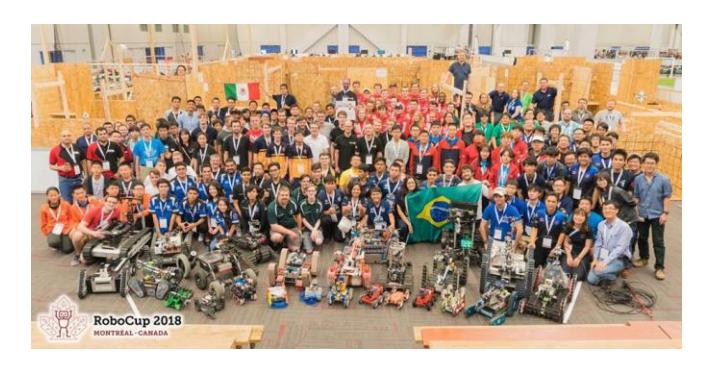
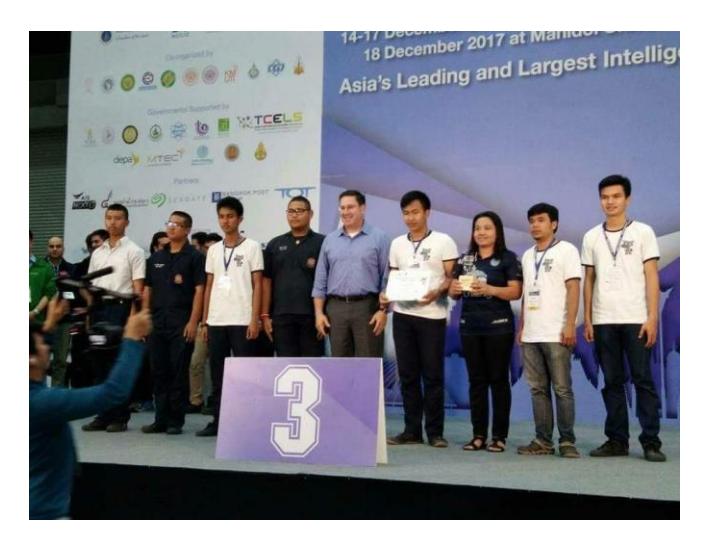
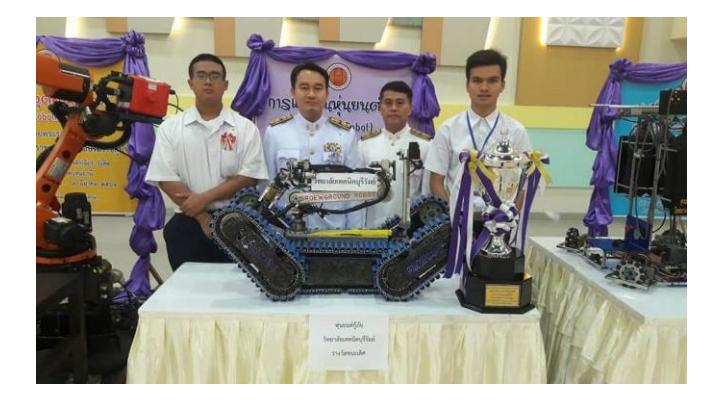
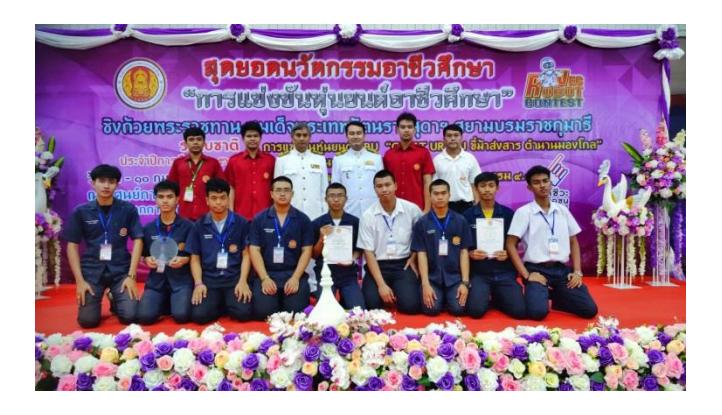
The Ministry of Education and the Office of Vocational Education Commission in Thailand launched the Rescue Robot Competition in the year 2009 under the auspices of Her Majesty the Princess of Thailand. As a vocational and technical education college under the Ministry of Education, Buriram Technical College selected a team of electricians, mechanics and programmers with many years of hands on experience. Their professionalism in their respective fields allowed them to grasp the latest available technology relevant to their area of competence and, thus, gave us the chance to develop our rescue robot.. This paved the way for our participation in the competitions organized by the office of Vocational Education Commission in Thailand. Nurturing a team of formerly inexperienced students came with many failures and disappointments. However, our team learned from every opportunities not only in terms of adopting new technology but also in its will to excel. Although only secured a lower end position in the Rescue Robot Competition of 2015, this turned out to grant our team new ambition. Our henceforth redesigned robot has earned us laurels over the course of the last years. This includes receiving the first prize at Rescue Robot Competition twice and the third place at RoboCup Asia-Pacific 2017 in Bangkok as shown in Fig.3 We won the fourth place in World RoboCup 2018 in Montreal as shown in Fig.2 and recently, we were the champion of Recue Robot Competition of the Office of Vocational Education Commission in Thailand under the of Her Majesty the Princess of Thailand in 2019 as shown in Fig.5
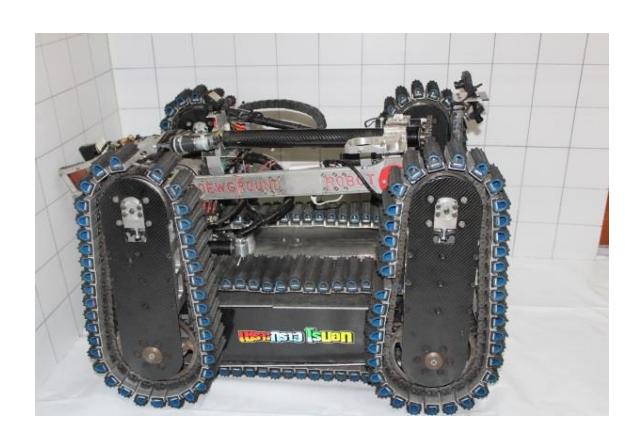
DESCRIPTION
Our rescue robot is designed with the purpose to pass through rough terrain. We use caterpillar tracks, highquality engines and effective sensors to reach this aim.
The sensors are installed on the armrest to measure temperature, distance, CO2, and to render a 2D-map. Our team has set up stable cameras mounted on the extendable arm of our robot. This enables two way communication, firstly, it enables the ground team to identify all victims in the robot's pathway. Secondly, the combined usage of camera, microphones and speakers allows two-way-communication between victims and ground team. Our goal for this competition is to present our progress and the capability of vocational training, be part of a bigger competition and educate our students. As a result of our achievements, we were selected by the Defense Technology Institute under the Ministry of Defense of Thailand to construct robots for the rescue of bomb-blast victims in the Southern part of Thailand. Furthermore, we build a robot for the bomb rescue department in the province of Buriram in Thailand to protect the royal family of Thailand during their visit to our province.
The Ministry of Education and the Office of Vocational Education Commission in Thailand under the auspices of the Princess, started Rescue Robot Competition 10 years ago in the year 2009. We as a vocational and technical Education college under the ministry of Education took it upon ourselves and came up with a team of both electrical, mechanical and a group of students who showed some great ability in technology to fabricate our own rescue robot. As a result we were able to take part in competitions organized by the Office of Vocational Education Commission in Thailand. Even though the Rescue Robot Competition in Thailand started in 2009, we had to wait until 2015 that we made our first appearance in the Rescue Robot Competition organized by Office of Vocational Education Commission in Thailand under the auspices of Her Majesty the Princess of Thailand. Despite being our first time in the competition, we were awarded the 7th position among 62 competitors. Encouraged by the same on our first appearance; we redesigned the whole project by strengthening many areas of our weakness. In the year 2016 we participated in the same competition and placed at fourth place. Three years later in the year 2017 we were awarded being the champions of Recue Robot Competition of the Office of Vocational Education in Thailand under the auspices of Her Majesty the Princess of Thailand as shown in Fig.4 In the same year, we also participated in RoboCup Rescue Robot League of RoboCup Asia-Pacific 2017 in Bangkok. We were awarded the third place. In 2018, we took in World RoboCup 2018 in Montreal, Canada and because of our excellence in every aspects of technology , we were placed fourth in an international competition participated by all technology advanced countries from all parts of the world. Apart from the same we were the champions of Recue Robot Competition of the Office of Vocational Education Commission in Thailand under the auspices of Her Majesty the Princess of Thailand in 2019 as shown in Fig.5
THE IMPROVEMENT OVER PREVIOUS CONTRIBUTIONS
Our first Sroewground Robot could mechanically move with front and rare chains with double frame. It could only check the temperature, the carbon dioxide, and the movement of objects or victims. This shows our ability to reconfigure our robot by constantly incorporating new technology in terms of hardware, upgrading the software for the same. One of the biggest decision to move the robot from a double frame to a single frame enabled it to move faster to rescue the victims incorporating necessary changes on for controller.
The first version was designed for the first competition. We fabricated it for rescue purpose. The robot could mechanically move on trends and overcome obstacles to reach the victims so that the robot can detect if there is still life of a victim because it's capability to check carbon dioxide, the victim's temperature and the sound but the rescue robot had 2 frames which was heavy resulting very slow in motion. As a result, it couldn't easily reach the victims, so we were awarded the lower end position as mentioned earlier.
For the second version of our rescue robot, we had to do few changes. The double frames which was used in the first version had some setbacks, as a result, we took the initiative to change it to one frame. This enabled the rescue robot to cut across the surface easily and easily move to the victims because of light weight. We also changed the warm so that the robot could move with greater flexibility. As a result of which we were awarded the 4th position in the same competition in 2016.
For the third version, we changed the structure to enable the chains fit well in between the wheels so as to facilitate motion. The center was expanded to bind the front and the back wheels and to avoid any looseness around the timing chain. As a result the robot became stronger bring the laurel make us the being placed in first position in 2017 in the same competition.
With the high morale by the team members after the progressive achievements with every passing years, we planned to improve all aspects of the mechanical and technological ability of the robot by adding the one auto sensor which enabled the robot to interact with the controller and also give feedback of the QR code, symbols, temperature and Co2. We added one more new thermal camera with 2D mapping to mark the location of the victims by reading movement and symbol so the robot could detect the exact place of the victims. Because of these improvements, we were able to take part in the RoboCup Asia-Pacific in Bangkok, Thailand in the year 2017 placing us third position.
Because of our consistent achievements in the field , we were invited to take part in World RoboCup 2018 at Montreal, Canada and we were placed in fourth place because of our endeavor we did a very good result. That was the fourth place among all competitors participating from all over the world.
We upgrades our robot by designing bigger size and developing a driving system as shown in Fig 2, which rewarded us to be the champions of Recue Robot Competition of the Office of Vocational Education Commission in Thailand under the auspices of Her Majesty the Princess of Thailand in 2019.
II. SYSTEM DESCRIPTION
A. Hardware
The control motor consists of
- Forward set
- Body lift
- Arm lift control set
- Handle control unit
- Pipe rotation control set
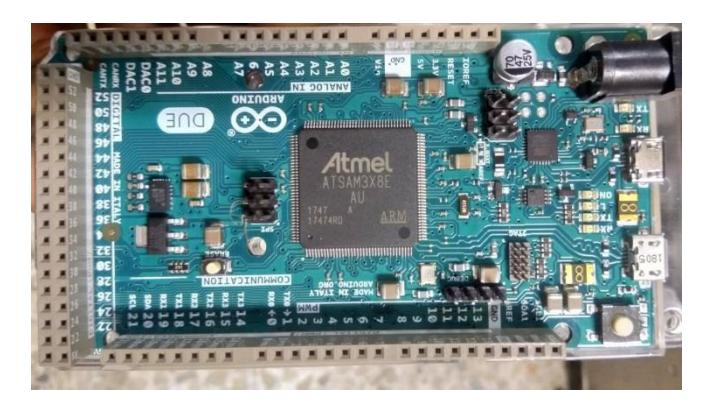
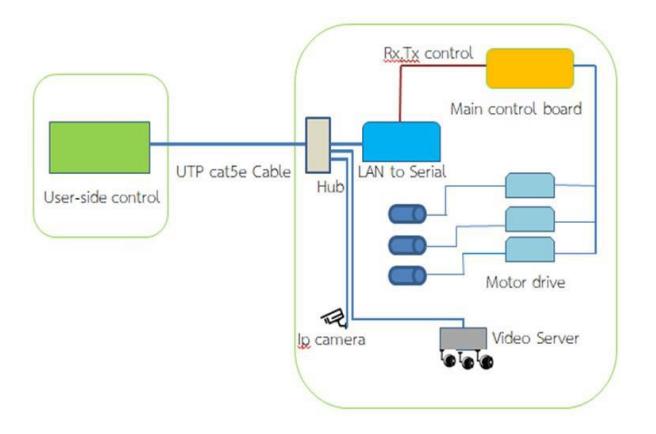
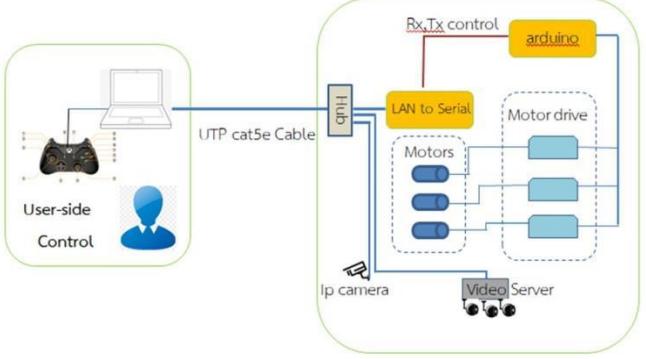
Arduino microcontroller board as shown in Fig. 6 based on the Atmel SAM3X8E ARM Cortex-M3 CPU. It has 54 digital input / output pins (of which 12 can be used as PWM outputs), a reset button and an erase button.Rotary Wirewound Potentiometer Display device position (This series of RS potentiometers offer a range of 10Ω and 25kΩ. They are single turn wir Video encoder supports both audio and video connections (Audio Interface and Analog Video Input Power Source DC 12V) Camera for image decoding and motion detection (IP camera support RTSP protocol). Switching Hub DC 12V power
Locomotion
The locomotion of our robot is provided by the conveyer belt system. We adapted it to fit different surface characteristics of terrain. Many parts of the robot have been improved in order to be strong enough for tough surrounding, to be lighted for moving fast and fixed easily. There are two drive systems consisting of two motors. These are front and rear armrest motors with 40mg and 200 watts. The camera and measuring systems can be quickly and easily adapted or replaced. The data can be transmitted by radio or fiber optic cable directly to the head of operators as shown in Fig. 7
wound potentiometers with a rotational life of 100,000 revolutions.) 5 cameras for CCTV Camera navigation (available at 720p and 1080p)
Batteries
The robot consumes energy from two lithium polymer batteries of 14000 mAh 11.1V and two lithium polymer battery of 6300 m Ah 11.1V
Electronics
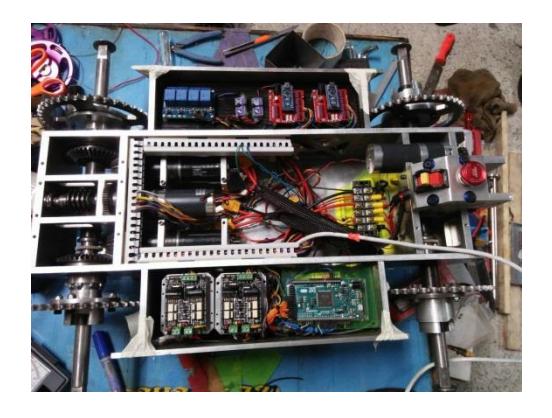
The electronic systems are low-level. The microcontrollers are used to create an interface to acquire data.
Manipulation
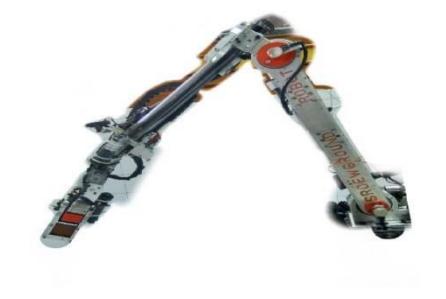
The robot can extend its tele-operative up to 155 cm to search for victims in the surrounding or disaster area as shown in Fig.8 The steerable arm is equipped with a temperature sensor and a CO2-sensor. The arm of the robot can navigate itself by utilizing the end-effector position in the Cartesian coordinate system.
Sensor
The robot identifies victims by analyzing the information gathered by different kinds of sensors which are fixed to the robot´s surveying arm. The controller can check the situation of victims through CCTV-camera and measure the victims´ temperature by utilizing the temperature sensor. In the instance of disaster, we can know if the victim is alive or not with the temperature sensor which will interact with the data from CO2-sensor, and with the microphone as shown in Fig.8
B. Software
The robot-driven mechanism is developed by using the Arduino Software (IDE) under the Arduino Due board and controlling the operation via the UDP protocol with the C # instruction set to control the forward and backward movements and control the arm mechanism to capture objects. Video signal transmission via streaming system Communicate via protocol RTSP (Real Time Streaming Protocol)Spread the video signal via streaming communication via rtsp (Real Time Streaming Protocol) protocol to detect obstacles.Object detection kit Developed with Python
C. Communication
The robot-driven mechanism is developed by using the Arduino Software (IDE) under the ArduinoDue board and controlling the operation via the UDP protocol with the C # instruction set to control the forward and backward movements and control the arm mechanism to capture objects. Video signal transmission via streaming system Communicate via protocol RTSP Spread the video signal via streaming communication via RTSP to detect obstacles. bject detection kit Developed with Python and OpenCV (Open source Computer Vision) function libraries by using motion tracking commands, image reading commands (Object Mapping) and Qr-code decode as shown in Fig. 10
and OpenCV (Open source Computer Vision) function libraries by using motion tracking commands, image reading commands (Object Mapping) and Qr-code decode.
D. Control method and Human Robot interface
Joystick is used to control the robot from a notebook. The operator uses the controller to interact with the robot. He can steer effectively with the help of the monitor which is connected to the cameras attached to the robot. We educate our operators to reach high technological skill in operating machines using PCS and joysticks. The operators have specialized in repair should there be any break down in the robot. Our operators are also given sound knowledge on assembling a robot as shown in Fig. 9
III. APPLICATION
A. Set-up and Break down
The set-up and break down time of the operation system of the robot is conducted within one minute. It is secured that all actuators are in the initial positions including starting the mapping, autonomy and victims detection mode the robot .The operator control includes a notebook, a joystick, an access point, an antenna, and a monitor. We use an aluminum case to store the robot. When we need it, it is switched on and the robot is ready for usage.
B. Mission strategy
From the experiences in World RoboCup 2018 in Canada, we found that the most difficult mission for us were the step field and stair debris missions that our robot had short size, so that we could not do it well. For this reason, we reconstructed the longer size and we hope we can do it better in World RoboCup 2019 in Australia.
C. Experiment
After we participated in World RoboCup 2018 in Montreal, Canada. From the fact that we have developed the robot Including the internal working system along with the driving system by using new motors with better features resulting in the team being successful in the national competition in Bangkok for Rescue Robot competition of the Office of Vocational Education Commission in Thailand under the auspices of Her Majesty the Princess of Thailand on 7th -9 th 2019. we have tested and learned that we were enabled to win those competitions due to the robot´s unsurprising ability to navigate through various terrain, its camera usage, and the Co2 sensor´s capability to locate and identify whether survivors are alive.
D. Application in the Field
The robot has a strong structural design along with the power to drive in high places and uncontrollable routes. It also has a navigation system and a strong arm that allows the robot to respond to searches and help the victims as well. With a motion detection system, arm mechanism can open the door to search quickly and accurately. Robotic design with durable materials resulting in a space to create a backup power connection system respond to maintenance easily but makes a lot of weight. If we have chance to develop better robot in real use, we will change the motor with high quality. The possibility of future development for our use is to choose a high-performance motor-driven system to support driving in difficult areas. Develop a self-learning system To reduce equipment damage And have self-analysis and decision-making systems Such as using a navigation camera to decide the best route to help victims immediately Including having a system that supports both current and future technologies
CONCLUSION
Being a vocational college with limited financial resources for research we have showcased our achievements with every progressing years by upgrading Robotics technology incorporating Artificial Intelligence in every upgradation for past many years. We intend to incorporate Cloud technology for our future project as we feel it is required. We strongly believe that great achievements can be brought by new young generation students which has been our motto to showcase the world about their ability given a chance to participate in international events.We have proved the same in past and we assure you that we can prove the same in Australia. Please consider us to prove ourselves by participating.
APENDIX A
Team members and their contributions
Sanga Taechersai Team leader
Somsakkayapong Tansura Mechanical Engineer
Wiwat Puyati System Design NareE Inram operator assistant and coordinator
Prawit Saengsil Electronic Designer
Tarandorn Keram Programmer
Chakrit Wattapongpisan Programmer assistant
Karn Tangprasertwut Operator
Nattaphut Bunlung Electronic Controller Assadawut Kotiram Electronic Controller Jamras Chaisriram Operator Assistant Dechatorn Phumoolmuang Electricity operator
APENDIX B
TABLE I Manipulation System
| Attribute | Value |
|---|---|
| Name | Soewground Robot |
| Locomotion | Tracked |
| System weight | 65 kg. |
| Weight including transportation case | 78 kg. |
| Transportation size | 0.7x1.0x0.7 m. |
| Typical operation size | 0.6x1.0x0.6 m. |
| Unpack and assembly time | 150 min |
| Startup time(off to full operation) | 15 min |
| Power consumption (idle/typical/max) | ND |
| Battery endurance (idle/normal/heavy load) | ND |
| Maximum speed (flat/outdoor/rubble pile) | ND |
| Payload (typical, maximum) | 5 kg. |
| Arm : maximum operation height | 1.2 m. |
| Arm : payload at full extend | 8 kg. |
| Support: set of bat. Chargers total weight | ND |
| Support: Set of bat. Chargers power | ND |
| Support: Charge time batteries (80%/100%) | ND |
| Support: Additional set of batteries weight | 1.12 kg. |
| Any other interesting attribute | - |
| Cost | 23,000USD |
TABLE II AERIAL VEHICLE
| Attribute | Value |
|---|---|
| Name | Sroewground Robot |
| Locomotion | quadcopter |
| System weight | 3 kg. |
| Weight including transportation case | 6 kg. |
| Transportation size | 0.7x1.0x0.7 m. |
| Typical operation size | 0.7x1.0x0.7 m. |
| Unpack and assembly time | 10 min |
| Start up time(off to full operation) | 3 min |
| Power consumption (idle/typical/max) | 100/150/300 W |
| Battery endurance (idle/normal/heavy load) | 20/15/10 min |
| Maximum speed | 10 m/s |
| Payload | 0.15 kg. |
| Any other interesting attribute | - |
| Cost | 2,000 USD |
TABLE III OPERATOR STATION
| Attribute | Value |
|---|---|
| Name | Sroewground Robot |
| System weight | 20 kg |
| Weight including transportation case | 30 kg |
| Transportation size | 0.6x0.8x0.4 m |
| Typical operation size | 0.6x0.9x0.4 m |
| Unpack and assembly time | 30 min |
| Startup time(Off to full operation) | 20 min |
| Power consumption (idle/typical/max) | ND |
| Battery endurance (idle/normal/heavy load) | ND |
| Any other interesting attribute | - |
| Cost | 2,000 USD |
TABLE VI HARDWARE COMPONENETS LIST
| Part | Brand & Model | Unit Price | Num. |
|---|---|---|---|
| Robot Structure | - | 2,000 USD | 2 |
| Drive motors | Maxon | 645 USD | 2 |
| Drive gears | Planetary Gearhead GP 62 | 150 USD | 2 |
| Drive encoder | Omron rotary | 120 USD | 2 |
| Motor Drivers | SE-HB40-1 | 58 USD | 4 |
| DC/DC | Rcgutator | - | 1 |
| Battery management | ND | - | 1 |
| Batteries | LIPO | - | 1 |
| Micro controller | Arduino DUE | - | 1 |
| Computing unite | Nootbook, Embedded | - | 1 |
| WiFi Adapter | Access point outdoor UBIQUITI Bullet M5-HP) Wireless N150 | - | 1 |
| IMU | Xeens | 320 USD | 4 |
| VDO Cameras | ND | 320 USD | 4 |
| PTZ Camera | ND | - | 1 |
| Infrared Camera | ND | - | 1 |
| LRF | ND | - | 2 |
| CO2 Sensor | ND | 125 USD | 1 |
| Temperature Sensor | ND | 19.78 USD | 1 |
| Battery Chargers | ND | 259 USD | 4 |
| Owned construct | ND | 1,000 USD | 1 |
| Aerial Vehicle | ND | 2,000 USD | 1 |
| Rugged Operator Laptop | ND | 1,000 USD | 1 |
| Cost | 12,126.78 USD |
TABLE V SOFTWARE LIST
| Name | Version | License | Usage |
|---|---|---|---|
| Ubuntu | 14.04 | Open | |
| ROS | Indigo | BSD | |
| OpenCV | 2.4.8 | BSD | Haar: Victim detection |
| OpenCV | 2.4.8 | BSD | LBP: Hazmat detection |
| Hector SLAM | 0.3.4 | BSD | 2D SLAM |
| 2D Mapping | - | Close source | 2D Mapping |
| Owned construct | - | Close source | Operator Station |
APENDIX C
References
- https://www.arduino.cc/en/Guide/ArduinoDue
- https://docs.microsoft.com/en-us/dotnet/csharp
- https://en.wikipedia.org/wiki/Real_Time_Streaming_Protocol
- https://opencv-python-tutroals.readthedocs.io/en/latest/py_tutorials/py_tutorials.html
- https://en.wikipedia.org/wiki/User_Datagram_Protocol
- https://en.wikipedia.org/wiki/Two-way_communication