RoboCup Rescue 2019 Team Description Paper TecnoBot
Aguilar Zarazua Luis Fernando, Dr. Fernandez Ramirez Arnoldo Apolonio, Dr. Hernández Santos Carlos, Macias Solis Jose Francisco, Olivares Borja Eduardo, Pérez Echeverría Alberto Daniel, Rangel Gómez Irving Gerardo
Tecnológico Nacional de México/Instituto Tecnológico De Nuevo León
Abstract This project shows a prototype of a reprogrammable multifunctional rescue robot capable of manipulating materials, parts, tools or special devices according to programmed variable trajectories and perform various tasks, developed by students of the Tecnológico Nacional de México/Instituto Tecnológico de Nuevo León.
The robot has two flippers in the front and two more in the back for better access to the area where the victims are or where the robot is required, the robot also has multiple sensors that make it suitable for tasks that go beyond the rescue of people in disaster areas.
Index Terms—Rescue Robot, Artificial Vision, Manipulator, RFB, Passive gripper.
I. INTRODUCTION
This project was born as a prototype test bench for the mechatronics engineering master's department of the Instituto Tecnológico de Nuevo León in order to do to bring it to a successful conclusion, and that is what is described in this article.
But as progress was being made the opportunity was seen for the robot to be used for tasks that are dangerous to humans, such as rescue tasks, It was necessary to expand the scope and objectives of the project in order
SYSTEM DESCRIPTION
Eco the main robot can move through different terrains, its 4 flippers allow it to become immovable when it reaches areas difficult to access.
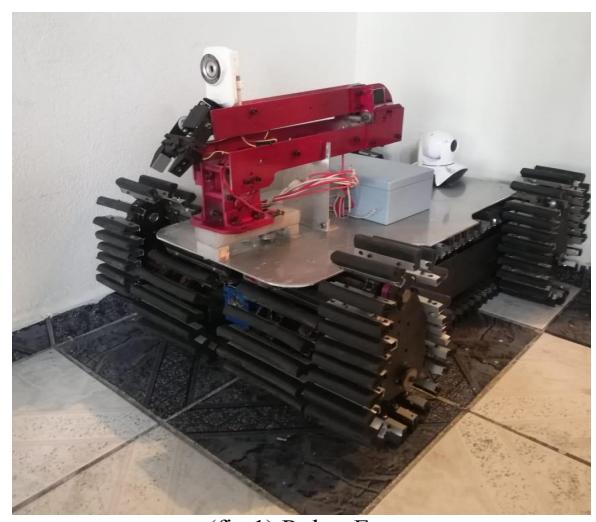
The eco robot (fig.1) is the main tracker along with its 4 independent flippers for your best exploration performance after the earthquake. Eco has been focused to navigate non-uniformly on different terrains, open doors, climb stairs, lift debris and transport people. It has a 5-axis articulated arm which allows you to interact to place or pick up objects. The robot has a kinematic control,
1) Locomotion
The mobile Robot is tele-operated from a control cabin. Its size is "70" cm long "50" cm wide and "60" cm. Compact height for your dexterity in operation with its 4 flippers grows 25 cm, see Fig 1.
The weight of the Robot is 35 kg, Eco has a wheel drive system called caterpillars that allow better travel in complex terrain Based on the above characteristics, "Eco" can travel stably.
2) Motor gearbox
The gearbox has a worm screw that
Built into the crawler drive unit, the flìper is attached to the main drive shaft, the worm drive mechanism helps the robot not to move on steep slopes and steps to an energized state.
Manipulator arm
The manipulator arm of the "Eco" has the following characteristics.
Articulated hand
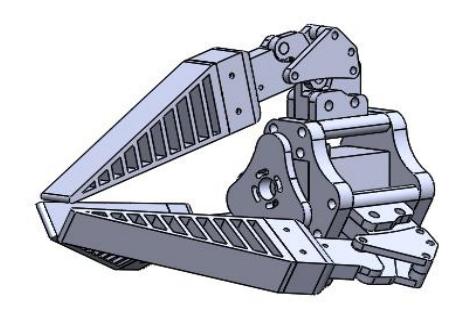
The tip of the "ECO" arm is an articulated hand with three fingers (fig.2). The design is inspired by the FESTO system adaptable gripper DHDG[1].
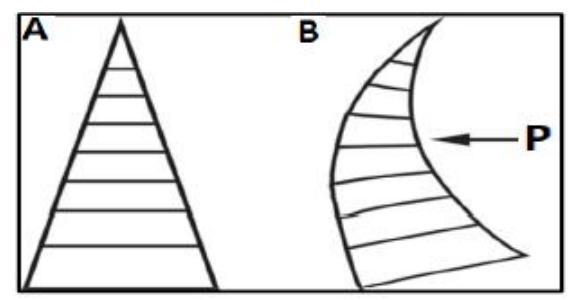
The fingers are opened and closed by means of a servomotor, these hold the objects firmly regardless of the physical structure of it. This is due to the flexible filament material from which they were manufactured and a gripping mechanism formed by Fin Ray Effect [2], is described by the deformation of a V-shaped rib structure through an applied force P illustrated in (fig.3). The nondeformed structure is shown in A and the deformed structure is shown in B.
Articulated arm
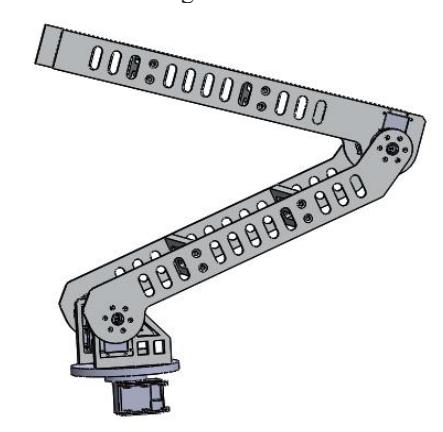
As shown in (fig.4), this arm has a total of 3 degrees of freedom of rotation in the joint. The arm has a length of up to 87 cm, and when combined with a caterpillar can reach almost the same height as a human shoulder.
A. Hardware
Se utilizó los actuadores Power modelo HD-1235 MG, un servo digital de alta tensión de calidad Premium con una fuerza masiva para los requisitos de alto par. Este servo digital cuenta con una fuerza de 555 oz-in de torque. Este dispositivo está construido con componentes de alta calidad con engranajes metálicos y opera a un voltaje más alto que los servos promedio.Se requiere un voltaje de 6-7.4V DC para su funcionamiento.
Gas Sensor MQ135
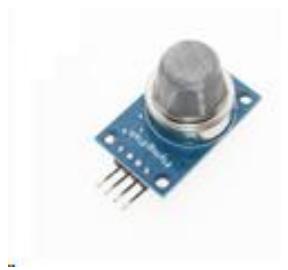
This type of sensor is electrochemical, and its operation consists of varying its resistance when exposed to certain gases; such is the case for the MQ135, which is sensitive to carbon dioxide (CO2 ). The sensor is shown in (fig.5). Internally, the sensor has a heater that increases the internal temperature and thus reacts with the gases in question, causing a change in the analog value. This sensor operates with 5 VDC [3].
Temperature and Humidity Sensor DHT22
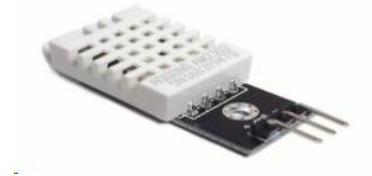
It is a digital sensor that is calibrated from factory, this sensor is shown in (fig.6). It consists of a capacitive sensor to measure the relative humidity of the air; it also consists of a thermistor to measure the surrounding air and, with this data, it is possible to calculate the temperature. As mentioned, the module displays the data by means of a digital signal via the data pin. This module can census new data every 2 seconds and operates from 3.3 VDC to 6 VDC and is very low cost [3].
Thermal camera AMG8833
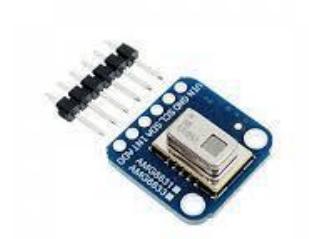
This camera consists of a set of 8x8 IR thermal sensors. The camera can perform 64 infrared temperature readings using I2C protocol. This camera can measure temperatures from 0°C to 80°C with an accuracy of +/- 2.5°C. It can detect objects at a distance of 7 m. 5VDC [4] is required to power this device. see (fig.7).
B. Software
Arduino open source software was used to make it easier to write the code and load it into your IDE where it ran on Linux. The Atmega2560 microcontroller was used in this software.
The Processing[5] IDE was used to use the interface.
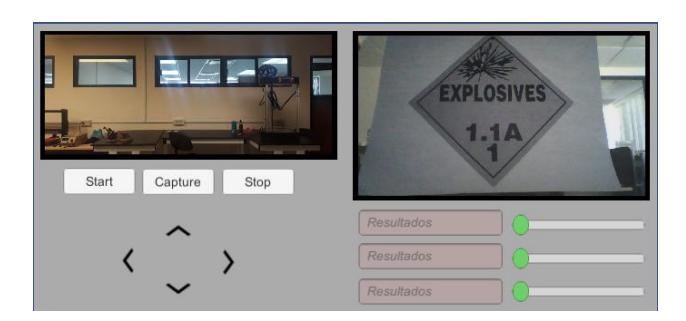
The interface consists of several windows, which includes real-time graphs of the sensors that make up the robot, in the upper right of the interface is located the window where the simulation of the robot is performed in 3 dimensions[6], which will determine its correct operation just by activating the robot, in the upper left part of the interface there is the visualization window of the camera connected to the manipulator robot where it will be shown which areas the "echo" robot will be passing through, also this GUI has interconnection with the sensors and codes in charge of carrying out the 3D mapping.
C. Communication
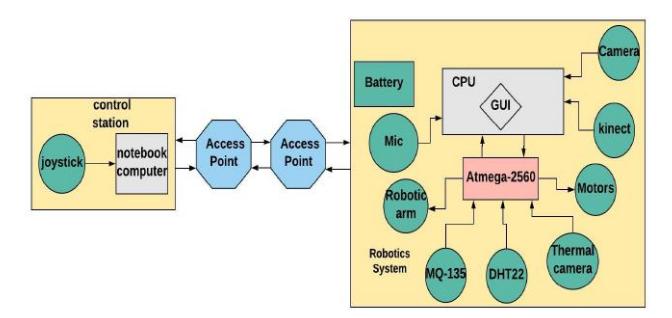
The communication between the control station and the robot takes place through a wireless network using technology based on the IEEE 802.11 ac protocol. For the visualization of the video VNC technology is used which uses the RFB protocol to transmit screen pixel data from one unit to another through the wireless network and thus send in exchange control events.
D. Human-Robot Interface
The system between the operator and the robot is illustrated below, we have created a GUI (fig.8), which allows the user to have total and precise control of all the tools available in the robotic prototype as well as the robot in a very easy way.
III. APPLICATION
A. Set-up and Break-Down
The setup of our robot is very easy to use, is a selfloading system so that any computer equipment whether laptop, desktop computer and even a mobile device can be used to control the robot.
B. Experiments
Field tests have been carried out, where the robot is requested to move different pieces of different mass, valves, carry out inspection tasks, as well as transit through different terrains very similar to real conditions.
IV. CONCLUSIÓN
We have concluded that the development of the robot can act in situations of different natural disasters in urban and rural areas. The appearance of this type of technology is relatively new, although it is still necessary to advance in both hardware and software to increase the quality of detection in identificaciones multiple efforts are being made in this direction and it is expected that sensors and processing software will emerge confiables to integrate directly into this project.
APPENDIX A TEAM MEMBERS AND THEIR CONTRIBUTIONS
The TecnoBot team is formed by several students and researchers, belonging to the Tecnológico Nacional de México/Instituto Tecnológico de Nuevo León, The following list is in alphabetical order:
Aguilar Zarazua Luis Fernando Mechanical Design Fernandez Ramirez Arnoldo Apolonio Adviser Hernández Santos Carlos Adviser Macias Solis Jose Francisco Programmer Olivares Borja Eduardo Electronic Design Echeverría Pérez Alberto Daniel Mechanical Design Rangel Gómez Irving Gerardo Electronic Design
APPENDIX B CAD DRAWINGS
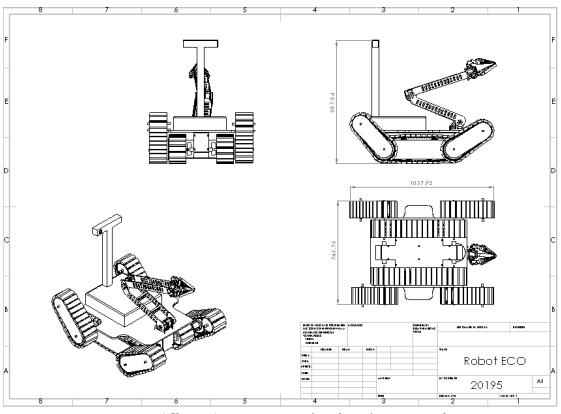
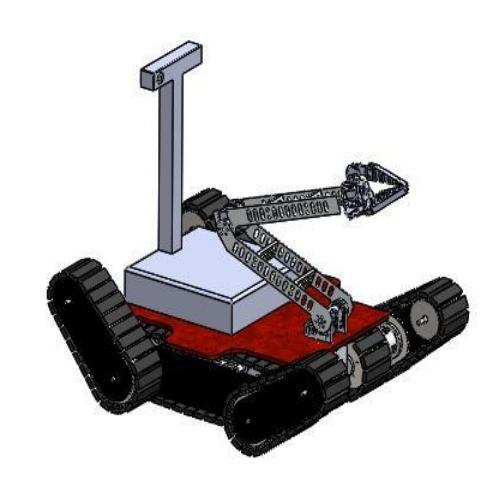
2D Technical Drawing is shown below (fig.9) y 3D CAD Drawing (fig.10)
APPENDIX C LISTS
A. Systems List
Table I lists several features of the tele-operative rescue robot with manipulation system.
.The Table III includes information on the operator's station.
TABLE I MANIPULATION SYSTEM
| Attribute | value |
|---|---|
| Name Locomotion System Weight Weight including transportation case Transportation size Typical operation size Unpack and assembly time Startup time (off to full operation) Power consumption (idle/ typical/ max) Battery endurance (idle/ normal/ heavy load) Maximum speed (flat/ outdoor/ rubble pile) Payload (typical, maximum) Arm: maximum operation height Arm: payload at full extend Support: set of bat. chargers total weight Support: set of bat. chargers power Support: Charge time batteries (80%/ |
Eco Tracked 35 kg 40 kg 180 min 5 min ND ND 1.5 ms 3 kg 87 cm 5 kg ND ND ND |
| 100%)Support: Additional set of batteries weight Cost |
3 kg 1100 USD |
TABLE II OPERATOR STATION
| Attribute | value |
|---|---|
| Name System Weight Weight including transportation case Transportation size Typical operation size Unpack and assembly time Startup time (off to full operation) Power consumption (idle/ typical/ max) Battery endurance (idle/ normal/ heavy load) Cost |
ECO STATION 5 kg 2 kg 40cm x 30cmx 30cm ? 5min 5 min 60 / 80 / 90 W 10 / 5 / 4 h 140 USD |
TABLE III HARDWARE COMPONENTS LIST
| Part | Brand & Model Unit Price | Num |
|---|---|---|
| servo motor | Power modelo HD-1235MG US $34.90 | 5 |
| Sensor Tempera/humedad | DHT 22 US$5.00 | 1 |
| Sensor CO2 | MQ-135 US$8.00 | 1 |
| Cámara térmica | AMG8833 US$40.00 | 1 |
TABLE IV SOFTWARE LIST
| Name | Versión | License | Usage |
|---|---|---|---|
| ROS | KineticKame | BSD | O.S |
| OpenCV | 4.0.1 | Open | Haar: Victim detection |
| Ubuntu (Xenial) | 16.04 | Open | O.S |
| Processing | 3.7.2 | Open |
References
- F. R. Effect, "Unique !"
- C. I. Basson and G. Bright, "Active Haptic Control for a Biologically Inspired Gripper in Reconfigurable Assembly Systems Testing Active Haptic Control through Force Feedback," vol. 2, no. Icinco, pp. 81–90, 2018.
- I. G. R. Gómez, J. L. S. Cuevas, J. I. H. Vega, C. H. Santos, and E. J. Rincón, "Diseño e Implementación de una Red de Sensores Inalámbricos para el Monitoreo de Fuego en Zonas Forestales," CIM, vol. Vol.6, no. 2007–8102, pp. 466–472, 2018.
- A. K. Saha, J. Saha, R. Ray, S. Sircar, S. Dutta, and S. P. Chattopadhyay, "IOT-Based Drone for Improvement of Crop Quality in Agricultural Field," 2018 IEEE 8th Annu. Comput. Commun. Work. Conf., pp. 612–615, 2018.
- "Libraries \ Processing.org." [Online]. Available: https://processing.org/reference/libraries/. [Accessed: 26-May-2018].
- R. M. E. Olivares Borja Eduardo,Macias Solis francisco,Fernandez Ramirez Arnoldo,Garcia Andrade Roxana,Martinez Reyes Armando, "DESARROLLO E IMPLEMENTACIÓN DE UN CONTROL GESTUAL PARA UN ROBOT DE 4 GRADOS DE LIBERTAD," vol. 40, pp. 199–204, 2018.
- and W. G. Steve Cousins, Brian Gerkey, Ken Conley, "Sharing Software with ROS," IEEE Robot. Autom. Mag., pp. 12–14, 2010.
- C. Melchiorri and G. Vassura, "DESIGN OF A THREE-FINGER GRIPPER FOR INTRA-VEHICULAR ROBOTIC MANIPULATION," IFAC Proc. Vol., vol. 31, no. 33, pp. 7–12, 1998.
- K. Telegenov, Y. Tlegenov, and A. Shintemirov, "A Low-Cost Open-Source 3-D-Printed Three-Finger Gripper Platform for Research and Educational Purposes," vol. 3, 2015.