RoboCup Rescue 2022 Team Description Paper Nexis-R
Hayato Kobayashi, Ryoga Shimizu, Keitaro Takeuchi, Ryutaro Sugai, Haruki Hasegawa
Nagaoka University of Technology
http://nexisr2016.wixsite.com/benri-robot · https://tdp.robocup.org/ · [https://robocup-rescue.github.io/team description papers/](https://robocup-rescue.github.io/team description papers/) · https://drive.google.com/file/d/1GL3Nd9LFWXL11DOvtMDMrq8YSfKRPhv4/view?usp=sharing · https://drive.google.com/file/d/1-vbmc9_8C3AjU5pKwB7D_HYT0lZB0lZP/view?usp=sharing · https://drive.google.com/file/d/19IY4D16AP8oxV-xbeoehCnaQdk3301hi/view?usp=sharing
Abstract The robot "R-5" developed by us won the RoboCup Japan Open as 3 rd place 2015 and has achieved the result of winning in 2016. In 2017 RoboCup Asia-Pacific ,R-5 has achieved the result of 2nd place.In 2018 WRS trial(Standard Disaster Robotics Challenge), R-5 won the championship. The activity of Nexis - R is the 13th year, and the idea learned from the robot which we have produced up to now is condensed in R-5. Currently we have developed a new arm for R-5 and realized lifting of heavy items of 10 kg.
Index Terms
RoboCup Rescue, Team Description Paper, Telerobot, Disaster Response Robot
I. INTRODUCTION
T HE was originated in the establishment of our Nexis-R (former Nutech-R) is the Chuetsu Earthquake that occurred on October 23, 2004.
Nexis-R is a joint organization of Nagaoka University of Technology and local metal manufactures. Our mission is to contribute to Nagaoka area promotion who experienced the earthquake through development of rescue robot. Nexis-R has developed many robots so far and has participated in Robocup Rescue Robot League (RRRL). In 2008 the activity was appreciated and received the Nagaoka City Mayer Award.
In Nexis-R, students design the robot, and participating companies support students by design advice and difficult processing. Our lastest robot "R-5" won the WRS trial 2018 Japan open.
II. SYSTEM DESCRIPTION
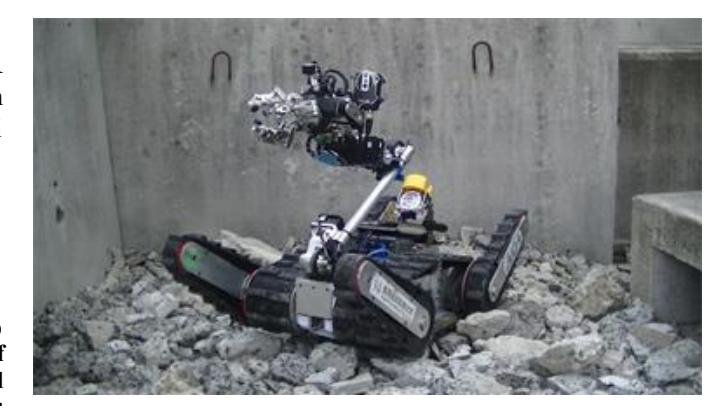
Figure 1 shows an overview of the "R-5". Charac- teristics of R5 are shown below.
A. Hardware
1) The large main crawler and four independent subcrawlers: In order to do the exploration after the earthquake occurrence, it is necessary to have a capability to move on rubble of a complicated shape. Also, in order to prevent secondary disasters such as collapse of rubble, there is also a need to move softly without impinging on unstable rubble. Our robot, "R-5" made these possible by having The large main crawler and four independent sub-crawlers.
The large main crawler prevents the robot from becoming immovable when it gets on rubbles. The rubber belt used for the main crawler has two types of protrusions, large and small, with the large protrusions on the outside of the robot, and the small protrusions on the inside. The protrusion improves mobility on rubble. In designing large protrusions on the outside, the installation surface at the time of plane movement is made small, so that the load at the time of turning is reduced. This design is based on the experience of Nexis-R.
The four sub-crawlers can be moved independently. By transforming the sub-crawler into an optimum shape matching the terrain, you can grip the road surface firmly and move less impact on rubble.
Based on the above characteristics, "R-5" can stably travel the SYMMETRIC STEPFIELDS[1].
- 2) Self lock with worm gear: Since the worm gear is incorporated in the crawler drive, the flipper is fixed even in the non-energized state. This mechanism prevents sliding down by slope and steps.
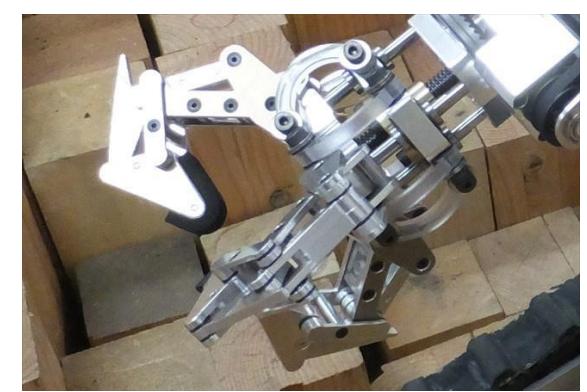
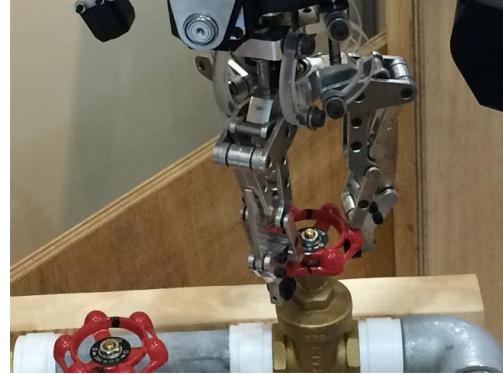
- 3) Manipulator arm: The Manipulator arm of "R-5" has the following features.
- • The Hand of shape following:
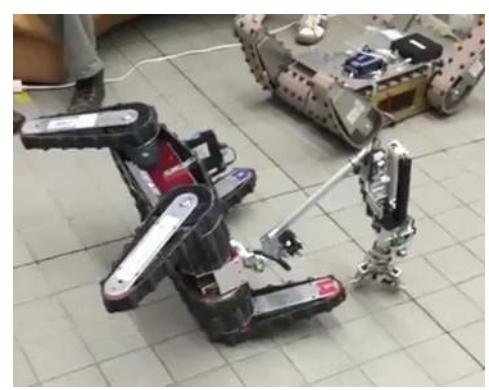
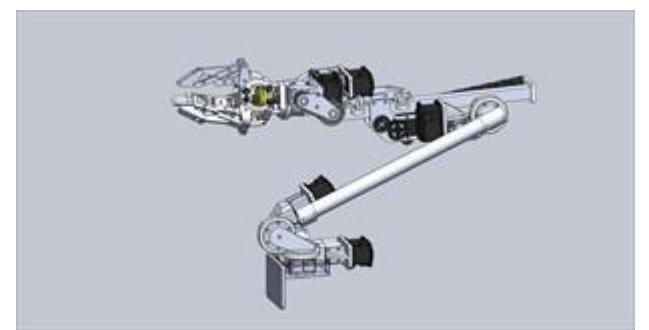
The tip of the arm of "R-5" is a multi - jointed hand with three fingers. Fingers are opened and closed by one actuator, and grasp the object. Then, the finger deforms following the shape of the object in a passive way and can grasp even objects of complicated shape. Even if the robot rolls over, it is possible to return using the arm as shown in the figure.
B. Software
The basic control system diagram of "R-5" is shown in the figure. If you just want to run the robot, you can use only one operation PC, but you need PC of Ubuntu OS when mapping.
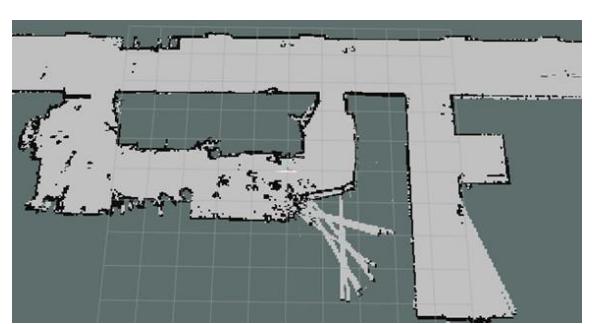
1) 2D mapping: We are developing 2D mapping. In the rescue operation, the map including the position of the requisite rescuer becomes important information. The mapping system consists of "Hector SLAM[2]" and LRF. With this system we successfully mapped laboratory and hallway as shown in the figure.
C. Communication
We only use one robot. Information on the radio to be used is shown below.
- 1) Our wireless LAN router supports IEEE 802.11 a.
- The channel supports 36, 40, 44, 48, 52, 56, 60 and 64.
D. Human-Robot Interface
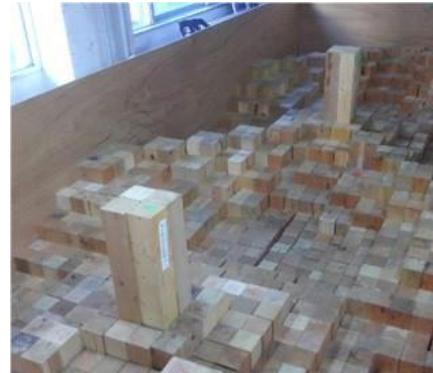
- 1) SYMMETRIC STEPFIELDS[1]: We used our own SYMMETRIC STEPFIELDS for daily robot mobility test and operator training.
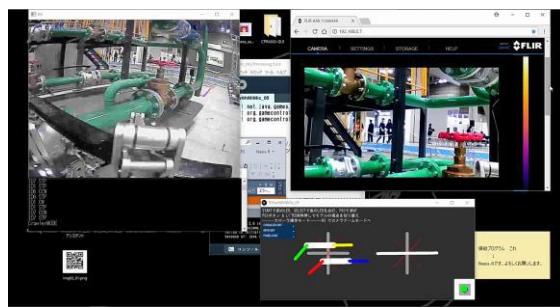
- 2) User interface: As shown in the figure, the posture of the robot and the angle of the sub-crawler are shown by model using IMU and encoders.This is information that can not be obtained by the camera alone, and it is important information for the operator.
III. APPLICATION
A. Set-up and Break-Down
1) Set-up(5min):
• Carry robot and operation system
• Turn on the PC and robot
• Activate the crawler operation program
• Start the arm and camera program
• completion
2) Break-Down(3min):
• Shut down the robot
• Shut down the program
• Carry robot and operation system
• completion
B. Mission Strategy
We would like to challenge competition by making good use of "R-5" excellent mobility performance and 10kg payload arm. Since the arm has just been completed this year, we will test it in many fields before RRRL-WC and we would like to make it a reference for future development.
C. Experiments
We made our own SYMMETRIC STEPFIELDS proposed by NIST and carried out robot mobility testing. In the future, we plan to utilize STM related to arm operation.
D. Application in the Field
Although "R-5" is not immature in waterproofing function, we consider that physical intervention in the disaster area is possible because of its high level as a system performance.
Also, we consider that it is possible to transport relief supplies using the hand arm.
IV. CONCLUSION
We have developed a robot "R-5" with high mobility performance and arm performance. We will evaluate these performances with RRRL and use it as a reference for future development.
APPENDIX A TEAM MEMBERS AND THEIR CONTRIBUTIONS
Hayato Kobayashi, Ryoga Shimizu, Keitaro Takeuchi, Ryutaro Sugai, and Haruki Hasegawa are member of Nexis-R, e-mail: n[email protected]
Team Members and Contributions
| Contribution | |
|---|---|
| Hayato Kobayashi | Team Leader and Operator |
| Ryoga Shimizu | ROS algorithm |
| Keitaro Takeuchi | ROS algorithm |
| Ryutaro Sugai | Electrical design |
| Haruki Hasegawa | Electrical design |
| Cooperative enterprises of Nexis-R | Manufacturer and adviser |
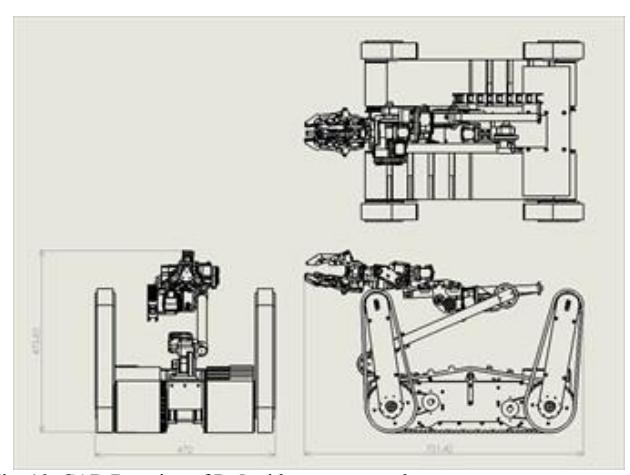
APPENDIX B CAD DRAWINGS
The figure shows the CAD drawing of "R-5" with arm mounted.
APPENDIX C LISTS
A. Systems List
The list of the robot system is shown in the following table.
SYSTEM LIST
| Attribute | Value |
|---|---|
| Name | R-5 |
| Locomotion | tracked |
| System Weight | 35kg |
| Weight including transportation case | 40kg |
| Transportation size | 1.0 x 0.6 x x 0.4m |
| Typical operation size | 0.65[max1.1] x 0.47 x 0.37m |
| Unpack and assembly time | 10min |
| Startup time (off to full operation) | 5min |
| Power consumption (idle/ typical/max) | ?/216W/720W |
| Battery endurance (idle/normal/ heavy load) | 3h/1h//0.5h |
| Maximum speed (flat/ outdoor/rubble pile) | 0.5[m/s]/0.4[m/s]/0.3[m/s] |
| Payload (typical/maximum) | 20kg/? |
| Arm: maximum operation height | 1.1m |
| Arm: payload at full extend | 10kg |
| Support: set of bat. chargers total weight | 3kg |
| Support: set of bat. chargers power | 200W |
| Support: Charge time batteries (80%/100%) | 70min/90min |
| Support: Additional set of batteries weight | 1kg |
| Cost | 60000USD |
B. Operator StationList
The list of the Operator Station is shown in the following table.
OPERATOR STATION LIST
| Attribute | Value |
|---|---|
| Name | R5-Op |
| System Weight | 4kg |
| Weight including transportation case | 8kg |
| Transportation size | 0.25 x 0.6 x 0.8m |
| Typical operation size | 0.4 x 0.4 x 0.4m |
| Startup time (off to full operation) | 5min |
| Power consumption (idle/ typical/ max) | ?/50W/? |
| Battery endurance (idle/ normal/ heavy load) | 6h/4h//3h |
| Cost | 1500USD |
C. Hardware Components List
The list of the Hardware Components is shown in the following table.
HARDWARE COMPONENTS LIST
| Part | Brand & Model | Unit Price |
|---|---|---|
| Drive motors of main crawler | maxon EC-4pole 30 | 700CHF |
| Drive motors of sub crawler | maxon EC-max 30 | 260CHF |
| Drive gears of main motor | GP32HP 79:1 | |
| Drive gears of sub motor | GP32 23:1 | |
| Drive encoder | Encoder HEDS 5540 | |
| Motor drivers | maxon ESCON | 200CHF |
| DC/DC | ND | |
| Battery Management | lipo alarm | 10USD |
| 12V Batteries | KT3700 3S 35C | 40USD |
| 24V Batteries | KT3700 6S 35C | 80USD |
| Micro controller1 | sanritz TPIP3 | 1000USD |
| Micro controller2 | mbed | ND |
| Micro controller3 | Raspberry Pi model B+ | 30USD |
| WiFi Adapter | NEC PA-Aterm WR9500-HP | 100USD |
| IMU | ND | ND |
| Cameras | raysonics RSJ-071BC | 700USD |
| LRF | HOKUYO UTM-30LX | 4000USD |
| Battery Chargers | HiTEC multi charger X4 AC plus | 300USD |
| Motor Robot Arm | DYNAMIXEL MX-64R | 400USD |
D. Software List
The list of the Software is shown in the following table.
SOFTWARE LIST
| Name | Version | License | Usage |
|---|---|---|---|
| Windows | 7 | Value | Operation |
| Ubuntu | 14.04 | Open | Mapping |
| ROS | Indigo | BSD | Mapping PC |
| Hector SLAM[2] | - | BSD | Mapping |
ACKNOWLEDGMENT
The authors would like to thank Nagaoka University of Technology for their research.
References
[1] National Institute of Standerds and Thechnology, "Guide for Evaluating Purchasin and Training with Response Robots Using DHS-NIST-ASTM International Standerd Test Method", [Online]. Available: https://www.nist.gov/sites/default/files/documents/el/isd/ ms/DHS NIST ASTM Robot Test Methods-2.pdf
[2] ROS wiki,"hector slam", [Online]. Available: http://wiki.ros.org/hector slam