The 5Rings "Team Report"
Paulo T. Silva, Helder Coelho
Instituto Superior de Engenharia de Lisboa, Departamento da Engenharia da Electrónica e Telecom. e de Computadores, R. Conselheiro Emídio Navarro, 1, 1949-014 Lisboa, Portugal; Faculdade de Ciências da Universidade de Lisboa, Departamento de Informática, Bloco C5, Piso 1, Campo Grande, 1749-016 Lisboa, Portugal
Abstract This technical report describes the essential concepts of the 5Rings team agents and illustrates the most relevant implementation issues.
Introduction
This technical report describes the essential concepts of the 5Rings team [1] agents and illustrates the most relevant implementation issues.
The section 2 presents a formal frame of the agent concept. At section 3, the formal frame is used to specify the RoboCupRescue agents. The section 4 describes the implementation of each agent constituent (from the formal frame). The last section outlines the current main strength and weakness of our implementation.
The tuple representation of an agent
At this section an attempt is made to formally frame the agent concept. We pretend to build a systematic and higher view of our agents' implementation.
The following 7-tuple defines the structure of an agent ag immersed in a multi-agent system:
$$ag = \langle G, M, Wm(E_{self}, E_{other-}, Mr), P_{Ac}, H_{Ac}, E, C \rangle$$
where,
- G is a set of goals that the agent aims to achieve as a whole,
- M is the theoretic model implemented by the agent,
- Wm is an working memory inhabited by representations self and other agents' environment representation (Εself and Εother respectively) and any representations built to support the agent model (designated by the Mr symbol),
- PAc is a set of primary actions or primary protocols that the agent can use,
- HAc is a set of higher level actions or protocols that the agent can use,
- Ε is an environment where the agent act,
- C represents the constraints on the channels used for inter-agent communication and for the agent's interaction with Ε.
The agent has three main sources of G goals: i) the agent designer, that usually pre-defines goals, ii) the other agents, with whom an hierarchical relationship may exist, and iii) the human user, when such a direct interaction exists.
The agent behavior implementation is superimposed by theoretical model M guidelines. The model ranges from a pure reactive and socially deaf to a deliberative and socially fulfiller agent.
The agent working memory contains its own environment representation (e.g. its current state, historic evolution, aggregated knowledge) and the agent's view of others' agents' perspective on the environment. All representations that need to exist in order to support the agent model M are also contained at Wm.
The PAc symbol represents the primary (basic) capabilities used by the agent to communicate with others or to interact with the surrounding environment.
The HAc symbol represents the higher level capabilities designed over PAc.
The environment Ε, evolves accounting for agent actions and to models of change based on physical laws or artificial rules.
The C links are used by the agents to communicate. We explicitly distinguish two C subsets: the ag to ag' (inter-agent) communication subset and the ag to Ε (agent to environment) communication subset. From here we state that C = Cag ∪ CagE, where Cag represents the communication channels among agents and CagE, represents the interaction channels between agents and Ε. The Cag = Ø means that agents act with no communication (among them). The CagE = Ø means that agents can not interact with the environment and thus the simulation is not taking place (perhaps a replay of a previous simulation).
Rescue agents based on the tuple representation of an agent
The RoboCupRescue multi-agent system is inhabited by a set of agent types. Each agent type represents a set of agents with a specific capabilities' pattern. Thus, there are differentiation capabilities, which only apply to a particular agent type (e.g. "extinguish" only apply to Fire Brigade agent type), and common capabilities that apply to all agent types (vision, hearing, speech and locomotion).
The number of agents that belong to each agent type depends on the RoboCupRescue competition rules.
The set AgType of agent types is:
AgType = { Civilian, Fire Brigade, Ambulance Team, Police Force, Fire Station, Ambulance Center, Police Office }
Each ag ∈ AgType is represented by its own tuple. To get things simple and clear we will first describe the basic "Fire Brigade" agent.
The basic "Fire Brigade" agent follows Morimoto's agent description [2] and was adopted by the 5Rings team as the first step towards more sophisticated rescue agents. The basic "Fire Brigade" tuple representation is the following:
- G = { extinguish fires, inform on endangered agents },
- M is the very general "action is an immediate response to an external event" programming model,
- Wm: Εself ≡ Εother is the map representation of the disaster space; Mr contains all state variables that support M,
- PAc = { move(node_array), extinguish(nozzle_array), say, tell, hear say, hear tell },
- HAc = { route finder, fire selector },
- Ε is a city region (at Kobe, Foligno or random) for the five hours that take place after an earthquake,
- C = Cag ∪ CagE, is physically materialized by one single channel; the usage of that same channel is sampled in time, so we may think of two logical channels with following constraint between them: i) Cag is only available between two consecutive instants where CagE is available, and ii) the time period between two consecutive CagE availability is about 500 milliseconds.
For each agent type, the constraints on C also depend on the PAc element. We represent such constraint as a 2-tuple where the first element is a PAc subset and the second element is a numeric value representing the upper bound capacity of the channel. The C constraints are the following:
Cag = { < {say, tell}, 4 >, < {hear say, hear tell}, 4 > }, meaning that, there is an upper bound of 4 outgoing (say, tell) and 4 incoming (hear say, hear tell) messages between two consecutive uses of CagE.
CagE = { < {move(node_array), extinguish(nozzle_array)}, 1 >, meaning that, there is an upper bound of 1 message to post an action intention towards Ε.
All other ag ∈ AgType are expressible as simple variations of G, PAc, HAc and C elements. More sophisticated agents require sophistication of M, Wm and HAc elements.
The implementation of the tuple representation of an agent
The tuple representation of an agent was implemented for the RoboCupRescue 2004 competition and variations on G, PAc, HAc and C were sufficient to construct all the different rescue agents' structures.
The builder design pattern [3] was used to implement a flexible ag tuple representation. The Table 1 presents a code excerpt.
concreteBuilder.buildConnector( initiatorCommunicator ); // C
concreteBuilder.buildAgentToPlatformConnection(); // C
concreteBuilder.buildAgentGoalSet(); // G
concreteBuilder.buildAgentModel(); // M
concreteBuilder.buildAgentWorkingMemory(); // Wm
concreteBuilder.buildAgentPrimaryCapability(); // PAc
concreteBuilder.buildAgent(); // ag
Table 1. The tuple implementation.
Two different M elements (agent models) were implemented:
- the first was called "baseline" and was used at the qualification stage; it followed the very general "action is an immediate response to an external event" programming model,
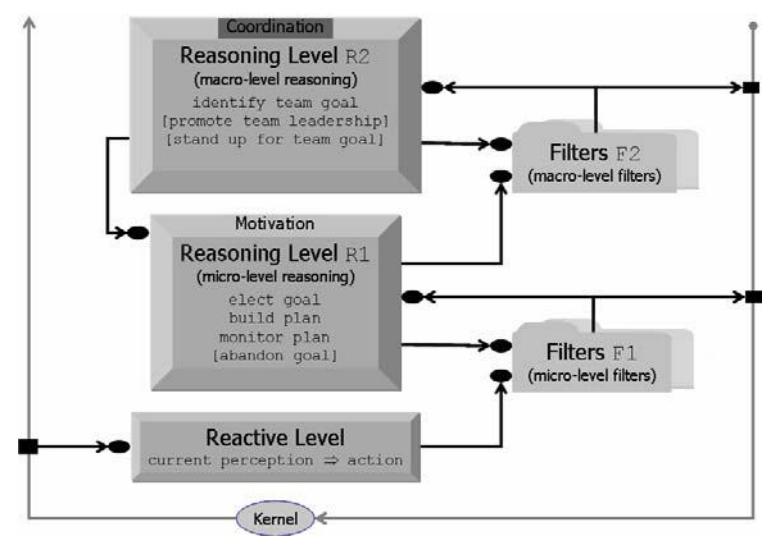
- the second was called "RRR" and was used at the final competition stage; the model was built around the theoretic guidelines of reactive, deliberative and socially oriented agents; the "RRR" model proposes an equilibrium among the reactive level (R0), the self motivation reasoning level (R1) and the social strength towards global achievements (R2). The "RRR" model architectural guideline is graphically represented at the Fig. 1.
The reactive level (R0)
The reactive level contains a set of rules with the general "condition implies behavior" format. Two rule subsets are defined: i) one for interaction, where "condition implies communication", and ii) other for the action rules, where "condition implies action". A total order is imposed over rules of each subset.
The Table 3 shows each rule and the interaction (I) and action (A) lists (ordered subsets) for each agent type: Ambulance Team (AT), Police Force (PF), and Fire Brigade (FB). Each number indicates the position of the rule at its own list (I or A); conditions have qualifiers (
Table 3. The "condition implies behaviour" rules and each rule's order, within interaction (I) and action (A) lists, for each agent type (AT, PF and FB).
| AT | PF | FB | Rule | Condition | Behavior |
|---|---|---|---|---|---|
| I/A | I | A | Ι | A | condition |
| 5 | 2 | 2 | |||
| 1 | 1 | 1 | |||
| 3 | 1 | 1 | |||
| - | 3 | - | |||
| 1 | - | ||||
| 2 | - | ||||
| 4 | - | ||||
| 6 | - | ||||
| - | 2 | 2 |
|
||
| - | 3 | 3 |
Each rule list (I and A) is evaluated at each simulation cycle. All interaction rules (I) satisfying its conditions are fired; the first action rule (A) satisfying its condition become ready to fire (but does not fire).
When a rule fires, its behavior is sent to the RoboCupRescue kernel process. When a rule becomes ready to fire, it goes through the R0 filter. If the filter accepts the rule, then the rule is fired. Otherwise the action proposed by the ready to fire rule is confronted with the outcome of the R1 reasoning.
The micro-level reasoning (R1)
This reasoning level starts with a belief update function. At each simulation step the function updates the beliefs concerning the buildings already visited by the agent (damaged civilian's exploration) and the roads already visited by the agent (blockade exploration).
The desires are built after the belief update activity. Each desire is a list of the most interesting (from the agent's perspective) arguments for the possible agent actions. A total order is defined over desires.
Thus for the Ambulance Team (AT) agent type, the following desires, for the move action, are defined: i) any humanoids buried within the agent's vision radius, ii) any other AT agents at known locations, iii) any other rescue teams (Police Force or Fire Brigade) at known locations, iv) any civilians at known locations, v) any civilians at unknown locations (local exploration), and vi) any not burning building within the agent's geographical section.
For Police Force (PF) agent type the following desires, for the move action, are defined: i) any other rescue team reported blockade, ii) blockades within the agent's vision radius, and iii) any unvisited road within the agent's geographical section.
Although the Fire Brigade (FB) implementation of the "RRR" model was not fully accomplished, the FB desires are: i) extinguish an early fire within its own geographical section, ii) extinguish an early fire elsewhere, and iii) extinguish any fire anywhere.
The desires predefined order is used to select the first (following desire's order) non empty list of preferable desires (most interesting action arguments).
The list of preferable desires is used to build a plan to achieve one of the elements in that list. A plan is a sequence of actions that takes the agent from its current state to a state described by any element contained at the preferable desires list. The planner minimizes a cost function, so the minimal cost desire is found during the construction of the plan.
The minimal cost desire becomes the agent's intention and a plan monitor is used to account for delays and repairs of the original plan. The intention persists until a predefined number of plan repairs occur; after that a new intention is allowed to be elected.
A path planner and path plan execution monitor were implemented. The path planner implemented cost functions are: i) passable roads, where lower costs are assignment to roads the agent knows to be free of blockades, ii) shorter roads, where lower costs are assigned to lower length roads, and iii) wider shorter roads, where lower costs are assigned to wider (with more lanes) roads assuming the same length (uses length/lanes ratio).
The path planner has two additional capabilities: i) the "must go" list, and ii) the "taboo" list. The "must go" list is used to indicate that the agent must go through, at least one of the locations contained in the list, before reaching its final destination. The "taboo" list gives the reverse indication, that is, the agent must avoid all the "taboo" list locations.
The general path planner algorithm composes two sub-problems. The first is to get a path from the current location to a "must go" location. The second is to get a path, from the solution of the previous sub-problem, to one of the destination locations. The Table 4 shows the general planner algorithm.
public ArrayList getWiderShorter(
 Collection destination, Collection mustGo, Collection taboo )
{
 if( mustGo.isEmpty() )
 { return getWiderShorter( destination, taboo ); }
 // The 1st SubProblem (from current to a mustGo location)
 GIS_RoutingProblem firstSubProblem =
 new GIS_RoutingProblem_widerShorter(
 self.motionlessPosition(), mustGo, taboo );
 // The 2nd SubProblem (from "mustGo" to a destination location)
 // Note: initial state of 2nd subproblem is still unknown
 // (it will be the solution state obtained from 1st subproblem)
 B_GIS_RoutingProblem secondSubProblem =
 new B_GIS_RoutingProblem_widerShorter(
 destination, taboo );
 // Return the composition of 1st and 2nd SubProblems
 return getSolutionFromTwoSubProblemComposition(
 firstSubProblem, secondSubProblem );
}
Table 4. The general planner algorithm.
The plan is monitored at each simulation cycle. Both the agent's expected location at the next simulation cycle and the accumulated deviation (from expectations) are calculated. The Table 5 shows an excerpt of the method invoked at each plan monitoring time.
public void updateTime( int time )
{
...
 int elapsedTime = time – previousTime;
 int elapsedTimeToConsider = Math.max(elapsedTime – unexpectedCost, 0);
 unexpectedCost = Math.max(unexpectedCost - elapsedTime, 0);
 int maximumExpectedProgress =
 elapsedTimeToConsider * maximumExpectedProgressAtEachTime;
 int effectiveProgress = distanceFromTo(
 indexOfPreviousLocation, indexOfCurrentLocation, planToMonitor );
 int deviation = maximumExpectedProgress - effectiveProgress;
 accumulatedDeviation = accumulatedDeviation + deviation;
...
}
Table 5. Accumulated deviation update during plan monitoring.
When the accumulated deviation exceeds a certain threshold a plan repair is proposed. Then, after a predefined number of plan repairs a new intention may be elected. The Table 6 shows an excerpt of the method invoked during the evaluation of intention persistence; the intention persists for a predefined number of plan repairs.
public void persistPreviousIntention( ArrayList aarr_newPlan )
{
...
 PlanMonitor monitor = getMonitor();
 if( monitor.isExecuting() )
 if( monitor.getTotalNumberOfPlanRepair() < persistence_move )
 moveWithMonitorToDestination( monitor.getPlanDestination() );
...
}
Table 6. Intention persistence evaluation.
The macro-level reasoning (R2)
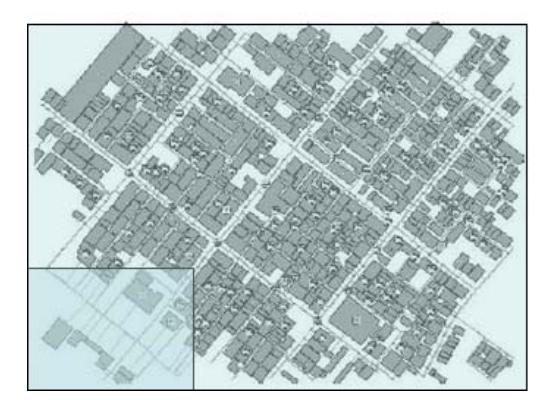
The coordination reasoning level (R2) assumes a basic convention that mainly distributes the agent's responsibilities over different geographical sections of the disaster space.
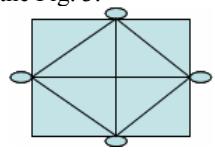
The implemented geographical responsibility defines a grid partition over the disaster space. The Fig. 2 show a disaster space (Kobe) and the bottom left element (section) of its grid partition.
The agent's rescue performance
At this point it is important to remark that the agent's tuple structural definition proved to be flexible, concerning the exchange of the agent models and the implementation of the capabilities of the different agent types. The Police Force and the Ambulance Teams implementation both follow the RRR model; the Fire Brigade is the more incomplete implementation of RRR. The command centers (Police Office, Ambulance Center and Fire Station) implementation is still very immature; they mainly act at communication relay agents.
The agent's tuple structural definition alone does not imply a "good" rescue performance. From this report it is clear that the weakness of our agents follows from some main issues that remain to be handled: i) the explicit specification of the team work concept within the agent model, ii) the leader concept as a means to deal with coordination and communication scarceness, iii) a sophisticated situation evaluation and decision making technique, and iv) an effective usage of command centers (institutional leadership).
References
- Silva, P. Araújo, P. Remédios, A. Lopes, C. Basílio, B. Loureiro, T. Moniz, L. and Coelho, H. (2004). "The 5Rings Team Description Paper". Proc of the RoboCup2004 Symposium. July 4-5, Lisbon, Portugal.
- Morimoto, T. (2002). How to Develop a RoboCupRescue Agent for RoboCupRescue Simulation System. version 0, first edition. RoboCupRescue Technical Committee.
- Gamma E., Helm R., Johnson R., and Vlissides J. (1995). "Design Patterns Elements of Reusable Object-Oriented Software". Addison-Wesley.