Hinomiyagura Rescue Simulation Infrastructure Team - Everywhere Evacuation Simulation System
Masaru Okaya, Tomoichi Takahashi, Masaru Shimizu
Meijo University, Aichi, Japan; Chukyo University, Aichi, Japan
[http://sakura.meijo-u.ac.jp/ttakaHP/Rescue index.html](http://sakura.meijo-u.ac.jp/ttakaHP/Rescue index.html)
Abstract We propose a system with that the behavior of evacuation or rescue can be simulated using data of buildings on the Web. Our system consists of three components: the first one is a tool that convents a WEB data format into a RoboCup Rescue compatible one, the second one is a civilian class that contains parent and child, and the last one is a tool that displays the results of simulation on the Web. Three-dimensional (3D) models of buildings and geographic information system (GIS) data for roads have been created and used for everyday purposes such as sightseeing. Our system uses these 3D data and GIS data as the environments for simulations and makes it possible to present the simulation results on the Web.
Evacuation and rescue simulation has the potential for decreasing the amount of damage resulting from disasters. Presenting the simulation results in proper ways is one of valuable preventive methods for disaster. Our system provides a useful platform for rescue simulation community that agents of any team can be sent to any buildings and the activities can be presented on the Web to save human lives.
1 Introduction
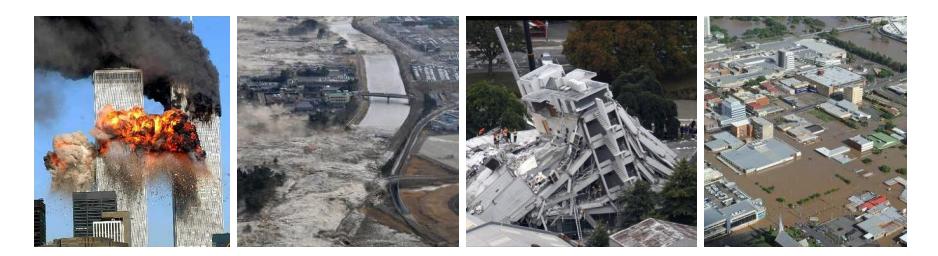
A number of great disasters have occurred since RoboCup Rescue Simulation (RCRS) started at 2000. Figure 1 shows some disasters, and there were other disasters such as Sichuan earthquake at 2008, Northern Sumatra earthquake at 2004, etc. The size, kind, damages and others of disasters exceed the ones that were supposed at the design of RCRS.
We propose an Everywhere Evacuation Simulation System (EESS). Disaster can occur at any time and any place. EESS can simulate the behaviors of civilians inside and outside buildings over a wide area. Evacuation guidance as well as rescue operations by rescue agents can be simulated, and the results of simulation can be presented on the Web browser. EESS consists of following three steps.
Step 1: Preparing of maps. In order to use disaster management systems properly at emergencies, it is desired the system and data are linked to ones that are used for day-to-day operations [17]. Three-dimensional (3D) models of buildings and geographic information system (GIS) data for roads have been created and used for everyday purposes such as sightseeing are used. As the first step, our system convents a data created by SketchUp TM(sketchup.google.com) into a RoboCup Rescue compatible one.
Step 2: Run Simulation. RCRS v.1 provides an agent based simulation platform to simulate the behavior of agents on open space. We propose a civilian class library and a traffic module that makes it possible to simulate the evacuation behaviors of agents inside buildings and on the roads. The civilian class that contains two subclass, parent and child. The heterogeneity in civilian agents; civilian, parent and child agents, causes varieties in evacuation simulations.
Step 3: Display the results and use it for public relations. We provide a tool that the result of simulation can be displayed on Web browsers. It converts the results in KML files. Presenting the simulation results in proper ways is one of valuable preventive methods for disaster.
The followings are the features of EESS.
- – The World Trade Center Disaster (2001) and the Daegu subway fire (2003) indicate that human behavior in evacuation form buildings is a matter of life and death [16]. EESS can simulate the behavior of agents in buildings.
- – "Everywhere" means that ready-to-use maps are on the Web and used in many aspects of daily life so that we can simulate any place at once. The data of buildings that are created for other commercial purposes, can be used for simulations and results of simulations can be viewed on Google Earth.
2 Related works and evacuation scenarios
This section discusses related work and evacuation scenarios.
2.1 Evacuation scenarios and space presentation model
Table 1 shows properties of simulators that are related to rescue activities and evacuation behaviors.
Exodus is an analyzing tool for the evacuation of people from enclosures such as an aircraft or supermarket [1].
USARSim can simulate very detailed situation such as smoke or falling of rescue robots. USRASim uses a physical engine to compute robots' movements and collisions among them, and supports three dimensional environments. It takes a lot of computation power to calculate dynamics of robots. Only a small number of agents can be simulated.
RCRS Ver.1 simulate the motion of agents using Helbing's model [8]. The adopting Helbing's model and open-space model make it possible to simulate congestion situations. An automatic map generator which create map files for RCRS from OSM data is presented.
EESS is based on RCRS Ver.1 and can simulate the behavior of agents in buildings as well as on roads. Individual decision based on their relationship such as parent and child and guidance for evacuation can be handled [7].
Table 1. Properties of disaster management systems
| RoboCup Rescue | |||||
|---|---|---|---|---|---|
| properties | Exodus | USARSim | RCRS(V.1) | EESS | |
| Agent | size | 10000 | 10 | 10000 | 10000 |
| types | civilian | civilian, | civilian, police, | ||
| rescue robot | fire brigade, | ambulance | |||
| communication | √ | ||||
| rescue operation | |||||
| Simulation | target | building | building | town | town |
| inside buildings | |||||
| Disaster | fire | ||||
| smoke | |||||
| Map generation | available for others |
2.2 Emergency cases and evacuation scenarios
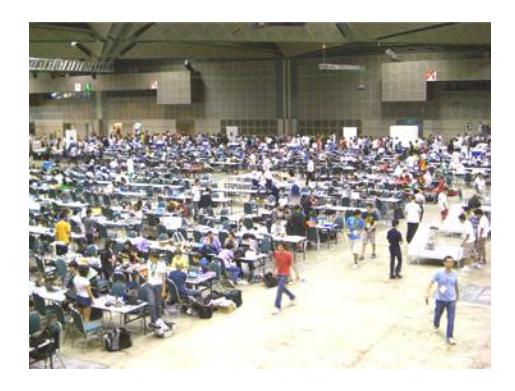
Figure 2 shows a snapshot of the Junior League at RoboCup 2010. There were team members participating in games, and their mentors watching them from distant places. In the time of emergency, some rush to exits, or mentors go to their members to evacuate together rather than go to the exits. The human behavior in evacuation form buildings is a matter of life and death [16]. The following situations become scenarios of evacuation simulation when disasters occur at a school campus.
Outside buildings: Students evacuate from buildings to open-space areas or go to refuges. Rescue teams rush to the buildings to rescue injured students. The injured are transported to hospitals.
Inside buildings: Students go to exits of rooms, look for emergency exits, and take stairs to the ground floor. The rescue teams go to rooms, and check whether occupants remain there.
Outside and inside buildings: Emergency notices are announced to lead people to safe places.
Before scheduling major events such as RoboCup, safety managers of the events are required to assess the levels of safety for human life provided in the buildings and plan effective layout of escape route signs in case of emergency. After disasters, disaster-related measures have been taken in various countries and regions [15][3]. These measures aim to decrease the amount of damage caused by disasters. Some projects and systems have been proposed to ensure prompt planning for disaster mitigation and risk management with the support of IT infrastructures [6][11].
3 EESS based RCRS and simulation results
This section presents the EESS system based on RCRS.
3.1 Prototype system based RCRS
In emergencies, human behaviors differ from those in ordinary times. There are various kinds of people in the buildings, such as young and old and men and women. It is desirable that the characteristics of occupants in buildings are taken into consideration in simulating the evacuation behavior and planning escape routes.
RoboCup Rescue Simulation v.1 (RCRS) is used as a platform to simulate the behavior of agents [4]. RCRS comprehensively simulates agents' behavior in a simulated disaster world. The crowd simulator is modified to simulate the behaviors of agent that have related to others such as parent-child relationships [7]. The results of micro simulation are returned to the agents as their own and other agents' positions that are within their visible area.
3.2 Framework of EESS
Figure 3 shows an overview of EESS which consists of three phases.
Phase 1: Modeling 3D buildings and Web world. 3D models of buildings or GIS data of towns are created for evacuation simulation, and they are also used for other every day usages such as sightseeing or indoor guidance. They are represented in several formats such as DXF or KMZ that are compatible with a Web browser. KMZ files have the geographical data and location data of objects in the ΣGlobal, and GML files contain map data of the area.
3D data of buildings are created in each coordinates system, ΣLocal, and they are merged into a global coordinate, ΣGlobal (Figure 4). The data in ΣLocals are represented in corresponding KMZ files or they are converted ones in ΣGlobal and merged into one KMZ file. The merging into the global coordinate is used to simulate the behaviors of agents.
Phase 2: Pseudo-3D evacuation simulation based on RCRS. Evacuation from buildings is simulated. Inside buildings, the movements of agents are simulated and their motions are calculated in ΣLocal of the building. Right-down two figures in Figure 3 show the simulation results of an evacuation behavior in a two-story library. Two figures correspond to two floors, B1F and 1F respectively, which are connected with a stairway that is also represented in an open-space model.
Following three modules of RCRS are modified.
GIS module: New GIS module can initialize the world state of RCRS with GML, KMZ and KML files. The common library is modified to specify 3D objects.
Traffic module: The definition of area is changed to handle 3D buildings and traffic simulator is expanded in order to handle the agent's motion in 3D coordinate.
Kernel: We added a log writer which can output the KML files.
Phase 3: Displaying simulation on the Web. The results of evacuation simulation are embedded in
Displaying the results of simulations on the Web provides a good instructional material for evacuation drills. The following shows a listing of the KML file.
<kml>
 ...
 <Placemark>
  <styleUrl>#civilian-parent</styleUrl>
  <TimeStamp>
   <when>2007-01-14T21:05:02Z</when>
  </TimeStamp>
  <Point>
   <coordinates>-122.536226,37.86047,0</coordinates>
  </Point>
 </Placemark>
 ...
</kml>
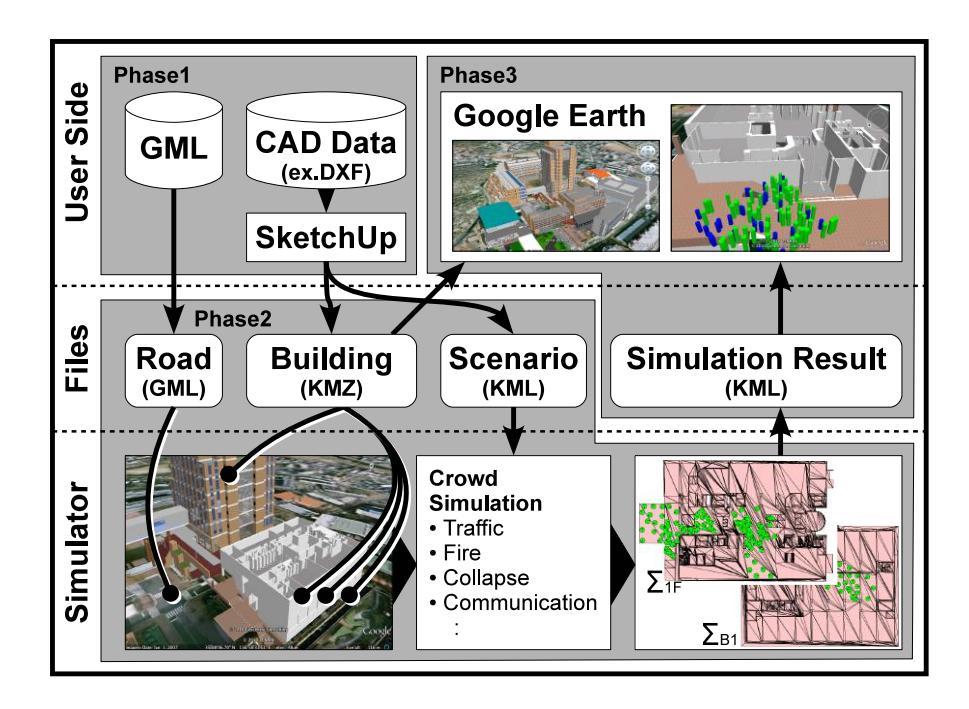
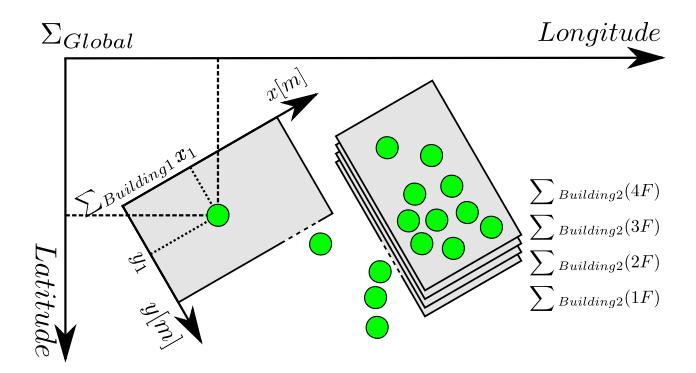
Table 2. Components and properties
| Human Agent | Vehicle | Building | |
|---|---|---|---|
| (longitude, latitude) | √ | ||
| area ID | √ (Road or Building) | √ (Road) | |
| orientation | |||
| out line | |||
| agents | |||
| floors | |||
| stairs | |||
| rooms | |||
| blockade | |||
| fieryness | |||
| temperature | |||
| buriedness | |||
| hp | √ | ||
| stamina | |||
| timestamp | √ |
4 Discussion and Summary
Our team proposes a platform that can simulate the evacuation behaviors in buildings. The features are
- When there are 3D model that are created by SketchUp $^{\rm TM}$, the data can be used for simulations. The simulations support the movements in multi-floor buildings.
- Heterogeneous civilian agents are supported to simulate the behavior of parents who take care of their child.
- The simulation results can be displayed in Google Earth. This make it possible to explain the effect of simulation to the public.
Our prototype system provides a platform that wides the activities of RoboCup Rescue community. And we hope that the system will be used for public relations to illustrate how proper behavior will save human lives and decrease the harm from disasters.
References
- http://fseg.gre.ac.uk/exodus/ (date: 28. Mar. 2011).
- http://wiki.openstreetmap.org/wiki/Main Page (date: 30. Jan. 2011).
- K. Abe, F. Misumi, and K. Okabe. Behavior Science at Natual Disaters (in Japanese). Fukumura Shuppan, 1988.
- S. R. Cameron Skinner. The robocup rescue simulaiton platform. In Proc. of 9th Int. Conf. on Autonomous Agents and Multiagent Systems (AAMAS 2010), 2010.
- T. I. L. D. J. Kaup and N. M. Finkeistein. Modifications of the helbing-molnarfarkas-vicsek social force model for pedestrian evolution. SIMULATION, pages 81(5):339–352, 2005.
- B. V. de Walle and M. T. (edited). Emergency response information systems: Emerging trends and technologies. COMMUNICATIONS of the ACM, 50(3):28– 65, 2007.
- Masaru Okaya and Tomoichi Takahashi. BDI Agent model Based Evacuation Simulation Demonstration at AAMAS, 2011.
- I. Farkas, D. Helbing, and T. Vicsek. Simulating dynamical features of escape panic. NATURE, pages 407:487–490, 2000.
- E. R. Galea, L. Hulse, R. Day, A. Siddiqui, G. Sharp, K. Boyce, L. Summerfield, D. Canter, M. Marselle, , and P. V. Greenall. The uk wtc9/11 evacuation study: An overview of the methodologies employed and some preliminary analysis. In S. A. Klingsch W.W.F., Rogsch C. and M. Schreckenberg, editors, Pedestrian and Evacuation Dynamics 2008, pages 3–24. Springer, 2008.
- E. D. Kuligowski and S. M. Gwynne. The need for behavioral theory in evacuation modeling. In Pedestrian and Evacuation Dynamics 2008, pages 721–732, 2008.
- S. Mehrotra, T. Znatri, and W. T. (edited). Crisis management. IEEE Internet Computing, 12(1):14–54, 2008.
- N. I. B. N. Pelechano. Modeling crowd and trained leader behavior during building evacuation. IEEE Computer Graphics and Applications, 26(6):80–86, 2006.
- M. Okaya, S. Yotsukura, K. Sato, and T. Takahashi. Agent evacuation simulation using a hybrid network and free space models. In Principles of Practice in Multi-Agent Systems, volume 5925 of Lecture Notes in Computer Science, pages 563–570. Springer, 2009.
- X. Pan. Computational Modeling of Human and Social Behaviors for Emergency Egress Analysis. PhD thesis, Stanford, 2006.
- R. W. Perry and A. Mushkatel, editors. Disaster Management: Warning Response and Cummunity Relocation. Quorum Books, 1984.
- A. Ripley. The Unthinkable: Who Survives When Disaster Strikes and Why. THREE RIVERS PRESS, 2008.
- T. Takahashi. RoboCup Rescue: Challenges and Lessons Learned, chapter 14, pages 423–450. CRC Press, 2009.
- T. Yamashita, S. Soeda, and I. Noda. Evacuation planning assist system with network model-based pedestrian simulator. In Principles of Practice in Multi-Agent Systems, volume 5925 of Lecture Notes in Computer Science, pages 649–656. Springer, 2009.