RoboCupRescue2011-Rescue Simulation League Team Description
Takefumi Ohta, Fujio Toriumi
Graduate School of Information Science, Nagoya University
http://www.kishii.ss.is.nagoya-u.ac.jp
Abstract The aim of the RoboCup Rescue Simulation is to find effective strategies for dealing with disaster situations. The system provides a platform for exploring ideas for a multi-agent system. However, it requires high-level programming skill to develop agents on RCR Simulation because of its complexity.
In this paper, we designed a communication library that supports communication between agents and a command center. By using this library, it is possible to develop a command center that gives orders to agents of various teams.
1 Problem in RCRSS
The RoboCup Rescue Simulation System (RCRSS) is one of the most complicated multi-agent systems, and presents an interesting area of study [1]. However, it requires high-level programming skills and knowledge of detailed rules. Therefore, it is difficult to operate agents (move to the destination on the shortest path, extinguish fire in a building, and so on) and to conduct cooperative work between agents (for example, help police force coordinate movement of fire brigade).
Though the aim of RoboCup Rescue Simulation is to find effective strategies for dealing with disaster situations, agent developers require certain skills to develop the agents freely before considering a rescue strategy. This is one of the reasons newcomers to the field are scarce.
Moreover, in disaster relief settings, it is possible that the control room must command not only subordinates who are usually leading but also workers from other regions (for example, a fire brigade from a neighboring town). For this reason, when considering real-life disaster relief, the command center must be able to lead any agent, and agents must be able to react to commands.
In RCRSS, most teams use their own protocols to achieve communication between centers and agents. Thus, when we try to use agents developed by other teams, we have to analyze the protocols of communication used in certain teams before developing new centers. However, generally, it is too difficult to analyze protocols used by other teams. Thus, it is impossible to develop a command center that can lead these agents.
2 Communication Library
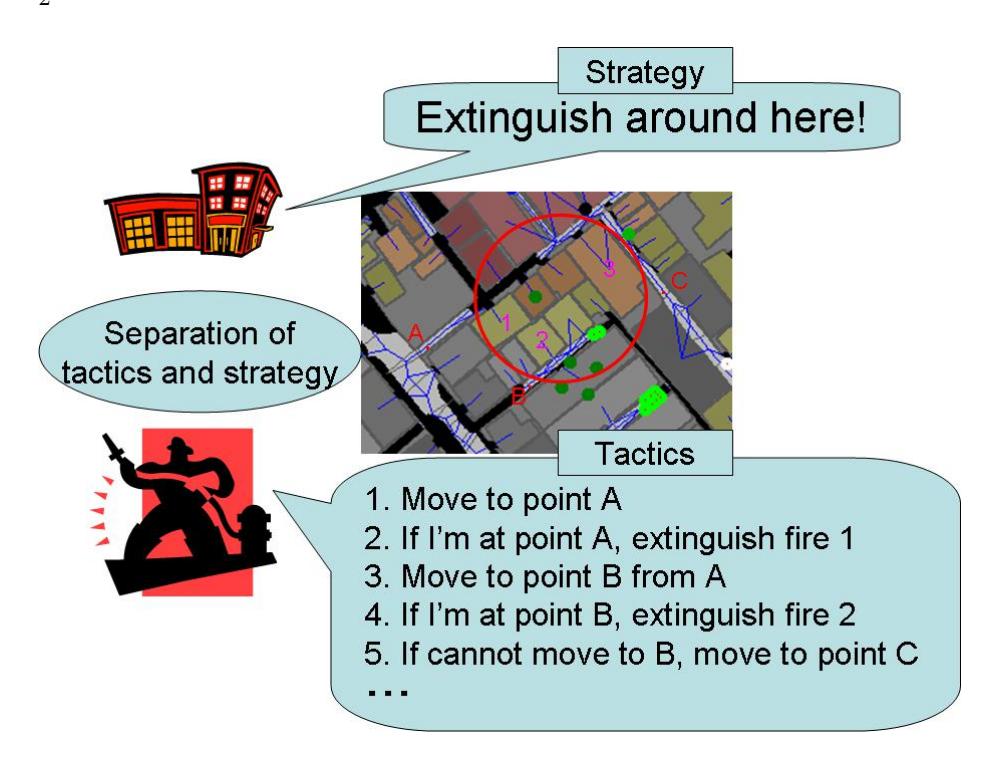
To solve the problem described above, we designed the communication library.[^1] By using the library, it becomes easy to separate the development of the command center and development of the agent. In other words, we can easily separate strategy and tactics. "Strategy" here means the overall policy in the virtual disaster space, and "tactics" means details for executing the strategy (for example, which fire should be extinguished). Figure 1 shows examples of strategy and tactics.
By separating them, we can easily replace command centers and agents without considering communication protocols.
[^1]: Available at http://sourceforge.jp/projects/rcrscs/releases
2.1 Command Center
The command center gives the agent the directionality of action. For example, the command center gives an order to extinguish a fire at a certain site to some fire brigade agents. Notice that the command center NEVER gives orders about how to extinguish the fire, but only the location. This means that each agent has discretion about how to execute the orders.
The command center must integrate the information coming from each agent, and send back that integrated information to the agents.
Because command centers need to send both the strategy and integrated information, efficient communication protocols are required.
2.2 Agent
Agents determine their actions based on their perception and information sent by centers.
In a communicationable situation, agents must follow the strategy set forth by the command center. Even if the command center has conceived good strategies, if the agents execute the strategies poorly, the response effort will deteriorate. Therefore, it is important to develop agents that can perform orders efficiently.
However, in a non-communicationable situation, agents must be implemented to take action without any orders or integrated information.
2.3 Protocol
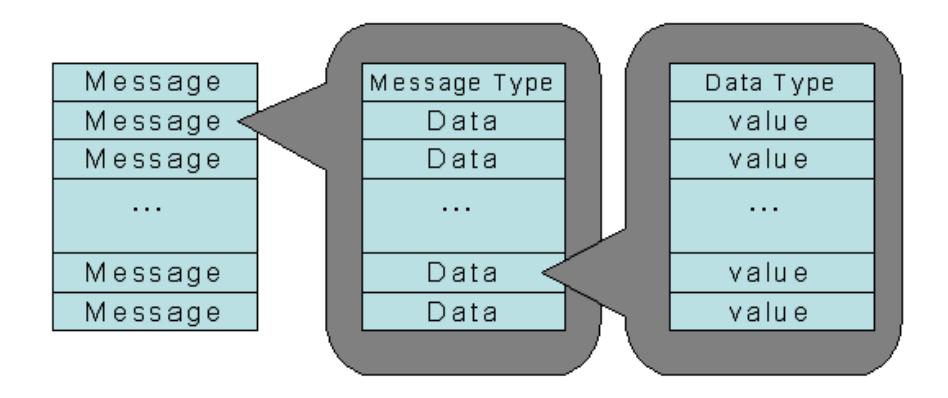
A conceptual diagram of the data structure in the library is shown in Fig. 2. The transmission data consists of some Message, and each Message consists of some Data with Message Type. Moreover, each Data is composed of Data Type and some value.
Message
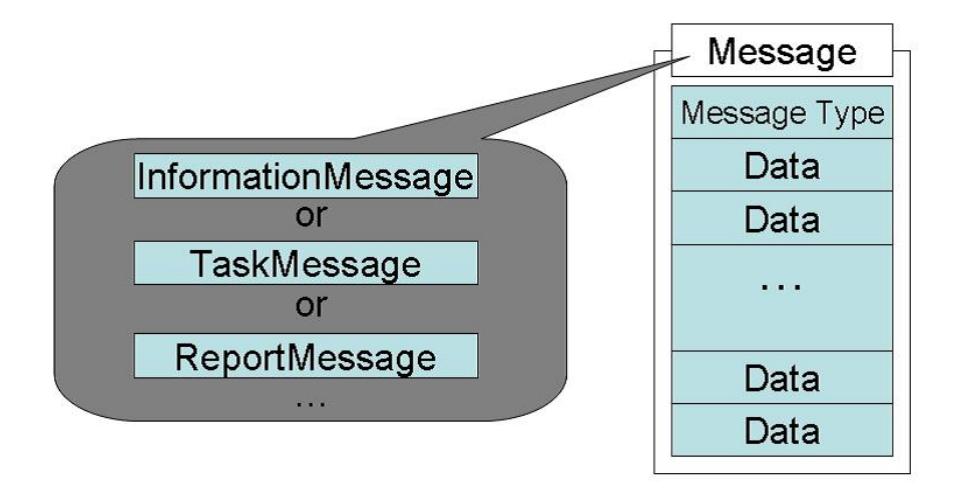
The Message shows transmitted information (Fig. 3), and the Message Type expresses what kind of information the Message is.
Each Data shows the element of information included in the Message. Different types of Message have different numbers of Data. There are three main types of Message (Information Message, Task Message and Report Message).
The Information Message is the Message to transmit information obtained from the disaster space, such as brokenness and fieryness. The Information Message is used to share the information between agents and command centers.
The Task Message is used to send the order to agents from the command center. The agent that receives the Task Message acts according to the order included in the message. When an agent is instructed to do different tasks at the same time by two or more command centers, higher priority is given to the task sent by the center to which the agent belongs (for instance, if the agent is in a fire brigade, the command center is a fire station). Moreover, each agent is also able to send a Task Message to other agents for coordination in a command center-less situation. However, when command centers are communicationable, the Task Message sent by the command center always gets higher priority.
The Report Message represents a report that contains the result of the instructed strategy. For example, there is a Message named the Exception Message, which reports that the instructed strategy was impossible to achieve in the agent's situation.
Data
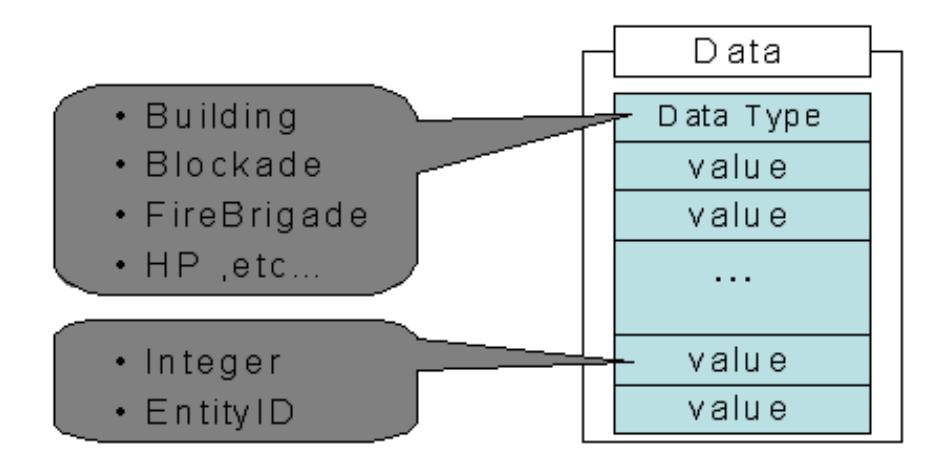
The Data shows the element of information included in the Message (trapped civilian, building on fire, and so on)(Fig. 4).
The Data Type expresses what kind of element the Data is, and value shows an actual value of the Data. Only Integer or EntityID can be substituted for value. Different types of Data have different numbers of value. For instance, some Data have one element of an integer that shows physical strength, and other Data have some element of EntityID in the Data, which show tracks of movement.
2.4 Types of Messages
In this section, we describe the details of each Message defined in this library.
Information Message
The Information Message shows information obtained from the disaster space. It doesn't include static information (outline of roads, gross area of building, etc.) to reduce the size of data. Table 1 shows the types of Information Message and the elements included in it.
The Building Message represents information on the building that includes brokenness and fieryness. The Blockage Message shows information on blockages. The Victim Message contains information on civilians. The Position Message represents location information of each agent. The Transfer Message shows the movement locus of each agent. The FireBrigade Message, PoliceForce Message and AmbulanceTeam Message show information on each kind of rescue agent. Here, the items with an asterisk(*) in Table 1 are optional items. The developer can include the item or not.
Table 1. Definition of Information Message
| Information Message | Elements contained |
|---|---|
| Building Message | fieryness,brokenness |
| Blockage Message | road ID,barycentric coordinate*,repair cost |
| Victim Message | area ID,HP,buriedness,damage, position coordinate* |
| Position Message | agent ID,position coordinate |
| Transfer Message | agent ID,IDs of some area |
| FireBrigade Message | agent ID,HP,buriedness,damage,water quantity, area ID |
| PoliceForce Message | agent ID,HP,buriedness,damage,area ID |
| AmbulanceTeam Message | agent ID,HP,buriedness,damage,area ID |
Task Message
The Task Message gives the order (e.g. help civilians in area). However, this Message does not order agent behavior directly. This type of message provides only the direction of the behavior. The type of Task Message and the included elements are shown in Table 2.
The Clear Route Message is the Message for police forces to clear blockages in a road connecting two areas. The Rescue Area Message is the Message for an Ambulance Team to find and rescue civilians in a specified area group. The Extinguish Area Message is the Message for Fire Brigades to fight fire around a specified area group. These Messages add flexibility to the actions the agent can take to execute the order.
Table 2. Definition of Task Message
| Task Message | Elements contained |
|---|---|
| Clear Route Message | pf ID,ID of work beginning area,ID of end of work area |
| Rescue Area Message | at ID,rescue work area ID list |
| Extinguish Area Message | fb ID,extinguish work area ID list |
Report Message
The Report Message reports the results of each strategy. The types of Report Message and the included elements are shown in Table 3.
The Done Message reports that the given strategy is completed. The Exception Message reports that the ordered strategy was impossible to complete at that moment, e.g. Could not go to specified location and extinguish fire.
Table 3. Definition of Report Message
| Report | Elements contained |
|---|---|
| Done Message | agent ID |
| Exception Message | agent ID |
3 Learning with Library
Our team used machine learning for the decision-making of the command center by using the library introduced in the previous chapter. As mentioned, when the team is developed using the library, the command center plays the role of giving orders to the agent. Thus, command centers can determine the most important region in the disaster space at that moment. From the learning result, the command center can send more effective orders to the agents.
3.1 Police Office
In our team, the Police Office informs the police force about which roads should be opened. At this point, roads leading to buildings on fire or containing civilians take priority.
Thus, the police office must determine the priorities of roads to open. We use machine learning such as SVM from the point of view of the probability of civilian presence, the importance of the building and so on[2].
3.2 Ambulance Center
The Ambulance Center informs the Ambulance Team which areas have high priority for executing rescue operations.
However, it is difficult to optimize which areas have high priority. Let's suppose a situation where two civilians, A and B, have been found. There is fire near civilian A, but he/she still has enough physical strength. On the other hand, the physical strength of civilian B is limited, but a refuge exists near B. In such a situation, it is difficult decide which civilian must be rescued first.
Then, we use simulation logs and a machine learning algorithm such as the Bonanza Method to learn the priorities of rescue order [3]. The Bonanza Method can generate an effective evaluation function of the phase various factors involve, even if an enormous feature vector is generated. Our team calculates the evaluation value of the phase that the victim was rescued, and this value is expressed as his priority. By using this result, the Ambulance Center decides the area in which to execute a rescue operation with high priority.
3.3 Fire Station
The Fire Station informs the fire brigades of the most important area in the disaster space to achieve effective fire fighting strategies.
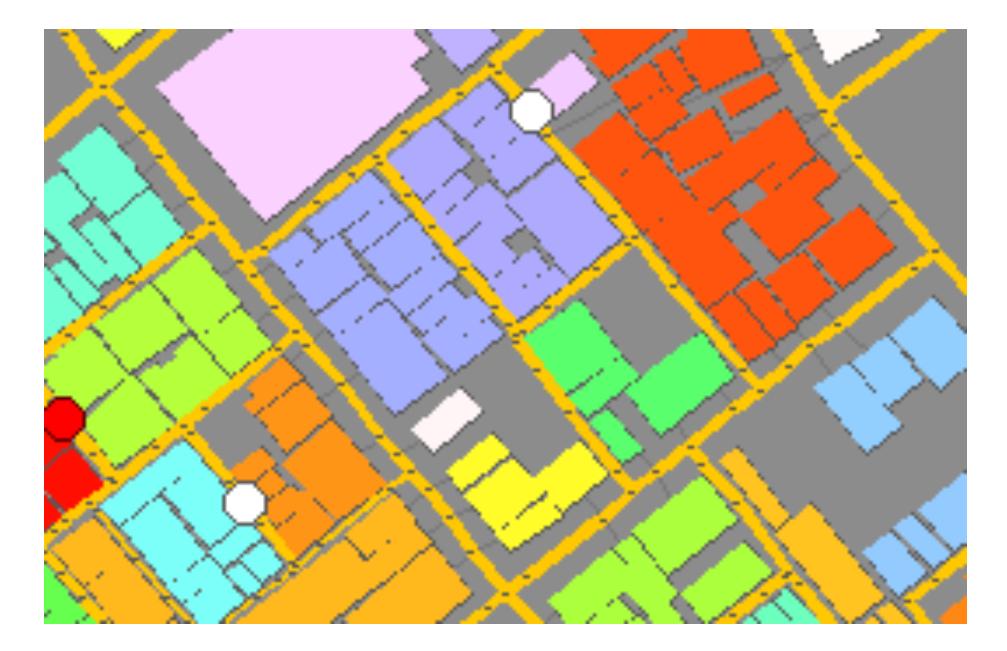
To achieve effective fire fighting strategy, we use the concept of a FireSite [4]. A FireSite is a cluster of buildings in which there is high possibility of fire spreading. Figure 5 shows an example of a FireSite. In this figure, buildings with the same color belong to the same FireSite.
If a fire in FireSite A becomes so large that it threatens to burn all of the buildings, agents must try to extinguish it to stop inside FireSite A. In such a case, the fire station must assume that the FireSite A has become the most important area in the disaster space.
In our team, the important FireSites are learned from simulation logs by using a machine learning algorithm. The parameters for learning algorithms are the size of the building and the strength of the fire.
References
- RoboCup Rescue Simulation Wiki. http://sourceforge.net/apps/mediawiki/roborescue/.
- C.J.C. Burges. A tutorial on support vector machines for pattern recognition. Data mining and knowledge discovery, 2(2):121–167, 1998.
- K. Hoki. Optimal control of minimax search results to learn positional evaluation. Joho Shori Gakkai Shinpojiumu Ronbunshu, pages 78–83, 2006.
- T.Ohta , F.Toriumi. RoboCupRecue2010-Rescue Simulation League Team Description. 2010.