Introducing the New Air Simulator as a Standard Simulator in Rescue Simulation
Pooya Deldar Gohardani, Peyman Ardestani, Siavash Mehrabi, Mohammad Amin Yousefi
Mechatronics Research Laboratory, Islamic Azad University, Qazvin Brach, Qazvin, Iran
Abstract Regarding to the importance of studying the behavior of toxic gases and their impact on urban areas and also providing a standard framework for studying stigmergy and swarm intelligence in multi-agent systems using pheromones, we have designed and implemented a new simulator called Air Simulator based on the standards of RoboCup's Rescue Simulation System. Based on the Air Simulator we have also provided a few other simulators like toxic gas simulator, smoke simulator and pheromone simulator.
Keywords: rescue simulation system, urban disaster, toxic gases, gas dispersion simulator, Pheromone, stigmergy.
1. Introduction
Regarding to the fact that the disaster occurrence in crowded urban areas could threaten thousands of people's lives, anticipating and studying incidents that could lead to a crisis is vital. One of the systems especially designed for this task, is the Rescue Simulation System [1]. Since this system was provided in 2000, great improvements have been made on it but, there is still a long way to go until having a perfect Rescue Simulation system, one of the things which is missing is a gas simulator. Because an earthquake may set some buildings on fire, break gas pipelines or damage the gas storages [2,3,4]. In this case the smoke, natural gases or toxic gases can be dispersed in the environment. The existence and effect of such gases have not been included in Rescue Simulation System. Considering that the rescue simulation System is a multi-agent system, it is a good platform for researches in stigmergic[5,6,7,8] and swarm intelligence[9] fields. This project needs an appropriate field which can provide a way to use pheromone for agents, also this will require a simulator itself that has capability of simulating gas behavior of pheromone in simulation system.
To meet these demands, we designed air simulator based on current standards of Robocup Rescue Simulation System and based on this simulator, two samples of gas dispersion simulator and pheromone simulator have been designed and implemented. In addition based on the capabilities of our platform other applications of air simulator will be introduced and implemented.
In first section, air simulator, its structure and entities are described. Then we will discuss about gas simulator and introduce pheromone simulator. After the introduction of implemented simulators, we will talk about other applications of air simulators and other added features in further section and finally we will make a conclusion and list the references.
2. Air simulator
Air layer is a new entity in system which is added based on Robocup Rescue Simulation Systems' standards and in format of air simulator.
<
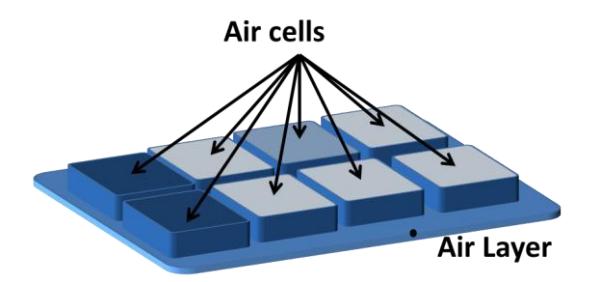
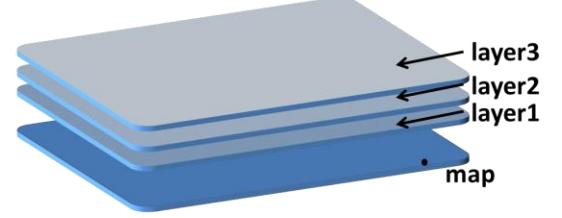
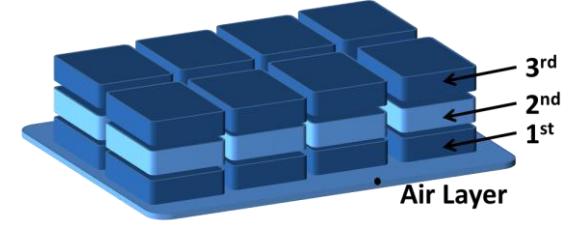
Each air layer can be defined as a new entity in the system; this layer is defined as a matrix. Each of the matrix's elements contains an entity which is called air cell. An air cell inherits characteristics of defined gas in that layer. Because the air simulator is designed for simulating the behavior of different types of gas, we can consider an air layer for each type of gas.
This air layer contains chemical and physical features of the gas, like dispersion speed, half-life and effects on civilians and agents. Also the point or the points of gas dispersion in air layers are specified in air cells based on its coordination in air layer matrix.
2.1. Gas Dispersion Simulator
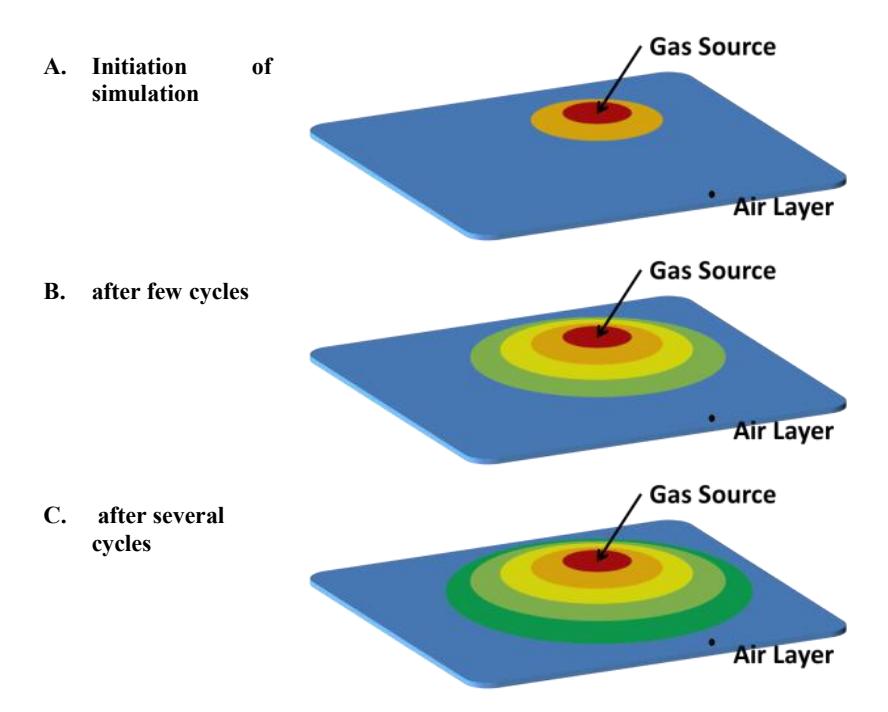
Gas dispersion simulator is connected to each gas layer independently and simulates the changes in gas dispersion. Initially no gas is placed in the air cells so nothing will happen while the entire cells are empty. But if for any reason, like gas leakage, smoke or placing pheromone by an agent, simulator finds gas in an air cell, it will initiate the process of gas dispersion simulation based on the gas's physical characteristics.
Gas dispersion models are studied in a few general experimental models included: Box model, Gaussian model, Lagrangian model, and Euler model [10]. Experimental models are applied for uniform and continuous release and the features of these models are simplicity and low cost of process [11]. Thus we use Gaussian model in our simulation. In general form, the gas dispersion in Gaussian model for gas leakage from source is computed by formula 1 and the gas amount in new coordination is computed by formula 2.
$$Q_0 = C_d A \rho \sqrt{\frac{2(p - p_0)}{\rho} + 2gh}$$
$$C(x,y,z) = \frac{2Q_0}{(2\pi)^{1.5}\sigma_x\sigma_y\sigma_z} e^{\frac{(x-x_0)^2}{2\sigma_x^2}} e^{\frac{-(y-y_0)^2}{2\sigma_y^2}} e^{\frac{-z_0^2}{2\sigma_z^2}}$$
In formulas above, $Q_0$ is leak rate, $C_d$ is leak coefficient, A is gap, $\rho$ is liquid density, $P_0$ is environment pressure, P is substance pressure before leakage, g is acceleration of gravity, h is liquid above the gap, $C_p$ is specific heat at constant pressure of gas, T is temperature before leakage, $T_0$ is boiling point at normal pressure, H is heat of vaporization, $C_{(x,y,z)}$ is concentration downwind of the point (x,y,z), $z_0$ $x_0$ $y_0$ are coordination of the center of mass of air, $\sigma_x$, $\sigma_y$ and $\sigma_z$ are dispersion coefficients in each of the directions x, y, and z.
If a particular gas dispersion occurs, initial amount of leaked gas is placed an air cell. This amount of gas will be dispersed in next cycle of simulation by gas dispersion simulator in environment.
If the gas is released like a puff in a cycle, its value will be reduced based on configuration file until it completely wipes out. This condition will happen, if the source which contains toxic substances explodes. In this case formula 2 is only used in calculations, but if leakage of toxic substances is happening, first we use formula 1 to calculate the leakage and then we use formula 2 to apply gas dispersion.
If the affected area of two sources has overlap, the final value is gained from formula 3 by adding effects of distinct sources.
$$C_{total}(x, y, z) = \sum_{i} C_{i}(x, y, z)$$
You can see a sample of gas dispersion in the figure 4:
2.2. Toxic Gas Dispersion
In times of disasters like earthquake or other humanitarian disasters, there might be toxic gas dispersion in urban areas that threatens people's lives.
Toxic gases have many different varieties. These gases have different dispersion models, different dispersion speeds and different dispersion types thus there are too many simulation projects have been carried out to simulate the certain group of gases. Many examples of these models are categorized in [6]. In terms of behavior, gases are classified in 3 categories: lighter than air, natural gases and heavier than air. Generally, toxic gases are heavier than air because of their molecular mass or because of their low temperature they have higher density. These heavy gases can remain on surface so they can infiltrate in urban areas and cause poisoning civilians or even death.
Considering what is discussed about toxic gas characteristics, we assume the height of air layer as a 2D layer with height 1 in the simulation. If a civilian is located in a cell which contains toxic gas, the air cell inflicts damage to the civilian. The amount of this damage in each cycle is calculated from formula 4 then the civilian damage will be updated by formula 5.
$$D_{gas} = C_{total}(x, y, 1) * \gamma_{gas}$$
$$Human.setDamage(\sigma);$$
$$\sigma = \sum_{i \in gases} D_i$$
is the amount of applied damage to a civilian. is total amount of air cell gas by formula 3. is gas toxicity degree and is the total amount of damages from different types of gas in a particular air cell.
2.3. Pheromone Simulator
Pheromone simulator is designed for research purpose in fields like stigmergic and swarm intelligence.
What happens in pheromone simulator seems very similar to the toxic gas dispersion simulator but the internal process of these simulators are different. The main difference is that unlike toxic gas dispersion, the agents release pheromones in a particular place, and the other agents can sense the pherpmone in the environment and react. The next difference is the type of released gas, toxic gases generally leak continuously from the source and their pressure changes according to formula1, but pheromones are released in liquid, solid or gas form to the environment based on its type. In this case computing the amount of released substance depends only on half-life of the substances. Also in this case the degree of toxicity of pheromone is not necessarily non-zero but it can be considered as zero in certain circumstances and to implement some of the stigmergic behaviors.
2.4. Smoke Simulator
After an earthquake there can be a lot of smoke all over the urban area due to the possible explosions and buildings on fire, which can greatly effect on the performance of rescue agents by limiting the visual of land and aerial units and inflicting damage to the civilians, exposed to the dense smoke.
The smoke can expand near the ground or form a palm in the sky, depending on its volume and density. So we need a 3D simulator for smoke simulation.
3. Config File:
Q0: 0-100
Cd: 1-10
p: 1-10
: 0.5-1.5
h: 10-150
σ 0-1
σ 0-1
σ 0-1
4. Conclusion:
In this paper we introduced the air simulator as a platform for different research purposes that enabled us to implement simulators like Gas Dispersion Simulator, Toxic Gas Dispersion Simulator, Pheromone Simulator and Smoke Simulator, for studying the behavior of toxic gas, pheromone and smoke in rescue simulation system. Also the pheromone simulator is a helpful tool for experimenting in multi-agent stigmergic and swarm intelligent fields.
References
- Tadakoro, S., Kitano, H., and Takahashi, T.,The RoboCup-Rescue project: a robotic approach to the disaster mitigation problem, San Fransisco: IEEE, (2000).
- Robert l. buckley, Charles h, hunter, Robert p. addis, amd ,attew j . parker," Modeling dispersion from toxic gas released after a train collision in Graniteville" savannah river national laboratory, aiken, sc. Technical paper, issn 1047-3289, j. air & waste manage. Assoc, 57:268-278 (2007).
- Bourdeau P. and Green G., Methods for Assessing and Reducing Injury from Chemical Accidents, John Wiley & Sons Ltd., (1989).
- Marc J. Assail, Konstantinos E., fires, explosions, and toxic gas dispersions, effect calculation and risk analysis, CRC press,. ISBN : 978-1-4398-2675-1, (2010).
- Grassé, P. P., La Reconstruction du nid et les coordination interindividuelles chez bellicostermes natalensis et cubitermes sp. La Theoriede la stigmergie: Essai d'interpŕentation du comportement des termites con-structures. Insectes Sociaux, 6, 48-83, (1959).
- Holland, O .Melhiush, C. Stigmergy, self-organization, and sorting in collective robotics, University of the West of England.
- Van Dyke Parunak,H. Expert Assessment of Human-Human Stigmergy , Altarum Institute ,Defence R&D Canada , Copyright © Her Majesty the Queen in Right of Canada (2005).
- Marsh, L., & Onof, C. Stigmergic epistemology, stigmergic cognition, Cognitive Systems Research, (2007).
- Bonabeau, E., Dorigo, M., and Theraulaz, G., swarm intelligence: from natural to artifitial systems, oxford university press, New York, USA, ISBN: 0-19-513159-2, (1999).
- Turner, D., Workbook of atmoshpheric dispersion estimate, CRC press inc, (1994).
- At,pspheric dispersion modeling resources, 2nd edition, United State Department of energy emergency management advisory committee subcommittee on consequence assessment and protective action, (1995).