RoboCupRescue 2015 – Rescue Simulation League Team Description <SEU_Jolly(P.R.China)>
Wei Niu, Jie Wu, Hangzhou Wan, Changwang Yuan, Kaikai Wang
School of Mechanical Engineering, Southeast University
Abstract In this paper, a task-state based decision making method will be introduced. Then we build an effective communication system structure. A new clear method and a new classification of clearing tasks are proposed to improve the performance of police forces. In order to get a better understanding of fire, a simplified fire propagation model based on the principle of fire simulator is implemented. And a centralized assignment approach is put forward to allocate limited fire brigades to various fire sites.
1. Introduction
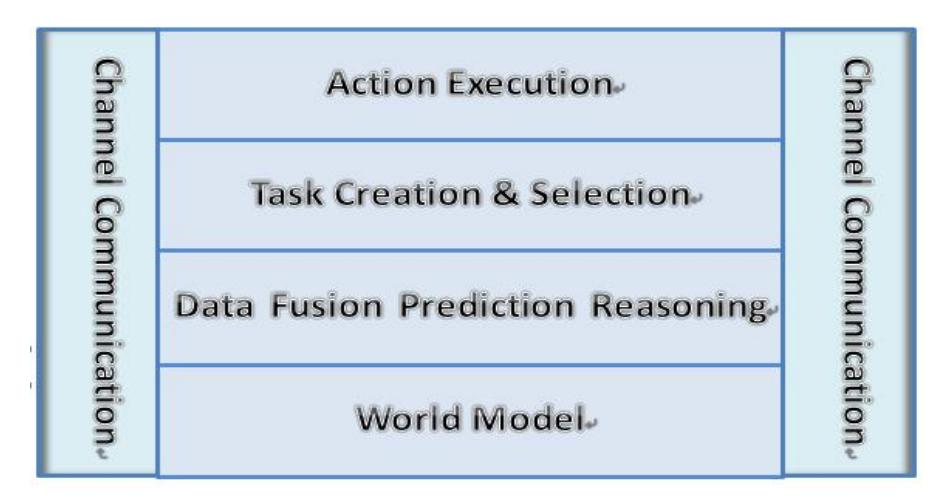
RoboCup Rescue Simulation System (RCRSS) is a large-scale Multi-Agent System (MAS) of urban disasters. In such a dynamic, partially observable environment, the action decision making is always the primary problems which needs to be effectively solved. Our code structure is shown in the graph below.
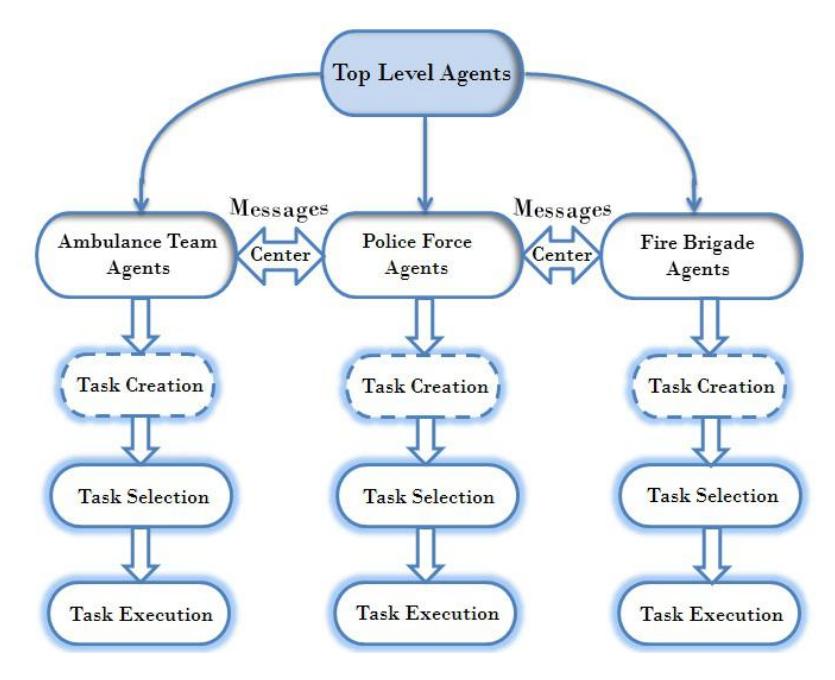
The effectiveness of decision making needs a complete and accurate world modeling. So, we established different channel based communication models in diversified disasters for information sharing: the typical communication model and communication model under no center conditions. The latter model has some profitable characteristics such as adaptability, minimum time delay and virtually equally distributed channels. These characteristics especially enable us to build a more realistic world model under certain sharp conditions. As for decision making, we use task-state based decision method. A simplified decision process is shown in Fig.2. Basic low level action of moving is addressed to fulfill different needs of our agents in such a dynamic and uncertain system.
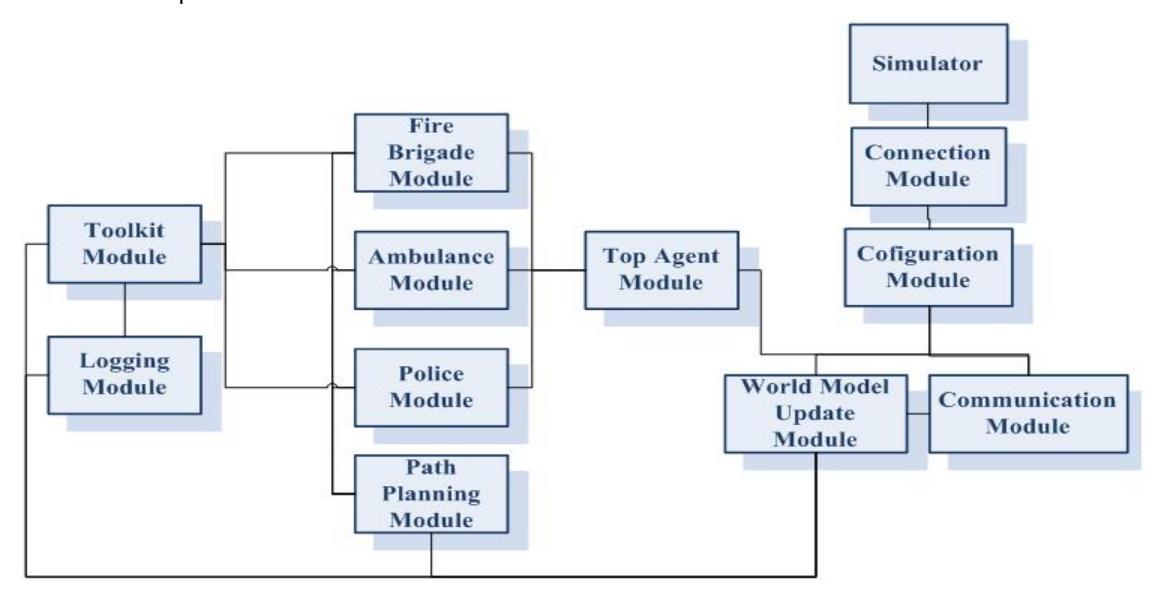
Our main code structure is as Fig.3. There are 12 modules in our code. The most important modules include communication module, world model update module, path plan module and top agent module. They are the basic modules to construct all the code. The knowledge base of task-state decision module is updated by the world model update module. The communication module helps to update the world and execute the agents' command. Path plan module is a basic module that every kind agent must use it to get a path to the destination. The BFS method is low efficiency, so we do some efforts to improve it. We use traditional a star method to explore the path. The top agent model is the agent task manage center. The 3 kind agents' common task is done in this module and the world model update module is also called in this module.
2. Communication
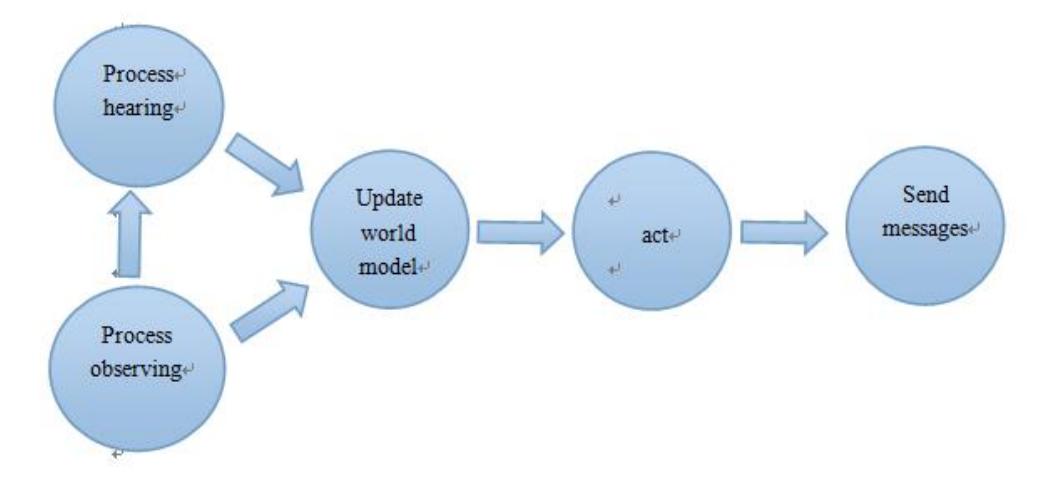
Every platoon agent will do the following things in each period of simulation:vision processing, hearing processing and then update world model. After all information is handled properly, decisions will be made,actions will be taken, and messages will be sent. Obviously, communication is of great significance to this process,and we have put large effort to promote our communication system.
2.1 Identify essential messages
In order to accomplish various tasks, different agents need different messages to support decision making. Previously, there are more than 30 kinds of messages in our code, but the essential messages are real.
Table 1: The essential messages
| agent | The types of messages | The composition of the message |
|---|---|---|
| Ambulance Team | humanIsBuriedMessage | HumanID、Damage、Buriedness、HP、PositionID |
| humanIsRescuedOrDiedMessage | HumanID | |
| Police Force | humanIsStuckMessage | HumanID、PositionID |
| humanIsFreeMessage | HumanID | |
| Fire Brigade | buildingIsBurningMessage | BuildingID、Temperature、Fireyness |
| buildingIsExtinguishedMessage | BuildingID | |
| buildingIsBurningOutMessage | BuildingID | |
| All platoon agents | positionMessage | PositionID |
2.2 Optimize messages
Messages is made up of some important components like HumanID、PositionID、BuildingID. The EntityID of the platoon is known while initializing, so we try to translate ID into label to make messages briefer. Table 2 shows couples of maximal ID in different maps and the label we translate into.
Table 2: A contrast about roads and buildings in different maps
| map | Road Maximal RoadID | Road Number of roads | Building Maximal BuildingID | Building Number of buildings |
|---|---|---|---|---|
| Kobe | 36512 | 1602 | 36476 | 757 |
| VC | 53374 | 1954 | 53536 | 1263 |
| Joao | 29714 | 3467 | 19715 | 879 |
| Istanbul | 68971 | 3337 | 68976 | 1244 |
| Paris | 63477 | 3025 | 65236 | 1618 |
| NY | 78694 | 3467 | 29245 | 2900 |
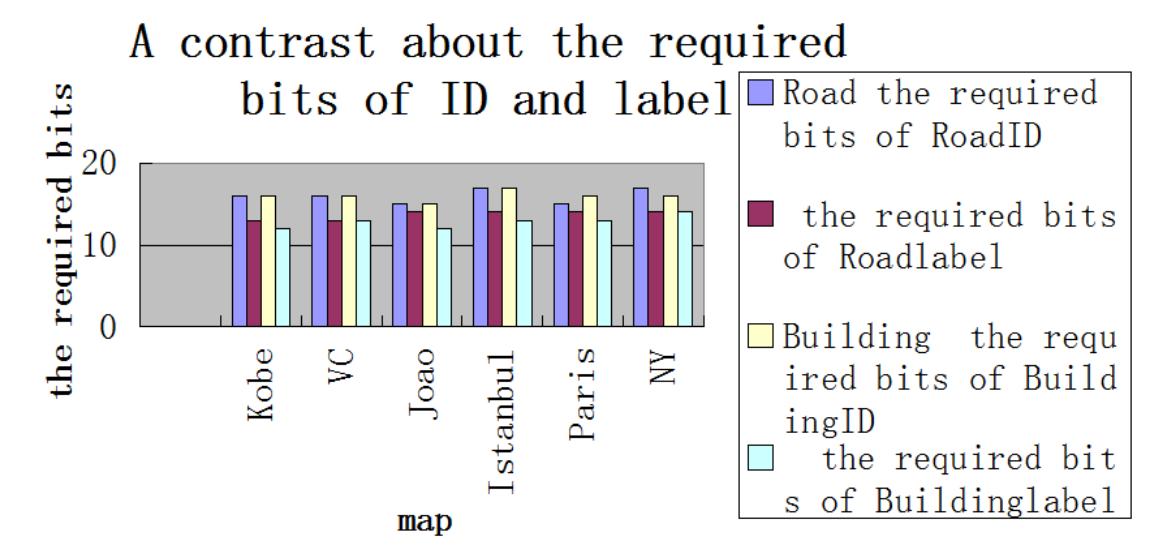
2.2 Optimize messages (continued)
It's obvious that translate ID into label can make messages briefer and greatly reduce required bits, which is extremely useful when communication is poor.
2.3 Compress messages
Compress means using less bits and containing more information. For example, HP is range from 0 to 10000, and it will take 14 bits to describe HP. We have done some mathematical processing to HP, HPBit=10000/322=31. By this means, five bytes can describe HP clearly.
2.4 Message filter
When there is no center agent and the communication condition is poor, messages can be inaccurate. A message filter is proposed to help agents screen messages according to the visual information, and eliminate interference information. Figure 6 shows the filter mentioned above.

Police Forces
The performance of police forces affect the mobility of fire brigades and ambulance teams, and thus, indirectly, their ability to fulfill their tasks. And the efficiency of clearing is affected greatly by the clearing method.
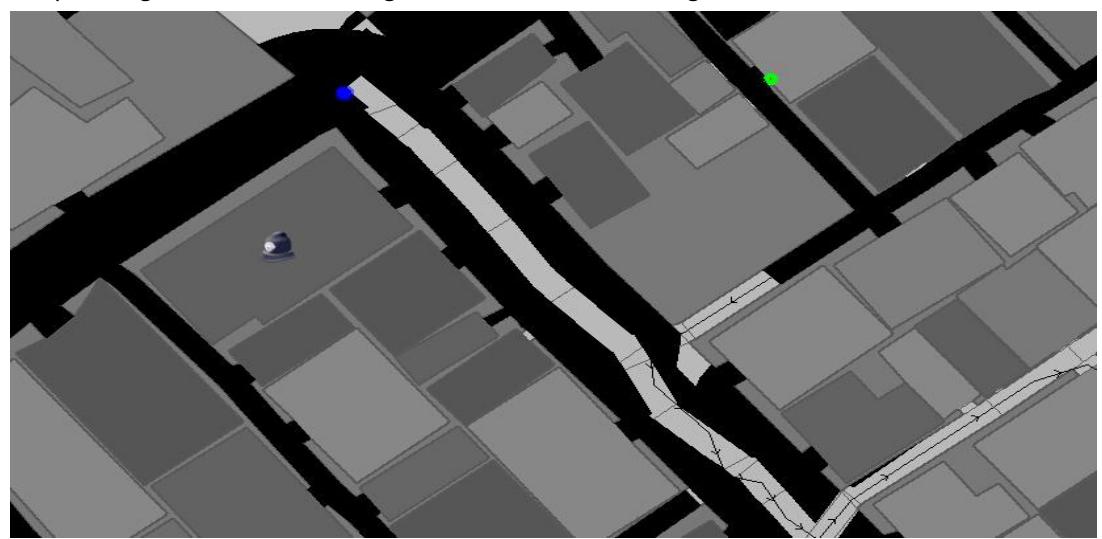
Police forces clear roads by specifying the location and rotation of the effective clearing rectangle. Thus, the main challenge is how to optimize the clearing rectangle. In light of MRL's clear tools, we build a new clear method to make sure police agent moves along the centerline of the planning road toward the target. Its effect is shown in figure 7:
Based on our previous work, the task priority based approach is still used. A new classification of clearing tasks is introduced and tasks are divided into two levels:
Level 1: i) ObservableTask –the targets police can see currently.
ii) NearTask – the targets police seen recently.
iii) AllTargetTask – the targets police get from all approaches including communication.
Level 2: As targets of different tasks are different, all types of Level 1 tasks can be further subdivided. For example, clearing observable tasks can be divided into clearing observable stuck-agent task, clearing observable refuge, clearing observable gas station, and so on.
3. Fire Brigades
The firefighting task can be decomposed into some subtasks, and the two most important subtasks are:
1- Have a clear understanding of the fire.
2- Allocate limited resources (fire brigades) to various fire sites.
Efficient communication is necessary for the first subtask. Besides, we also set up our own simulator modeled on the mechanism of the fire simulator to estimate the spread of fire. The specific process of updating building temperature is shown below:
Updating of building fuel.
Updating of building energy.
Updating of building's water quantity.
Radiation process.
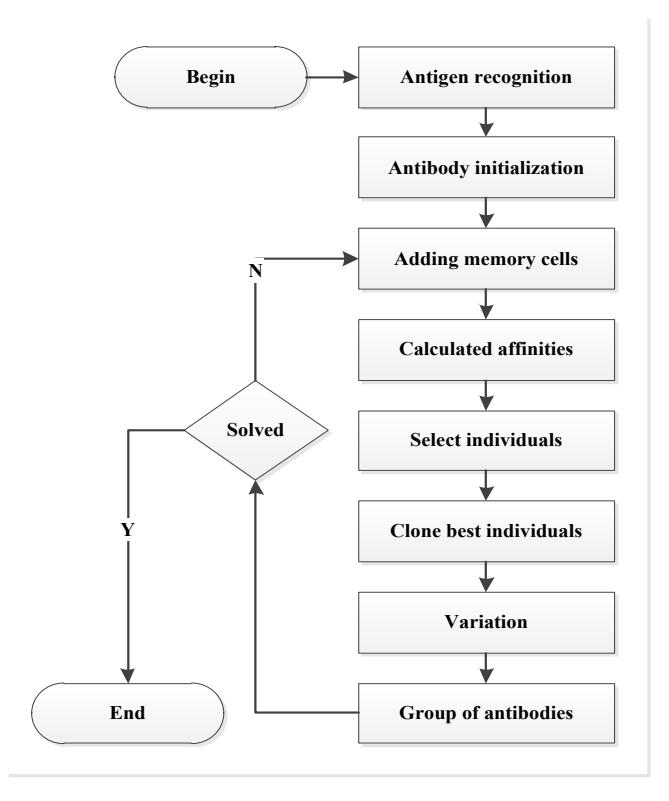
This paper proposes a solution for the second subtask based on the center agents. Center agents collect information through communication between agents, and clustering analysis is used to process the collected information. The method this paper puts up with is based on improved artificial immune algorithm, and can be realized through the following steps, as shown in Fig 8. Memory cells can help to store excellent solutions, which can be used as initial antibodies in the next round of clustering to make the whole process dynamical and at the same time speed up calculation.
The clusters of burning buildings will be accessed accordingly and make assignments to fire brigades based on heuristics. If a fire brigade is not assigned, then he will choose a cluster himself. Then fire brigades should choose a specific building to extinguish. We put forward a weighted model to help evaluate the importance of all the burning buildings within the cluster. While center agents are default, some field agents are made act on behalf of centers. Tests show that this method work well in dealing with small maps (like Kobe) and maps with few initial fire spots, because fire brigades tend to gather together. This tendency may results in the decrease of the efficiency of search.
Some improvements are also made in other aspects. In order to delay the spread of fire, we try to pre spray the large buildings which are in the direction of the spread of fire. Although the effect is limited, but tend to play a critical role. We also made a lot of efforts in dealing with the hydrants, because using hydrants to refill water can effectively reduce the moving distance. The main challenge here is how to determine whether a hydrant is occupied to prevent multiple agents from choosing the same hydrant.
References
- RoboCup-Rescue Simulation Manual, RoboCup Rescue Technical Committee (2000).
- Wei Niu, Shuang Cai, Jie Wu. SEU_Jolly 2014 Team Description.
- Huang Zhourong, Guan Daqi, Shi Fabin. SEU_Jolly 2012 Team Description.
- Guan Daqi, Ouyang Jin, Wang Huijun. SEU_RedSun 2011 Team Description.
- Guan Daqi, Chen Ning, Jiang Yinhao. SEU_RedSun 2010 Team Description.
- Meng Qingfa, Guan Daqi. SEU_RedSun 2009 Team Description.
- Guan Daqi, Xu Yingqiu, Tan Yingzi. Particle Filter Based Study of Fire Forecasting in RCRSS.
- Jiang Yinhao, Xu Yingqiu, Tan Yingzi. MST & SP Based Traffic Clearing and City Search in RCRSS.