RoboCup 2019 - TDP Rescue Agent Simulation MRL (Iran)
Shiva Zarei, Mahdi Chatri, Shima Mirfattahi
Mechatronics Research Laboratory, Islamic Azad University Qazvin branch, Qazvin, Iran
Abstract In this paper we are going to describe our approaches for RoboCup 2019 competitions in last year's competitions we brought of the basic and important ideas for police force, ambulance team and fire brigade agents strategies and also ideas such as path planning and clustering. but for this competition we have been concentrated more on fire brigade agents strategy.
Keywords: Robocup, Rescue Simulation, Strategy, Fire Brigade
1 Introduction
In the past few years, the MRL team has been ranked first in the RoboCup Rescue Simulation competition. Last year, we focused on the fire brigade and ambulance team strategists and implement some approaches. Also, this year we focused on the fire brigade agent strategies and we are trying to improve it.
One of the important problems in the RoboCup Rescue Simulation is to spread and control in various areas. To solve this problem, we have used the model of temperature and fire spot prediction based on the gray system theory. Another problem for the fire brigade is how they propagated in fire clusters. To solve this, we have used an approach that our agents can cover all the fire clusters. In the following sections, we will introduce these approaches.
2 modules
In the last year we implemented the most important ones like the K-Means [1] algorithm for clustering and A * [2] for path planning. This year we have no plans for specific modifications or new implementations for these types of modules.
3 Strategy
As we said before in the introduction section, our improvements and developments for this year are focused on using previous experiences and ideas we reached during last events. Considering this idea, we decided to concentrate more on our Fire brigade and ambulance agents.
3-1 Fire Control and Extinguish
In order to give fire brigade a better way to control and extinguish the fire, we used temperature and fire point prediction models based on Gray system theory. In the previous method, however, the focus of the model was on extinguishing only burning buildings. In this competition we used the "Pre-Extinguish" method, which allows effective control of fire spreading process by managing unburned buildings around burning area. In this method, the temperature of buildings can be predicted for the next one or two cycles. This would enable us to see which buildings are going to catch fire next, so a plan could be made accordingly.
In this article, the fire control process based on the Gray theory prediction algorithm will be executed with a very incomplete and dynamic set of data. The original fire spot is random, but its neighbors' temperatures are growing higher with the persistent overheating of the burning building. Companied with the heating, the neighbor buildings warm easily over the ignition point and then catch fire, which will lead to another inferno around them and further chain reaction. So the tendency of ignition here is not clear for the neighboring buildings, yet not burning, are unrecognized whether they would be on fire the next simulation cycle.
Gray prediction is used to solve this problem and to ensure that the dynamic property of temperature variation is adjusted by algorithm features, which crediting the latest variables to prevent errors. In RCRSS, if an extinguish-action is executed in a non-burning building by a fire brigade, the temperature of that building will significantly decrease, which eliminates the probability of further fire spreading.
Pre-Extinguish Process
The steps of this process are as follows:
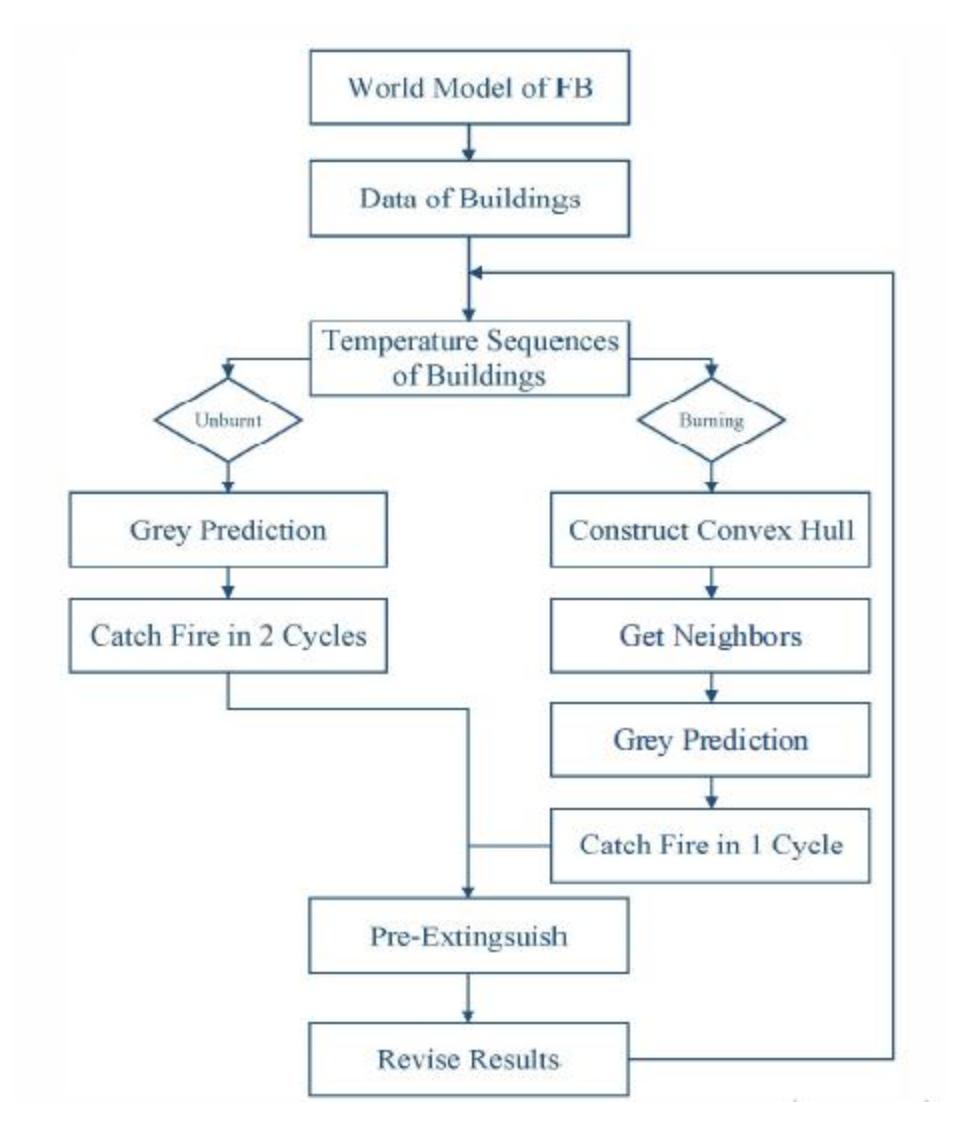
Step 1: Once the data of each building is collected, a number of building temperatures for the last four cycles will be calculated. (Gray theory requirement for future cycle assessments)
Step 2: Building the combustion situation will be evaluated. If the building is not going to catch fire, the process will be skipped to step seven. Otherwise step three will happen.
- Step 3: The convex hull of burning buildings will be determined so that it is easier to select buildings on the edge of the cluster.
- Step 4: Unburned buildings on the edge of the fire cluster will be selected to evaluate their temperature.
- Step 5: Based on the Gray theory, if the building is going to catch fire in the next cycle and firefighting forces are within the water radius, this building will be extinguished.
- Step 6: If another nearby building has Pre-Extinguishing Parameters, it will be targeted for the next cycle.
- Step 7: If the target building in the second step is not burning yet, but it would be in the next two cycles based on the Gray theory, then this building gets extinguished.
- Step 8. To revise the result by contrasting the actual temperature through updated records of sensations and radio communication when the new cycle starts to avoid predicting despite new data updates. This step is the most critical part of the process since it overcuts the curve of the temperature trend in FB's world model it would oscillate and lead to a large deviation and the accuracy of continual prediction would decrease exponentially if the result was not revised. The whole process is shown in figure 1 flow chart.
The proposed model and method in this paper make building temperature and fire control in RCRSS more precise and effective than the previous method we used in the past tests and competitions.
3-2 Find all fire zone
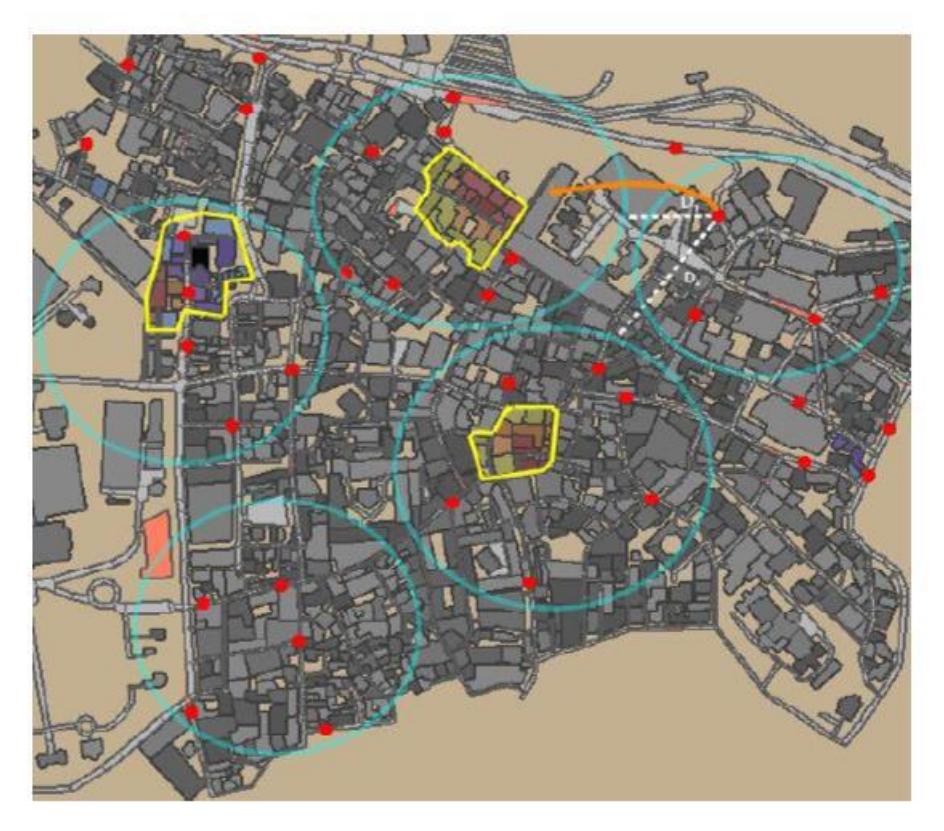
One of the problems of our fire brigade agents is how they propagate in fire clusters. To solve this problem, we have used the idea of measuring the initial temperature of each cluster, which is the temperature of all buildings in the cluster before fire starts. Then, the cluster temperature is updated and compared with the initial cluster temperature in each cycle. If the measured temperature is higher than the initial one, there is a possibility of fire. At this step, the weighting method is applied considering two factors. First, the distance between the agent and the cluster which is on fire and second, the cluster temperature.
Then, the agent chooses the most important cluster based on the weighting method as target. Due to this process, if fire happens simultaneously in different places of the fire map, agents can cover all clusters on fire. In Fig. 2, the process of selecting the fire clusters is shown.
4 Results
To evaluate our approaches, we have tested them on different scenarios against our own previous approaches in the last event. Table 1 shows the results.
Table 1: Comparison of MRL new strategy and MRL latest implementations for RoboCup 2018.
| Team | Paris 2 | Berlin 2 | Istanbul 3 | VC 3 |
|---|---|---|---|---|
| Map | ||||
| MRL 2018 | 68.56 | 140.25 | 213.14 | 127.90 |
| MRL New | 73.20 | 146.68 | 220.56 | 135.49 |
5 Conclusions
In order to the changes we made to the fire brigade agent's strategy:
- Fire brigade agents can work better by predicting the temperature of buildings in the next cycle in the process of controlling the spread of fire.
- Given the randomness of the fire areas, fire brigade agents can cover all of these areas to make the extinguish and fire control faster.
6 References
[1] Steinbach, M., Karypis, G. and Kumar, V. A Comparison of Document Clustering Techniques, University of Minnesota. Technical Report, 2000. [2] Github: ADF Project, https://en.wikipedia.org/wiki/A*search algorithm [3] J.L. Deng, Control problem of gray systems. Syst Control Lett. 1 (5): 288-294, 1982.