RoboCupRescue 2022 TDP Agent Simulation AIT-Rescue (Japan)
Hiroya Suzuki, Akira Hasegawa, Haruki Uehara, Joe Fujisawa, Itsuki Matsunaga, Ryoya Maeda, Yuki Shimada, Kazunori Iwata, Nobuhiro Ito
Department of Information Science, Aichi Institute of Technology, Japan; Department of Business Administration, Aichi University, Japan
Abstract We modeled the RoboCupRescue Simulation as a distributed constraint optimization problem and studied communication volume reduction in the Binary Max-Sum ADVP algorithm. In our experiments, we reduced the communication volume by approximately 97% and confirmed the effectiveness of our approach. However, we cannot implement our ideas on our agents owing to communication limitations. We therefore improved our agents using voice communication. This improvement enables agents to propagate information about civilians to each other and to communicate important information in a timely manner through radio communications. As a result, our agents perform better than they did in 2021.
1 Introduction
The task assignment problem is an important issue for the RoboCupRescue Simulation (RRS). This problem can be expressed as a distributed constraint optimization problem (DCOP) in a multi-agent system. Furthermore, the DCOP can be solved using a DCOP algorithm.
We therefore modeled the task assignment problem of the RRS as a DCOP and applied the Binary Max-Sum ADVP algorithm [4]. However, the DCOP algorithm cannot be executed without an ADF extension environment [2] in the RRS. Additionally, the bandwidth is set for each channel in communication on the RRS, and it is thus not possible to have a large communication volume. We therefore attempted to reduce the communication volume of Binary Max-Sum ADVP. As a result of our efforts, we reduced the communication volume of Binary Max-Sum ADVP by approximately 97%.
However, communication limitations in the RRS do not permit the application of the above mentioned research. We therefore improved on last year's agent by propagating information about civilians through voice communication. Through voice communication, we can avoid the bandwidth pressure of radio communication, allowing the transmission of important messages with sufficient bandwidth through radio communication. This implementation resulted in our agent's score improving from last year in six out of eight scenarios.
Chapter 2 explains the DCOP and Binary Max-Sum ADVP, presents the method of reducing the communication volume of Binary Max-Sum ADVP, and reports on an experiment comparing the communication volume before and after the volume reduction. Chapter 3 describes the modules used in AIT-Rescue 2022. Chapter 4 presents the strategy of each agent implemented in AIT-Rescue 2022. Chapter 5 reports on an experiment conducted to evaluate the effectiveness of the implemented strategy. Chapter 6 summarizes the TDP and discusses issues to be addressed before RoboCup 2022.
2 Scientific topic
This chapter describes the modeling of the RRS task assignment problem as a DCOP and the Binary Max-Sum ADVP algorithm. It also describes the reduction of the communication volume in this algorithm and evaluates the effect of the reduction.
2.1 Distributed Constraint Optimization Problem
The distributed constraint optimization problem (DCOP) is the problem of determining the combination of variable values that minimizes the cost of the variables corresponding to the distributed agents, given the variables and the constraints between the variables [1].
The DCOP is defined by the following five elements. We also explain the modeling of the task assignment problem of the RRS on the DCOP, using the example of a Fire Brigade.
– A = {$a_1, \ldots, a_m$} is a set of agents, where $a_i$ is an agent. In the RRS, it represents the set of all Fire Brigades.
– X = {$x_1, \ldots, x_p$} is a set of variables. However, $p \geq m$, where $p$ is the number of variables and $m$ is the number of agents. In the RRS, the variables represent which tasks are assigned to which Fire Brigades. In other words, each variable is in correspondence with one agent.
– D = {$D_1, \ldots, D_p$} is a set of discrete ranges for a finite set of variables X. $D_i$ is the range of variable $x_i$. Each element of the range is called a candidate value for the variable and is represented by $d$. The combination of any candidate values is represented by $\sigma$, and the combination of all candidate values is represented by $\Sigma$. $\Sigma$ is obtained by the following Eq. (1). Additionally, $\sigma \in \Sigma$.
$$\Sigma = \prod_{i=1}^{p} D_i \tag{1}$$
In the RRS, we consider a set of ranges that represent all the tasks that can be assigned to each Fire Brigade. This paper regards a task as extinguishing a fire in the previous rule and describes an example of Fire Brigades.
– F = {$f_1, \ldots, f_l$} is a set of functions (called cost functions) that represent constraints between variables. A cost function is defined as $f_i : \prod_{x_j \in X_i} D_j \rightarrow \mathbb{R}$. In this formula, $X_i$ is the set of variables whose constraint relation is denoted by $f_i$.
In the RRS, we represent a set of cost functions $f$ with a variable $x \in X_f$, where the variable is a parameter for all Fire Brigades that can be assigned to a task. Therefore, each cost function corresponds to one task.
– $\alpha: X \rightarrow A$ is a mapping function of variables and agents. It represents which agent corresponds to which variable.
The objective function $\mathbf{F}g(\sigma)$ for optimization is defined by Eq. (2). $\sigma{f_i}$ is a combination of only the candidate values corresponding to the cost function $f_i$ from $\sigma$.
$$\mathbf{F}g(\sigma) = \sum{i=1}^k f_i(\sigma_{f_i}) \tag{2}$$
The optimal combination $\sigma^*$ that minimizes the cost of $\mathbf{F}_g(\sigma)$ is defined by Eq. (3).
$$\sigma^* = \underset{\sigma \in \Sigma}{\operatorname{argmin}} \mathbf{F}_g(\sigma) \tag{3}$$
In this paper, the selection of an arbitrary variable $x \in X$ for any candidate value $d \in D_x$ in its range is represented by an ordered pair $\langle x, d \rangle$.
2.2 Binary Max-Sum ADVP
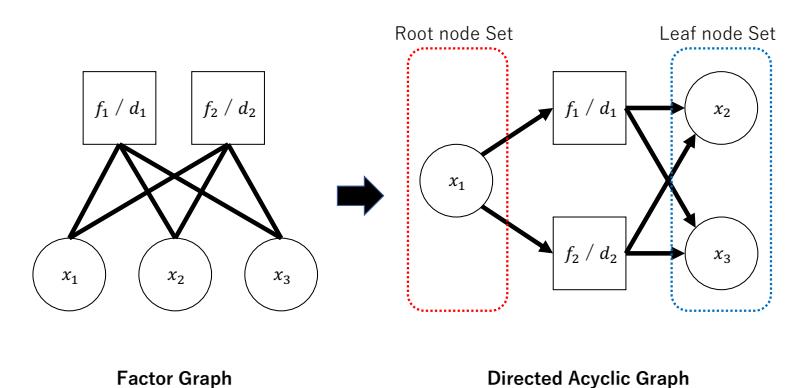
Binary Max-Sum ADVP [4] is a derivative algorithm of Binary Max-Sum [3] with a modified working graph and message content that improve the solution quality. Binary Max-Sum ADVP converts the factor graph in which Binary Max-Sum operates into a directed acyclic graph (DAG), as shown in Fig. 1, thereby eliminating closed paths and guaranteeing convergence of the solution. Additionally, the incorporation of the evaluation value and the variable's chosen value in the message content guarantees that the solution at least does not worsen with an increasing number of message communications. In this algorithm, sending and receiving not only the evaluated value but also the variable value selected by the variable node is called value propagation.
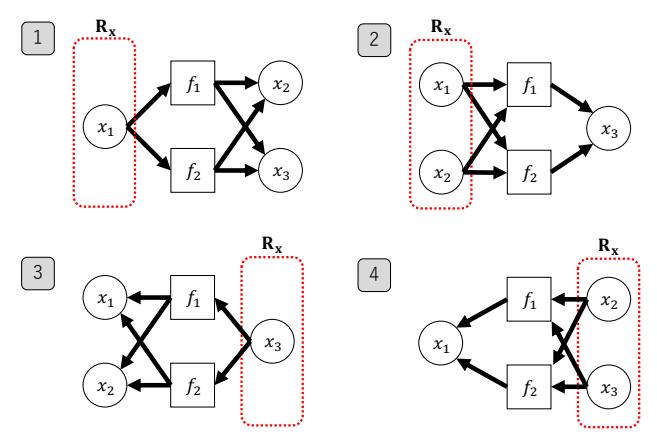
In both a factor graph and a directed acyclic graph, variables in the DCOP definition are represented as variable nodes, and cost functions are represented as function nodes. Edges connect variable nodes and function nodes and represent assignable relationships. During the conversion of the graph, all variable nodes are divided into root and leaf node sets. Which variable nodes belong to the root node set and the leaf node set changes as the algorithm runs. In this paper, the set of all nodes is V, the set of variable nodes is X, the set of root nodes is $R_x \subset X$, and the set of leaf nodes is $X \setminus R_x$. The set of variable nodes has the same definition in the set of variables X in the definition of the DCOP, and it is thus represented by the same symbol. The edges of the DAG are connected from the variable nodes in the root node set to all function nodes, and from each function node to all variable nodes in the leaf node set, as shown in Fig. 1.
2.3 Reduction of the communication volume for Binary Max-Sum ADVP
The RRS has communication limitations. In radio communication, each channel has its own bandwidth, which limits the volume of messages that rescue agents can communicate. In voice communication, there is a limit to the range of messages that agents can send, and only one message can be communicated in one step. Binary Max-Sum ADVP described in Section 2.2 requires much communication and it is thus important to reduce the communication volume.
In this paper, we propose the following method of message reduction.
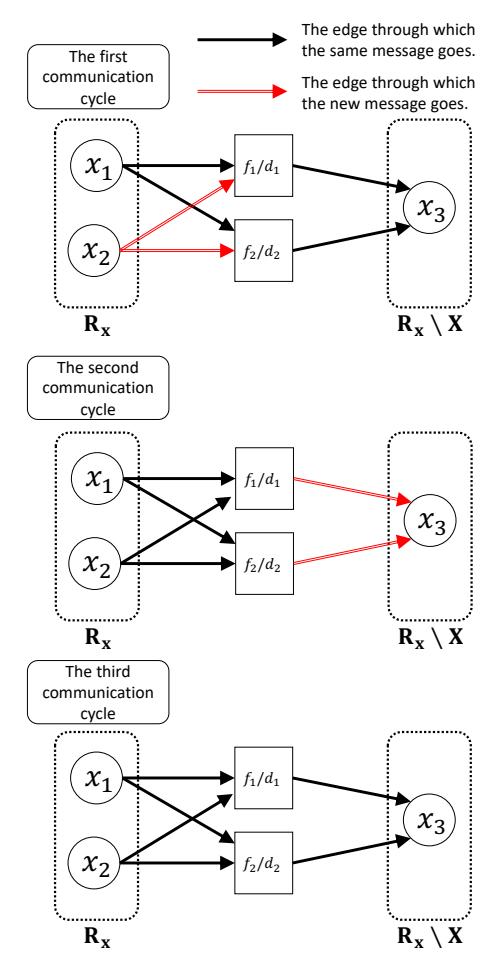
Algorithm behavior and reduction using graph structures In step 3 of the VP phase described in Section 2.2, messages including new content are propagated in the order of the root node set, function node set, and leaf node set as shown in Fig. 3. The reason is that each node calculates the new message to be sent on the basis of the messages immediately before the node received. The contents of these sent messages is then reflected on each node after one communication cycle because the nodes operate synchronously.
Each node calculates the evaluation value to send according to the evaluation value received in the previous communication cycle. In other words, if a message has no new information, no node needs to send the message. Thus, each node stops sending messages below in each communication cycle.
First communication cycle Messages sent by variable nodes that have not been added to the root node set and messages from function nodes
Second communication cycle Messages from variable nodes belonging to the root node set
Third communication cycle Messages from all nodes
Reduction using algorithmic behavior In the communication cycle immediately before a variable node is added to the root node set, only the highest variable node in $<_{\mathbf{X}}$ among the variable nodes in the leaf node set needs to receive a message from the function node. The variable nodes included in the leaf node set do not send messages because they have no destination node. Such nodes do not send and they thus do not need to calculate or receive an evaluation value. However, in the case of a variable node that moves to the root node set in the next communication cycle, the node needs to receive the evaluation value and calculate the value.
Therefore, the function nodes stop sending messages to the variable nodes belonging to the leaf node set, except for the highest variable node in $<_{\mathbf{X}}$.
Reduction through message comparison For the same reason as in the reduction using the algorithm behavior and graph structure, if the messages are the same as in the previous communication cycle, nodes do not need to send the messages because such messages do not affect the calculation of the evaluation value or the assignment. Therefore, each node compares the message it sent in the previous communication cycle with the message it plans to send in the current communication cycle, and stops sending if they are the same.
2.4 Experiment
This experiment compares the communication volume of Binary Max-Sum ADVP before the reduction with that after the reduction through simulations with various conditions. In this experiment, we use the ADF extension environment for DCOP [2]. In other words, each agent can communicate multiple times during one step.
We use the VC2 and SF2 map of RoboCup 2021 and prepare a total of 480 disaster scenarios for experiments. The average numbers of messages before and after the communication volume reduction are compared in Table 1. The experiment uses the initial step of each simulation, and the algorithms run 300 cycles during the step. In other words, we focus on the initial condition of the disaster and the simulation state does not change with time.
Table 1: Comparison of the number of messages
| Before reduction | After reduction | |
|---|---|---|
| Minimum | 15,000 | 460 |
| Average | 15,000 | 497 |
| Maximum | 15,000 | 886 |
| Standard deviation | 0 | 31 |
As shown in Table 1, the average number of messages after the communication volume reduction is 497, whereas the average number of messages before the reduction is 15,000. Therefore, the method of reducing the volume of communication proposed in this TDP reduces the communication volume by approximately 97% on average. There is no change in the solution before and after the reduction of the communication volume in any disaster scenario.
3 Modules
Modules for the AIT-Rescue 2022 agent system.
3.1 Refuge Selector
Since last year, the refuge capacity was introduced to the RRS. Having a capacity means that the refuges admit only a limited number of victims to their premises. This change affects how the Ambulance Teams decide where to carry victims. The agents get the following information about the refuge capacity.
– bedCapacity: total number of beds available in a refuge – occupiedBeds: number of occupied beds in a refuge – waitingListSize: number of victims already waiting in a queue for treatment in a refuge
We therefore developed Refuge Selector. Refuge Selector is a module that decides to which refuge the Ambulance Teams transport victims. Refuge Selector calculates for each refuge the utility of selecting this refuge. The utility for each refuge is shown in Eq. (8). Refuge Selector decides the refuges where this utility is maximized.
$$utilityVariable = (maxDistance - distanceR_i) + \left(\frac{bedCapacityR_i}{refugeSize \times 2}\right) \tag{8}$$
where $maxDistance$ is the longest straight-line distance between an Ambulance Team and any refuge, $distanceR_i$ is the straight line distance between an Ambulance Team and a refuge $R_i$, $bedCapacityR_i$ is a bed capacity of a refuge $R_i$, and $refugeSize$ is the number of refuges on the map. $bedCapacityR_i$ is divided by $refugeSize \times 2$, which is currently an empirically determined value, meaning that it is simply a coefficient.
It is necessary to consider a utility formula that takes into account occupiedbeds and waitingListSize. However, Ambulance Teams never have the latest information, and the reliability of the information is low. Therefore, in this paper, we do not use these two pieces of information.
3.2 Overcrowding Area (Clustering)
In some disaster scenarios, agents may initially deploy densely. In addition, in the RRS, agents cannot move when blocked by blockades and cannot commence rescue tasks quickly. Therefore, the Police Force must remove the blockades in areas with high agent density as soon as possible.
We developed a clustering module called Overcrowding Area. Overcrowding Area is a module that detects the area where the Police Force, Ambulance Teams, and Fire Brigades are densely packed.
When the same type of agent exists in the perceptual range of each agent for more than half of the total number of agents, Overcrowding Area holds EntityID of the road or building where the agents are located.
4 Strategies
Agent strategies implemented in AIT-Rescue 2022.
4.1 Ambulance Team
An Ambulance Team is responsible for transporting civilians who have been rescued by a Fire Brigade to refuges. This implies that cooperation between an Ambulance Team and Fire Brigades is essential.
Cooperation with other agents In the 2021 TDP [5], when some agents found a civilian who was buried in a collapsed building, the Ambulance Team used radio communications to communicate with the Fire Brigades about the buried civilian and to request rescue. However, radio communication has a bandwidth cap, and it is not easy to provide such communication stably. Therefore, the Ambulance Team adopts a strategy whereby agents mainly use voice communications within their communicable range. The strategy is that agents send rescue requests and propagate information about civilians to other agents.
Using voice communications avoids bandwidth pressure on radio communications and communicates critical information with plenty of bandwidth. The following critical case requires radio communications. If the rescue agents cannot move, radio communications are effective because of the delay in rescuing victims. Agents need to send requests to the Police Force if a road is blocked or a Fire Brigade if a victim is buried in rubble.
Search and transport The Ambulance Team adopts merged clustering as described in the 2021 TDP [5]. Merged clustering assigns an area on a map to a properly responsible agent. The area is called a cluster. The cluster assigned to each agent can be extended by merging neighboring clusters. In the case that the agent has no more tasks to complete in the assigned area, the agent can search for new tasks in other areas.
The Refuge Selector described in Section 3.1 determines the transport destination.
4.2 Fire Brigade
A Fire Brigade is responsible for rescuing the buried civilians and readying them for transportation by the Ambulance Team. Therefore, a Fire Brigade must cooperate with the Ambulance Team.
Cooperation with other agents In the 2021 TDP [5], the Fire Brigade sent information of the targeted civilian and a transportation request to the Ambulance Team via communication immediately after agents finished rescuing a buried civilian. Thus, the Fire Brigade does not use radio communication but voice communication to rescue civilians as described by the Ambulance Team.
The Fire Brigade adopts the same voice communication strategy as the Ambulance Team to ensure that there is sufficient bandwidth to communicate the critical information.
Rescue operations prioritize the number of surviving agents and civilians The Fire Brigade rescues rescue agents and civilians according to the priorities in Table 2. Assigning higher priority to the rescue agents improves the efficiency of rescuing civilians.
Table 2: Priority of conditions used by our Fire Brigade teams
| Priority | Condition |
|---|---|
| 1 | Agent in the cluster |
| 2 | Civilian in the cluster |
| 3 | Agent outside of the cluster |
| 4 | Civilian outside of the cluster |
The Fire Brigade prioritizes a life-savable civilian as much as possible. In other words, the Fire Brigade decides whether it rescues a found buried civilian according to Eq. (9). $timeToReach$ is the number of steps from the current location to the nearest refuge.
$$(timeToReach + buriedness) \times damage < hp \tag{9}$$
4.3 Police Force
The Police Force is responsible for clearing debris from a blocked road and allowing other agents to move along the calculated path. The rescue operation will be delayed if a rescue agent cannot move owing to the blockage of roads.
Therefore, if rescue agents are initially concentrated at certain locations, the Police Force uses the clustering module described in Section 3.2 to remove debris from the dense areas with the highest priority. Table 3 gives the priority of the Police Force in clearing debris. In the case of the same priority, the Police Force firstly clears the debris at the closest linear distance from the current position.
Table 3: Priority of conditions used by our Police Force
| Priority | Target |
|---|---|
| 1 | Refuges in its assigned cluster |
| 2 | Roads and buildings in an area where many agents are initially deployed and concentrated |
| 3 | Ambulance Teams and Fire Brigades stuck in rubble within perceptual range, Debris on a path which a rescue agent moves along within perceptual range |
| 4 | Requests for clearing a blockage from an Ambulance Team or a Fire Brigade |
| 5 | Buildings where a rescue agent is initially deployed, in its assigned cluster |
| 6 | Highways in its assigned cluster |
| 7 | Buildings in its assigned cluster |
| 8 | Roads in its assigned cluster |
Cooperation with other agents The Police Force receives a request from the Ambulance Team and the Fire Brigade to clear the blockage and works to rescue agents stuck in the rubble. If rescue agents are within the range of voice communication, they will send a request and the information of found civilians via voice communication.
5 Preliminary Results
We conducted comparison experiments using our agent from last year to examine the effectiveness of AIT-Rescue 2022. The scenarios were taken from the RoboCup 2021 final scenarios. The experimental results are given in Table 4.
The experimental results show that our improved agent scored higher than our agent from last year in six out of eight scenarios. In addition, the scores improved greatly for the berlin3 and Kobe3 scenarios. The higher scores were due to the scenario conditions being suitable for our strategies and modules. However, the map sizes of berlin3 and Kobe3 are different, so that we will clarify the reason in the future.
The score dropped by approximately 0.1 for the paris3 scenario. The rescue request was made via radio communication in AIT-Rescue2021 and via voice communication in AIT-Rescue 2022. There was thus a delay in the communication of information and the agent's rescue operation in AIT-Rescue2021.
Table 4: AIT-Rescue 2021 and AIT-Rescue 2022 Experimental results
| Scenario | AIT-Rescue 2021 | AIT-Rescue 2022 |
|---|---|---|
| berlin3 | 12.760 | 22.063 |
| eindhoven3 | 38.479 | 40.999 |
| kobe3 | 19.499 | 27.721 |
| montreal1 | 40.384 | 41.576 |
| paris3 | 66.949 | 66.830 |
| sakae2 | 53.446 | 54.972 |
| sf2 | 17.748 | 18.463 |
| sydney2 | 4.707 | 4.707 |
The above assumes that the modules and strategies that we have described in this paper work effectively in the RRS.
6 Conclusions
We modeled part of the RRS task assignment problem as a DCOP and applied a DCOP algorithm, Binary Max-Sum ADVP. In addition, we attempted to reduce the communication volume of Binary Max-Sum ADVP for use in competitions. As a result, the communication volume was reduced by approximately 97%. However, this algorithm cannot yet be used in competition because it requires an ADF extended environment [2].
We therefore implemented a method of propagating information about rescuing civilians via voice communication. The voice communication strategy avoids the bandwidth pressure of radio communication and transmits critical communication with plenty of bandwidth via radio communication. Our agent surpassed its scores achieved last year in six out of eight scenarios through the introduction of our method.
For RoboCup 2022, we will further improve Eq. (9), as shown in Section 4.2. The damage done to the citizens is added to each step in the RRS. Additionally, Eq. (9) does not consider the time it takes for the Ambulance Team to get to the location of the civilians. These problems introduce difficulty in making accurate predictions. We will therefore improve the equations used in predictions and apply them to our agent.
References
- Fioretto, F., Pontelli, E., Yeoh, W.: Distributed constraint optimization problems and applications: A survey. CoRR abs/1602.06347 (2016), http://dblp.uni-trier.de/db/journals/corr/corr1602.html#FiorettoP016
- Miyamoto, Y., Kusaka, T., Okado, Y., Iwata, K., Ito, N.: RoboCupRescue 2019 TDP Infrastructure AIT-Rescue (Japan) (2019)
- Pujol-Gonzalez, M., Cerquides, J., Farinelli, A., Meseguer, P., Rodríguez-Aguilar, J.A.: Binary max-sum for multi-team task allocation in RoboCup Rescue. In: Optimisation in Multi-Agent Systems and Distributed Constraint Reasoning (OptMAS-DCR) (2014)
- Toshinari, S., Yuki, O., Yuki, M., Taishun, K., Takeshi, U., Kazunori, I., Nobuhiro, I.: Development of a DCOP Pseudo-Communication Module for RRS and Improvement of Binary Max-Sum. Proceedings of Fuzzy System Symposium 37, 501–506 (sep 2021), https://ci.nii.ac.jp/naid/40022697127/
- Yuki, O., Toshinari, S., Akira, H., Hiroya, S., Haruki, U., Kazunori, I., Nobuhiro, I.: RoboCupRescue 2021 TDP Agent Simulation AIT-Rescue (Japan) (2021)