RoboCupRescue 2008 – Rescue Simulation League (Infrastructure Competition) Team Description Brave Circles(Iran)
Khalil Sadjad, Abbas Abdolmaleki, Ali Khorsandian, Pedram Farzaneh, Hamed Shahbazi
SheikhBahaee University Iran-Isfahan
Abstract RCRSS environment is made of some simulators which have the role of simulation in disaster space so it is possible to have an environment which is similar to a city that an earthquake have happened in it. in this paper we are trying to introduce a new simulator that is called agent simulator which is added to RCRSS simulators. This simulator define a new concept in the system that is emotional behavior.
1. Introduction
These days , computer and human have a kind of indecision which means for a task to be done correctly , it is necessary to have an effective cooperation between human and computer. It is clear that the main goal of RCRSS(RoboCup Rescue Simulation System)is to cope tensions and difficult situations, but it is forgotten that in each situations there is an special condition by which each and every individuals who are in that position will act differently in accordance to their personality , as an example we can talk about a timid individual who would probably deny going into a house that is in fire. So the only way to rely on RCRSS is to consider some behavior just like human for each agents that is working in RCRSS. So it is necessary to find out the process of decision making in human beings. Recent studies have been shown that decision making in human is by both our reasoning intelligence and our emotional intelligence and also it has been shown that the emotional part of our decision making process influences quality of human beings decisions up to 90%. One of the main factors in emotional intelligence is human personality which is quite easy to prove and that is how two different decisions will be made by two individuals who are quite similar in their reasoning intelligence but are different in their personality.
Whereas personality has great influence on human decisions , we have decided to simulate agent simulator and add it to other simulators in environment. In other words this simulator leads simulators to have different personality by which they will have different limitation. By having this simulator we can have more reliable data. Also the degree of certainty in the environment has become less than the previous ones which leads to a better environment for further researches.
2. Personality
The first cycle of agent simulator would consider a personality for each agent that requires a scientific modeling in personality simulating. Personality knowledge is often expressed in terms of linguistic variables that can describe concepts that usually have vague and fuzzy values [Durkin, 1994]. Two excellent references for personality knowledge are Costa and McCrae [1992] and Acton [2001]. They present a fivefactor model, named OCEAN model and an extensive table outlining the research on personality by over thirty researchers. Other good references on the topic are Howard [2000] and Howard and Howard [2001a, b]. They refer to the five-factor model as the Big Five.
A concise classification of personalities is given at the site of personality project . In contemporary psychology, personality is specified as a function of thirty attributes – each of which called personality facet. The personality facets are clustered in five groups –each called a personality trait [or personality factor]. The five personality factors are also referred to as "the big five" [Costa and McCrae, 1992; Howard, 2000].
The value of each personality factor is determined by the values of its six facets. The five clusters of personality factors are also referred to as letter designation [Acton, 2001; Howard and Howard, 2001a, b]. Acton refers to them as the OCEAN model. In the OCEAN model, the letters stands for the following meanings:
- O: Openness, culture, originality, or intellect
- C: Conscientiousness, consolidation, or will to achieve
- E: Extraversion
- A: Agreeableness or accommodation
- N: Need for stability, negative emotionality, or neuroticism
Openness: "Openness refers the number of interests in which one is attracted and the depth to which those interests are pursued. It is also referred to as culture, originality, or intellect. It is about creativity." [Howard and Howard, 2001a]
Conscientiousness: "conscience is the awareness of a moral or ethical aspect to one's conduct together with the urge to prefer right over wrong"[AHD].
Extraversion: "It refers to the number of relationships in which one is comfortable" [Howard and Howard, 2001a].
Agreeableness: "Agreeableness is tendency to be a nice person" [Acton glossary].
Negative emotionality: "Negative Emotionality refers to the number and strength of stimuli required to elicit negative emotions in a person" [Howard and Howard, 2001a].
OCEAN model is consisted of series of facet for each of five traits. We have considered four of these facets suitable for RCRSS environment [table 1] it is clear that to reach agents whose personality is suitable for the environment it is necessary to have a deep research among rescue agents in real world which is not possible.
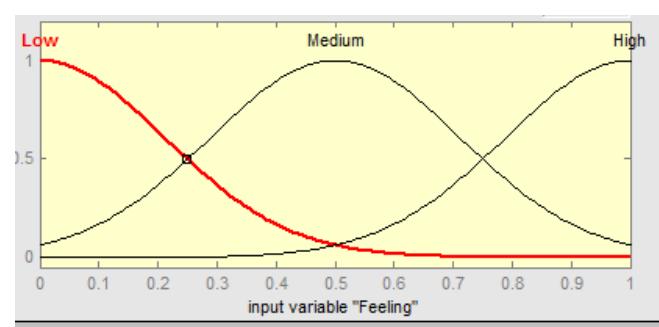
Agent simulator would let each of the agents have facets that are different in degree(low,mid,high).
Table 1. Personality descriptions based on the levels [or values] of the four facets of five trait's facet and corresponding personality types and characteristics.
| Low | Medium | High | |
|---|---|---|---|
| Feelings | ignores and discounts feelings | accepts feelings | values all emotions |
| Dutifulness | casual about obligations | covers priorities | governed by conscience, reliable |
| Assertiveness | stays in background | in foreground | Assertive, speaks up, leads |
| Discouragement | rarely discouraged | occasionally discouraged | easily discouraged |
3. Benefits Of Agent Simulator
Agent simulator not only would let us face only three different platoon agent in environments which is done by personality processing, it also makes each of these three platoon agents to be different from each other which means each agent has its own personality vector that is consisted of different degrees of four facets(low,medium,high). Agent simulator would also limit platoon agent behavior in accordance to its personality which shows that two agents that have same type, act differently and this will increase the degree of uncertainty in RCRSS.
4. Agent Simulator
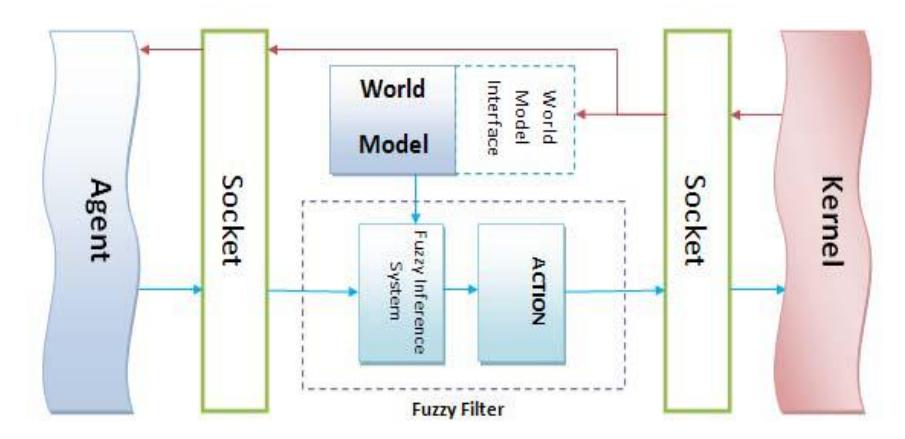
agent simulator is a kind of simulator which place between agent and kernel in which the way of connection is TCP/IP. By receiving an order from agent, simulator would filter it and sends it to kernel. Filter processing is the way that fuzzy inference engine would decide whether to change an order in accordance to agent personality vector or send it to kernel without change. Table 1 shows different parts of agent simulator
4.1 Agent simulator components:
Different components of agent simulator has been shown in figure 1.
4.1.1 World model
It is unavoidable to have a world model to make decision and to know different situations. By receiving messages from kernel, World model information would be updated.
4.1.2 Socket
socket is a unit that is used to make connection to TCP/IP.
4.1.3 Fuzzy Filtering
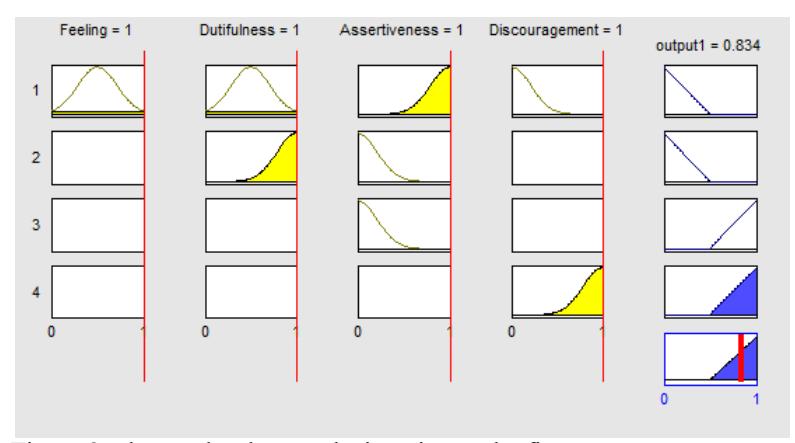
Fuzzy rule base is the main part of agent simulator. In fact the limitation which is for agents behaviors is made by this part. Agent simulator receives agent different actions and in accordance to the world model and agents personality it will decide whether to send the order without a change, filter it, stops the order to be sent to the kernel or change the accuracy of the undergoing act. In the other way the agent will not do the act or it will be changed in accordance to its personality if the act do not match to its personality. We have used a fuzzy inference engine to clarify the chosen behavior from the received act therefore by receiving the agent act, personality vector and world model , it will process them and consider the rules which are related to the act . We will classify the phase rules in four state in accordance to the received act:
State 1 - Accepting the order to go to the fire:
If the agent that is close to the fire orders to go to the fire, agent simulator would accept it and send it to kernel without change or deny it and stops the rule to be send to the kernel . These are in accordance to the different personality facet that are in the below rules. For example if the agent has low degree of assertiveness the agent simulator stops it from going to the fire(table 2)
Table 2: phase rules that results in going to the fire.
| Feelings | Dutifulness | Assertiveness | Discouragement | Result |
|---|---|---|---|---|
| Medium | Medium | High | Low | Accept |
| - | High | Low | - | Accept |
| - | - | Low | - | Deny |
| - | - | - | High | Deny |
State 2 - The order of not saving and caring the patient:
If the ambulance agent be on the process of moving or rescuing a civilian and it gives another order , agent simulator would deny or accept the order of not saving the civilian.
Table 3: phase rules that results in saving the patient
| Feelings | Dutifulness | Assertiveness | Discouragement | Result |
|---|---|---|---|---|
| High | - | - | - | Deny |
| Medium | High | - | - | Accept |
| Medium | Medium | - | - | Deny |
| - | - | - | High | Deny |
State 3 - Accepting the order of saving a civilian on the spot:
If an agent has the personalities that are in table4 and there be a civilian somewhere near it. The agent may try to save it.
Table 4: phase rules that results in saving a civilian on the spot
| Feelings | Dutifulness | Assertiveness | Discouragement | Result |
|---|---|---|---|---|
| High | Low | - | - | Accept |
| Low | Medium | - | - | Deny |
| Medium | High | - | - | Deny |
| High | - | - | Low | Accept |
State 4 - Accepting the order of saving a wounded:
If the agent ambulance gives an order to save a civilian and its personality be one of those in table5, the order may or may not be accepted.
Table 5: phase rules that results in saving a wounded
| Feelings | Dutifulness | Assertiveness | Discouragement | Result |
|---|---|---|---|---|
| Low | - | Low | High | Deny |
| High | Medium | High | Low | Accept |
| - | High | Medium | - | Accept |
5. Conclusion
By adding the agent simulator to RCRSS, it is possible to make the role of personality in agent decision making by having agents with different personality. These differences will make agent developers to choose a suitable agent with appropriate behavior to do the task in task allocations which will results in RCRSS be more real and degree of uncertainty will increase and the environment will be a better test bed for other researchers in this area and also it will make the results to be more reliable for real rescue missions.
References
hbr-validation-pr.pd
- Acton, G,S. (2001). Five-Factor Model: http://www.personalityresearch.org/
- Acton-Glossary: http://www.personalityresearch.org/glossary.html
- Adamatti, D.F., Bazzan, A.L. (2002). A Framework for Simulation of Agents with Emotions, http://www.inf.ufrgs.br/~adamatti/pag/ingles/Workcomp02.pdf
- [AHD] The American Heritage Dictionary: http://www.bartleby.com/61/86/C0578600.html
- Bazzan, A.L.C., Bordini, R.H. (2001). A Framework for the Simulation of Agents with Emotions, http://www.inf.ufrgs.br/~adamatti/pag/ingles/principalingles.ht m
- Campos, A.M.C., Hill, D.R.C. (1998). Web-based Simulation of Agent Behaviors. 1st International Conference on Web-based Modeling and Simulation (P. Fishwick, D.R.C. Hill, and R. Smith (eds.)), SCS, San Diego, CA, pp. 9-14.
- Cohn, A. (ed.) (1989). Proceedings of the 7th Conference of the Society for the Study of Artificial Intelligence and Simulation of Behaviour. Pitman, London, UK; Morgan Kaufmann, San Mateo, CA.
- Costa, P.T., Jr., McCrae, R.R. (1992). NEO PI-R Professional Manual, Odessa, Fla: Psychological Assessment Resources, http://psyche.tvu.ac.uk/phdrg/atkins/atws/person/67.html
- Durkin, J. (1994). Expert Systems – Design and Development, Prentice-Hall (McMillan Publishing Co.) Englewood Cliffs, NJ.
- Dutton, J.M., Starbuck, W.H. (1971). Computer Simulation of Human Behavior. John Wiley, New York, NY.
- El-Nasr, M.S., Skubic, M. (1998). A Fuzzy Emotional Agent for Decision-Making in a Mobile Robot, www.cecs.missouri.edu/~skubic/Papers/fuzzieee.pdf
- El-Nasr M.S., Yen, J., Ioerger, T.R. (2000). "FLAME-Fuzzy logic Adaptive Model of Emotions" Autonomous Agents and Multi-Agent Systems, 2000 Kluwer Academic Publishers Netherlands, 3, 219-257.
- Ghasem-Aghaee, N., Ören, T.I. (2003). Towards Fuzzy Agents with Dynamic Personality for Human Behavior Simulation, In Proc. of the 2003 Summer Simulation Conference, Montreal, PQ, Canada.
- Harmon, S.Y., Hoffman, C.W.D., Gonzalez, A.J., Knauf, R., Barr, V.B. (2002). Validation of Human behavior representations, http://www.msiac.dmso.mil/vva/Special_Topics/HBRValidation/
- Howard, P.J. (2000). The Owner's Manual for the Brain, Second Edition, Bard Press, Atlanta, GA, www.bradpress.com