RoboCupRescue 2009 – Rescue Simulation League (Infrastructure Competition) Team Description MRL2009 - brave circles (Iran)
Ali Khorsandian, Abbas Abdolmaleki
Azad university of Qazvin
http://www.personalityresearch.org/ · http://www.personalityresearch.org/glossary.html · http://www.inf.ufrgs.br/~adamatti/pag/ingles/Workcomp02.pdf · http://www.bartleby.com/61/86/C0578600.html · [http://www.inf.ufrgs.br/~adamatti/pag/ingles/principalingles.ht m](http://www.inf.ufrgs.br/~adamatti/pag/ingles/principalingles.ht m) · http://psyche.tvu.ac.uk/phdrg/atkins/atws/person/67.html · www.cecs.missouri.edu/~skubic/Papers/fuzzieee.pdf · [http://www.msiac.dmso.mil/vva/Special_Topics/HBRValidation/ hbr-validation-pr.pd](http://www.msiac.dmso.mil/vva/Special_Topics/HBRValidation/ hbr-validation-pr.pd) · www.bradpress.com
Abstract One of the major purpose of Rescue Simulation league is to provide an automatic system for automation and controlling the disaster space and also to help commanders to decide more rapidly and more truly in critical events in base of one of experts idea in rescue operation "There are more than 100 parameters in big disasters like earthquakes for deciding but the commander's team decide only base of at most 10 parameters because of limitations in human capabilities and lack of time" so it is obvious that a properly inference system can be so useful in these events both in data management and in decisions. For having a good system at first we need a good simulator, unfortunately current simulator (RCRSS Robocup Rescue Simulation Server) has some problems (Like the few number of civilians) and differences with real disaster space environment like the role of civilians and viewing area simulation for agents. In this TDP at first we introduce a new way for viewing area simulation and then we will talk about a new agent (thefts) and at the end we will see the implementation of civilian simulator and its specifications in detail.
1. Viewing area
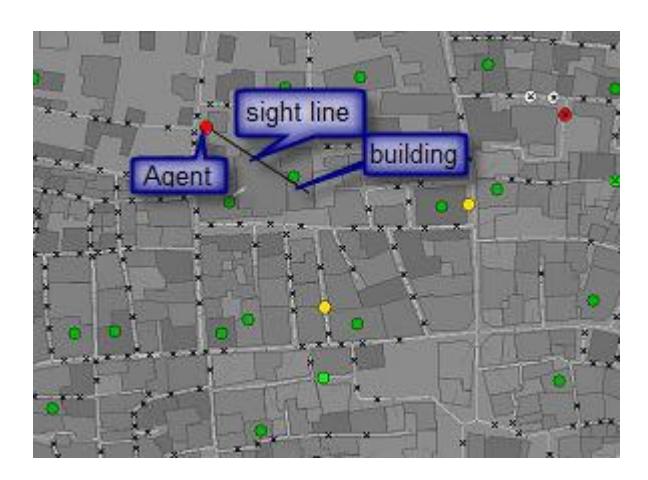
In current RCRSS agents can sense a circle around themselves with r=10m in each cycle and they can also see inside the buildings, as a case in point, suppose an agent that it is in A in ith cycle of the simulation and in the (i+1)th it is in B, the things that this agent sense from environment is two circle around A and B and the agent don't have any information about the rout AB, also Buildings don't have any kind of wall so agents can see inside buildings. To have better simulator for viewing area following items should be considered.
1-1) We should attention to the effects of smoke and fog, for this purpose we define parameter f (0<=f<1) which shows the amount of fog. This parameter should be filled by fire simulator.
See limitation bound =10-10f
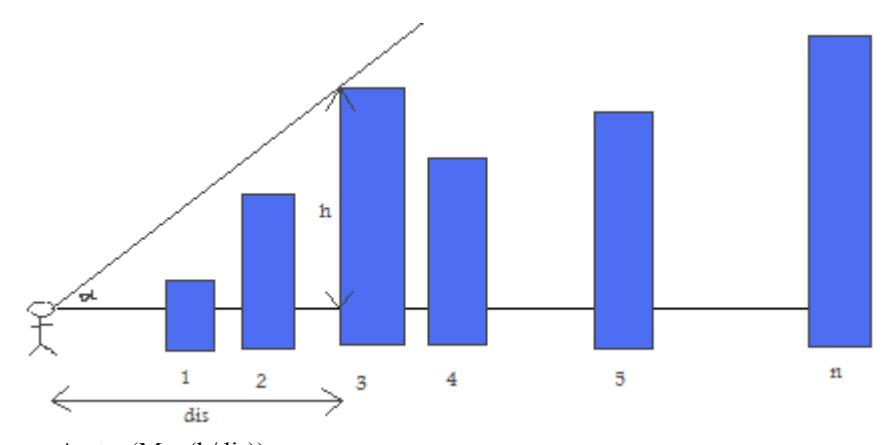
1-2) Tall and near buildings cover their back buildings.
α = Arctan(Max(h/dis)) h= high of buildings dis = distance between agent and building
Note :When the value(h/dis) for a building in the sight line become max this building is seeable and covers its behind buildings.
Here is the pseudo code for defining sense buildings:
If(agent is not in the building)
 {
  set INLINE;
  set SENSE;
  set INR={every house in (10-10f) around the agent};
  house H;
  for each m ϵ INR
  {
  Define this line :
  Y- Yhouse=((Yhouse – Yagent)/(Xhouse - Xagent))(X - Xhouse);
  INLINE = {every house in the line's path}
  m.remove(INLINE members);
  While(INLINE has one or more members)
  {
  H=the house that the value (h/dis) is Max in INLINE set;
  SENSE.add(H);
  INLINE.remove( every members in INLNE that
dis>=dis(H));
  }
  }
  //effects of walls
  RemoveAllInformationAboutCivilians(SENSE);
  Send(SENSE);
 }
 else if(agent is in the building)
Send(building'properies with inside civilians)
When our agent changes its position it should have information about the roads which it gone. So for all of the roads in a rout path that agent gone we calculate the above algorithm.
2. Thefts
In large earthquakes one of the important works is to protect from people's properties, this subject have not ever noticed in the RCRSS. For this purpose we add a new field to buildings that shows the owner's properties. Some kind of civilians which we define them as thefts can go to these buildings (Banks, Department Stores,…) and in each cycle decrease the value of property's field depends on "Theft's Rate" for that building in this regards we define new types of buildings with different "Theft's Rate" (the amount of money that each cycle is reduced by the theft) and different "Max-Cost"(maximum amount of money in building) also add Jails to our simulation environment for thefts. The important thing about the jail is the thefts will escape just before the building being in fire.
Types of buildings in simulation environment
| Building's Types | Jails |
|---|---|
| Banks | |
| Department Stores | |
| Ordinary Houses | |
| Refuges |
Cost's limitation for different types of buildings
| Cost | Banks :Theft's Rate=15 MaxCost =40000 |
||
|---|---|---|---|
| Department Stores: Theft's Rate=8 MaxCost =8000 |
|||
| Ordinary Houses: Theft's Rate=1 MaxCost=1500 |
3. A new police responsibility
As we have a new behavior in our civilians we need a way to control it so we add three new capabilities to police forces, polices can arrest, load and unload civilians(thefts).
3.1 Arrest
for arresting a civilian police should send the arrest packet for two following cycle and police should be near enough to the civilians (r=10m).when police arrest a civilian, the civilian will stick in its place and it is ready for police forces or ambulance teams to load it.
Arrest Packet
| Arrest Packet | |||
|---|---|---|---|
| Self ID Target ID |
3.2 Load and Unload
For this purpose police should be in the same position with civilian as same as load and unload in ambulances.
Load and Unload packet
| Load and Unload packet | ||
|---|---|---|
| Self ID | Target ID |
4. Civilian Simulator
Agent simulator not only would let us face only three different platoon agent in environments which is done by personality processing, it also makes each of these three platoon agents to be different from each other which means each agent has its own personality vector that is consisted of different degrees of four facets(low,medium,high). Agent simulator would also limit platoon agent behavior in accordance to its personality which shows that two agents that have same type , act differently and this will increase the degree of uncertainty in RCRSS.
These days , computer and human have a kind of indecision which means for a task to be done correctly , it is necessary to have an effective cooperation between human and computer. It is clear that the main goal of RCRSS is to cope with tensions and difficult situations, but it is forgotten that in each situations there is an special condition by which each and every individuals who are in that position will act differently in accordance to their personality , as an example we can talk about a timid individual who would probably deny going into a house that is in fire. So the only way to rely on RCRSS is to consider some behaviour just like human for each civilian agents that is working in RCRSS. So it is necessary to find out the process of decision making in human beings. Recent studies have been shown that decision making in human is by both our reasoning intelligence and our emotional intelligence and also it has been shown that the emotional part of our decision making process influences quality of human beings decisions up to 90%. One of the main factors in emotional intelligence is human personality which is quite easy to prove and that is how two different decisions will be made by two individuals who are quite similar in their reasoning intelligence but are different in their personality.
Whereas personality has great influence on human decisions , we have decided to make Civilian simulator and add it to other simulators in environment. By having this simulator we can have more reliable data. Also the degree of certainty in the environment has become less than the previous ones which leads to a better environment for further researches.
4.1 Personality
The first cycle of agent simulator would consider a personality for each agent that requires a scientific modelling in personality simulating. Personality knowledge is often expressed in terms of linguistic variables that can describe concepts that usually have vague and fuzzy values [Durkin, 1994]. Two excellent references for personality knowledge are Costa and McCrae [1992] and Acton [2001]. They present a fivefactor model, named OCEAN model and an extensive table outlining the research on personality by over thirty researchers. Other good references on the topic are Howard [2000] and Howard and Howard [2001a, b]. They refer to the five-factor model as the Big Five.
A concise classification of personalities is given at the site of personality project . In contemporary psychology, personality is specified as a function of thirty attributes –each of which called personality facet. The personality facets are clustered in five groups –each called a personality trait [or personality factor]. The five personality factors are also referred to as "the big five" [Costa and McCrae, 1992; Howard, 2000].
The value of each personality factor is determined by the values of its six facets. The five clusters of personality factors are also referred to as letter designation [Acton, 2001; Howard and Howard, 2001a, b]. Acton refers to them as the OCEAN model. In the OCEAN model, the letters stands for the following meanings:
- O: Openness, culture, originality, or intellect
- C: Conscientiousness, consolidation, or will to achieve
- E: Extraversion
- A: Agreeableness or accommodation
- N: Need for stability, negative emotionality, or neuroticism
Openness: "Openness refers the number of interests in which one is attracted and the depth to which those interests are pursued. It is also referred to as culture, originality, or intellect. It is about creativity." [Howard and Howard, 2001a]
Conscientiousness: "conscience is the awareness of a moral or ethical aspect to one's conduct together with the urge to prefer right over wrong"[AHD].
Extraversion: "It refers to the number of relationships in which one is comfortable" [Howard and Howard, 2001a].
Agreeableness: "Agreeableness is tendency to be a nice person" [Acton glossary].
Negative emotionality: "Negative Emotionality refers to the number and strength of stimuli required to elicit negative emotions in a person" [Howard and Howard, 2001a]. OCEAN model is consisted of series of facet for each of five traits.
We have considered four of these facets suitable for RCRSS environment [table 1] it is clear that to reach agents whose personality is suitable for the environment it is necessary to have a deep research among rescuers which we have done to some extent.
Table 1. Personality descriptions based on the levels [or values] of the four facets of five trait's facet and corresponding personality types and characteristics.
| Low | Medium | High | |
|---|---|---|---|
| Worry | Calm, relaxed | worried-calm | Worried, un- easy |
| Altruism | reluctant to get involved | sometimes will- ing to help others |
willing to help others |
| Assertiveness | stays in back- ground |
in foreground | Assertive, speaks up, leads |
| Discouragement | rarely discour- | occasionally | easily discour- |
| aged | discouraged | aged |
Civilian simulator would let each of the agents have facets that are different in degree(low, medium, high).
4.2 Benefits of Emotional-Based Civilian Simulator
New civilian simulator simulates Civilian agents with different personalities which have different behaviours. So we have civilian agents act differently and this will increase the degree of uncertainty in RCRSS.
4.3 Civilian Simulator Package
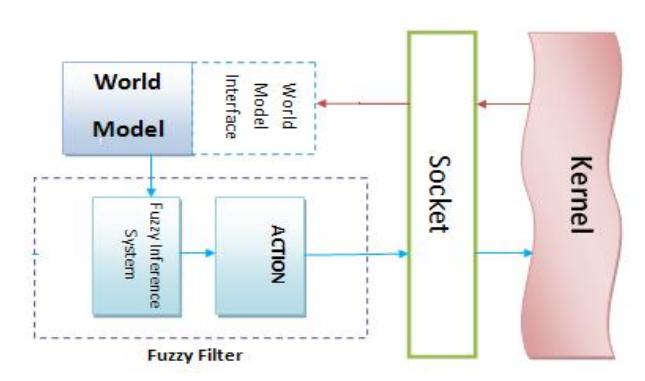
Civilian Simulator connects to kernel like other simulators .Each civilian after receive sensory information from kernel situation send an act to kernel with the consideration of its personality . choosing an act to send to the kernel is the way that fuzzy inference engine would decide in accordance to agent personality vector, fuzzy rules and its situation. Fig 1 shows the structure of Civilian Simulator.
4.3.1 Agent simulator components
Different components of agent simulator has been shown in figure 1.
World model
It is unavoidable to have a world model to make decision and to know different situations. By receiving messages from kernel, World model information would be updated.
Socket
socket is a unit that is used to make connection to TCP/IP.
Fuzzy rule base
Fuzzy rule base is the main part of agent simulator. In fact the different behaviours of agents is made by this part. Civilian simulator send an act to kernel each cycle base on fuzzy rules ,personality and world model of each agent. We have used a fuzzy inference engine to choose a behaviour for civilian agents. in next section we will explain the rules t we consider to simulate different behaviours for civilian agents.
Fuzzy Rules
we have categorized the agents into 3 categories based on our research:
- 1-the good agents that help rescuers in the process of rescue. this kind of agents try to find injuries and send information about their location.
- 2-The bothersome agents act like thieves and some of them make traffic around the fiery buildings.
- 3-Agents that are scared and just want to survive. This kind of agents search environment to find a refuge or not to move until a rescuer come to survive them.
Overall we have 7 different behaviours in new civilian simulator and each of civilians do one of them based on its personality.
To implement these behaviours we have considered 5 rules for 5 different behaviours of civilian agents.
1-Civilians that after earth quake will search for injuries and after finding them try to send information about them to rescuers.(Table 2)
2-Civilians that will move in environment and buildings. They make traffic in roads and it causes process of rescue get slow.
3-Civilians that after earth quake will search for refuges and after finding it enter to refuge.
4-Civilians that after earthquake are scared and expecting for rescuers to survive them.
5-Civilians that probably to survive their family will enter to a fiery building.
Table 2:Fuzzy rules of rule 1
| Worry | Altruism | Assertiveness | Discourage ment |
|---|---|---|---|
| low | High | medium | medium |
| low | medium | medium | Low |
Table 3:Fuzzy rules of rule 2
| Worry | Altruism | Assertiveness | Discourage ment |
|---|---|---|---|
| low | low | medium | - |
| low | low | high | - |
Table :Fuzzy rules of rule 3
| Worry | Altruism | Assertiveness | Discourage ment |
|---|---|---|---|
| medium | low | medium | low |
| high | medium | medium | low |
Table 5:Fuzzy rules of rule 4
| Worry | Altruism | Assertiveness | Discourage ment |
|---|---|---|---|
| high | low | low | high |
Table 6:Fuzzy rule of rule 5
| Worry | Altruism | Assertiveness | Discourage ment |
|---|---|---|---|
| low | high | low | high |
5. Conclusion
In this TDP we noticed to differences between real disaster space and robocup rescue simulation server. We tried to make this server more similar to real world so we add new types of buildings, we change the behaviors of civilians also they have different behaviors and a new viewing area same as real world is presented.
References
- Acton, G,S. (2001). Five-Factor Model: http://www.personalityresearch.org/
- Acton-Glossary: http://www.personalityresearch.org/glossary.html
- Adamatti, D.F., Bazzan, A.L. (2002). A Framework for Simulation of Agents with Emotions, http://www.inf.ufrgs.br/~adamatti/pag/ingles/Workcomp02.pdf
- [AHD] The American Heritage Dictionary: http://www.bartleby.com/61/86/C0578600.html
- Bazzan, A.L.C., Bordini, R.H. (2001). A Framework for the Simulation of Agents with Emotions, http://www.inf.ufrgs.br/~adamatti/pag/ingles/principalingles.ht m
- Campos, A.M.C., Hill, D.R.C. (1998). Web-based Simulation of Agent Behaviors. 1st International Conference on Web-based Modeling and Simulation (P. Fishwick, D.R.C. Hill, and R. Smith (eds.)), SCS, San Diego, CA, pp. 9-14.
- Cohn, A. (ed.) (1989). Proceedings of the 7th Conference of the Society for the Study of Artificial Intelligence and Simulation of Behaviour. Pitman, London, UK; Morgan Kaufmann, San Mateo, CA.
- Costa, P.T., Jr., McCrae, R.R. (1992). NEO PI-R Professional Manual, Odessa, Fla: Psychological Assessment Resources, http://psyche.tvu.ac.uk/phdrg/atkins/atws/person/67.html
- Durkin, J. (1994). Expert Systems – Design and Development, Prentice-Hall (McMillan Publishing Co.) Englewood Cliffs, NJ.
- Dutton, J.M., Starbuck, W.H. (1971). Computer Simulation of Human Behavior. John Wiley, New York, NY.
- El-Nasr, M.S., Skubic, M. (1998). A Fuzzy Emotional Agent for Decision-Making in a Mobile Robot, www.cecs.missouri.edu/~skubic/Papers/fuzzieee.pdf
- El-Nasr M.S., Yen, J., Ioerger, T.R. (2000). "FLAME-Fuzzy logic Adaptive Model of Emotions" Autonomous Agents and Multi-Agent Systems, 2000 Kluwer Academic Publishers Netherlands, 3, 219-257.
- Ghasem-Aghaee, N., Ören, T.I. (2003). Towards Fuzzy Agents with Dynamic Personality for Human Behavior Simulation, In Proc. of the 2003 Summer Simulation Conference, Montreal, PQ, Canada.
- Harmon, S.Y., Hoffman, C.W.D., Gonzalez, A.J., Knauf, R., Barr, V.B. (2002). Validation of Human behavior representations, http://www.msiac.dmso.mil/vva/Special_Topics/HBRValidation/ hbr-validation-pr.pd
- Howard, P.J. (2000). The Owner's Manual for the Brain, Second Edition, Bard Press, Atlanta, GA, www.bradpress.com