Hinomiyagura Rescue Simulation Infrastructure Team -Crowd Evacuation Simulation Package
Masaru Okaya, Tomoichi Takahashi
Meijo University, Aichi, Japan
[http://sakura.meijo-u.ac.jp/ttakaHP/Rescue index.html](http://sakura.meijo-u.ac.jp/ttakaHP/Rescue index.html)
Abstract We propose Crowd Evacuation Simulation package that enables crowd evacuation simulation. Simulation of a large number of people's evacuation behaviors is assumed to support the decision of rescue operations. Our package simulates evacuation behaviors inside and outside houses and expands the application fields of RoboCup Rescue Community.
Introduction
We propose CES (Crowd Evacuation Simulation) Package that enables crowd evacuation simulation on RCRS (Robocup Rescue Simulation System) Version 1. In a case of disaster and rescue simulations in cities, human evacuates from buildings and moves to refuges. With RCRS that has been providing a platform that simulate disaster situation and rescue operations on a disaster Ares, CES adds new functions to direct the crowd to safe places by providing proper information as one of rescue operations.
The simulation of a large number of people's evacuation behaviors is assumed to support the decision of rescue operations. In RoboCup Rescue simulation leagues, some teams proposed crowd simulations. Michael et al. presented a civilian crowd simulator [2]. Kamal et al. presented a crowd simulator using database system [6]. They tried to simulate realistic disaster situations that involved the number of civilians inhabited there. Their approaches were assumed that people gathered at the same location will be guided by common psychological and environmental influences.
Crowd simulation should take the individual conditions into consideration. Section 2 overviews crowd evacuation system. Our CES package consists of civilian agent class, emergency communication command and traffic simulator and is described in section 3. Section 4 shows the simulation results using CES package. The summary of our proposal and discussions are described in Section 5.
Crowd Evacuation Simulation System
(Section header with subsections below)
2.1 Back Ground and Related works
Various methods on crowd simulation have been presented. Helbing et al. proposed an individual-center-model that simulates behaviors of crowd by discrete individuals rather than a continuous fluid [3] [7]. Their model is a mixture of socio-psychological and physical force that can simulate non-fluid crowd properties such as faster-is-slow phenomenon. Nuria et al. showed limitations of gridbased models and discussed an agent-based approaches to overcome the limitations [5]. They introduced psychological factors into the agent-based model to be able to simulate agents' mental states, memory, and roles. Bandini et al. surveyed issues and approaches to modeling and crowd simulation of pedestrians [1].
2.2 Human Factors in Crowd Evacuation Simulation
We think that evacuation simulation should reflect factors of humans. For example,
– When earthquakes occur in urban areas, people evacuate from buildings or underground malls, move outside to safer places. There are men and women, young and old, family. The evacuation speed of the old is slower than the young man. The physical differences cause various patterns of evacuation behaviors and may bring out other disasters such that people are crushed and trampled.
– When we notice familiar people lost in a crowded situation, we feel uneasy and search for them. And when it is informed that some of a family member are others places, other members go to there to evacuate together. The family-minded behaviors may be obstacles to the evacuation of other persons.
We assume that the physical and mental human factors affect its decision. Followings show that our cares to family change according to our mental states.
endanger state : When an agent is at dangerous situations, the agent can manage itself. The agent does not afford to take care of family and friends.
anxious state : The agent itself is safe and has emotional capacity to worry about others. They can think of their own family.
normal state : This state is that we have in daily life.
Components of CES package
(Section header with subsections below)
3.1 Civilian Class with Mental States
Civilian agent is one of key components in evacuations simulations. We present civilian class with following features (cf. Appendix A).
Human Class : Human class represents a human that has properties of his/her age, damage, HP, mental state and family relationships. The properties cause differences in the speed of agents, and in deciding its actions.
Adult Class (subclass of Human): An adult civilian can decide their actions by itself, so it goes to refuges. The adult class is linked to other agents with Family. When it has family, it tends to take care of its family.
Senior Class (subclass of Human): It moves slower than Adult ones.
Child Class (subclass of Human): This Child agent cannot go to refuges by its self, but can follow it family Adult agents.
HumanRelation Class: HumanRelation represents relationships among agents such as group of coworker and friends. This relation reflects a group that evacuate together.
Family Class: Family class represents family structure and it is a special case of human relation such as relationship between parents and children instances.
3.2 Communication among family
Two new communications are added as ways of emergency broadcasting system. They are assumed to direct safety paths to refuges or to inform agents about some dangerous buildings.
AKSayEvacuationGuide class: This message is directly spoken one and reaches near agents as well as say commands.
AKTellEvacuationGuide class: This message is announced by remote microphone and agents who are in some area can hear the message.
3.3 Traffic simulator
Our traffic simulator handles agents' movements in open space areas [4]. The movements of agents are calculated based on Helbing's physical force model [3].
$$m_i \frac{\mathrm{d}\mathbf{v}i}{\mathrm{d}t} = m_i \frac{v_i^0(t)\mathbf{e}i^0(t) - \mathbf{v}i(t)}{\tau_i} + \sum{j(\neq i)} \mathbf{f}{ij} + \sum_W \mathbf{f}{iW}$$
(1)
where $m_i$ represents an agent i of mass, $v_i^0$ represents a certain desired speed, $\mathbf{e}i^0$ represents a certain direction, $\mathbf{v}i$ represents a actual velocity, $\tau_i$ represents a certain characteristic time, j and W represent other agents and walls, $\mathbf{f}{ij}$ and $\mathbf{f}{iW}$ represent interaction forces, and t is simulation time.
The destinations of agents, $\mathbf{e}_{i}^{0}(t)$, are determined in move method based on their mental model. Following shows a basic move of parent class.
move(){ if (in endanger sate) escape to a refuge.
if (in anxious sate){
   if (child is near) escape to a refuge.
   else search and go to the child.}
do rescue operations.}
Simulations using CES Package and RCRS
(Section header with subsections below)
4.1 Evacuation simulation in a room
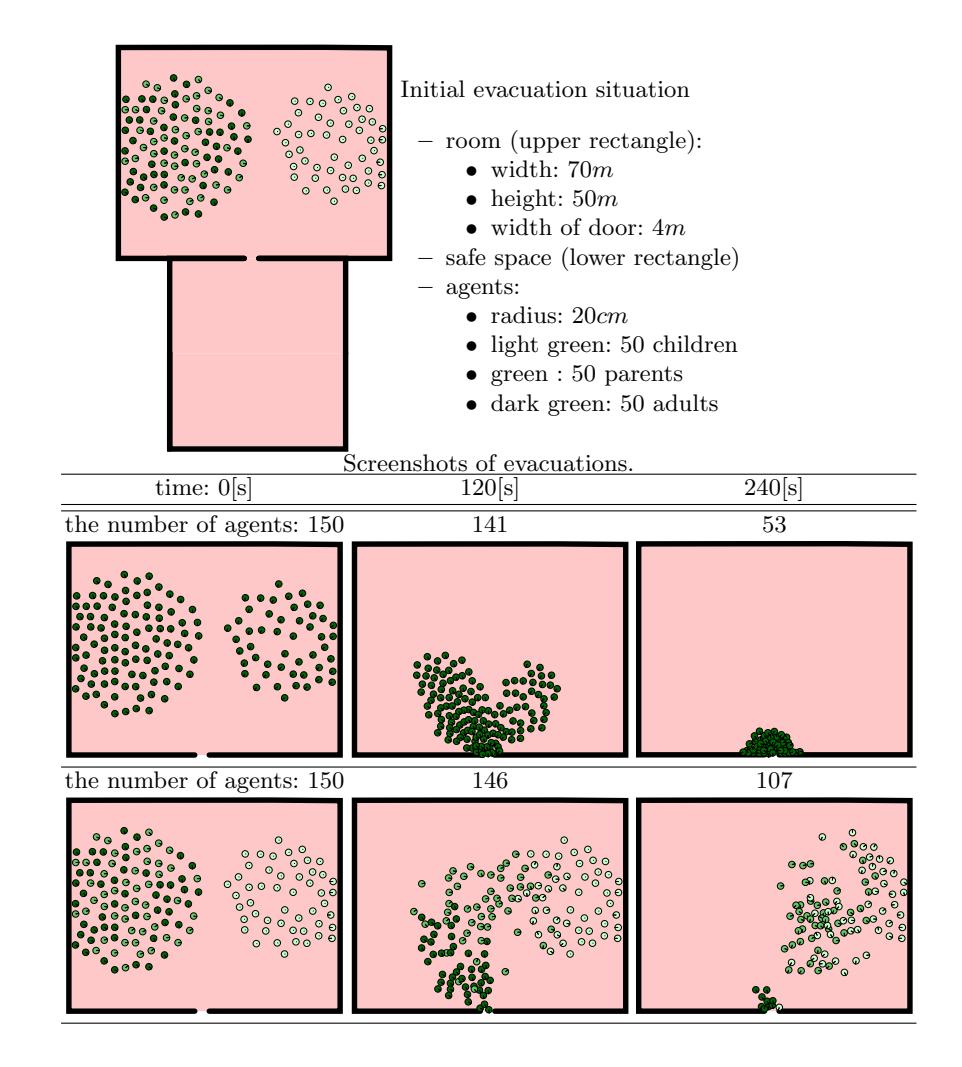
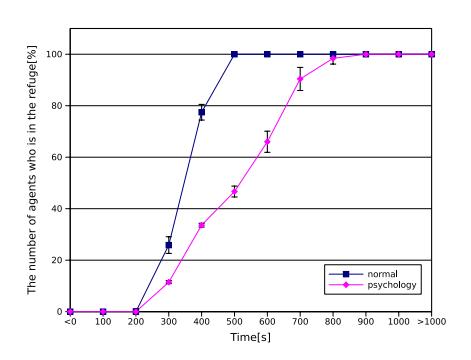
Fig.1 shows the initial layout of 150 persons in a big room and two patterns of evacuation.. They evacuate from the room to a hall way though an exit four meter wide. The figures of up row show a case that all 150 agents are senior agents. The figures of down row show a case that 100 agents are parent agents and 50 agents are child ones. Fifty children are in the right side and 100 adults are in the left. Fifty of 100 parents are parents of fifty children and they go to their child, while the other fifty persons go to the exit. The figures at 120 time step show such situations. At 240 time step, all pairs of parent and child are in the room. Fig.2 show that it takes 400 steps that 80 % of people evacuate form the room and takes more 600 steps when parents go to their child. Such situations are familiar in everyday life.
4.2 Evacuation simulation in campus
Fig. 3 shows campus layout of our university and screenshots of RCRS with CES package. Two buildings are in the top left corner and there is an open space in front of them. People in the buildings go to two refuges through the open space. Fifty pairs of parent and child are in building 1 and building 2.
We have simulated three cases; Case(a) is that parent and child are the same building. Case(b) is that the positions of parent and child are randomly assigned, so some of pairs are in the same building and the parents and child of other pairs are in the different buildings. Case(c) is that all pair of parent and child are the different buildings, namely if a parent is in building 1 (2), then the child is in building 2 (1). The first and second rows of Fig. 3 show the screenshots of case (a) and (c) simulations, respectively. In case (a), the pairs evacuate smoothly from the buildings. However, in case (c), behaviors that the parents go to their child in the different buildings make crowd situations in the buildings and the open spaces.
The graph of percentages of agents in the refuges matches our empirical rule. It takes the least time to evacuation of buildings in case (a), and the next is case (b) and the case (c) takes the most time. The crowd situations take more 50% time that 80% of pairs arrive at refuges between (a) and (c).
Discussion and summary
Directing people to evacuate from buildings or ruined area are important issues of rescue operations. The crowd moves in similar way as a whole, the individual motions are different each other and some behaviors may become impediments to smooth evacuations of the whole. We think mental state of human is one of important factors in evacuation of peoples during an emergency or disaster.
We propose CES (Crowd Evacuation Simulation) package that enables crowd evacuation simulation on RoboCup Rescue Simulation. We have presented in this paper civilian class that has model of human mental state and the evacuation simulations using CES package. The results show an possibility that RoboCup Rescue simulation system can be used not only wide area disaster rescue simulation but also applied to simulate evacuation behaviors in houses.
A Overview of typical classes
(Appendix with class definitions and methods)
Class Human
java.lang.Objecrt ← Human
Human Class Method Summary
| Method Summary | Description |
|---|---|
| int getAge() | age |
| double getAnxious() | level of feeling anxious |
| int getDamage() | damage. |
| double getEndanger() | level of feeling endanger. |
| Family getFamily() | family stracture. |
| Human getFollowingPerson() | human who this agent is following. |
| double getMovingSpeed() | moving speed. |
| HumanRelation getRelationships() | human relationships. |
| abstract void think(Entity[] changes, Command[] heard) | Think behaviour. |
Class HumanRelation
java.lang.Objecrt ← HumanRelation
HumanRelation Class Method Summary
| Method Summary | Description |
|---|---|
| double getCloseness() | A closeness of this relation. |
| Human[] getRelationships() | All the members in this group. |
Class Family
java.lang.Objecrt ← Family
Family Class Method Summary
| Method Summary | Description |
|---|---|
| HumanRelation[] getChildren() | children. |
| HumanRelation[] getMarriagePartner() | marriage partner. |
| HumanRelation[] getParents() | parents. |
| HumanRelation[] getRelatives() | relatives. |
| HumanRelation[] getSiblings() | siblings. |
Class Adult
java.lang.Objecrt ← Human ← Adult
Adult Class Method Summary
| Method Summary | Description |
|---|---|
| void think(Entity[] changes, Command[] heard) | Think behhavior. |
References
- S. Bandini, S. Manzoni, and G. Vizzari. Crowd Behavior Modeling: From Cellar Automata to Multi-Agent Sysytems, chapter 10, pages 301–324. CRC Press, 2009.
- Michael Brenner, Nanda Wijermans, Timo Nüssle, and Bart de Boer. Simulating and controlling civilian crowds in robocup rescue. 2005.
- I. Farkas D. Helbing and T. Vicsek. Simulating dynamical features of escape panic. NATURE, 407:487–490, Sep. 2000.
- Masaru Okaya, Shigeru Yotsukura, Kei Sato, and Tomoichi Takahashi. Agent evacuation simulation using a hybrid network and free space models. In Jung-Jin Yang, Makoto Yokoo, Takayuki Ito, Zhi Jin, and Paul Scerri, editors, Principles of Practice in Multi-Agent Systems, volume 5925 of Lecture Notes in Computer Science, pages 563–570. Springer, 2009.
- Nuria Pelechano and Ali Malkawi. Comparison of crowd simulaton for building evacuation and an alternateive approach. In Building Simulation 2007, pages 1514– 1521, 2007.
- Rahul Sarika, Harith Siddhartha, and Kamalakar Karlapalem. Database driven robocup rescue server. In RoboCup 2008: Robot Soccer World CUP XII, pages 602–613. Springer, 2009.
- D. J. Kaup T. I. Lakoba and N. M. Finkeistein. Modifications of the helbingmolnar-farkas-vicsek social force model for pedestrian evolution. SIMULATION, 81(5):339–352, May 2005.