Hinomiyagura 2014 TDP: Diffraction mode in Wireless Communication Simulation
Hideki Nishimura, Masaru Shimizu, Tomoichi Takahashi
Meijo University, Aichi, Japan; Chukyo University, Aichi, Japan
[http://sakura.meijo-u.ac.jp/ttakaHP/Rescue index.html](http://sakura.meijo-u.ac.jp/ttakaHP/Rescue index.html)
Abstract Robots have been used to explore the interior of the Fukushima Daiichi Nuclear Plant (FDNP) that was destroyed by a tsunami. Robots are supposed to be used for FDNP for it's decommissioning over the next several decades. There are many types of works that robots can do instead of human workers. Especially, for human healthy conditions, the robots are expected to do routine works in addition to exploration at FDNP. In this paper, we propose a new mode, diffration, in wireless communication model. The function supports the remote operability of robots at the fields of FDNP.
1 Introduction
Since the 2011 Great East Japan Earthquake, robots have been used to explore the interior of the Fukushima Daiichi Nuclear Plant (FDNP). At FDNP, robots are supposed to do tasks: clear debris, monitor and map the inside and outside of buildings, setup instruments, shield and decontaminate, transport material, construct pipes and equipment, etc. [4]. It is necessary to design new mechanisms and develop sensing algorithms to meet the mid and long term schedule to decommission FDNP [1].
An operator at FDNP noted some very important and useful points in his blog [7]. He said that training for robot operations made me capable of operating the robots agilely. Checking the functions of new robots and the operations of robots in virtual situations helps to make the robots operations effective ones in real situations.
Our team, Hinomiyagura, have proposed standardizations for robot tasks and training environments for robot operators to fill the needs for checking and the operating of robots [9]. This year, we propose a new function of Wireless Simulation Server.
2 Background and Related works
The RoboCup Rescue project has been held every year with one objective: to promote research and develop topics related to rescue robots [3]. Quince, a robot that has participated in the RoboCup Rescue competition, was actually applied at FDNP, demonstrating it's performance by exploring the disaster areas [10]. They tested Quince's ability in a test environment that was constructed based on the data presented by TEPCO before they used Quince in real situations. ASTM International has released standardized method for evaluating radio-wave communications in simple situations[5, 6].
In the virtual robot competition of RoboCup Rescue (VRRCR), USARSim has been used as a platform. USARSim is configured based on the Unreal Tournament game engine and provides a high-fidelity simulation of robots by creating 3D environments and emulating wireless communications and other sensors, which make the simulations more realistic. Simulation systems such as VRRCT, provide platforms that functions of rescue robots and algorithms are tested for disaster areas where they will operate.
Pfingsthorn provided Wireless Simulation Server (WSS) in the VRRCR to simulate wireless network links in a disaster setting [2]. While the wireless network is one of key components to control robots, the WSS have remained the same one as Pfingthorn provided. As Pfingsthorn pointed, participants of VR-RCR are forced to deal with issues of wireless links, such as limited range and the resulting need for either multi-hop routing or temporary autonomous behavior.
The nuclear plants at FDNP are decided to decommissioned and the decommission process will take a long time. As well as the decommission task, there are tasks in everyday operations that robots are supposed to do. For example, water contaminated with radioactive materials is stored in tanks that are located in the outside of FNDP. The tanks are fenced to reduce the risks of rainwater overflowing from fences around the tanks. Because the leak of the water was previously detected within the fences, an investigation by human has been conducted to check for any leak of rainwater from the fences. We think the investigation task is one of routine tasks and is easier than that the rescue robot, Quince, explored inside buildings in FDNP at 2011.
3 Future Robot Tasks at FDNP
3.1 Investigation tasks of around tanks
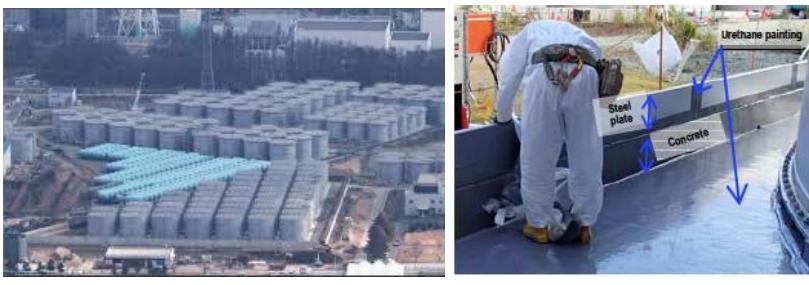
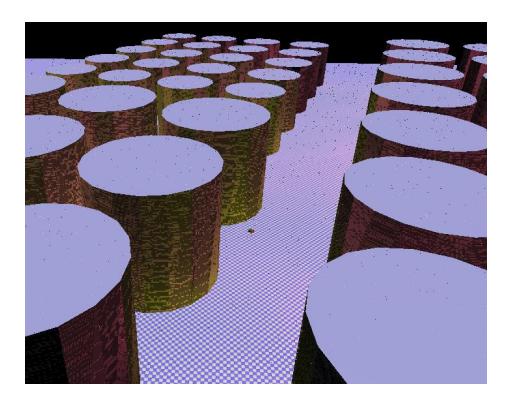
Figure 1 shows a picture of tanks and fence around the tank. The tanks were constructed in the FDNP to store water that was used cool the nuclear fuel of FDNP. The tanks are placed systematically in the FDNP and the size of the height and diameter of the tank are 10m and 12m respectively and the area is 100-meter size wide. Figure 2 shows an image of VRRCR's environment to invetigate the tanks and the area. The small black dot in the center of the figure is P3AT robot. The invetigation task is to move around the tanks and to check the the conditions of inside and oudside of the fences.
It is assumed that the robots are operated remotely to cope with unexpected accidents. In a case of wired connection, tracking cable limits the range and movements of robots operations. In a wireless connection, tanks become obstacles for propagating of radio wave. A hybrid system of the wired and wireless connections is one of practical solutions that. The hybrid system was used in the exploration tasks of a building of FDNP. A pair of Quinces, one of the pair was connected with a cable and worked as access point of wireless system. The other is connected via wireless system. The pair of Quinces was connected stably and acquired its mobility.
3.2 Wireless transmission models
The WSS provides two transmission models; propagation and non-propagation models. The propagation model supports attenuation of signals between two connecting stations. The radio wave goes straight with following phenomena.
- signal attenuates with distance,
- absorbed by objects,
- reflected by objected,
- diffracted around corners.
After the reflection and the diffraction, the radio wave goes straight again. The current WSS (version 0.61 at 14.2.2014) has two wireless transmission modes and simulates the phenomena of radio wave.
Distance Mode: This mode calculates the distance between a base station and robots that communication with each other. When the distance is longer than a threshold value set in advance, the WSS cuts the wireless communication between them.
Obstacle Mode: This mode checks whether there are objects on the straight line between two of a base station and robots. When there is an object on the line, the WSS cuts the wireless communication between them.
3.3 Diffraction mode in wireless transmission
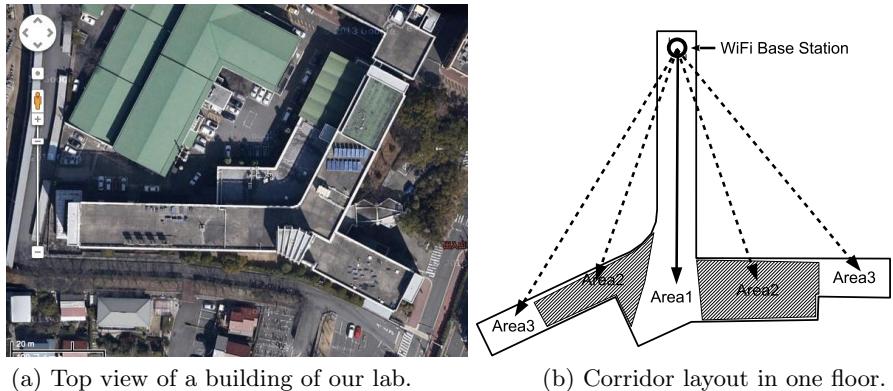
Figure 3 (a) is the top view of a building of our university and Figure 3 (b) shows the layout of corridor. The corridor is Y-shaped and a WiFi station is located at the end of Y. Table 1 shows the results of measurements. The column labeles as 'real' indicates the status of WiFi connections. The signal of wave can be received with sufficient power for WiFi communication at Area 1 and adjacent two areas labeled as Area 2. At Area 2, the signal can reach with strength by diffraction of wave. The wave does not have strength at Area 3 even the distances are less than the distance that WiFi wave can reach with power to communication.
The columns labeled as 'WSS mode' indicate the status of connections simulated by WSS. The signal reaches all points using Distance mode because the points are within the range of the threshold. Using Obstacle mode, the signal does not reach at Area 2 behind walls. These do not match the real situations and indicate VRRCR cannot simulate such operations that robots can be operated remotely from the base station and become out of control when they enter Area 3.
We implement a new transmission mode, diffraction mode. The diffraction mode is based on the equations of the radio wave [8]. The WSS can decide the WiFi connection status from the strength of the diffracted radio wave. The columns labeled as 'our node' are diffraction mode and show the calculated powers of signals and the connection status. When -92dB is used as a value of threshold whether connections are linked or not, the status of WiFi connection match the real situations.
Connection of wireless communications in real, WSS simulation and diffraction mode.
| area | point real | WSS mode | our mode | |||
|---|---|---|---|---|---|---|
| distance obstacle signal power (dB) connection | ||||||
| Area 2 | 1 | Y | Y | - | -90.1 | Y |
| 2 | Y | Y | - | -90.7 | Y | |
| 3 | Y | Y | - | -91.2 | Y | |
| 4 | Y | Y | - | -91.7 | Y | |
| Area 3 | 5 | - | Y | - | -92.9 | - |
| 6 | - | Y | - | -92.2 | - | |
| 7 | - | Y | - | -92.3 | - | |
| 8 | - | Y | - | -92.4 | - |
Y: connectioin linked, -: no connection.
4 Discussion and Summary
In this paper, we have presented a new transmission mode of WSS that simulates propagating of radio wave at the presence of corners. Taking investigation tasks around tanks at FDNP as an example, we show tasks that robots will do instead of human workers. The task is not a kind of rescue and search in disaster area. We think such tasks will increase as the process of decommissions at FDNP and realistic simulation module of wireless communication will become one of key issue simulation environments.
5 Release Schedule
We can release our proposing simulation system on our web site by the end of June 2014.
References
- http://www.tepco.co.jp/en/nu/fukushima-np/roadmap/images/d131226 01e.pdf, date:11. Feb. 2014.
- http://sourceforge.net/apps/mediawiki/usarsim/index.php?title=Wireless Simulation Server, date:11. Feb. 2014.
- http://wiki.robocup.org/wiki/Robot League, date:25. July. 2012.
- H. Asama. Robot & remote-controlled machine technology for response against accident of nuclear power and toward their decommision. International Conference on Intelligent Robots and Systems (IROS2012), 2012.
- ASTM International. Standard Test Method for Evaluating Emergency Response Robot Capabilities: Radio Communication: Line-of-Sight Range (E2854-12). CD-ROM, 11 2012.
- ASTM International. Standard Test Method for Evaluating Emergency Response Robot Capabilities: Radio Communication: Non-Line-of-Sight Range (E2855-12). CD-ROM, 11 2012.
- E. GUIZZO. Fukushima robot operator writes tell-all blog. http://spectrum.ieee.org/automaton/robotics/industrial-robots/fukushimarobot-operator-diaries, date:25 Mar. 2012.
- Y. Hosoya. Radiowave propagation handbook. Realize Science & Engineering Center Co.,Ltd, Tokyo, Japan, 1999.1 1999.
- M. Shimizu and T. Takahashi. Training platform for rescue robot operation and pair operations of multi-robots. Advanced Robotics, 27(5):385–391, Mar. 2013.
- T. Yoshida, K. Nagatani, S. Tadokoro, T. Nishimura, and E. Koyanagi. Improvements to the rescue robot quince toward future indoor surveillance missions in the fukushima daiichi nuclear power plant. http://www.astro.mech.tohoku.ac.jp/ keiji/papers/pdf/2012-FSR-Yossyonline.pdf, date:30. June. 2013.