UvA Rescue Team Description Paper Infrastructure competition Rescue Simulation League RoboCup 2014 - João Pessoa - Brazil
Arnoud Visser
Universiteit van Amsterdam, Science Park 904, 1098 XH Amsterdam, NL
http://www.jointrescueforces.eu
Abstract The UvA Rescue Team has several innovative ideas to further improve the infrastructure of the RoboCup Rescue Simulation League. Those ideas range from providing USARSim an interface compatible with the RoboCup@Home Simulation, to provide the possibility to specify robots in the URDF format, to create a model for the Ricoh Theta 360° camera, to create a model of the omnidirectional robots like the KUKA youBot and to modify the simulator of the Agent competition so that agents receive observations while moving.
Introduction
The RoboCup Rescue competitions provide benchmarks for evaluating robot platforms' usability in disaster mitigation. Research groups should demonstrate their ability to deploy a team of robots that explore a devastated area and locate victims.
The RoboCup is moving towards a goal and the benchmarks should become each year more challenging to accommodate the progress made by the teams. The Infrastructure competition allows to demonstrate possible extensions of the benchmark to facilitate those innovations.
The UvA Rescue Team has participates three times before in the Infrastructure competition. In 2010 the simulator of the Virtual Robot competition was extended with a realistic response of laserscanners on smoke; a circumstance which is quite common in disaster situations. The response of the laserscanners was validated in a number of experiments in a training center of the Dutch rebrigade [1]. In 2011 a model of a humanoid robot was introduced in USAR-Sim, which made it possible to model one of the robots in the RoboCup@Home League [2]. In 2012 a validated flying robot was introduced to USARSim and it was demonstrated that such robot allows to explore a disaster site fast, while creating a visual map of the area [3]. This resulted in winning the Infrastructure award in 2012. Also outside the Infrastructure competition our team contributed to the simulation environment, as described in a document which highlight our contribution up to 2010 [4]. More recent other contributions are for instance the introduction of animations to victims [5, 6], the introduction of model for a radar sensor [7, 8] and the automatic generation of competition maps [9].
Uniform Robot Description Format
Currently robots inside USARSim are dened in an Unreal Script, the language native to the Unreal Engine. Most other robot simulators make use of the Uniform Robot Description Format (URDF), which allows them to easily exchange models of mobile platforms, robot arms, grippers or sensors. The number of robots supported by USARSim could be easily extended when a tool is developed which could import URDF-models, with the constraint that the models not only should look realistic, but also move realistically. An increase of the number of supported robots in USARSim could also broaden the number of institutes which use (and maintain) this infrastructure.
Ricoh Theta
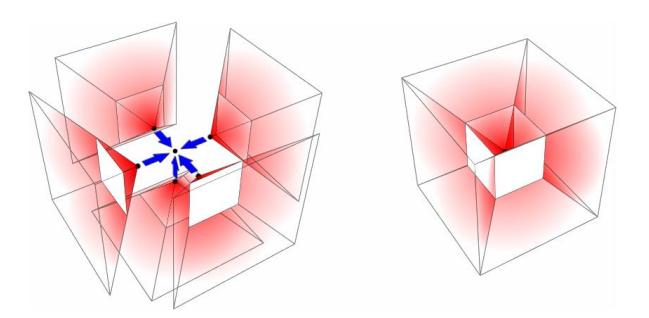
Recently Ricoh introduced a new camera with to lenses which gives a 360° view of the surroundings. When mounted on a robot, such camera could be used for obstacle avoidance, optical odometry [10], localization and mapping. Creating such a model for such camera with such wide eld of view would require to combine six virtual cameras with a eld of view of 90° (see Fig. 1) and warping their images on a perfect sphere. A comparable eort has been performed for a catadioptric omnidirectional camera with a hyperbolic convex mirror [11].
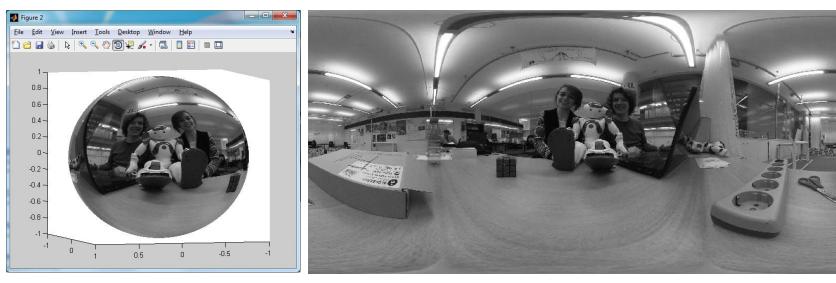
Once you have the image on a sphere, you could use the single eective viewpoint at the center of the sphere to recreate the rectangular image as natively produced by the Ricoh Theta by equirectangular projection (see Fig. 2).
RoboCup@Home Simulation
Realistic simulation is important in robotics, because it allows to perform repeatable experiments under controlled circumstances. USARSim is such a realistic simulation environment, based on the gaming engine Unreal Tournament.
The RoboCup@Home competition is a challenge to demonstrate the progress in service robots. Robots have to navigate through a house, manipulate objects and interact with humans. Inamura et al [12] proposed to bring the competition to a higher cognitive level by introducing a simulator to the competition. The simulator environment created by Inamura et al is called SocioIntelliGenesis and is based directly on the Open Dynamics Engine and OpenGL. This environment is well suited to introduce humans as avatar into the simulated robot world, but lacks the perceptual richness which is a characteristic which can be encountered in a real domestic house.
It would be interesting to create a scenario for one of the RoboCup@Home tasks, for instance the Clean Up task, inside USARSim. Next, the interface of USARSim, written in Unreal Code, has to be extended to support the API of the SocioIntelliGenesis environment, which will make the two simulators compatible from a user viewpoint. With the scenario and interface ready it should be possible to demonstrate the eect of additional perceptual richness for a RoboCup@Home task.
Not only the RoboCup@Home community could benet from this development. This development is also important for the RoboCup Rescue Simulation League. Robots developed in the RoboCup Rescue can participate in the RoboCup@Home competition [13] and vice versa. The problems encountered when bringing a robot to a cluttered home have some similarity with the problems when encountered after a disaster. The exploration algorithms developed inside the Virtual Robot competition could be directly applied a RoboCup@Home simulation, while the manipulation algorithms developed inside the RoboCup@Home competition could be used to aid victims once they are found.
KUKA youBot
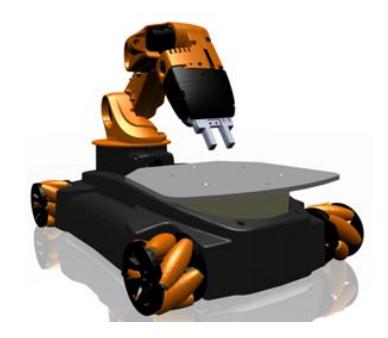
The Universiteit van Amsterdam participates in the KUKA Innovation in Mobile Manipulation Award and in the RoCKIn competition with a KUKA youBot [14]. The KUKA youBot consist of an omnidirectional mobile platform with a small robot arm mounted on top of the platform. The platform has omnidirectional capabilities thanks to Swedish wheels; wheels with rollers mounted under an angle of 45°. This concept is not introduced before in USARSim, which implies that the KUKA youBot model could be the predecessor of a whole family of omnidirectional robots.
The Unreal Code of USARSim has to be extended with the components needed to create a KUKA youBot, including Swedish wheels. The behavior of these wheels has to be validated by comparing the dynamics in simulation and reality, comparable with previous work [15].
Observations while moving
Inside the Agent competition the challenge is to mitigate a disaster inside a city with a limited number of agents in a limited amount of time. Typically, the problem has to be solved in 300 timesteps. During such timestep an agent can decide to go to another part of the city, traveling several blocks. The agent only receives observations at its current position, which means that it can pass a burning house or injured civilian without noticing it. Although it is realistic that one is less observant while traveling, obvious clues should be noticed.
The proposal is to extend the simulator of the Agent competition with observations along the route.
Conclusion
This paper summarizes the plans for improvement of the infrastructure of the Rescue Simulation League by the UvA Rescue Team. Those developments are not only interesting to enable new research opportunities, but also make it possible for cooperation with other RoboCup Leagues.
References
- Formsma, O., Dijkshoorn, N., van Noort, S., Visser, A.: Realistic Simulation of Laser Range Finder Behavior in a Smoky Environment. In: RoboCup 2010: Robot Soccer World Cup XIV. Volume 6556 of Lecture Notes on Articial Intelligence series., Heidelberg, Springer (2011) 336{349
- van Noort, S., Visser, A.: Extending virtual robots towards robocup soccer simulation and @home. In: RoboCup 2012: Robot Soccer World Cup XVI. Volume 7500 of Lecture Notes in Computer Science. Springer Berlin Heidelberg (2013) 332{343
- Dijkshoorn, N., Visser, A.: An elevation map from a micro aerial vehicle for urban search and rescue. In: Proceedings CD of the 16th RoboCup Symposium. (2012)
- Terwijn, B., Formsma, O., Dijkshoorn, N., van Noort, S., de Hoog, J., Out, N., Bastiaan, C., Visser, A.: Amsterdam Oxford Joint Rescue Forces: Community Contribution. Published online (2010)
- Katt, S.: Introducing movements and animations to virtual victims in USARSim. Bachelor's thesis, Universiteit van Amsterdam (2012)
- Bastiaan, C.: Virtual victims in USARSim. Bachelor's thesis, Universiteit van Amsterdam (2010)
- Rozeboom, R.: Navigating using a radar sensor in USARSim. Bachelor's thesis, Universiteit van Amsterdam (2012)
- Out, N.: Virtual radar sensor for USARSim. Bachelor's thesis, Universiteit van Amsterdam (2010)
- Zwennes, O., Weiss, A., Visser, A.: Adapting the mapping diculty for the automatic generation of rescue challenges. In: RoboCup IranOpen 2012 Symposium (RIOS12). (2012)
- Munteanu, O., Pronk, R.: Visual odometry with the ricoh theta. Project Report, Universiteit van Amsterdam (2014)
- Schmits, T., Visser, A.: An Omnidirectional Camera Simulation for the USARSim World. In: RoboCup 2008: Robot Soccer World Cup XII. Volume 5339 of Lecture Notes in Articial Intelligence., Berlin Heidelberg New York, Springer (2009) 296{ 307
- Inamura, T., Tan, J., Sugiura, K., Nagai, T., Okada, H.: Development of robocup@home simulation towards long-term large scale hri. In: RoboCup 2013: Robot Soccer World Cup XVII. Volume 8371 of Lecture Notes in Articial Intelligence., Berlin Heidelberg New York, Springer (2014)
- Wisspeintner, T., Van Der Zant, T., Iocchi, L., Schier, S.: Robocup@ home: Scientic competition and benchmarking for domestic service robots. Interaction Studies 10 (2009) 392{426
- Negrijn, S., Haber, J., Galama, Y., Visser, A.: UvA@Work RoCKIn2014 Toulouse, France. Team Description Paper, Intelligent Robotics Lab, Universiteit van Amsterdam, The Netherlands (2014)
- van Noort, S., Visser, A.: Validation of the dynamics of an humanoid robot in usarsim. In: Proceedings of Performance Metrics for Intelligent Systems Workshop (PerMIS12). (2012)