Hinomiyagura: RoboCup rescue simulation infrastructure: Answers to our 2014 proposals
Katsuki Ichinose, Tomoichi Takahashi, Masaru Shimizu
Meijo University, Shiogamaguchi, Tempaku-ku, Nagoya 468-8502 JAPAN; Chukyo University, YagotoHonmachi, Showa-ku, Nagoya, 466-8666 JAPAN
Abstract This paper presents our solution to the 2014 proposal that promotes the use of a RoboCup rescue (RCRL) league in real-life situations. The proposal consists of three stages: 1) preparation of 3D venue models; 2) development of accident prevention plans using the tools and platforms of related RCRL ; and 3) evaluation of the plans and feedback to the community of RCRL . Concrete research themes are provided by performing tasks in stages 1 and 2. Further, we specify the conditions required for the practical employment of the application and enlist its advantages in real-world applications.
Keywords: rescue simulation, RoboCup, Practical usage
1 Introduction
At 2014, Takahashi et al. proposed a new challenge, namely, to demonstrate the potential of the RoboCup rescue league (RCRL) in minimizing loss during disasters, and thereby contributing to prevention planning in real-world disaster situations [8]. The proposed test bed consisted of the following three stages.
- Stage 1: Approximately two years prior to the RoboCup competition, the future site of the RoboCup is established. At this point, a three-dimensional model of the site is presented to the community.
- Stage 2: Approximately six months before the RoboCup competition, the participants of the RRL use the 3D model. They prepare evacuation plans using simulation systems and present the plans to the RoboCup organizations. The organizations then select plans with cooperation from local governments.
- Stage 3: During the RoboCup competition, the organizations prepare an app that includes the evacuation guide for emergencies along with regular information such as schedules and a venue layout. If circumstances permit, the participants rate the guides after participating in drills at the venue.
In this paper, we propose a solution for stages 1 and 2 of the test bed for RoboCup 2017. RoboCup 2017 will be held in Nagoya, Japan. The specific venue is Portmesse Nagoya. The 3D CAD model of Portmesse Nagoya is presented in stage 1. A few examples provided by the present RRL at stage 2 are demonstrated in Section 2. Section 3 discusses research themes of RRL from the lessons learnt in performing the tasks in stage 2. The lessons help the RRL community to share common research themes and targets for developing robots. Our proposal is summarized in Section 4.
2 A solution to the 2014 test-bed proposal
2.1 3D model of RoboCup 2017 Venue
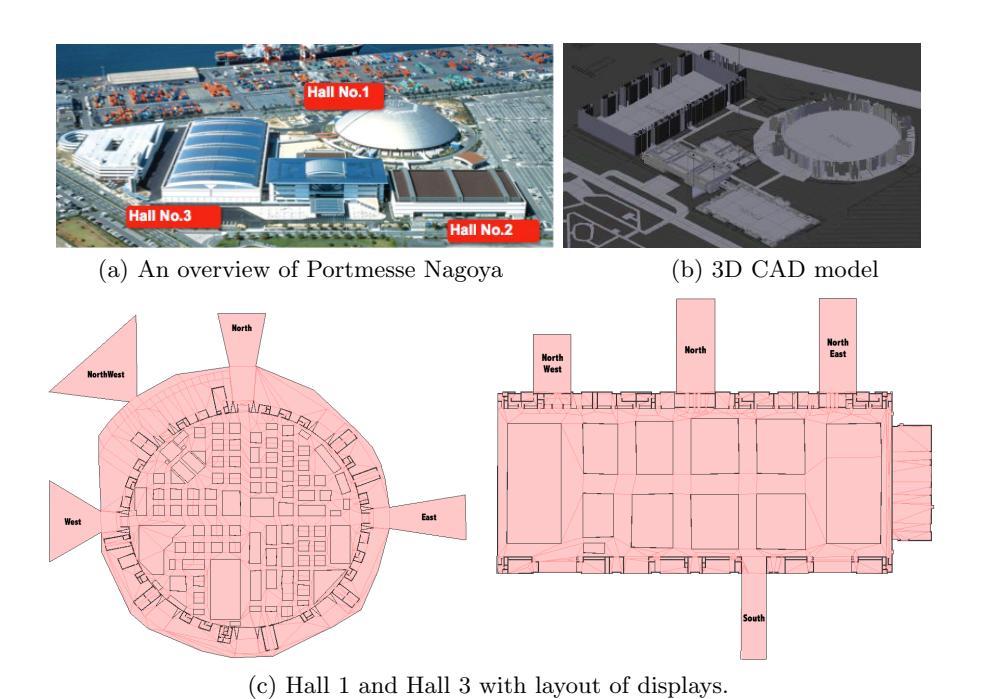
RoboCup 2017 is planned to be held in three halls of Portmesse Nagoya. Fig. 1 (a) shows the overview of Portmesse Nagoya. Fig. 1 (b) is a 3D model of the halls and the road around the venue. Fig. 1 (c) represents the floor layout of Halls 1 and 3. The figures illustrate an exhibition state of halls. The boxes in the figures are display spaces and small rooms for exhibitions. The box areas straiten people movement in the hall, while people can go in any direction they prefer in an open space state where there are no displays.
2.2 Rescue simulation league: prevention planning for emergencies
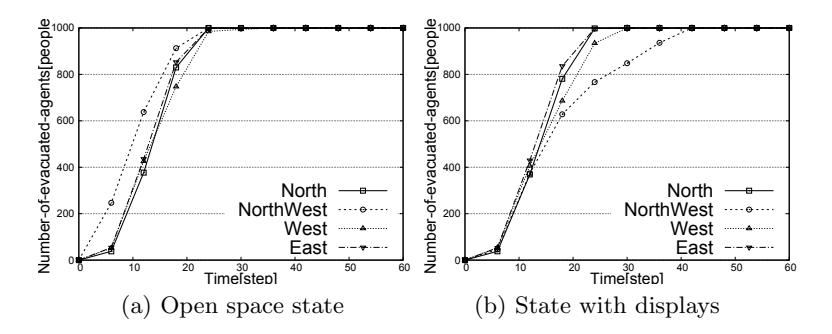
In Japan, fire departments examine sites before events to ensure that floor layouts fulfill their standards. They check prevention plans for emergencies to ascertain whether there are sufficient security guards to control visitors, and whether evacuation routes are sufficiently prepared for smooth evacuations. Fig. 2 shows the number of people evacuated. In every simulation, agents instantly evacuate to the building exteriors using the shortest path to the guided exit beforehand. In a case of an open space, it took approximately twenty steps for all agents to evacuate the hall.
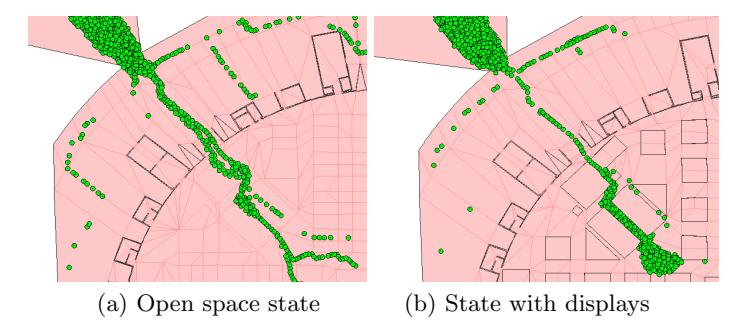
In a case of the northwest exit, the evacuation time doubled for agents when the exhibits were displayed. Fig. 3 shows snapshots of the northwest exit at states of the open space and display layout. The snapshot of the open space case demonstrates that the flow of people is smooth. The congestion occurred at a narrow path just before the exit in a case of the displayed layout. The congestion increased the evacuation time in this situation when compared to the open space case. This suggested that preparing signage for guiding individuals to move around the display allowed for a smoother evacuation.
The simulations were executed using TENDENKO. TENDENKO was developed based on the RoboCup rescue simulation system [7]. The features of TENEDNKO include simulation of human behaviors inside buildings and the simultaneous broadcasting of an emergency message to everyone.
2.3 Rescue virtual robot competition: sensing and vulnerability
Rescue robots participating in the RCRL are expected to demonstrate their functions when an emergency occurs at the RoboCup competition sites. Fig. 4 (a) shows the images of SLAM simulation results of Hall 1 using a RoboCup virtual robot platform and Fig.4 (b) shows output from SLAM simulation results. The robots are teleoperated from outside the building, and they explore the situation inside the halls. Table 1 shows areas of halls and the numbers of individuals that are expected to be in the halls at exhibitions. The area for displays in the second row is data from a past event. This indicated that the rescue simulation should be the size of several thousand agents.
The area size of the hall is about 100 m. The size gives specific values as the tasks of the Fukushima Daiich Nuclear Power Station that rescue robots were used to explore inside the buildings [6, 2]. These show that the test bed proposed 2014 provides a realistic environment to check the mobility and sensing abilities of rescue robots tested with a CAD environment.
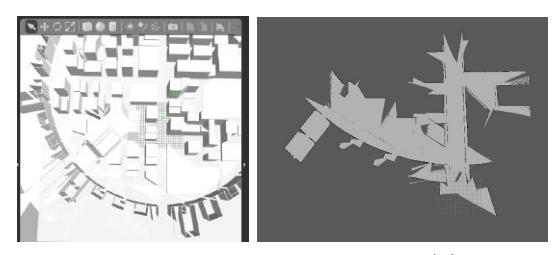
Table 1. Hall size and order of visitors
| Hall1 Hall2 | Hall3 | ||
|---|---|---|---|
| Hall area (open space)(m2) | 13,870 6,576 13,500 | ||
| Area with diplays (m2)* | 7,906 2,893 | 6,345 | |
| Rate of walking space(%) | 57 44 | 47 | |
| Occupancy load (number of individuals) 15,000 5,000 12,000 |
*: Data in he Area row is past event data.
3 Research topics based on lessons from testbed's experiences
3.1 Verification and validation of simulation
A number of studies have focused on human behavior during past disasters. For example, the National Institute of Standards and Technology examined occupant behavior during the attacks on the WTC buildings [3, 5]. They prepared models of evacuation simulations for potential emergencies. In order to allow for real-life applications, it is important to solve the following points that we pointed out in performing stages 1 and 2 in the test bed. These include:
- Virtual evacuation drills for the egress of occupants and rescue operations;
- Evacuation guidance in commercial and public facilities;
- Evacuation drills in both real-life situations and in simulations.
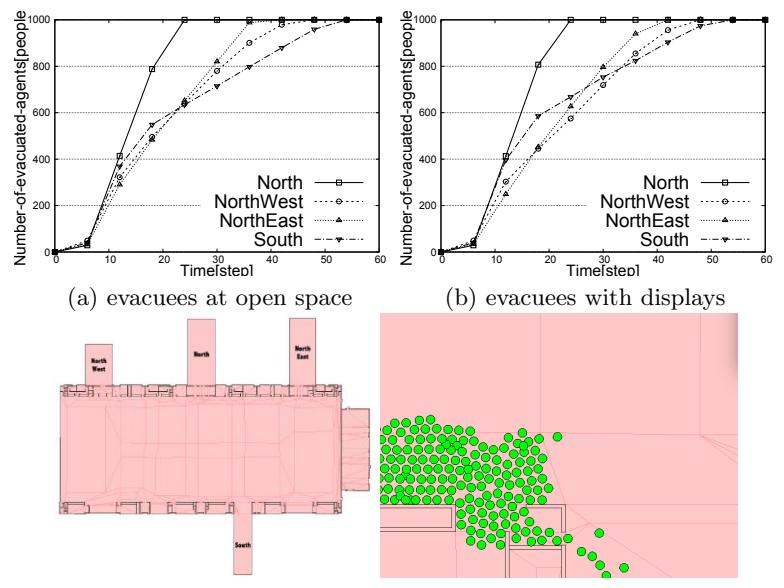
analysis of evacuation behavior: Fig. 5 (a) and (b) show the number of evacuees from four exits: north, northwest, northeast, and south of Hall 3. Hall 3 is a square hall and the north exit is a wide exit located in the middle of Hall 3 (Fig. 1). Hence, it is reasonable that the evacuation from the north is the fastest. It is interesting that evacuees from the south exit egressed smooth around 20 steps in a state with displays. This is a phenomena opposite to the one mentioned in subsection 2.2. Fig. 5 (c) shows a snapshot of congestion at the south exit in the open space situation. In the display layout, congestion was not observed. It appeared that the displays limited the traffic of agents and relaxed the congestion.
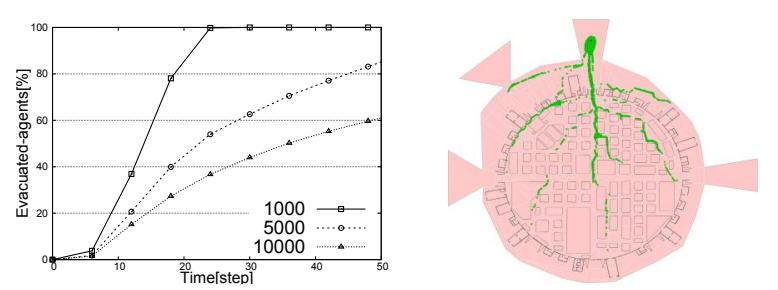
effect of the size of individuals: Fig. 6 (a) shows evacuation rates of 1,000, 5,000, and 10,000 agents from Hall 3. All agents in a case of 1,000 agents evacuate at 30 steps, while about 60 % and 40% of agents evacuate in 5,000 agents and 10,000 agents, respectively. Fig. 6 (b) shows an snapshot of evacuation behavior simulations. These results indicated the potential of evacuation simulation that simulations for various scenarios will help to design the evacuation planning in the halls.
- Virtual evacuation drills for the egress of occupants and rescue operations.
- Selection of situation dependent guidance in commercial and public facilities.
Verifying simulation results: Verifying simulation results is a key issue in social simulations. Evacuation simulations are a category of social simulations. In scientific and engineering fields, the principles of model hypothesis → consequence computation → results comparison has been used to increase the fidelity of simulations [4]. This principle cannot be applied to social simulations because these simulations are performed under future scenarios and unexperienced situations, which do not possess sufficient past data or allow for the performance of experiments under the same conditions. A framework affirming the planning based on the simulation results will work well in a possible emergency and is required in the future.
3.2 Exploration inside the venue by robots
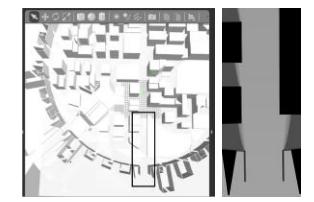
The environments were prepared based on of the test bed provided for rescue robots. The environments are used to test the functions of both mobility and sensing mentioned in Section 2.3, and the collaboration and autonomy of robots. The robot moved around the venue on the floor in order to explore for missing victims and checking damages. The demonstration showed that the map generation task is standard for rescue robots. The robots were expected to move around all areas of the halls. The areas surrounded by walls were also included in the target area that the robots explored (Fig. 7 (a, b)). Fig. 7 (a) is the same as Fig. 4 (a). In Fig. The gradation of color in the corridors show the power of Wi-Fi. The dark area show diffracted Wi-Fi reach robot, even though the power is weak.
In exploring the FDNP buildings [1], a robot pair was and will be used to ensure connection to the operators. A robot connected by a cable acted as a wireless access point. The second robot was operated wirelessly. The collaboration of the robots to move in the areas is further enabled by the strength of the Wi-Fi signal. Hence, Wi-Fi is a necessary technology in rescue tasks.
In generating a map of hall size, combining small maps measured by robots into a large map was another collaborative task. Autonomous mobility function was necessitated when the robots entered an area with no Wi-Fi signal. They were required to either wait until the Wi-Fi connection is re-linked, or to move autonomously when they could not connect to the Wi-Fi links.
4 Discussion and Summary
We proposed a test bed with the aim to further the practical use of RCRL achievement. In this paper, we demonstrated lessons gained from performing the test bed in stages 1 and 2. These lessons provided concrete themes to the community of RCRL participants who hope to apply their rescue simulations and robots to the following areas:
- Planning: Determining the most appropriate manner for preparation and response,
- Vulnerability Analysis: Assessing exist response strategies for hypothetical emergencies,
- Training: Training emergency services personnel to handle emergencies,
- Real-Time Response Support: Determining alternative response strategies for using real-time information.
Our proposed 3D model of Nagoya Portmesse provides realistic simulation environments and allows the robots to play the role of a real rescue crew.
References
- http://www.tepco.co.jp/en/decommision/principles/robot/index-e.html, date:21. Feb. 2016.
- http://www.tepco.co.jp/nu/fukushima-np/images/handouts 111021 03-j.pdf, date:25. Mar. 2012.
- J. D. Averill, D. S. Mileti, R. D.Peacock, E. D.Kuligowski, and N. E. Groner. Occupant behavior, egress, and emergency communications (NIST NCSTAR 1-7). Technical report, Gaitherburg, MD: National Institute of Standards and Technology, 2005.
- R. P. Feynman. The Character of Physical Law. The MIT Press, 1967.
- E. R. Galea, L. Hulse, R. Day, A. Siddiqui, G. Sharp, K. Boyce, L. Summerfield, D. Canter, M. Marselle, , and P. V. Greenall. The uk wtc9/11 evacuation study: An overview of the methodologies employed and some preliminary analysis. In S. A. Klingsch W.W.F., Rogsch C. and M. Schreckenberg, editors, Pedestrian and Evacuation Dynamics 2008, pages 3–24. Springer, 2008.
- E. GUIZZO. Fukushima robot operator writes tell-all blog. http://spectrum.ieee.org/automaton/robotics/industrial-robots/fukushima-robotoperator-diaries, date:21 Feb. 2015.
- M. Okaya, T. Niwa, and T. Takahashi. TENDENKO: Agent-based evacuation drill and emergency planning system (demonstration). In The Autonomous Agents and MultiAgent Systems (AAMAS), pages 169–1670, 2014.
- T. Takahashi and M. Shimizu. How can the robocup rescue simulation contribute to emergency preparedness in real-world disaster situations? In S. R. K. S. Reinaldo A. C. Bianchi, H. Levent Akin, editor, RoboCup 2014: Robot World Cup XVIII, Lecture Notes in Computer Science, pages 295–305. Springer International Publishing, 2015.