The Future of Robot Rescue Simulation Workshop
Arnoud Visser, Francesco Amigoni, Masaru Shimizu
Universiteit van Amsterdam, The Netherlands; Politecnico di Milano, Italy; Chukyo University, Japan
https://staff.fnwi.uva.nl/a.visser/activities/FutureOfRescue/ · http://www.lorentzcenter.nl/aim.php
Abstract Although the environment of RoboCup Rescue Simulation League is well used in research initiatives, the number of teams that are willing to benchmark their overall performance in a yearly competition is dropping. Yet, recent disasters have made clear how important continuous development in this field is. Previous initiatives were focused on improving the simulation environment, the documentation and the visualization towards the public, but this time we are trying to build a community. In The Future of Robot Rescue Simulation Workshop all participants worked together to define a roadmap, test the environment, create tutorials how to integrate perception, planning and control modules, build logging and visualization tools, and finalize the rules for the competition. This workshop should have an impact far outside the RoboCup community; it should also be relevant for related initiatives as the DARPA Robotics Challenge and the Japanese Virtual Robot Challenge. This is accomplished by publishing the code as ROS-nodes, including tutorial-pages how to use this code. Beyond the fact that the number of interested participants was larger than the number of available places and a selection had to be made, also the feedbacks from the participants confirm the success of the workshop.
1 Introduction
The Rescue Simulation League has a long history [37]. The first competition was organized at the RoboCup 2001 in Seattle. Initially the participation was steadily increasing, but the number of teams reached its top in 2006 (Agent Competition) and 2009 (Virtual Robot Competition) [2]. The research behind the competition resulted in a constant stream of publications at the RoboCup Symposium [3, 8, 13, 18, 19, 21–23, 26, 27, 30, 33, 34, 39, 40] and at other venues [1, 4, 5, 10–12, 14, 15, 17, 24, 25, 29, 31, 32, 35].
In the previous years there have been many initiatives on robot rescue competitions, which often have a simulation component. A nice example is the DARPA Robotics Challenge [28]; the finals in 2015 were between 25 international competitors, but the challenge started in 2013 with nearly 100 teams participating in the Virtual Challenge [1]. The RoboCup Rescue Simulation League has now the possibility to redefine its simulation setting to allow an easy transition of control software between rescue robot platforms (both real and virtual). This will further enhance its potential in favoring and stimulating the development of artificial intelligence (AI) solutions for multi-robot systems employed in search and rescue applications.
2 The Solution
The purpose of The Future of Robot Rescue Simulation Workshop is to set a new milestone and design an environment and scenario which can be used inside the Virtual Robot Competition (organized as part of the RoboCup Rescue Simulation League), and not only, for the coming 10 years and in which innovative scientific and technological solutions for rescue robots can be developed and validated.
In particular, the goals of the workshop are to redefine the challenge of the Virtual Robot Competition, to make the transition from the current Unreal/ROS based environment [16] (which has been used in the previous years) towards a ROS/Gazebo based environment [36] and to define the roadmap of the scientific challenges in the competition for the coming years.
In summary, the outcomes of the workshop include:
- the definition of a setting for the Virtual Robot Competition,
- the assessment of Gazebo as a suitable simulation platform for testing multirobot systems for search and rescue,
- a roadmap for the real-world validation of the simulations performed in Gazebo and involving multi-robot systems for search and rescue,
- an initial seed of a community of researchers around the rescue applications of multi-robot systems.
Note that, except the first one, all the above outcomes are of great interest for the general robotics community [20]. Since most of the above issues will be part of the future editions of the Virtual Robot Competition and since this competition exists already from 2006 [9], and is integral part of the mission of the RoboCup towards 2050 [37], the sustainability of the project beyond the workshop is guaranteed. Note that the Unreal based simulation environment has been downloaded more than 84,000 times and has been used inside the Virtual Manufacturing Automation Competition [7] and many other robotic research projects [6].
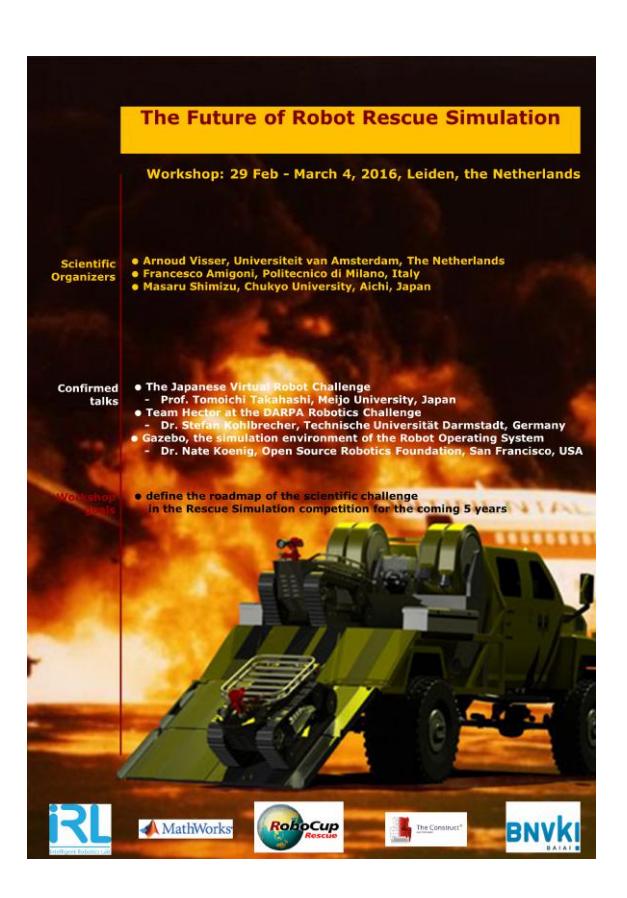
3 Community building
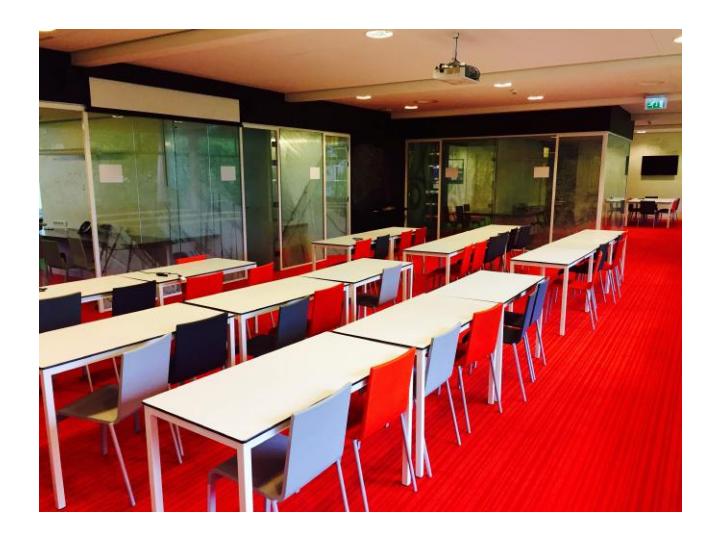
The Future of Robot Rescue Simulation Workshop has been held February 29 - March 4 2016 at the Lorentz Center that is located in Leiden, the oldest university city of the Netherlands. The Lorentz Center is an international center that coordinates and hosts workshops in the sciences, based on the philosophy that science thrives on interaction between creative researchers. Lorentz Center workshops focus on new collaborations and interactions between scientists from different countries and fields, and with varying seniority. The program of the workshop is available at the webpage and mixed lectures (morning) and handson activities (afternoon), supported by tutorial available at the same webpage. In addition, the workshop has been accompanied by an extensive social program in the evenings, to enhance the community building. The venue chosen is ideal for this combination of brainstorming and hacking; it has a small lecture room, 7 offices and a common room (see Fig. 2). Due to the venue, the number of participants is limited to 25 persons. The number of pre-registered participants was larger than the 25 available places, which meant that the organizers had to be restrictive and a selection had to be made according to participants' diversity and contribution potential, based on a short CV which highlights the participant's academic/industrial and technical skills. The idea is that the participants represent a synergic mix of junior and senior researchers, both from academia and industry. Moreover, to promote diversity, participation from all over the world is encouraged both in the selection process and by providing a partial travel support. At the end, the selected participants come from the Netherlands, Turkey, Italy, Tunisia, Austria, United Kingdom, Switzerland, Iran, Germany, Portugal, Peru, Malaysia, and Japan. The selected participants had experience in computer languages as C, C++, C#, R, Matlab, Java, Basic, Python, and Maple. They had experience with simulation environments as Unreal Engine, Gazebo, Player/Stage, Robotics Development Studio, Unit3D, V-rep, Open Dynamics Engine, and Bullet. They had participated in competitions as the DARPA Challenge, Japanese Virtual Robot Challenge, euRathlon, UAE Drones for Good, RoboCup Junior, RoboRace, Mid-size Sumo, and the RoboPoly challenges.
To cover the organization costs and partial travel grants, funds have been kindly provided by the Lorentz Center, the Intelligent Robotics Lab, the Intelligent Autonomous Systems fund, the Autonomous Intelligent Robots foundation, the Benelux Association for Artificial Intelligence, the RoboCup Federation, The Construct Sim, and MathWorks. The financial participation of research institutions and private companies shows the broad interest for the success of the workshop.
The feedback from the participants has been very positive. The average overall grade of satisfaction is 8.04 (out of 10).
4 Development
Gazebo, the simulation environment native to ROS, has a large community of developers. This will make the progress made by the Open Source Robotics foundation in improving Gazebo directly available to the RoboCup Rescue Simulation League community. In addition, the maintenance of the simulation environment of the Virtual Robot Competition would come in professional hands. ROS consists of many advanced perception and control modules, developed by the research institutes all over the world, allowing to continue development at a much higher level.
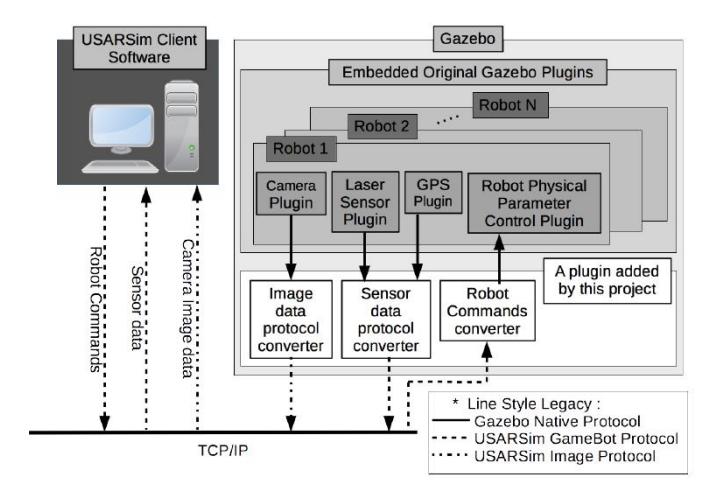
Thanks to the development of a Gazebo plugin, described in the previous year Infrastructure Competition [36], legacy USARSim Client software can directly connect to Gazebo (see Fig. 3). Yet, now is the time to build modules based on Gazebo native protocol. This not only includes robot control modules, but also the tools for monitoring and visualization of the progress of the competition. Some of those tools have been developed during the workshop and some of them are available on the workshop webpage. In addition, for the competition it is also important that the disaster scenarios developed in Unreal Editor are ported to Gazebo [38].
5 Application to the Agent Competition
The Agent Competition has a number of comparable problems, such as a declining number of participants [2], difficulties to find enough developers to maintain the simulation environment, and difficulties to get the participants involved outside the competition. The experience with this new initiative could be used to enlarge the community of the Agent Competition, by letting them building together on the simulation server, the tools and/or the development framework.
6 Conclusion
The Future of Robot Rescue Simulation workshop is intended to build a new community. In the workshop all participants worked together to define a roadmap, test the simulation environment, create tutorials on how to integrate perception, planning and control modules, build logging and visualization tools and finalize the rules for the competition. This workshop should have an impact far outside the RoboCup community; it should also be relevant for related initiatives as the DARPA Robotics Challenge and the Japanese Virtual Robot Challenge. This is accomplished by publishing the code as ROS-nodes and the accompanying tutorial-pages.
References
- Aguero, C.E., Koenig, N., Chen, I., Boyer, H., Peters, S., Hsu, J., Gerkey, B., Paepcke, S., Rivero, J.L., Manzo, J., et al.: Inside the virtual robotics challenge: Simulating real-time robotic disaster response. Automation Science and Engineering, IEEE Transactions on 12(2), 494–506 (2015)
- Akin, H.L., Ito, N., Jacoff, A., Kleiner, A., Pellenz, J., Visser, A.: RoboCup rescue robot and simulation leagues. AI Magazine 34(1), 78 (2012)
- Amigoni, F., Basilico, N., Li, A.Q.: How much worth is coordination of mobile robots for exploration in search and rescue? In: RoboCup 2012: Robot Soccer World Cup XVI, pp. 106–117. Springer (2013)
- Balaguer, B., Balakirsky, S., Carpin, S., Visser, A.: Evaluating maps produced by urban search and rescue robots: lessons learned from robocup. Autonomous Robots 27(4), 449–464 (2009)
- Balakirsky, S., Carpin, S., Kleiner, A., Lewis, M., Visser, A., Wang, J., Ziparo, V.A.: Towards heterogeneous robot teams for disaster mitigation: Results and performance metrics from robocup rescue. Journal of Field Robotics 24(11-12), 943–967 (2007)
- Balakirsky, S., Carpin, S., Lewis, M.: IROS2009 workshop on Robots, games, and research: success stories in USARSim (2009)
- Balakirsky, S., Madhavan, R., Scrapper, C.: NIST/IEEE virtual manufacturing automation competition: from earliest beginnings to future directions. In: Proc. PerMIS. pp. 214–219 (2008)
- Carpin, S., Wang, J., Lewis, M., Birk, A., Jacoff, A.: High fidelity tools for rescue robotics: results and perspectives. In: RoboCup 2005: Robot Soccer World Cup IX, pp. 301–311. Springer (2006)
- Carpin, S., Wang, J., Lewis, M., Birk, A., Jacoff, A.: High fidelity tools for rescue robotics: Results and perspectives. In: RoboCup 2005: Robot Soccer World Cup IX, vol. LNCS 4020, pp. 301–311. Springer (2006)
- Chalamish, M., Sarne, D., Lin, R.: The effectiveness of peer-designed agents in agent-based simulations. Multiagent and Grid Systems 8(4), 349–372 (2012)
- Davids, A.: Urban search and rescue robots: from tragedy to technology. Intelligent Systems, IEEE 17(2), 81–83 (2002)
- Ferreira Jr, P.R., Dos Santos, F., Bazzan, A.L., Epstein, D., Waskow, S.J.: Robocup rescue as multiagent task allocation among teams: experiments with task interdependencies. Autonomous Agents and Multi-Agent Systems 20(3), 421–443 (2010)
- Formsma, O., Dijkshoorn, N., van Noort, S., Visser, A.: Realistic simulation of laser range finder behavior in a smoky environment. In: RoboCup 2010: Robot Soccer World Cup XIV, pp. 336–349. Springer (2011)
- Kitano, H., Tadokoro, S.: Robocup rescue: A grand challenge for multiagent and intelligent systems. AI magazine 22(1), 39 (2001)
- Kleiner, A., Farinelli, A., Ramchurn, S., Shi, B., Maffioletti, F., Reffato, R.: Rmasbench: benchmarking dynamic multi-agent coordination in urban search and rescue. In: Proceedings of the 2013 international conference on Autonomous agents and multi-agent systems. pp. 1195–1196. International Foundation for Autonomous Agents and Multiagent Systems (2013)
- Kootbally, Z., Balakirsky, S., Visser, A.: Enabling codesharing in rescue simulation with USARSim/ROS. In: RoboCup 2013: Robot World Cup XVII, vol. LNCS 8371, pp. 592–599. Springer (2014)
- Lewis, M., Sycara, K., Nourbakhsh, I.: Developing a testbed for studying humanrobot interaction in urban search and rescue. In: Proceedings of the 10th International Conference on Human Computer Interaction. pp. 22–27 (2003)
- Luperto, M., Li, A.Q., Amigoni, F.: A system for building semantic maps of indoor environments exploiting the concept of building typology. In: RoboCup 2013: Robot World Cup XVII, pp. 504–515. Springer (2014)
- Murphy, R.R., Casper, J., Micire, M.: Potential tasks and research issues for mobile robots in robocup rescue. In: RoboCup 2000: Robot Soccer World Cup IV, pp. 339–344. Springer (2001)
- Murphy, R.R., Tadokoro, S., Nardi, D., Jacoff, A., Fiorini, P., Choset, H., Erkmen, A.M.: Search and rescue robotics. In: Springer Handbook of Robotics, pp. 1151–1173. Springer (2008)
- Nair, R., Ito, T., Tambe, M., Marsella, S.: Task allocation in the robocup rescue simulation domain: A short note. In: RoboCup 2001: Robot Soccer World Cup V, pp. 751–754. Springer (2002)
- Nair, R., Tambe, M., Marsella, S.: Team formation for reformation in multiagent domains like robocuprescue. In: RoboCup 2002: Robot Soccer World Cup VI. pp. 150–161. Springer (2003)
- Norouzi, M., De Bruijn, F., Mirón, J.V.: Planning stable paths for urban search and rescue robots. In: RoboCup 2011: Robot Soccer World Cup XV, pp. 90–101. Springer (2012)
- Okaya, M., Takahashi, T.: Bdi agent model based evacuation simulation. In: The 10th International Conference on Autonomous Agents and Multiagent Systems-Volume 3. pp. 1297–1298. International Foundation for Autonomous Agents and Multiagent Systems (2011)
- Paquet, S., Bernier, N., Chaib-draa, B.: Comparison of different coordination strategies for the robocuprescue simulation. In: Innovations in Applied Artificial Intelligence, pp. 987–996. Springer (2004)
- Pfingsthorn, M., Slamet, B., Visser, A.: A scalable hybrid multi-robot slam method for highly detailed maps. In: RoboCup 2007: Robot Soccer World Cup XI, pp. 457–464. Springer (2008)
- Post, S.B., Fassaert, M.L., Visser, A.: The high-level communication model for multi-agent coordination in the robocuprescue simulator. In: RoboCup 2003: Robot Soccer World Cup VII, pp. 503–509. Springer (2004)
- Pratt, G., Manzo, J.: The DARPA Robotics Challenge [competitions]. IEEE Robotics & Automation Magazine 20(2), 10–12 (2013)
- Pujol-Gonzalez, M., Cerquides, J., Farinelli, A., Meseguer, P., Rodriguez-Aguilar, J.A.: Binary max-sum for multi-team task allocation in robocup rescue. Optimisation in multi-agent systems and distributed constraint reasoning (OptMAS-DCR) (2014)
- Radmand, A., Nazemi, E., Goodarzi, M.: Integrated genetic algorithmic and fuzzy logic approach for decision making of police force agents in rescue simulation environment. In: RoboCup 2009: Robot Soccer World Cup XIII, pp. 288–295. Springer (2010)
- Ramchurn, S.D., Rogers, A., Macarthur, K., Farinelli, A., Vytelingum, P., Vetsikas, I., Jennings, N.R.: Agent-based coordination technologies in disaster management. In: Proceedings of the 7th international joint conference on Autonomous agents and multiagent systems. pp. 1651–1652. International Foundation for Autonomous Agents and Multiagent Systems (2008)
- Reinaldo, F., Certo, J., Cordeiro, N., Reis, L.P., Camacho, R., Lau, N.: Applying biological paradigms to emerge behaviour in robocup rescue team. In: Progress in Artificial Intelligence, pp. 422–434. Springer (2005)
- Rooker, M.N., Birk, A.: Combining exploration and ad-hoc networking in robocup rescue. In: RoboCup 2004: Robot Soccer World Cup VIII, pp. 236–246. Springer (2005)
- Schmits, T., Visser, A.: An omnidirectional camera simulation for the usarsim world. In: RoboCup 2008: Robot Soccer World Cup XII, pp. 296–307. Springer (2009)
- Sharbafi, M.A., Lucas, C., Haghighat, A.T., Ghiasvand, O.A., Aghazade, O.: Using emotional learning in rescue simulation environment. Transactions on Engineering, Computing and Technology 13(1), 333–337 (2006)
- Shimizu, M., Koenig, N., Visser, A., Takahashi, T.: A realistic RoboCup rescue simulation based on Gazebo. In: RoboCup Symposium 2015, Development Track, Hefei, China (2015)
- Tadokoro, S., et al.: The RoboCup-Rescue project: A robotic approach to the disaster mitigation problem. In: Proc. ICRA. pp. 4089–4094 (2000)
- Visser, A.: A guide to the robocup virtual rescue worlds. Tech. Rep. IRL-UVA-16-01, Intelligent Robotics Laboratory, Universiteit van Amsterdam, The Netherlands (2016)
- Visser, A., Ito, N., Kleiner, A.: Robocup rescue simulation innovation strategy. In: RoboCup 2014: Robot World Cup XVIII, pp. 661–672. Springer (2015)
- Zaratti, M., Fratarcangeli, M., Iocchi, L.: A 3d simulator of multiple legged robots based on usarsim. In: Robocup 2006: Robot Soccer World Cup X, pp. 13–24. Springer (2007)