RoboCup Graz-2009- Rescue Simulation League Team Virtual robot Team Description MRG (Iran)
Iraj Chegini, Abbas Teymouri, Meysam Karimi, Amaj Rahimi Midani, Hossein Mohammadpour Ojvar, Yaser Mohammadi
Abstract This paper describes the main features of the MRG Virtual Robots team which intends to participate in Robocup Graz 2009 competitions. MRG ( Mechatronic Research group)expands total steps of recognition and measurements; finally plan the maps with algorithms and solutions that are based on artificial intelligence.MRG robots have the ability to recognize and plan the unknown places and it can be use in the real robots in the near future. We focus on the fast slam for Preparation of maps in different robots. This report shortly describes some details about uses of above algorithms.
Key words: FastSLAM, artificial intelligence, Robocup Graz 2009
1) Introduction:
One of the main goals for this team is to promote the level of robots intelligence and to make communication between them in the time of accident and real events. One of the characteristics of this team is to make complete maps from the scene of accidents and to fully recognize the injured persons. The software on the robots is designed to support multiple robots. This includes Robot Communication and localization, taking picture and drawing measured environment.
2) Our Goals:
We are trying to recognize the shortages in the virtual robots and close these gaps , that's why we used P2DX robots because it have a lot of abilities. It has abilities such as high flexibility with hard situation, controlling and guiding and also making easy communication with other robots.
3) Team members:
Team members
| # | Name | Role |
|---|---|---|
| 1 | Iraj Chegini | Leader, AI Planner and Developer |
| 2 | Hossein Mohammadpour Ojvar | Software Developer, AI Developer |
| 3 | Abbas Teymouri | Coordinator, Image Processing |
| 4 | Yaser Mohammadi | Artificial Intelligence |
| 5 | Amaj Rahimi Midani | Image Processing, Translator |
| 6 | Meysam Karimi | Image Processing And SLAM |
4) Main Structure:
Interface: can do each robot settings and do all of the communicating and controlling between servers and the robots.
Robot: Every robot has a special characteristic in artificial intelligence in this program and it depends on task of robot in the operation for finding injured and mapping .
Driver: For preventing the software part from mixing with the hardware part, These drivers changes the special formulas that has been prepared by intelligent software of robot in to the understandable and controllable orders for hardware parts of the robot.
Gamebot: a modification to unreal tournament to bridge unreal engine with the tside application.
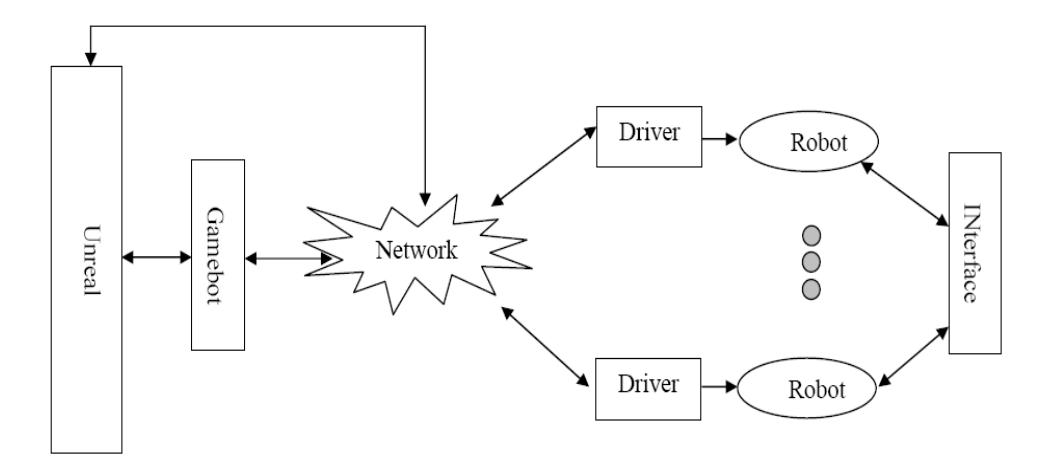
5) System structure:
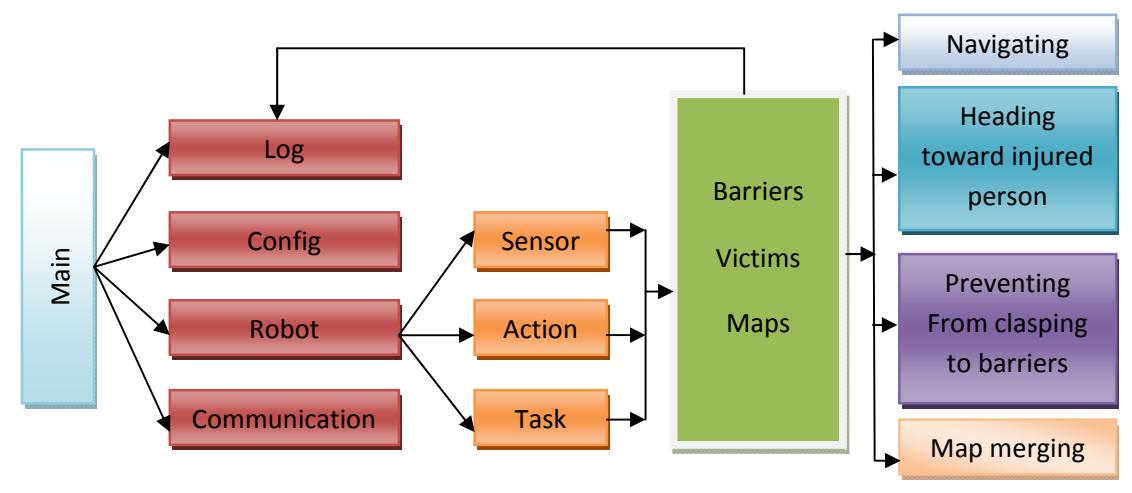
Tasks:
There are some priority that should be distinguished to the task explanation of robot .for example if it is close by the victim, the priority find the location of the victim and robot identify the victim.
Finding barriers:
By marking the arena with the help of barriers it can reduce the chance of clasping Of map planning.
Log:
Maintaining some information about the sensors and the arena coordinates for processing and to use this information for all robots because of preventing to do repetitive tasks.
Recognition of barriers and victims:
When robot faces a victim, sensors send some data about it and with the use of algorithm start to analysis information's, finally it introduces the victim by roles of the competition. There fore, it prevents other robots to claps with these barriers.
Maps assembly:
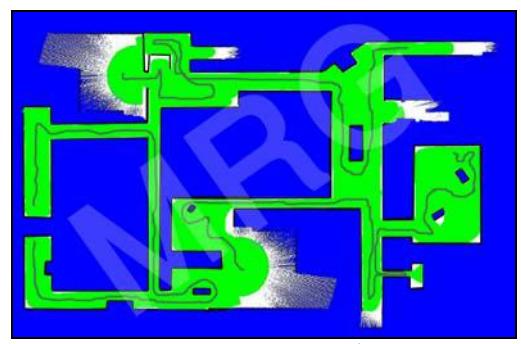
Each robots do the search with the help of sensors and gives some part of the maps. Ultimately by use of first direction and the coordination's , maps get mix and we getthe full map. In the next part we will give description about the map.
6) Incremental Probabilistic Mapping and Localization:
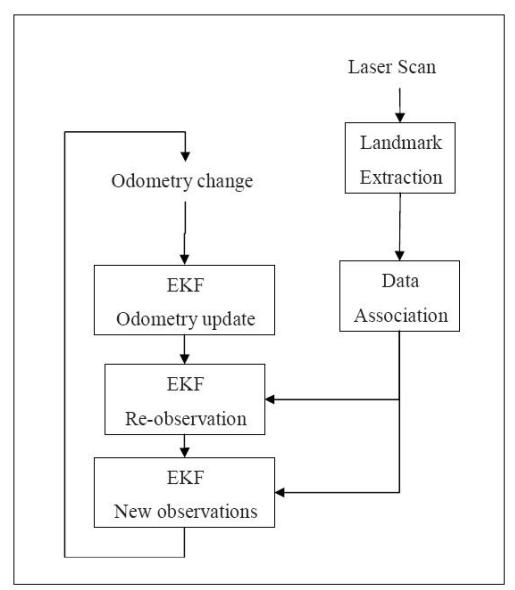
The SLAM process consists of a number of steps. The goal of the process is to use the environment to update the position of the robot. Since the odometry of the robot (which gives the robots position) is often erroneous we cannot rely directly on the odometry. We can use laser scans of the environment to correct the position of the robot. This is accomplished by extracting features from the environment and re-observing when the robot moves around. An EKF (Extended Kalman Filter) is the heart of the SLAM process. It is responsible for updating where the robot thinks it is based on these features. The EKF keeps track of an estimate of the uncertainty in the robots position and also the uncertainty in these landmarks it has seen in the environment. An outline of the SLAM process is given below.
7) Image Processing
In this field we use Omni directional cameras for every robot, this camera will give us chance to see 360degree all over the area around the robots. Because in many situations the robots that move on the surface can't move to some places (because of the things on its way), we used Air-robots to help our ground robots in exploring maps. Of course this robot only helps in the times that our ground robots can't move on the ground any more and if this happens our map will remain incomplete.
8) Cooperation
8-1 Coordination
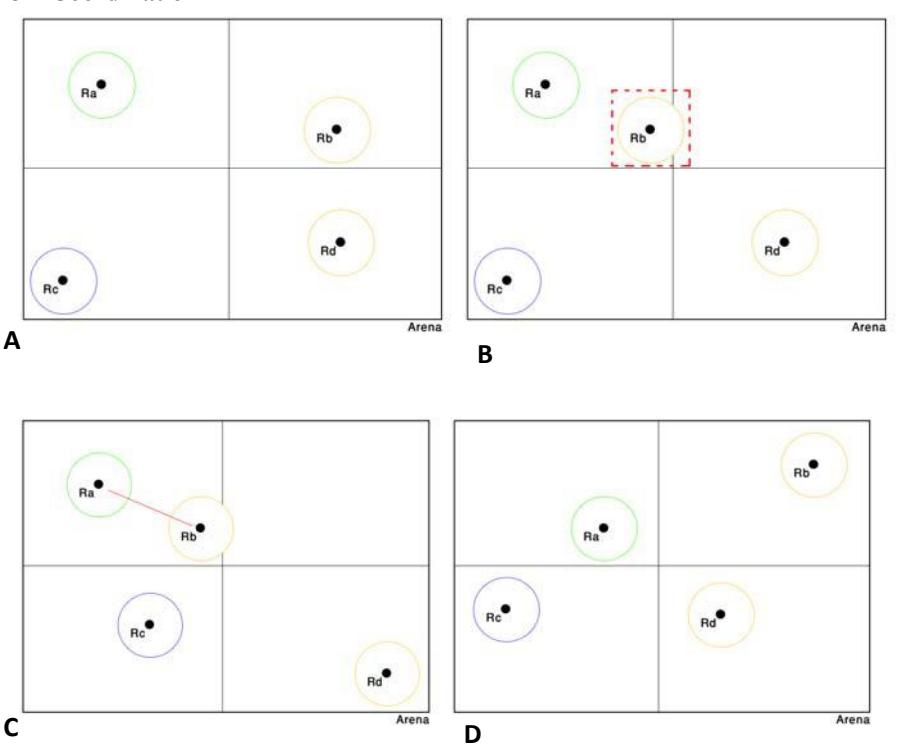
For preventing from re-exploring of arena we part the arena into smaller parts (As above picture).In every part we use a robot with different task, some of the robots are for exploring and some for victims finding. If a robot comes out from its arena which is defined for it, the robot in the same arena give alert to the entering robot and the entering robot will head back to its own arena. Exploring in this way will give us advantages in robots control. It lets us explore all parts of arena and prevent from re-exploring the known paths.
8-2 Wireless Communication
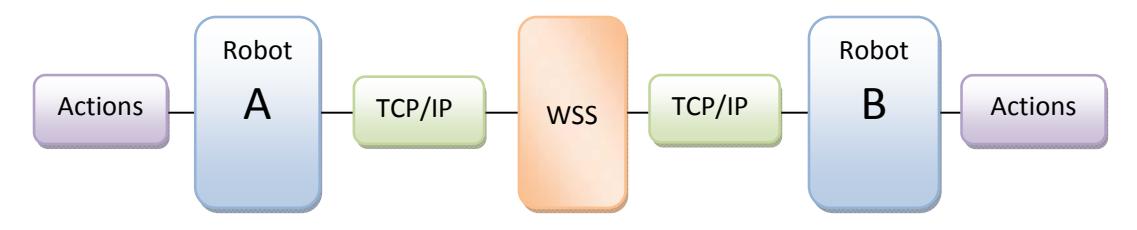
For logic communication between robots and operator we use messages which messages will be send by WSS. These messages can have information about victim detection, robots place in the arena and etc. messages will be stored in Message Manager and every second it will update automatically. With help of the gathered information from WSS we can explain the maps and decide our next steps.
9) Interface:
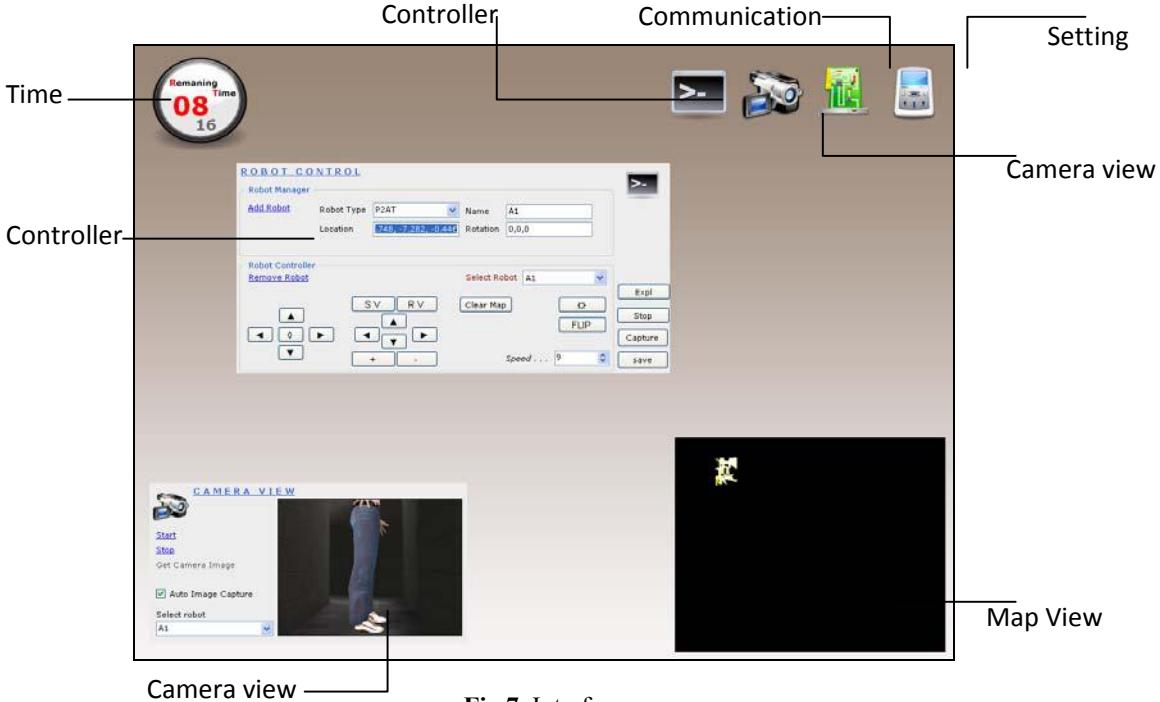
Software area is contain of settings, pictures receiver and the maps planning arena. You can see the parts below in the tools options.
10) Sensors and Robots
We have used these sensors mounted mainly on the P2AT robot.
Sensors and Robots
| Sensor | Count |
|---|---|
| Sonar | 4 |
| Victim RFID | 1 |
| PTZ Camera | 1 |
| INS | 1 |
| Odometry | 1 |
| RFID | 1 |
| Sick LMS | 1 |
References
- G. Dissanayake, H. Durrant-Whyte, and T. Bailey. A computationally efficient solution to the simultaneous localization and map building (SLAM) problem. In ICRA'2000 Workshop on Mobile Robot Navigation and Mapping, 2000.
- P. Besl and N. McKay. A method for registration of 3dshapes. Trans. Patt. Anal. Mach. Intell. 14(2), pages 239–256, 1992.
- Balakirsky, S., Carpin, S., A.Kleiner, Lewis, M., Visser, A.,Wang, J., Ziparo, V.: Towards heterogeneous robot teams for disaster mitigation: Results and performance metrics from robocup rescue. Journal of Field Robotics (2007)
- T. Röfer. Using histogram correlation to create consistent laser scan maps. In Proc. of the IEEE/RSJ International Conference on Intelligent Robots and Systems (IROS), 2002.
- G. Weiß, C. Wetzler, and E. von Puttkamer. Keeping trackof position and orientation of moving indoor systems by correlation of range-finder scans. In Proc. of the IEEE/RSJInternational Conference on Intelligent Robots and Systems(IROS), pages 595–601, 1994.
- S. Thrun. A probabilistic online mapping algorithm for teams of mobile robots. International Journal of Robotics Research, 20(5):335–363, 2001.
- Christian Brenneke, Oliver Wulf, Bernardo Wagner , "Using 3D Laser Range Data for SLAM in Outdoor Environments ", Institute for Systems Engineering, University of Hannover, Germany
- Hugh Durrant-Whyte and Tim Bailey, Simultaneous Localizaiton and Mapping (SLAM) : Part I The Essential Algorithms
- www.robocup.org
- www.robocuprescue.org