Amsterdam Oxford Joint Rescue Forces Team Description Paper Virtual Robot competition Rescue Simulation League RoboCup 2011
Nick Dijkshoorn, Helen Flynn, Okke Formsma, Sander van Noort, Carsten van Weelden, Chaim Bastiaan, Niels Out, Olaf Zwennes, Sev´aztian Soffia Ot´arola, Julian de Hoog, Stephen Cameron, Arnoud Visser
Universiteit van Amsterdam, Science Park 904, 1098 XH Amsterdam, NL; Oxford University Computing Laboratory, Parks Road, Oxford OX1 3QD, UK
http://www.jointrescueforces.eu
Abstract With the progress made in active exploration, the robots of the Joint Rescue Forces are capable of making deliberative decisions about the distribution of exploration locations over the team. Experiments have been done which include information exchange between team-members at rendez-vous points and dynamic role switching between relays and explorers. In the previous competition exploration was demonstrated with large robots with advanced mobility, such as the Kenaf and the AirRobot. This year our mapping algorithms are extended to be able to explore with the smaller AR.Drone, a flying robot used in the International Micro Air Vehicle competition. Further, progress will be demonstrated in automatic victim detection.
Introduction
The RoboCup Rescue competitions provide benchmarks for evaluating robot platforms' usability in disaster mitigation. Research groups should demonstrate their ability to deploy a team of robots that explore a devastated area and locate victims. The Virtual Robots competition, part of the Rescue Simulation League, is a platform to experiment with multi-robot algorithms for robot systems with advanced sensory and mobility capabilities.
The shared interest in the application of machine learning techniques to multi-robot settings [1] has led to a joint effort between the laboratories of Oxford and Amsterdam. This year machine learning techniques are used to advance the perception and Simultaneous Localization And Mapping (SLAM) capabilities of our team. For this year's challenge the automatic victim detection is of major importance, although the quality of the map becomes important to coordinate the efforts in larger robot teams.
1 Team Members
UsarCommander was originally developed by Bayu Slamet and all other contributions have been integrated into this framework. Many other team members [2–6] have contributed to perception and control algorithms inside this framework. In advance of the Iran Open this year several improvements in the user interface have been made. A separate socket connection was created to broadcast the camera images, which improved the response time on drive commands. The drive commands can also be given with keyboard and pointers on the map. The latter option was coupled with a new behavior: way-point navigation.
The following contributions have been made this year:
Nick Dijkshoorn : smoke and fire simulation [7], 2.5D SLAM, communication
Helen Flynn : object recognition with weak classifiers [8] Okke Formsma : smoke and fire simulation [7], on-demand SLAM
Sander van Noort : smoke and fire simulation [7], Nao model
Carsten van Weelden : AR.Drone model Chaim Bastiaan : victim behaviors [9] Niels Out : radar sensor [10]
Olaf Zwennes : automatic map generation Sev´aztian Soffia Ot´arola : webbased user interface
Julian de Hoog & : multi-robot exploration[11], communication roles [12]
Stephen Cameron
Arnoud Visser : autonomous exploration [11, 12]
2 2.5D Simultaneous Localization And Mapping
One of the most fundamental problems in robotics is the Simultaneous Localization And Mapping problem (SLAM). This problem arises when the robot does not have access to a map of the environment and does not know its own pose. In SLAM, the robot acquires a map of its environment while simultaneously localizing itself relative to the map. This knowledge is critical for robots to operate autonomously. SLAM is an active research area in robotics. A variety of solutions have been developed. Most solutions rely on bulky sensors that have a high range and accuracy (e.g., SICK laser range finder). However, these bulky sensors cannot be used on small (flying) vehicles. As a result, researchers focused on using vision sensors. Vision seems to offer a good balance in terms of weight, accuracy and power consumption. Lightweight cameras are especially attractive for small flying vehicles (AUVs), which are less affected by obstacles. Steder et al. [13] addresses the SLAM problem using an AUV with two low-cost down-looking cameras in combination with an altitude sensor. Their approach is able to learn visual elevations maps of the ground. If the vehicle carries only one camera, a visual map without elevation information is generated. Caballero et al. [14] present an approach that uses monocular vision. Inter-motions are used to estimate the motion of the AUV. Online mosaicking is applied to reduce the impact of accumulative errors in the position estimation.
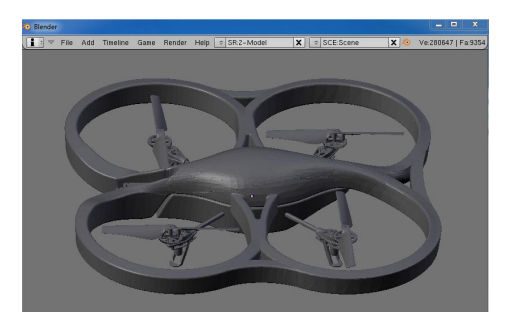
Our research addresses the problem of creating visual elevation maps of the ground using only a single camera (monocular vision) and an ultrasound sensor. Experiments are performed using the Parrot AR.Drone quadrotor helicopter. This helicopter is equipped with a low-resolution down-looking camera, an ultrasound sensor and an inertial unit that measures pitch, roll, yaw and accelerations along all axes. The vehicle is controlled by sending commands over a Wi-Fi connection. As described in section 4.2, a model of such an AR.Drone quadrotor is available in USARsim.
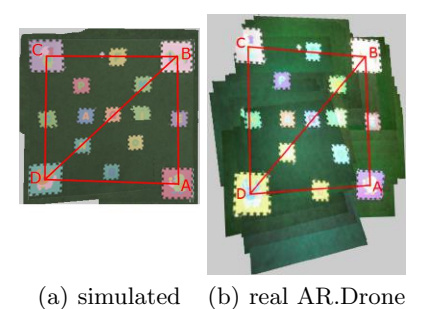
The map and pose of the vehicle are estimated using the measurements obtained by vehicle and the controls that are executed by the vehicle. However, sensors are noisy and the control commands are not executed accurately. This introduces uncertainty and makes the SLAM problem difficult. Probabilistic approaches are used to represent uncertainty explicitly. By doing so, they can represent ambiguity and degree of belief in a mathematically sound way. A possible probabilistic approach is to use an Extended Kalman Filter (EKF). Mosaicking is applied to reduce the impact of accumulative errors. The mosaic consists of a network of inter-image relations and is used to create a consistent view of the environment. This mosaic is used as a resource to detect drift in position estimations. Results of this method are given in Fig. 1. Both for the simulated and real AR.Drone a visual map is created with enough quality for human navigation purposes. The camera images in simulation are postprocessed (decreased saturation, increased brightness, downsampled resolution) to mimic the real images. Our current hypothesis is that the remaining stitching errors for the real AR.Drone are due to the effect of automatic white balancing of the camera. These small estimation errors should be easily corrected by implicit loop closure in more advanced SLAM algorithms.
3 Victim Detection
This year we are using a combination of Viola and Jones' face detection algorithm[15] and skin-color histograms in order to detect victims. By employing this dual approach to victim detection we hope to reduce the false positive rate which has been a hindrance in the past. Viola and Jones' detector is based on Haar features and the AdaBoost boosting algorithm. AdaBoost is a well-known algorithm for generating strong classifiers from many weak ones. The weak classifiers used in Viola and Jones' detector are based on Haar features of three kinds: a two-rectangle feature is the difference between the sum of the values of two adjacent rectangular windows. A three-rectangle feature considers three adjacent rectangles and computes the difference between the sum of pixels in the extreme rectangles and the sum of the pixels in the middle rectangle. A fourrectangle feature considers a 2x2 set of rectangles and computes the difference between sums of pixels in the rectangles that constitute the main on and offdiagonals. For a 24x24 pixel sub window there are more than 180,000 potential features. The task of the AdaBoost algorithm is to pick a few hundred of these features and assign weights to each using a set of training images. Object detection is then reduced to computing the weighted sum of the chosen rectangle features and applying a threshold. This is a very fast operation. We trained various classifiers for faces in both upright and lying down positions, using images from Usarsim [16].
In the past we have found [8] that the Viola - Jones detector has quite a high false positive rate (that is, if incorrectly classifies regions of an image as a face). This year we are combining the detector with a colour-based skin detector in order to reduce the rate of false positives. The skin detector is based on a histogram of skin color used in the 2007 Virtual Robot Competition[3]. A 3D colour histogram is constructed in which discrete probability distributions are learned. Given skin and non-skin histograms based on training sets it is possible to compute the probability that a given colour belongs to the skin and non-skin classes. Using this classifier we can discard large parts of the image as containing victims. We then run the Viola - Jones detector over the reduced image search space.
4 Infrastructure Contribution
The Amsterdam Oxford Joint Rescue Forces will also this year contribute on several aspects of the competition environment. The contributions of previous year (Battery, ComServer interface, Fire and Smoke, Kenaf) are indicated in [17].
4.1 Automatic map generator
One of the contributions this year will be an extension of the automatic map generator currently available in USARsim. The map generator will be extended in such a way that the difficulty of the environment can be gradually increased. Difficulty can be expressed along several aspects, such as indicated in the apriori information of previous competitions (mobility, communication, victims). This time the focus will be on another aspect, the difficulty to map the environment.
Another aspect is the development of robots with other means of locomotion than wheels (to circumvent the current problems with wheeled robots in the UT3 simulator). One robot will be a quadrotor, the other robot will be a walking robot.
4.2 AR.Drone quadrotor
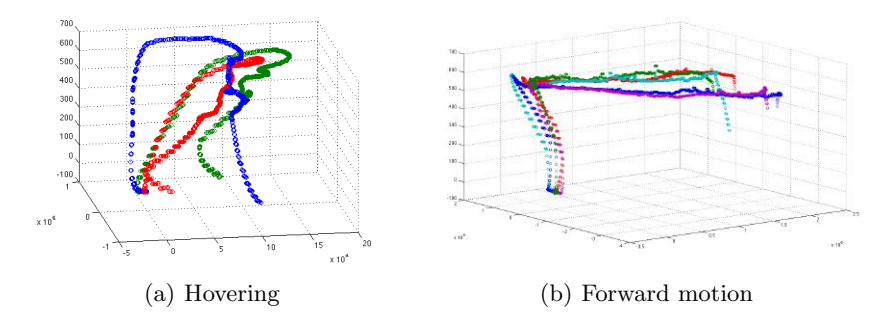
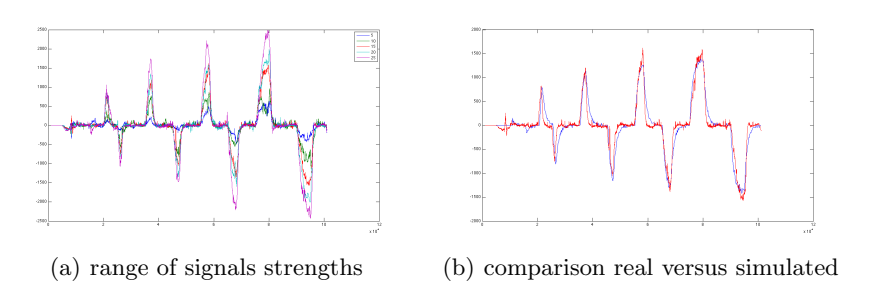
Our choice for the quadrotor is a Parrot AR.Drone, a robot the Universiteit van Amsterdam will use in the International Micro Air Vehicle Flight competition.
4.3 Nao humanoid robot
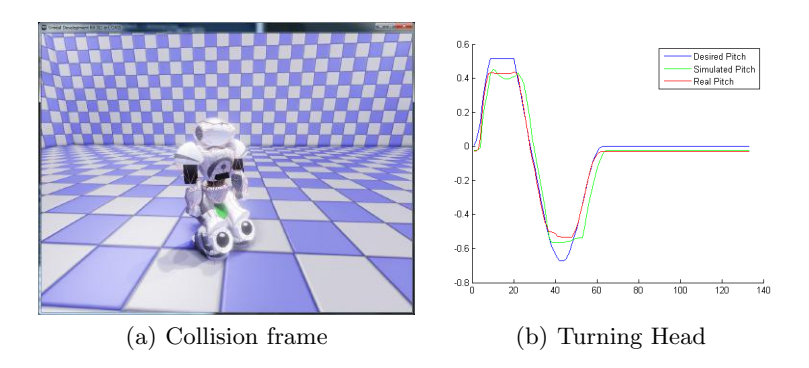
A whole new development is a model of a legged robot. Here a model of an Aldebaran Nao robot is chosen. Originally a version with two joints (T2) was developed, which was gradually upgraded to a model with 21 joints (T21). The different parts are now nicely scaled, have their corresponding collision frame (see Fig. 5(a)) and are correctly linked. This implementation method (based on constraints) is fundamental different from the current implementation of the robot arms (based on Unreal's SkelControl objects), which do not simulate collisions well.
A remaining task is to initialize each joint correctly, and to find the correct constraints on each joint. For the joints in the head the behavior is already quite
5 Conclusion
This paper summarizes improvements in the algorithms of the Amsterdam Oxford Joint Rescue Team since RoboCup 2010 in Singapore. Many developments are not only valuable inside the Rescue Simulation League, but also valuable for the Standard Platform League and the Soccer Simulation League. For the Virtual Robot competition, developments in the user interface, victim detection and autonomy are important. Our progress as team on these topics was demonstrated at the RoboCup Iran Open 2011, where the 3rd prize was won.
References
- Visser, A., de Hoog, J.: Amsterdam Oxford Joint Rescue Forces Realistic Simulations to aid research and education in advanced Robot Control algorithms. In: Proc. of the Scientific ICT Research Event Netherlands (SIREN 2008). (2008) 22
- Pfingsthorn, M., Slamet, B., Visser, A., Vlassis, N.: UvA Rescue Team 2006; RoboCup Rescue - Simulation League. In: Proc. CD of the 10th RoboCup International Symposium. (2006)
- Visser, A., Slamet, B., Schmits, T., Gonz´alez Jaime, L.A., Ethembabaoglu, A.: Design decisions of the UvA Rescue 2007 Team on the Challenges of the Virtual Robot competition. In: Proc. 4th International Workshop on Synthetic Simulation and Robotics to Mitigate Earthquake Disaster. (2007) 20–26
- Visser, A., Schmits, T., Roebert, S., de Hoog, J.: Amsterdam Oxford Joint Rescue Forces - Team Description Paper - RoboCup 2008. In: Proc. CD of the 12th RoboCup International Symposium. (2008)
- Visser, A., de Buy Wenniger, G.E.M., Nijhuis, H., Alnajar, F., Huijten, B., van der Velden, M., Josemans, W., Terwijn, B., Walraven, C., Nguyen, Q., Sobolewski, R., Flynn, H., Jankowska, M., de Hoog, J.: Amsterdam Oxford Joint Rescue Forces - Team Description Paper - RoboCup 2009. In: Proc. CD of the 13th RoboCup International Symposium. (2009)
- Visser, A., Nguyen, Q., Terwijn, B., Hueting, M., Jurriaans, R., van de Veen, M., Formsma, O., Dijkshoorn, N., van Noort, S., Sobolewski, R., Flynn, H., Jankowska, M., Rath, S., de Hoog, J.: Amsterdam Oxford Joint Rescue Forces - Team Description Paper - RoboCup 2010 and iran open. In: Proc. CD of the 14th RoboCup International Symposium. (2010)
- Formsma, O., Dijkshoorn, N., van Noort, S., Visser, A.: Realistic Simulation of Laser Range Finder Behavior in a Smoky Environment. In: RoboCup 2010: Robot Soccer World Cup XIV. Volume 6556 of Lecture Notes on Artificial Intelligence series., Heidelberg (2011) 336–349
- Flynn, H.: Machine learning applied to object recognition in robot search and rescue systems. Master's thesis, University of Oxford (2009)
- Bastiaan, C.: Virtual victims in USARSim. Bachelor's thesis, Universiteit van Amsterdam (2010)
- Out, N.: Virtual radar sensor for USARSim. Bachelor's thesis, Universiteit van Amsterdam (2010)
- de Hoog, J., Cameron, S., Visser, A.: Autonomous multi-robot exploration in communication-limited environments. In: Proceedings of the 11th Conference Towards Autonomous Robotic Systems (Taros 2010). (2010)
- de Hoog, J., Cameron, S., Visser, A.: Dynamic team hierarchies in communication-limited multi-robot exploration. In: Proceedings of the IEEE International Workshop on Safety, Security and Rescue Robotics (SSRR 2010). (2010)
- Steder, B., Grisetti, G., Stachniss, C., Burgard, W.: Visual slam for flying vehicles. IEEE Transactions on Robotics 24 (2008)
- Caballero, F., Merino, L., Ferruz, J., Ollero, A.: Unmanned aerial vehicle localization based on monocular vision and online mosaicking. Journal of Intelligent and Robotic Systems 55 (2009) 323–343
- Viola, P., Jones, M.: Rapid object detection using a boosted cascade of simple features. In: Proceedings of the IEEE Computer Society Conference on Computer Vision and Pattern Recognition. (2001)
- Flynn, H., de Hoog, J., Cameron, S.: Integrating automated object detection into mapping in USARSim. In: Proceedings of the International Conference on Intelligent Robots and Systems (IROS 2009), Workshop on Robots, Games, and Research: Success stories in USARSim. (2009) 29–34
- Terwijn, B., Formsma, O., Dijkshoorn, N., van Noort, S., de Hoog, J., Out, N., Bastiaan, C., Visser, A.: Amsterdam Oxford Joint Rescue Forces: Community Contribution. Published online (2010)
- Jacoff, A., Messina, E., Huang, H.M., Virts, A., Downs, A.: Standard Test Methods for Response Robots. ASTM International Committee on Homeland Security Applications (2010) subcommittee E54.08.01.