Technical issues of MRL Team for 2021 RoboCup Rescue Simulation Virtual Robot Competition ?
Mohammad H. Shayesteh, Mohammad M. Raeisi
Islamic Azad University of Qazvin, Electrical, IT Computer Sciences Department, Mechatronics Research Laboratory, Qazvin, Iran
Abstract This paper presents MRL team preparation technical issues to participate in the 2021 RoboCup Rescue Simulation Virtual Robot Competition. Due to the COVID-19 pandemic, the competition holds on remote access this year. Therefore we turn to operator-free systems by designing a new human detection system that recognizes victims in disaster areas with deep learning tools. Besides, a customized system has been presented in SLAM to generate multi-floor maps with new challenges. Finally, a multi-robot exploration system presents to search in disaster areas with a group of robots automatically.
Keywords: Virtual Robots · Victim Detection · SLAM · Multi-Robot Exploration.
1 Introduction
? Supported by Islamic Azad University of Qazvin.
In the virtual robot, In Virtual Robot, A simulated disaster environment has developed within a building scale. The aim is to find the victims and explore unknown areas with a team of rescue robots. Moreover, the system has developed with a high-fidelity and open-source Gazebo simulator. [2] . In these simulated environments, research teams set up multiple agents with many abilities such as maping, navigation, and autonomous exploration as a real robot. The simulator currently supports necessary sensors and actuators like laser scanners, odometry, camera, and battery. Also, all teams can quickly develop their new models, robots and sensors in this system.
MRL Virtual-Robot team has participated since 2006 in various RoboCup competitions such as IranOpen, WorldCup, and the Asia Pacific. Our primary focus is on developing four-wheels and areal robots. We have been champion in 2013, 2014, and 2019 RoboCup competitions in Eindhoven, João Pessoa, and Sydney. This team consists of Master and Bachelor of Science students in different fields such as Artificial Intelligent, Software Engineering, and Information Technology Engineering. Also, the Mechatronics Research Laboratory(MRL) supports by the Islamic Azad University of Qazvin.
2 Team Members
Mohammad H. Shayesteh: Multi-Robot Exploration
Mohammad M. Raeisi: Victim Detection, SLAM
3 System Overview
In this section, the outline of our system presents in different parts with distinct modules and packages. First, an overview of a single robot demonstrates various technical aspects and sub-parts—secondly, a general architecture of robots cooperation for multi-robot exploration.
3.1 Robot Instance
The virtual rescue robots are on a mission to find dead or alive victims in the urban areas due to the league objectives. They must explore a wide range of unknown environments autonomously, mark the dead victims in their generated maps, and park near the alive victims. According to mentioned rules, Our system presents two main sections: a Base-Station software with a lightweight GUI, and N instances for each robot. The robot instance includes a navigation module with a (local map, obstacle avoidance, and motion planner system), a local exploration system to search in unknown areas with greedy attitudes. Fig. 1 illustrates our robot instance for one robot.
![Fig. 1. Robots Instance Architecture: Three main modules including Navigation, Exploration and Victim Detection, which based-on the ROS Melodic Framework [1] [3] . In Navigation, slam-gmapping and move-base package is used as SLAM and (local/global) planners [4] [5] . The Exploration module utilize from explore-lite package to search in environment greedy. Victim Detection module tries to detect alive or dead victims from RGB and Thermal robot cameras [6].](/tdps/rescue_simulation_virtual__2021__MRL/_page_1_Figure_8.jpeg)
3.2 Base-Station Software
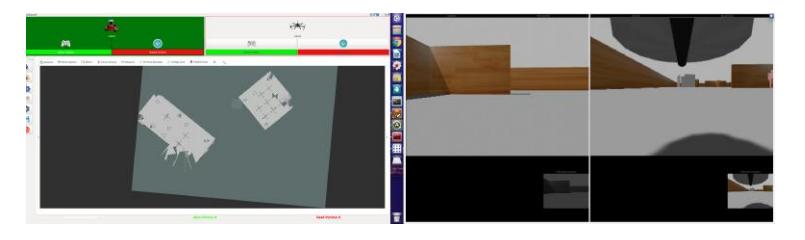
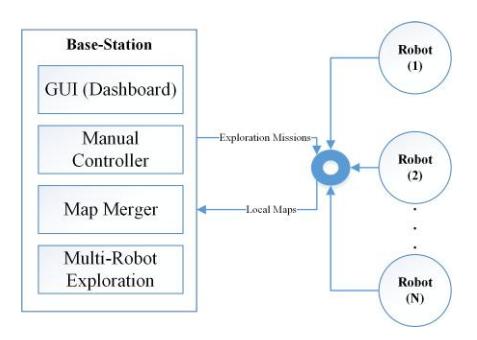
In this application, a user-friendly GUI is designed to control a group of fourwheeled and areal robot with manual and autonomous mode by operators. All robot instances have real time communication with this station and sent their map data to merge them in a global map. In addition, a map merging system is located in this software to merge local map of each robot in a public map for multi-robot exploration purposes.
4 SLAM and Multi-Floor Maps
Scan matching as an essential part of SLAM, has a crucial role in the localization and even Mapping of mobile robots. In previous research, an implemented ICEG as a Scan matching method and Grid Mapping presented by this laboratory to generate a global map from the robot's raw sensor data [7].
In RoboCup 2019, the slam-gmapping from ROS Melodic Framework used for creating a local map on each robot instance with a good performance on real-time rounds which using a 2D Hokuyo type laser scanner that embedded on all of our Pioneer-3at robots. after generating a local map from unknown environments, this data sent to Base-Station software to gathering them as a global map with multi-robot-map-merge package [8].
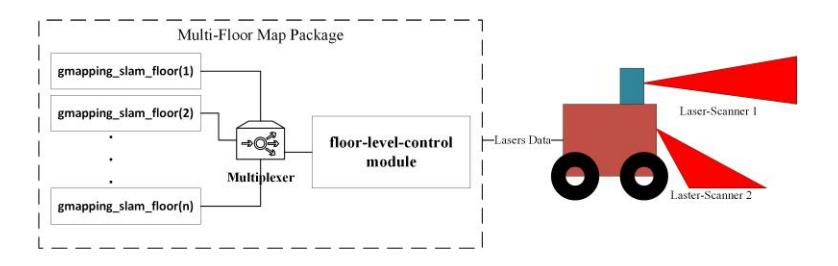
This year, the multi-map floors challenge has introduced by the technical committee. The robots should climb the floors by passing from designed ramps and generate multi-floor maps from different floors. Therefore, a new package has been designed to control the robot location's status and switch the sensor data between the separated maps from different floors.
5 Exploration
In Virtual-Robot, one of the critical missions is an autonomous exploration with four-wheeled robots. A group of robots should explore the urban areas autonomously in less time and find the victims. For this goal, a distributed system is designed in two parts of local and multi-robot exploration for this problem as follows:
Local Exploration: a customized system based on the explore-lite package is implemented with new features to explore locally in the environment with a new ability to define a region to limit the robots to explore just a limited area. These limited areas define with high-level decision-makers in the multi-robot exploration section.
Multi-Robot Exploration: A new package is presented as a decision-maker system in Base-Station software to divides unknown areas on separated missions for assigning to instances.
![Fig. 5. Exploration System Architecture. The multi-robot planner in Base-Station splits the map into many sub-regions and assigns them to the robots as a mission. These parts have real-time communications together to reschedule the missions for each robot [9].](/tdps/rescue_simulation_virtual__2021__MRL/_page_4_Picture_1.jpeg)
6 Victim Detection
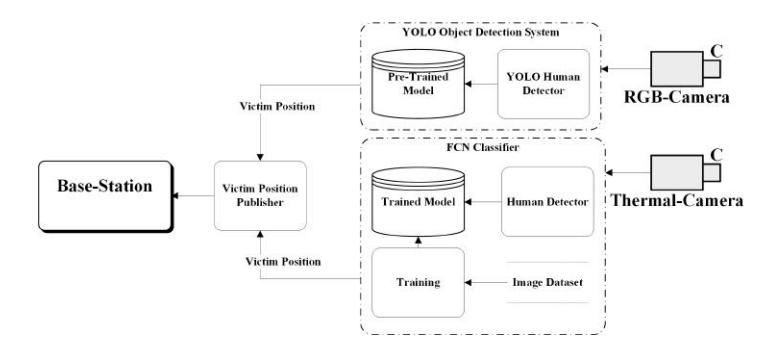
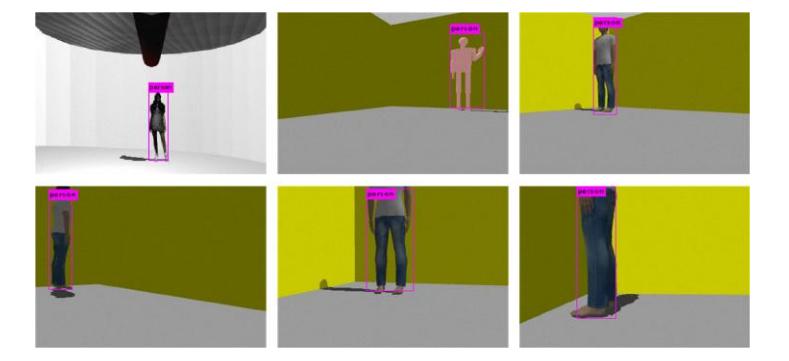
Victim detection is a package to find victims who are alive or killed by vision. The used are RGB and Thermal Camera that mounted on rescue robots. On this mission, a module is designed to detect the victims from mentioned sensors and announce the position of victims to Base-Station software. This module presets as a ROS package with a base of pre-trained datasets and deep-learning algorithms and can detect humans in real-time and with high performance and accuracy.
7 Innovations
This year, a new challenge has been demonstrated by the technical committee in multi-floor maps. For this purpose, we designed a new module to generate a multi-map floor with septated nodes along with a multi-level controller to swishing the sensor data in different map floors. Besides, a multi-robot exploration planner developed for Base-Station software to decide and set the exploration rules for each robot instance for an efficient exploration in local searches. Finally, the victim detection system presents to find the victims by robot cameras and announce the position of victims to Base-Station software.
8 Conclusion
This paper introduced our system architecture base with ROS Melodic Framework for multi-robot exploration. At First, some new modules produced in SLAM and multi-floor maps. Secondly, the structure of exploration in local and multirobot is presented and shows how they works together. Finally, a new victim detection system based on YOLO pre-trained system and FCN classifier presented with accuracy.
9 Future Works
Based on the new challenges of the virtual robot league, a new Wireless Communication Simulator package is introduced for next years by the technical committee. We plan to immigrate to this new technology for communication between our robots and pay attention to routing problems. On the other hands, a new SLAM and Autonomous system will develop for the areal robot in indoor environments to explore the environments faster and easier.
References
- Quigley M., Gerkey B., Conley K., Faust J., Foote T., Leibs J., Berger E., Wheeler R., Andrew N.: ROS: an open-source Robot Operating System. ICRA Workshop on Open Source Software.
- Gazebo Simulator Homepage, http://gazebosim.org/. Last accessed 4 Oct 2017
- ROS Kinetic Kame Homepage, http://wiki.ros.org/melodic/. Last edited 1 Jan 2018
- gmapping-slam package Homepage, http://wiki.ros.org/slamgmapping/. Last edited 8 Aug 2017
- gmapping-slam package Homepage, http://wiki.ros.org/movebase/. Last edited 27 Sept 2019
- m-explore package Homepage, https://github.com/hrnr/m-explore/. Last edited 11 Nov 2019
- Taleghani, S., Sharbafi, M. A., Esmaeili, E., Haghighat, A. T.: ICE matching, a robust mobile robot localization with application to SLAM. in IEEE 22nd International Conference on Tools with Artificial Intelligence (ICTAI), LNCS, vol. 9999, Arras, France (Oct 27–29).
- Hörner J.: Map-merging for multi-robot system. Bachelor's Thesis in Charles University in Prague, Faculty of Mathematics and Physics, Prague (2016).
- Burgard, W., Moors, M., Stachniss, C., Schneider, F: Coordinated Multi-Robot Exploration. in IEEE Transactions on Robotics, Volume: 21 , Issue: 3 , June 2005.
- Redmon, J., Divvala, S., Girshick, R., Farhadi, A.: You Only Look Once: Unified, Real-Time Object Detection. in 2016 IEEE Conference on Computer Vision and Pattern Recognition (CVPR), DOI: 10.1109/CVPR.2016.91, Location: Las Vegas, NV, USA, June 2016.
- Jiao, L., Zhang, F., Liu, F., Yang, S., Li, L., Zhixi, F., Qu, R.: A Survey of Deep Learning-based Object Detection. in IEEE Access, DOI: 10.1109/AC-CESS.2019.2939201, Sept 2019.