Team Description 2010 for team Ro-Pe Adult Size
Chee-Meng Chew, Albertus Hendrawan Adiwahono, Huang Weiwei, Li Renjun, Shen Bing Quan, Loh Wen Hao
National University of Singapore, 119260 Singapore
http://guppy.mpe.nus.edu.sg/~mpeccm/research.html
Abstract After participating in Robocup kid size since 2004, team RO-PE now intends to participate in the adult size of Robocup 2010. This paper is a brief description of the adult size robot NUSBIP-III ASLAN, developed by team RO-PE. Its hardware specifications, control architecture, and algorithm are described.
Introduction
There has been numerous bipedal robot in different sizes developed as the platforms of researches by the Legged locomotion Group (LLG) of National University of Singapore (NUS). Among the smaller platforms are the RO-PE I-VI series, which has been participating in Robocup kid size. Besides this smaller platform, LLG also has been developing the human-sized bipedal series, called NUSBIP.
The NUSBIP-III ASLAN is the latest, third generation of NUSBIP series. It has been developed since early 2008. It is developed mainly as a general platform for typical bipedal research such as bipedal walking gait and human basic movements. Robocup 2010 will be held in Singapore, which is a perfect opportunity for NUSBIP-III ASLAN to make its first debut in soccer competition.
Specification of NUSBIP-III ASLAN
This section details the specifications of the NUSBIP-III ASLAN robot.
Hardware Specification
ASLAN significantly improves the existing physical bipedal robot, NUSBIP-II, especially in the physical structure and the actuator subsystem. The structure of the legs has been improved and the joints are upgraded using the harmonic drives system. By using harmonic drive, ASLAN has achieved stable dynamic walking motions. Next, two arms and one waist joint have been added on the body, and new sensors have been added into the system.
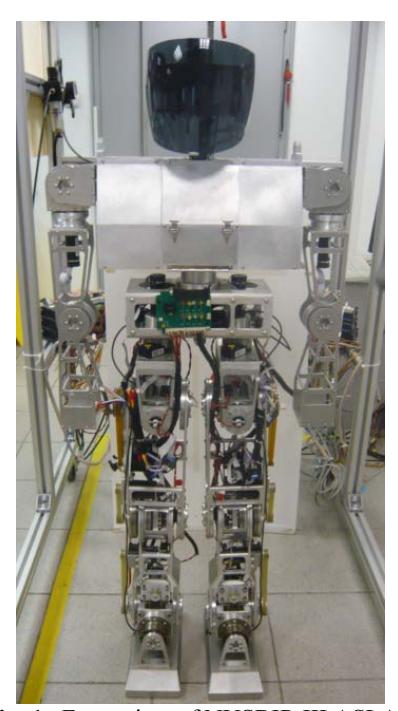
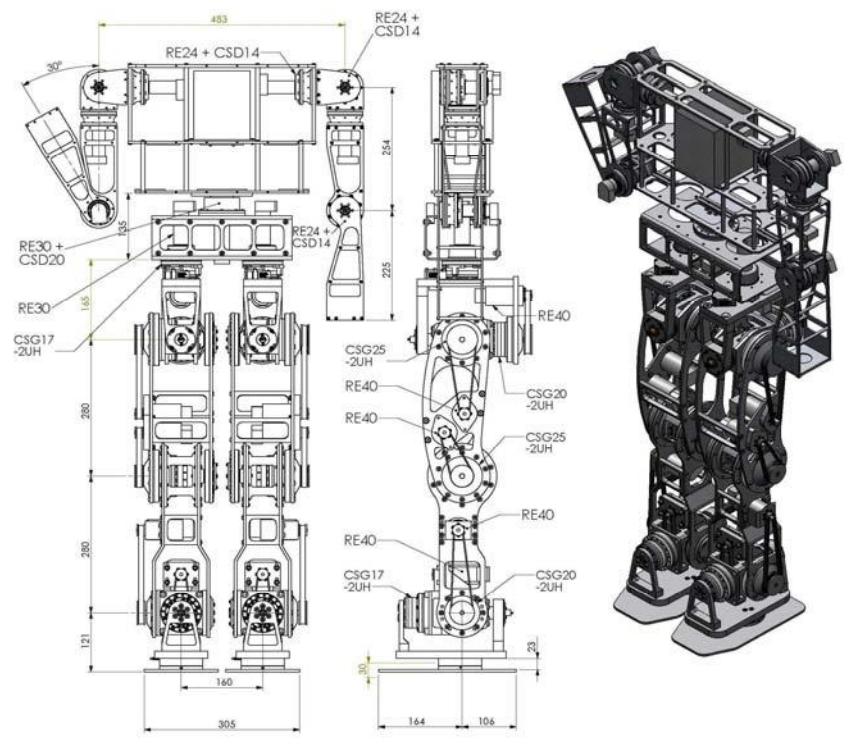
Overall, ASLAN is a humanoid robot modeled after a child. It has a trunk with two legs, two arms and one waist joint. Its weight is approximately 60kg and hip height is around 0.7m when the robot is standing. The robot has six DOFs on each leg: three at the hip, one at the knee, and two at the ankle; four degrees of freedom on each arm: three at the shoulder, one at elbow. The DOFs at the hip allow the leg to twist and adduct/abduct, as well as swing forward and backward. The DOF at the knee allows the leg to flex. The DOFs at the ankle allow the foot to pitch and roll. All the joints are driven by DC servo-motors with harmonic drive.
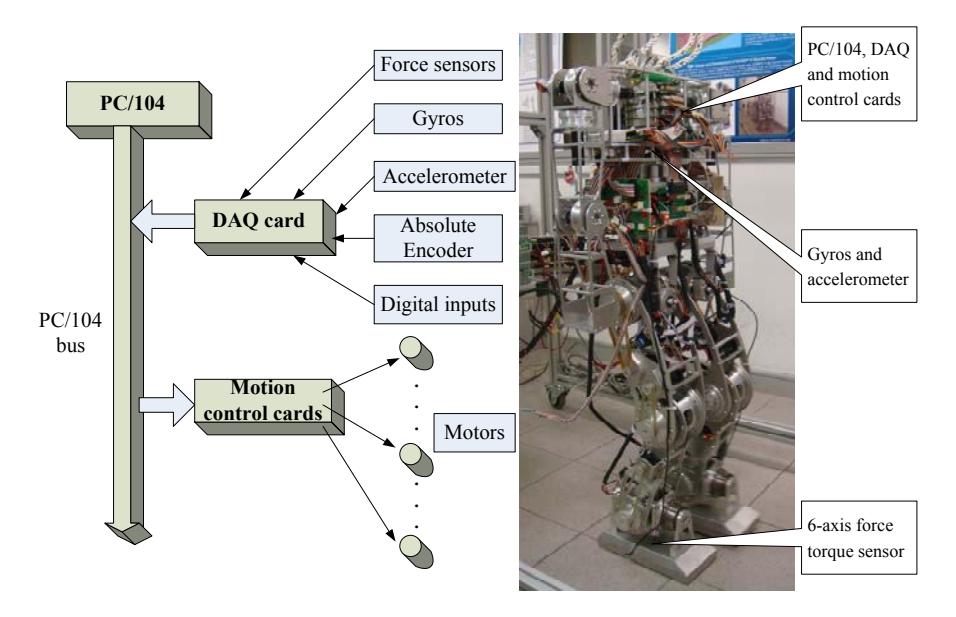
As for the sensory system, there is a force/torque sensor on each foot to provide the center of pressure location. Absolute encoders on each joint provide the initial condition for the robot. Digital encoders mounted on the motors will be used to indirectly measure the joint positions. Three-axis rate gyro and three-axis accelerometer will be mounted on the trunk to measure and provide inertia data of the body.
The Solidworks drawing of the ASLAN is shown in Figure 2 and the specifications of ASLAN is shown in Table 1.
Specification of NUSBIP-III ASLAN
| Height | 1350mm |
| Width | 550mm |
| Weight | 60Kg |
| Walk speed | 0.3m/s |
| Actuator | servomotor + harmonic gear + drive unit |
| Control Unit | PC/104 + Motion control card + DAQ card |
| Sensor | foot: 6-axis force sensor
torso: gyroscope, acceleration and sensor |
| Operation system | Windows XP RTX |
Control Architecture
PC/104 is used as the main processor to generate the command signal through PC/104 bus. The motion control cards receive the command signal and then send the control signal to amplifiers to drive the motors. Sensory information, such as gyros, accelerometer, force/torque sensors and absolute encoder is read by DAQ card and sent as feedback to PC/104 through PC/104 Bus. The control structure is shown in Figure 3.3.
Algorithm
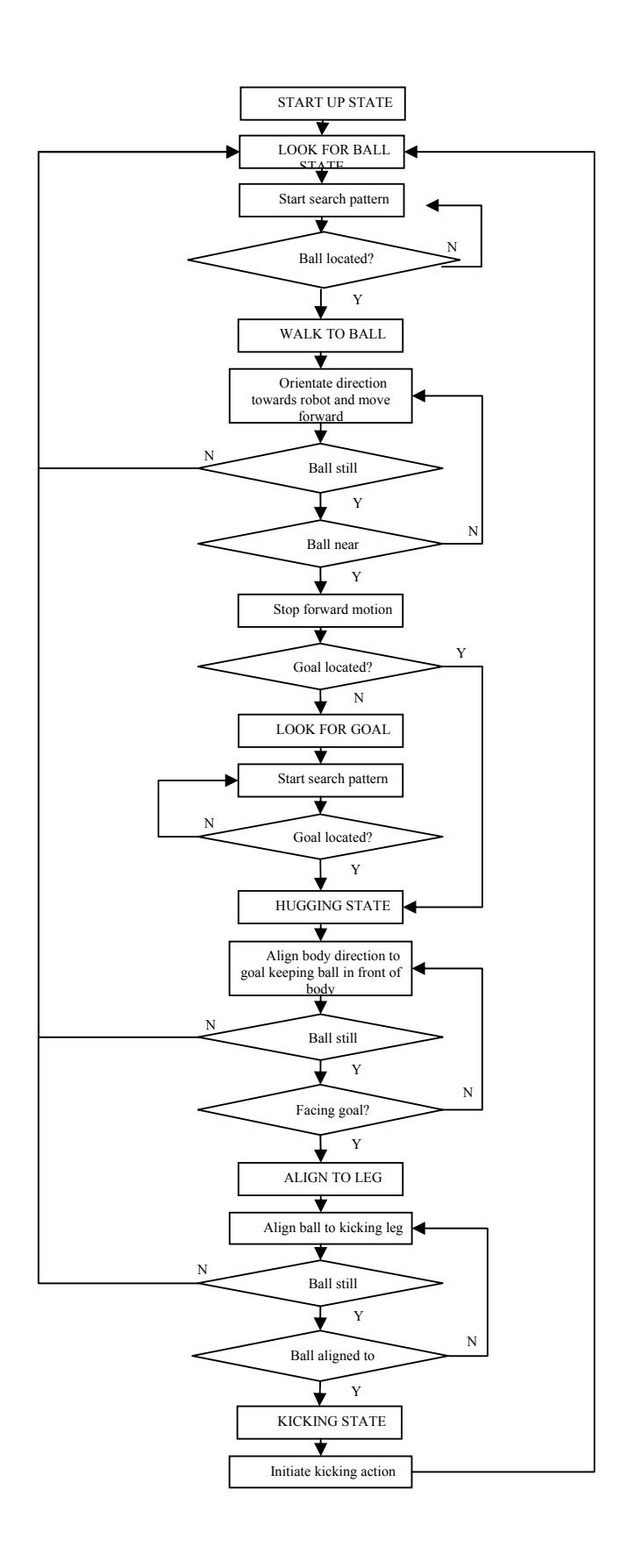
We will use the experience obtained from the kid-size competition to develop the strategy for the adult size. For the adult size, the robot will need to locate the ball behind itself, approach the ball, and slowly bring the ball closer to the goal before kicking it to score a goal. The following flowchart shows the strategy that is used to locate, approach and kick the ball.
References
- K. Hirai, M. Hirose, Y. Nakamura, and T. Takenaka: "The Development of Honda Humanoid Robot," in Proc. IEEE Int. Conf. Robotics and Automation, 1998, pp. 1321-1326.
- T. Ishida, Y. Kuroki and J. Yamaguchi: "Mechanical Systems of a Small Biped Entertainment Robot," in Proc. IEEE Int. Conf. Intelligent Robots and Systems, 2003, pp. 1129-1134.
- L.S. Tay: "Design and Fabrication of a 3D Bipedal Robot," B. Eng. Thesis, National University of Singapore, Singapore, 2003.
- R.Benosman, S.B.Kang, "Panoramic Vision: Sensors, Theory and Applications", Springer, 2001.
- T.S.Mui: "Soccer Playing Humanoid Robot," B. Eng. Thesis, National University of Singapore, Singapore, 2004.