Team Description Paper: HuroEvolutionAD Humanoid Robot for RoboCup 2011 Humanoid League
Chung-Hsien Kuo, Po-Chun Chia, Tsung-Chin Tsai, Yu-Cheng Kuo, Min-Hsiu Wu
Department of Electrical Engineering, National Taiwan University of Science and Technology, 43 Sec. 4, Keelung Rd, 106 Taipei, Taiwan
Abstract In this team description paper, our AdultSize humanoid robot entitled HuroEvolutionAD is introduced for the RoboCup 2011 humanoid league. The HuroEvolutionAD is constructed as a 21 degree-of-freedom biped humanoid robot. An active CMOS USB camera system is connected to a PICO-820 single board computer to perform autonomous image captures and motion controls. The functions within localization of unknown ball position and walking ability are all desired to perform qualifications for RoboCup 2011 humanoid league. At the same time, the joint motors use laboratory made closed loop DC motor joint modules. As a consequence, an adult size humanoid robot is produced to participate in the competitions for the RoboCup 2011 humanoid league.
Keywords: humanoid robot, autonomous robot, soccer robot, image localization.
Introduction
Humanoid robot studies are fast increasing in the last decade. In recent year, RoboCup [1] is one of the most important competitions within humanoid robot researches. Due to the increasement of the robot size, mechanical structure stiffness, and large control powers, the development of an adult size humanoid robot becomes a challenging task. On the other hand, competition situations are fast transiting, and humanoid robot are required to be justified according to situation changes. Therefore, an artificial intelligence (AI) based decision making module is developed using strategy based rules. These rules are fired with respect to the vision system of our robot.
On the other hand, the kinematics based walking patterns are generated in terms of an XScale [2] based gait controller, and UART serial motion commands are further generated to control the PSoC based closed loop position controller for DC motors [3]. As consequence, the overall hardware components of our HuroEvolution4D humanoid robot is composed of a single board computer with windows XP operation system, a conventional web camera, an XScale embedded controller, battery and power regulations module. The software components consist of the functions of image capture, image recognition, localizations of a ball and a goal, strategies and decisions, gait pattern generations, acceleration data detection, and motor controls.
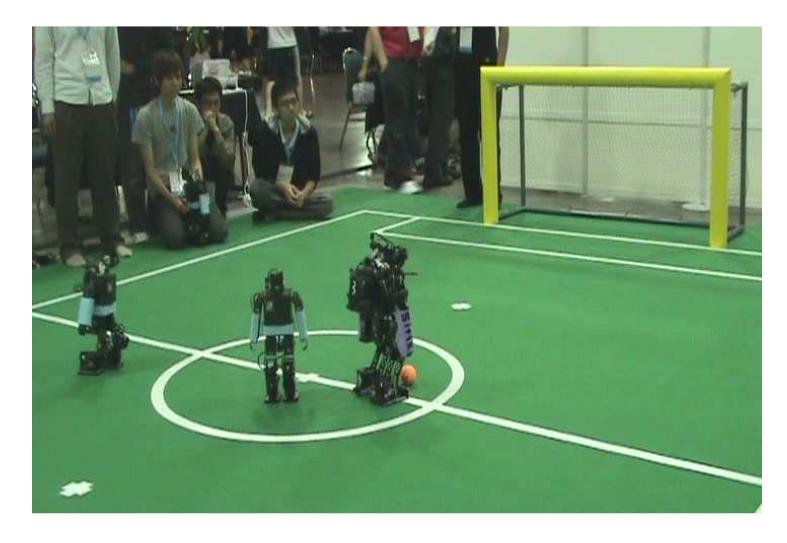
Although the HuroEvolutionAD humanoid robot is the first time to participate in the RoboCup humanoid league, our kid size humanoid robot (HuroEvolutionJR) has the experience of RoboCup kid size humanoid soccer robot competitions in 2010. In the last five years, we participated in the HuroCup of FIRA [4] from 2006 to 2010. We awarded the forth place of the overall rating of the FIRA HuroCup in 2006 (robot name: Taiwan 101 [5]) and the third place in FIRA 2010. The current developments of the HuroEvolutionAD are designed based on our previous autonomous humanoid robot hands-on experiences. In RoboCup 2010, we reached the quart-final in humanoid kid-size league. Fig. 1 shows our kid size humanoid robots in RoboCup 2010.
Mechanical Design
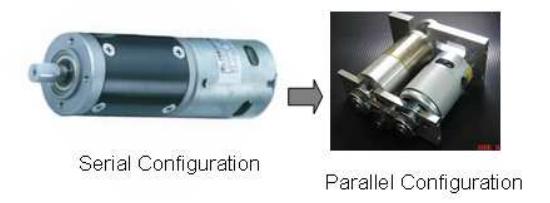
The HuroEvolutionAD is designed as a 21 degree-of-freedom (DOF) humanoid robot; where 6 DOFs are desired for each leg, 3 DOFs are desired for each arm, 1 DOF for waist, and 2 DOF for head (active vision sensor). We use conventional spur gear motors to construct the joints of HuroEvolutionAD, as shown in Fig. 2. The left-hand-side of Fig. 2 shows a conventional spur gear motor, and it is configured as serial configuration. Such a configuration is too long for the humanoid robot joints. Therefore, a parallel configuration is designed as shown in the right-hand-side of Fig. 2 to reduce the length of the joint.
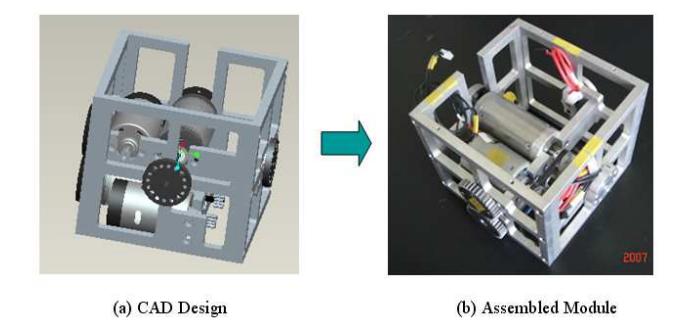
On the other hand, the 2-DOF joint module is also designed for the hip and ankle joints. The 2-DOF joint module provides two dimensional relative motions between two links (rigid bodies). Two active and two passive flanges with collinear and diagonal configuration are designed as the mechanical interfaces of connecting two diagonal rotating links. To achieve diagonal output configuration, two gears with the same specification are used to translate the output axis to the center of the joint module. The diagonal 2-DOF joint module achieves that two rotational axes intersect at one point. Such a 2-DOF joint module is capable of emulating the hip and ankle motions of humans. The 3D design and assembled photo of a 2-DOF joint module are shown in Fig. 3. Note that two rotational potentiometer are used to measure the joint angles.
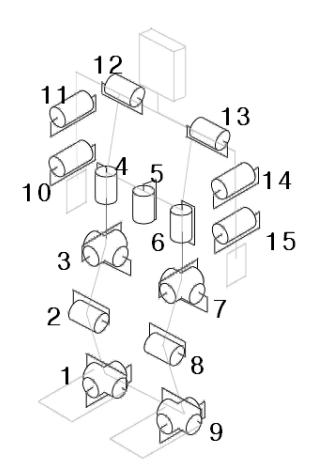
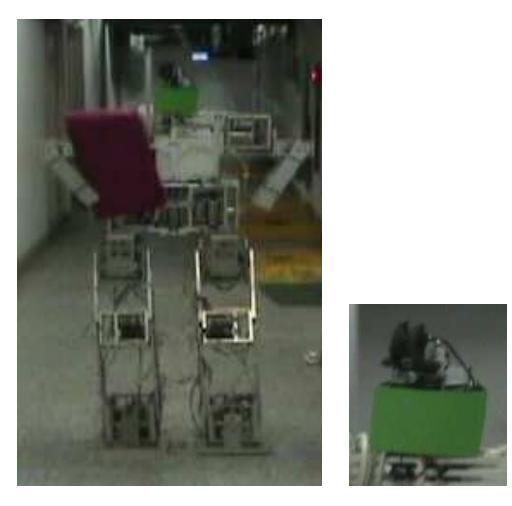
Fig. 4 shows the kinematic design of the HuroEvolutionAD. There are 6 DOFs for each leg; 3 DOFs for each arm; and 1 DOF for the waist. In this figure, the joint IDs with 1, 3, 7, and 9 use the 2-DOF joint modules with large torques; the joint IDs with 2, 4, 5, 6, and 8 use the 1-DOF joint modules with large torques; finally, the joint IDs with from 10 to 15 use the 1-DOF joint modules with small torques. Consequently, the mechanical parts are produced as assembled to form the HuroEvolutionAD, as shown in Fig. 5.

Hardware design
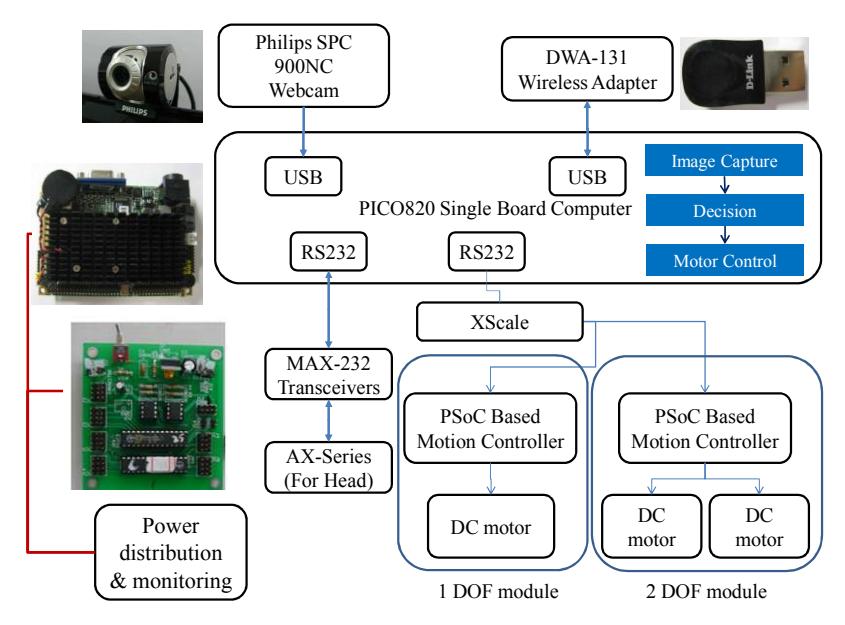
Hardware modules of the HuroEvolutionAD humanoid robot are a single board computer, a conventional web camera, an accelerometers module, 19 PSoC based motor controllers, an XScale embedded motion controller, 19 DC motors, and 2 RC servo motors. The hardware architecture is shown in Fig. 6, and the hardware specification is shown in Table 1. These modules are further introduced as follows.
Table 1. Hardware specification
| ROBOT Name | HuroEvolutionAD | ||
|---|---|---|---|
| Height of Robot | 160 cm | ||
| Weight of Robot | 60 kg | ||
| Walking Speed | Maximum: 5 cm/s | ||
| Type of motor | AX-12 (Servo motor) | DC Motors (φ 52 mm) | DC Motors (φ 42 mm) |
| Torque | 12.0kg/cm~ 16.5kg/cm | 100 kg/cm (Rated Torque) | 30 kg/cm (Rated Torque) |
| Speed | 0.196 sec/60° | 45 rpm | 13.5 rpm |
| Degree of freedom | 21 | ||
| With Leg: 6 x 2 (DC motors) | |||
| Arm: 3 x 2 (DC motors) Waist: 1x 1 (DC motor) Head: 2 (AX-12 Servos) | |||
| Computing unit | PICO820 (Single Board Computer) Processor: Intel® ATOM™ processor Z530 Operating System: Windows XP | ||
| Motion Controller | XScale Embedded System | ||
| Camera | Webcam(Philips SPC900NC) Frame rate: 90fps Total Picture Element 1024 (H) x 768 (V) | ||
| Batteries | 24 V | ||
| Accelerometer | ADXL345 |
Single board computer: An Axiomtek PICO-820 single computer board is used in this project. The single computer board uses the Microsoft Windows XP as its operation system. The software modules of image capture, image recognition, falling down detection, and gait generation are all implemented based on this single board computer.
Conventional web camera: In this team project, a conventional web camera (Philips SPC-900NC [6]) is desired to capture images in front of the robot.
PSoC based motor controller: The PSoC based motor controller is used to control the angular position of DC motors. All motor controllers are connected via serial communications which can reduce the complexity of cable wiring.
Accelerometer module: An accelerometer with ADXL345 [7] is used for this project to detect the falling down situations. When the falling down signal is detected, the control system turns off the power to protect the motion controllers.
XScale embedded locomotion controller: An XScale embedded system is used to implement the kinematics based locomotion. Real-time timers may ensure stable gait pattern generations.
DC motors: conventional DC motors are used in HuroEvolutionAD which provides low-cost solution. Each DC motor has one potentiometer to feedback the position data to motor controller.
Head control motors: head control motors are configured by two Robotis AX-12 RC servo motors, which provide the webcam pitch and yaw motions.
Software design
In addition to the hardware, the software components are also introduced. The software components consist of the modules of image capture, image recognition, localizations of a ball and a goal, strategies and decisions, gait pattern generations, acceleration data detection, and motor controls. These modules are implemented with the PICO-820, XScale or PSoC motor controller. They are further described in the follows.
Image capture and image recognition: This module is responsible of retrieving the pixel regions of the ball and goal. If the ball and goal cannot be recognized, the robot may rotate itself or move forward and try to find them.
Localizations of a ball and a goal: This module is responsible of retrieving the directions of the ball and goal as well as the approximate distance of the ball and goal.
Strategies and decisions: To finish a competition, a rule based decision subsystem is developed according to different strategies. In addition, a simple coordinated subsystem is further introduced to define the role of robots.
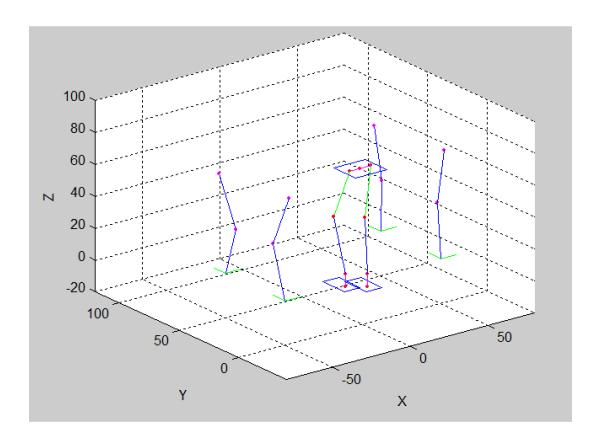
Gait pattern generations: Several basic gait patterns such as "moving forward", "side-shifting", "rotating itself", and "backward walking" are generated by using the XScale embedded controller. At the same time, the kinematics based locomotion is also simulated and verified by using the Matlab, as shown in Fig. 7.
Acceleration data detection: A serial communication packet is decoded to retrieve the acceleration data so that the falling down situation can be detected.
Motor control: Due to the uses of PSoC motor controllers and DC motors, the motor control is implemented using a sequence of serial communication packet.
Conclusion and Future Work
Adult size humanoid robotic research is a very challenging research topic. Our laboratory has devoted 6 years in the development of humanoid robot from small size humanoid robots [5, 8], adult size humanoid robot [9], parallel kinematics based humanoid robot [10], and hybrid-structure humanoid robots [11]. We also participated in the FIRA competitions for 5 years and RopboCup kid size league for 1 year. We are now trying to extend our research interests to the most challenging humanoid robot competition, RoboCup Adult Humanoid League. We believe that the participations of RoboCup will induce more research potentials for our team via sharing and learning with other teams. The current version is just a prototype to be submitted for the qualification. In the future, walking speed improvements and weight reduction are important tasks for us before the RoboCup 2011 annual event. On the other hand, self-adjustable humanoid locomotion is another issue for use to improve the walking performance. Finally, modular, flexible as well as reusable software and control architectures are also to be justified to increase the efficiency of on-site adjustments in the competition field.
References
- Robocup Humanoid League Competition Information, http://www.robocup.org/
- Intel PXA 270 product information Information, http://en.wikipedia.org/wiki/XScale
- Cypress PSoC Product Information Information, http://www.cypress.com/
- FIRA HuroCup Competition Information, http://www.fira.net/
- Kuo, C.H., Hung, Y.C., Lin, E.C., Chen, J.C., Lee, M.K., Sun, C.C.: Autonomous Humanoid Soccer Robot: Taiwan 101 V1, In FIRA Robot World Congress, Paper ID: 07-119, U.S.A. (2007)
- Philips SPC-900NC Product Information, http://www.p4c.philips.com/cgi-bin/dcbint/cpindex.pl?ctn=SPC900NC/00&scy=gb&slg=en
- ADXL345 Product Information, http:// www.analog.com
- Kuo, C.H., Chen, C.Y.: Development of Vision Guided Small Size Humanoid Soccer Robot Using Chip Based Controllers, In International Automatic Control Conference, pp. 854-859, Taiwan (2007)
- Kuo, C.H., Chen, C.C., Siao, J.W., Chen, C.T.: Development of Modular-Based Large Size Humanoid Robots, In Journal of Harbin Institute of Technology, Vol. 15, No. 2, pp. 190-194 (2008)
- Kuo, C.H., Chen, C.T., Hung, Y.C.: Design and Implementation of a Parallel Kinematics Mechanism Based Humanoid Robot, In International Automatic Control Conference, Paper ID: I-1903, Taiwan (2008)
- Kuo, C.H., Chen, C.C., Wang, W.C., Hung, Y.C., Lin, E.C., Lee, K.M., Lin, Y.M.: Remote Control Based Hybrid-Structure Robot Design for Home Security Applications, In IEEE/RSJ International Conference on Intelligent Robots and Systems, pp. 4484-4489, China (2006)