EDROM Humanoid - Team Description Paper Adult Size - 2013
Bruno Jou Hiraiwa, Carolina V. Resende, Leonardo A. Jappe, João Carlos M. Carvalho, Rogério S. Gonçalves
Universidade Federal de Uberlândia
Abstract This paper describes the development, architecture and programming of the project MABI, by the group named EDROM, from the Federal University of Uberlândia, Brazil. MABI is a robot competing on the RoboCup2013 Humanoid Adult Size Category. The main ideas for the robot to complete its task are shown here.
INTRODUCTION
EDROM (Equipe de Desenvolvimento em Robótica Móvel) is a team that develops automated robots in the Federal University of Uberlândia. This team already developed the projects Marta and Hope for the Brazilian's Robotic Competition (CBR) in 2011 in the RoboCup Humanoid league kid size. However the homemade Marta project has been discontinued, Hope has been improved with new controller and camera. In the year of 2012 the project Hope was improved with two other players, Kate and Lena, and a fourth player, Rose, as a backup to kid size competitions. Our team commit to participate in the RoboCup 2013 Humanoid League competition and we commit that one person from the team will have sufficient knowledge of the rules and available as referee during the competition.
The category chosen by the team is the RoboCup Humanoid Adult Size, which allows one robot playing. The height allowed to the robots is above 130cm. The main purpose is to score goals, to do that, the robot have to walk straight, to turn, to kick, as well as identify its position in the field, the opponent and the ball.
The robot was made based on the experience of the robots built in the kid size competition.
The Competition
The competition is based on a field of 900cm X 600cm, with two yellow goals, with a height of 180cm [1-2].
The ball is a FIFA size 5 ball, at least 50% orange.
The robot must be human-like with two legs, two arms, one head, that have to be attached to the trunk. They must be able to walk upright on the legs.
The height of a robot must be between 130cm and 160cm, and given the height of the robot, there are a series of equations to determinate the other robot's dimensions, Fig. 2. The developed MABI robot has 134cm, Fig. 2(b).
Each match lasts two equal periods of 10 minutes, with an interval of 5 minutes at half-time.
The team with the greater score is the winner, to score a goal the whole ball needs to pass over the goal line, between the goalposts and under crossbar.
![Fig. 1. Match field [1-2].](/tdps/soccer_humanoid_adult__2013__EDROM/_page_1_Picture_2.jpeg)
![Fig. 2. (a) Parameters robot [1]; (b) MABI 3D project.](/tdps/soccer_humanoid_adult__2013__EDROM/_page_1_Picture_7.jpeg)
Physical structure
The robot was made based on three robotic kits, Bioloid® , Tetrix® and Dynamics® associated with other mechanical components.
The women MABI robot has a total of twenty motors: Six Dynamixel AX 18 motors that can delivery as much as 18Kgf*cm, and it has 0.29º of resolution used in the movement of the arms (three servos each arm). Two Dynamixel AX 12 were used to make the movement of the head. Ten robot EX 106 motors that can delivery as much as 107 kg*cm, and has 0.06° of resolution, used to make the movement of the legs and feet; Two RX 64 motors, that can delivery 64 kg*cm, and has 0.29° of resolution to the moment of the rip (each leg has 6 degrees of freedom).
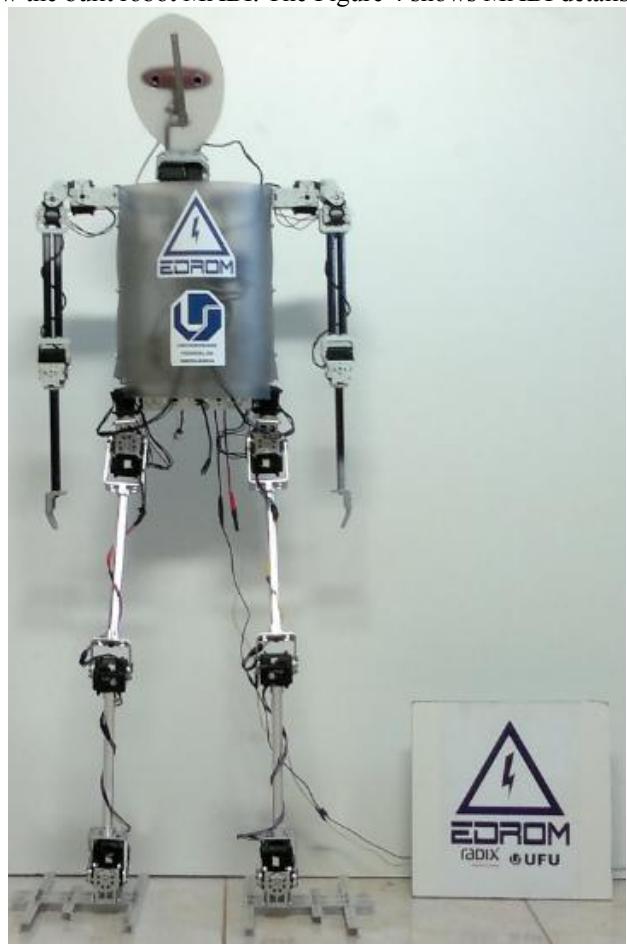
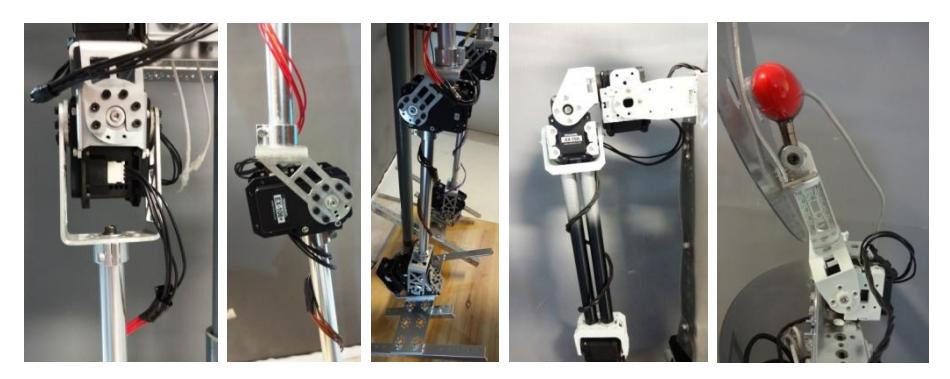
Figure 3 show the built robot MABI. The Figure 4 shows MABI details.
In Figure 4(a) is showed detail of the arm, Fig. 4(b) hip joint, Fig. 4(c) knee; Fig. 4(d) feet and Fig. 4(e) the head.
Mechanical support parts of the Tetrix® kit were used to compose the body and feet, and Tetrix® bars to constitute the legs. The protection plates on the head and body, and bars that compose the arms were made of plastic and carbon fiber.
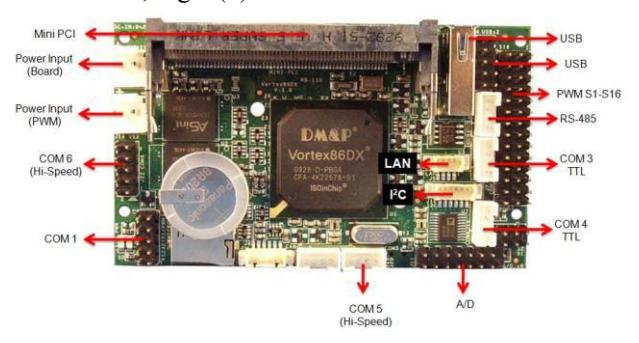
The chosen controller was Roboard RB-110, Fig. 5, for its capacity to support Linux, which will be used along with several libraries, like OpenCV and RoboIO. The controller has 1Ghz, and 250Mb DDR 2 memory, it accepts a SD micro card to be its "Hard Drive".
The Linux operating system was chosen because of its compatibility with OpenCV and it runs smoothly.
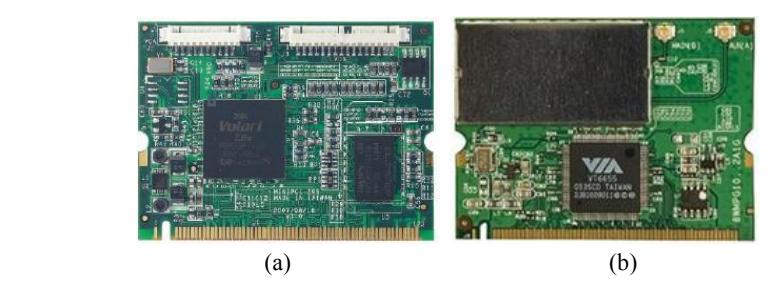
As can be seen, this controller can be treated as a computer. There is a graphic card as complement, which goes in the Mini PCI input, Fig. 6(a). The communication will be done with mini PCI WiFi, Fig. 6(b).
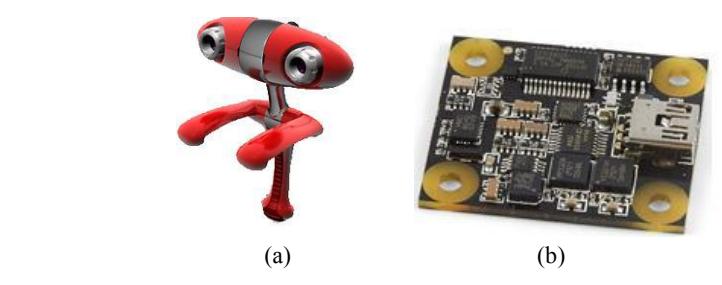
The camera Minoru 3D was chosen so, that the distance can be easily calculated, it will give the robot a better knowledge of the environment.
The camera with two "eyes" also gives the robot a more friendly face, whereas the competition is also about bringing robots that are human alike, Fig. 7(a).
The compact sensor used is a PhidgetSpatial 3/3/3, it has a Compass 3-Axis, Gyroscope 3-Axis, Accelerometer 3-Axis, Fig. 7(b). The functions compass is not used. It is used to determinate if the robot is falling or has fallen, taking the necessary action to reverse this situation.
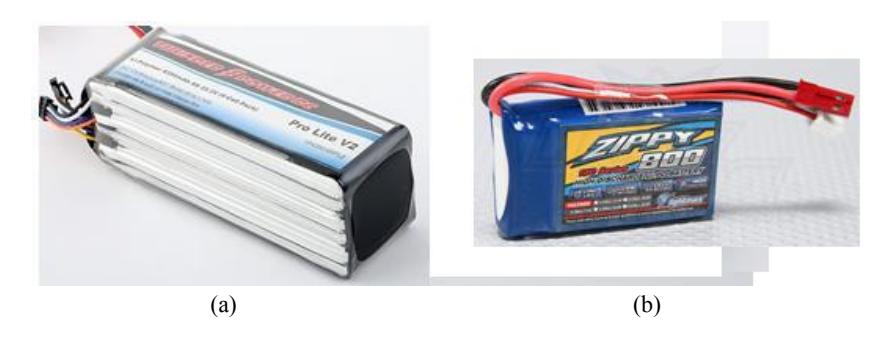
The battery used is a Li-Polymer, 4350mAh, 5S, 18.5V (5-Cell Pack), and one for the controller. It has 7.4V and 800mAh, Fig. 8.
Assembly
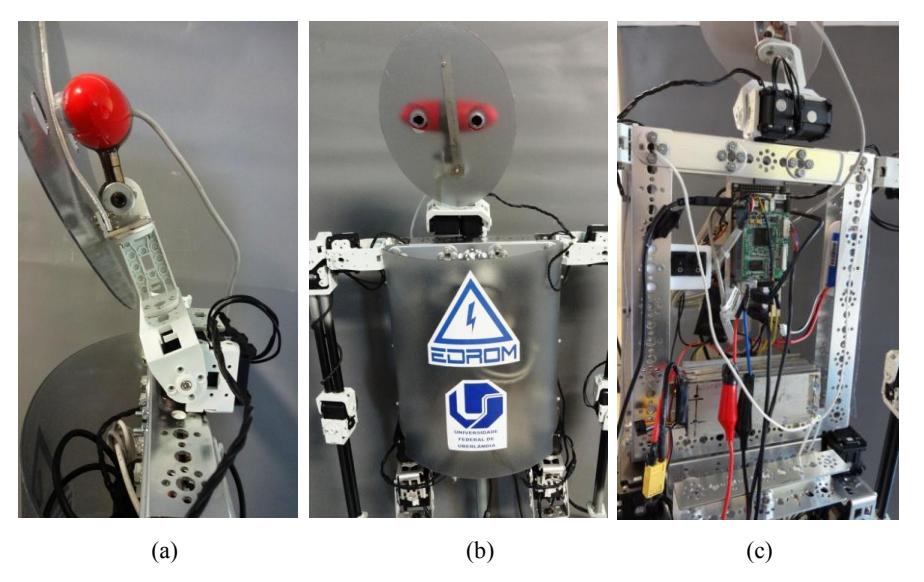
We based the head's assembly on the human's head, trying to imitate its movements, which were made with two Dynamics AX12 motors. On the top the Minoru 3D Camera was attached, Fig. 9 (a-b).
In the back of the robot, the RB-110 controller was carefully placed, along with power cables, USB cables, motor cables, PWM cables and the PCI mini Graphic card. To protect all of it, was used a plastic plate. Beneath the RB-110 was placed the 4350mAH battery, Fig. 9(c).
Programming
The program code has been divided in two parts. The first one moves the motors using the RoboIO library. This part is made of pages, and each page has one position for each motor. To complement this part, the PhidgetSpatial sensor was used, which gives us the possibility to keep the robot up right.
The equations about humanoid trajectories feet can be found in [4-7]. The programming of the robot is under development.
The second part of the program code is where the camera control is made. This one is where all the decisions are taken, if the robot goes right, left, kicks, or takes any other action.
In order to process all the information given by the camera, OpenCV Library is very important. Although is a free library, it's a very powerful one.
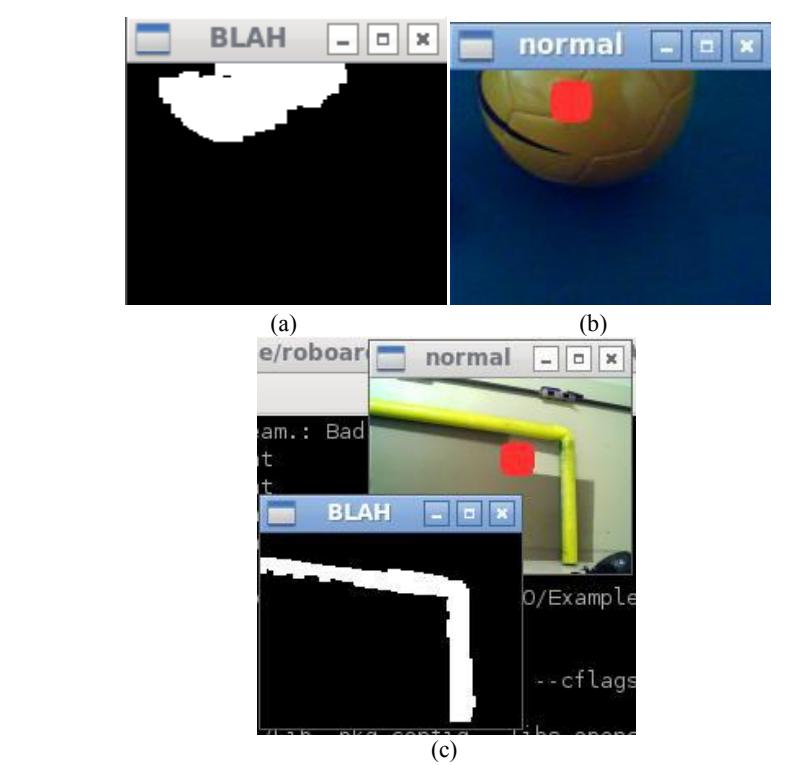
This library is capable of tracking motions, tracking colors, calculate distance of an objects given two different cameras, edge detection, face detection, and many other features that would be pretentious to try talk about them all [3]. Figure 10 shows the ball and goal identification by MABI.
Conclusion
This paper presents just a brief description of what will be used by our team to participated in RoboCup Humanoid competition Adult size. The robot was made from the experience of robots built to competition kid size.
A changes will still be made to improve the main functions so the project can be finished.
Acknowledgment
The authors thank the Universidade Federal de Uberlândia (UFU), Fundação de Amparo à Pesquisa do Estado de Minas Gerais (FAPEMIG), and RADIX Engenharia, for the financial support in this project.
References
- T. R. FE, "RoboCup", www.tzi.de/humanoid, 2013, home page.
- ROBOCUP SOCCER HUMONOID LEAGUE. RoboCup Soccer Humanoid League Rules and Setup for the 2013 competition. http://www.tzi.de/humanoid/pub/Website/Downloads/HumanoidLeagueRules2013_DRAFT_20121010.pdf
- NOGUEIRA, M. B. Posicionamento e Movimentação de um Robô Humanóide Utilizando Imagens de uma Câmera Móvel Externa. 2005. http://bdtd.bczm.ufrn.br/tedesimplificado/tde_arquivos/19/TDE-2006-10-13T011408Z-358/Publico/MarceloBN.pdf
- OTUYAMA, M. J. 1998. Programa de Pós Graduação em Ciência da Computação. http://www.inf.ufsc.br/~visao/1998/otuyama/index.html
- MESTER, G. Modeling of the Humanoid Robot Motion. 2008. 5f. http://internetjournals.net/journals/tar/2011/January/Paper%2005.pdf accessed in 26st January 2013.
- TORRES, S. O. A. Avaliação de Protótipo Mecatrônico de Locomoção Bípede. 2006. 111f. http://teses.ufrj.br/COPPE_M/SidneyOdocioDoAlmoTorres.pdf
- BARELA, A. M. F. Análise Biomecânica do Andar de Adultos e Idosos nos Ambientes Aquático e Terrestre. 2005. 112f. www.teses.usp.br/teses/disponiveis/39/39132/tde.../tese_amfb.pdf