Team KIS
Yasuo Hayashibara, Kazuyoshi Makisumi, Fumihiro Kawasaki, Tristan Lecomte, Takayuki Nagashima, Koutaro Ozawa, Hideshi Shimada, John Verzemnieks, Hongyou Wang
Chiba Institute of Technology, 2-17-1 Tsudanuma, Narashino, Chiba, JAPAN; Nabtesco, 594 Icchoda, Katada-cho, Tsu, Mie, JAPAN
Abstract In this paper, we describe a robot system for the RoboCup soccer adult size humanoid league. There are still many challenges to build the humansize soccer robot. One of the most important challenge is the robust mechanism against the external impact force. For example, when the tall robot fall down, the mechanism will be broken. Especially, the gear attached to the motor is sometimes broken. To solve the problem, we propose a novel geared motor system which contain a shock absorbing mechanism. Furthermore, we develop an light-weight eccentric oscillating speed reducer made by plastics. We introduce the novel servo motor system and show the effectiveness of the mechanism by the experiments.
Keywords: eccentric oscillating speed reducer, shock absorbing mechanism, series elastic actuator
1 Introduction
In this paper, we describe on a robot system for the RoboCup soccer adult size humanoid league. One of the most serious problem to build the human-size robot is how to keep the robustness against the external impact force. When the human-size humanoid robot fall down, the impact force will be large and it sometimes break the mechanism. Especially, the gears attached to the motors are sometimes broken. To play the soccer for a whole game, we should solve this problem. Therefore, we propose a novel geared servo motor system with a shock absorbing mechanism. We apply the elastic material to the servo motor system for decreasing the peak of the impact force. There are many researches to decrease the impact force by using elastic materials. Williamson studied a serial elastic actuator (SEAs) to control the joint's torque precisely. The SEAs decreased the peak of the impact force and the mechanism is applied to the commercial robot "Baxter". Pratt developed a biped walking robot "M2" with elastic joints. However, it seems the robot was difficult to walk stably. We develop a novel servo motor system with shock absorbing mechanism. We call the mechanism as Shock Absorbing Servo Motor (SASM). We confirmed that the SASM decrease the impact force and the human-size humanoid robot equipped with the SASM enable to walk. The SASM has easy-changeable urethane rubbers to absorb the impact force. Furthermore, for the robustness against the impact force, we develop an original eccentric oscillating speed reducer. It made by plastics, so its weight is light. We mention the SASM in a later chapter.
Our team is a collaborated team with Chiba Institute of Technology (CIT) and a company "Nabtesco". CIT has a long history to develop the autonomous soccer humanoid robot. We apply our technologies to the new robot system "Ixion". The Ixion was build totally from scratch including the servo motor system. We aim to build the robust humanoid system through this research and development.
2 Overview of the System
The photograph of our robot is shown in the Fig.1. The specification of the robot is indicated in the Table 1. The overview of the control system is shown in Fig. 2. The basic structure and system to play soccer autonomously are same as the traditional robots of CIT [3]. Our robot system consists of a camera, computers, sensors, servomotors, batteries. The camera sends image signal to the main CPU board. The signal is captured and stored in frame buffer memory. The CPU processes the image data to detect positions of ball, robots and landmarks. From the landmarks' positions, the robot estimates own position by using a particle filter. Based on these information, the robot selects a next behavior. The behaviors that we can choose are not only just simply moving, but also complex behaviors such as following the ball. The action command is sent to an isolated walking control process. The process decodes and executes the command. It sometimes returns the status data to the main process. If the command is a kind of moving the body or checking a status, the walking control process sends a command to servomotor via RS485 network. Each servomotor has own CPU to control motor and receive/send commands. Because all servomotors are daisy-chained, the command is sent to all motor. The command includes ID number, so the servomotor can identify the command to which is sent. The servomotor decodes and executes the command. The displacement angle is controlled in local motor unit. The walking control process not have to send commands at short intervals. In total, this system is constructed as a well-designed hierarchic system. Therefore, we can modify the system easily.
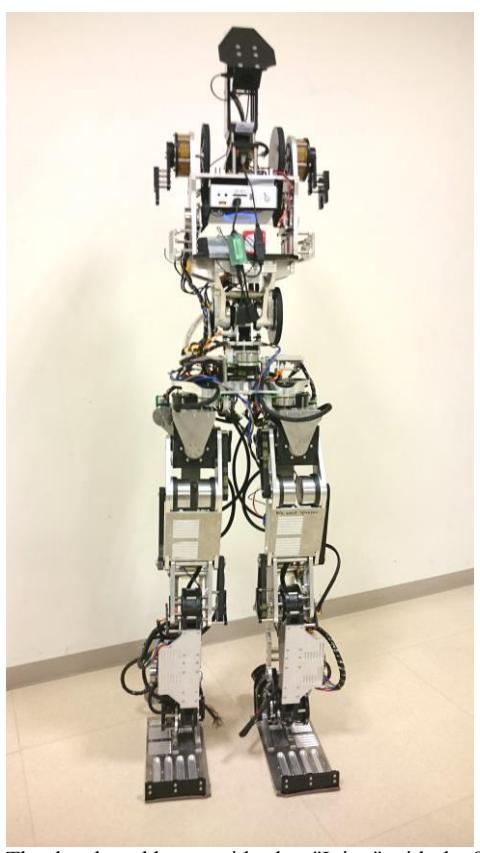
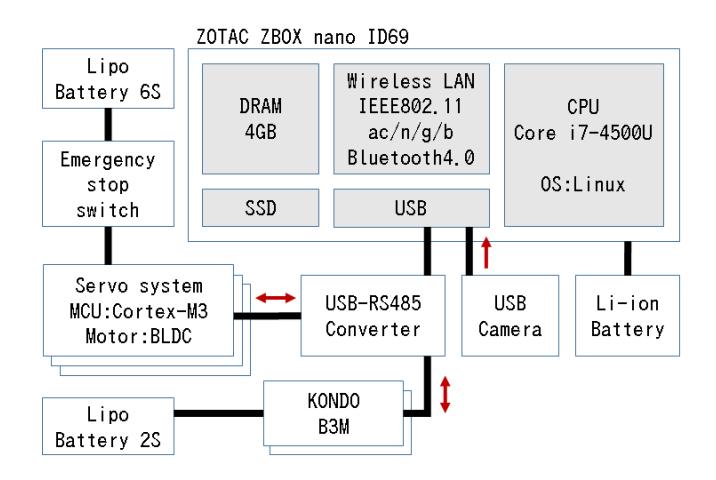
Table 1. Specification of the robot
| Weight | 23.0 kg (Including Batteries) |
|---|---|
| Height | 1400 mm |
| Velocity (Forward) | 0.4 m/s (Maximum) |
| Walking Directions | All direction and rotation |
| (Select the angle, stride, period and so on) | |
| CPU Board | ZOTAC ZBOX nano ID69 (Intel Core i7-4500U) |
| OS | Linux (Ubuntu1404) |
| Motors | Maxon EC 60 flat, EC 45 flat |
| Battery | Li-Po 22.2V x 1 |
3 Shock Absorbing Servo Motor
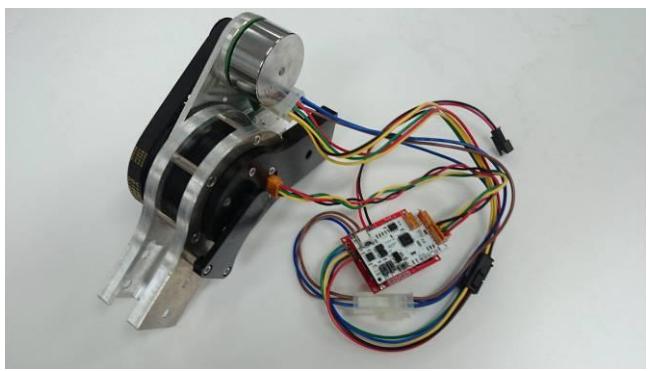
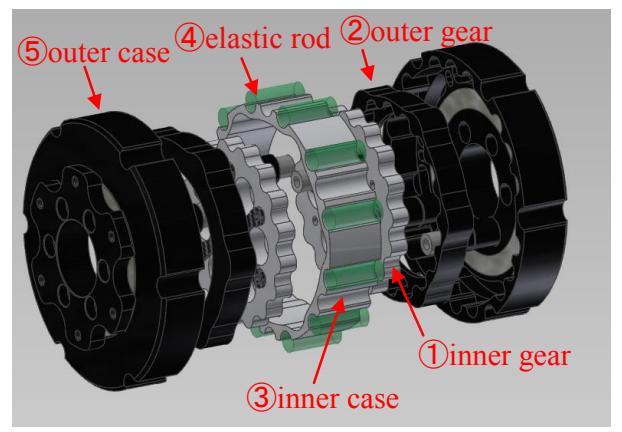
Fig.3 shows the shock absorbing servo motor (SASM). Fig.4 shows the proposed mechanism. The mechanism is separated between the inner case and the outer case. The cases are connected with the elastic urethane rubber rod. When the impact force is applied to the outer case, the urethane rod is deformed for decreasing the peak of the impact force applied to inner case. As a remarkable point, this mechanism allow to change the elastic characteristics by changing the number of the rods or the material of the rod. Furthermore, for the robustness of the mechanism, we develop the original eccentric oscillating speed reducer. It is made by plastics for light weight. We confirm its strongness through walking experiments.
4 Experiment of the Shock Absorbing
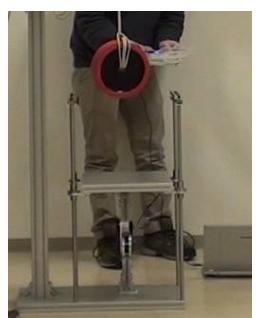
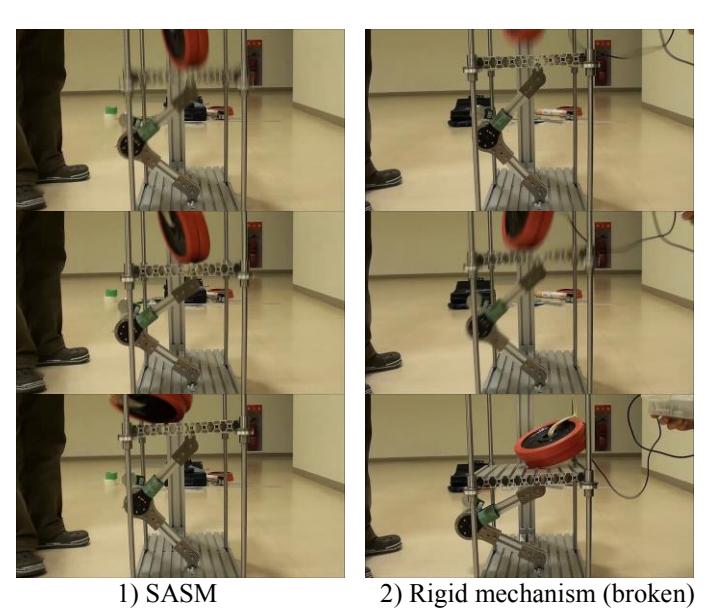
We executed simple experiments to evaluate the effectiveness of the shock absorbing mechanism. Fig.5 shows the experimental setup. We built a mock knee joint and apply an impact force to the mechanism. We drop a 10kg weight to the top plate from a height of 300mm. We implemented the following experimental conditions.
- SASM (urethane rubber rods are applied)
- Rigid Mechanism (metal rods are applied)
Fig.6 shows an example of the experimental results. We dropped the weight to the SASM five times, the mechanism was not broken. In contrast, we dropped the weight to the rigid mechanism three times, the mechanism was broken two times.
5 Walking Ability
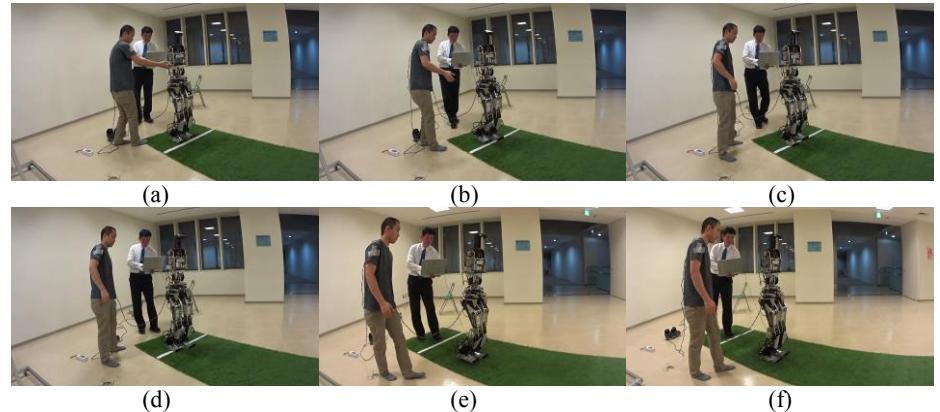
As mentioned in introduction, the robot with elastic joints is not easy to walk. In general, from the point of view of the stable walking, it is better that the joints are rigid. We applied the walking control program that was originally developed by Hajime [4] to our robot. Through many trial and error, our robot have been becoming able to walk.
6 Conclusion
In this paper, we described our robot system "Ixion" with elastic joints. We developed the novel servo motor system with shock absorbing mechanism. We confirmed the effectiveness of the proposed mechanism through the experiments and indicated the walking ability of the robot "Ixion".
References
- Williamson, Matthew M. "Series elastic actuators." (1995).
- Pratt, Gill Andrews. "Low impedance walking robots." Integrative and Comparative Biology 42.1 (2002): 174-181.
- Hayashibara, Yasuo, et al. "CIT Brains KidSize Robot: RoboCup 2015 KidSize League Winner." Robot Soccer World Cup. Springer International Publishing, 2015.
- Sakamoto, Hajime, and Ryohei Nakatsu. "Walking and running control of small size humanoid robot 'HAJIME ROBOT'." The Thirteenth International Symposium on Artificial Life and Robotics. 2008.