HERoEHS, Team Description Paper 2018
Baek Seok Kim, Cheon Yu Park, Yi Taek Kim, Dong Kuk Yoon, Younseal Eum, Jeakweon Han
Hanyang University, 55, Hanyangdaehak-ro, Sangnok-gu, Ansan-si, Gyeonggi-do, Republic of Korea; Sookmyung University, 100, Cheongpa-ro 47-gil, Yongsan-gu, Seoul, Republic of Korea
http://caffe.berkeleyvision.org/
Abstract Team HERoEHS is currently preparing for a ski robot competition to be held at the 2018 PyeongChang Olympic Games. Adult size humanoid robot, DIANA, has been developed for this competition. DIANA is a robot for Alpine skiing, but it has a structure that can be changed into a soccer robot that can participate in the RoboCup humanoid adult size league if only the soles are modified. Team HERoEHS has completed the development of two DIANAs and also developed all operating systems including vision recognition, pattern generation, motion control, compensation and framework as well, based on ROS system. We, team HERoEHS hope to join the Humanoid Adult Size League on RoboCup 2018.
Keywords: DIANA, RoboCup, Adult size league, Humanoid Robot
1 Introduction
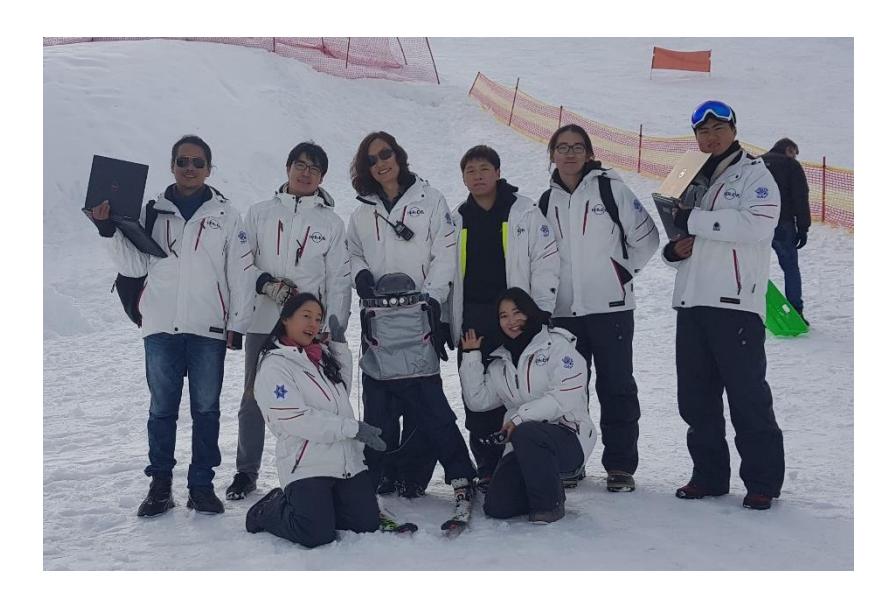
Team Heroes is a new lab created a year ago. It was created by Jeakweon (JK) Han, Team Leader of Team CHARLI that won the Best Humanoid Award at Robocup 2011 Istanbul Competition, and Younseal (Sheal) Eum who designed Robot CHARLI's exterior. In addition, Hanyang University graduate students and researchers in Shouth Korea are developing robots as team HERoEHS members. We are currently preparing for a ski robot competition to be held at the 2018 PyeongChang Olympic Games. We have developed adult size humanoid robot DIANA for this competition. Robot DIANA has been developed for Alpine skiing, but it has a structure that can be changed into a standard robot that can participate in the RoboCup humanoid adult size league if only the soles are modified. Team HERoEHS has completed the development of two Diana and hopes to join the 2018 Robocup Humanoid Adult Size League.
2 Designs
2.1 Mechanical Design and its Exterior Design
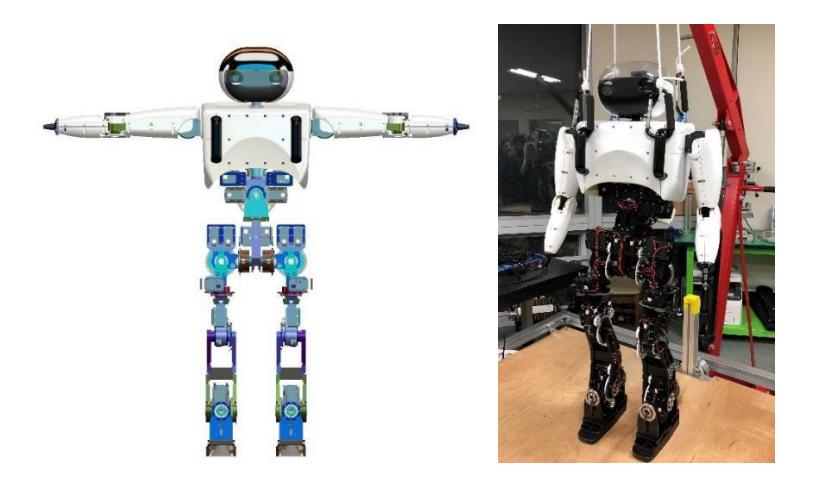
The humanoid robot Diana was born on January 9, 2018. Although it was developed for Alpine skiing, the mechanical structure is traditional and has a general humanoid structure, so it is designed to be versatile. In other words, it has 12DOF legs, 6DOF arms, 2DOF waist and 3DOF head, so it is possible to build soccer as well as skiing. The height is 130 cm and the weight is 30 kg. It is made for RoboCup Humanoid League Adult Size. The sensor also has a 6-axis IMU sensor installed on the pelvis so that bipedal walking is stable, and two 6-axis FT sensors, one for each foot, can be installed to perform the stable walking. A stereo camera is installed on the head to allow both object recognition and distance measurement at the same time.
The main joint is composed of two pairs of Robotis Dynamixel MX-106, and the two motors are connected to one spur gear for further reduction. This structure is similar to the structure of CHARLI used in the 2011 RoboCup. It's because that CHARLI's mechanical designer JK Han upgraded it.
The robot design also inherited the DNA of the robot CHARLI. This is because Sheal Eum, who designed CHARLI's exterior, designed DIANA. She has upgraded to a more robust and stronger design while maintaining the chest curve characteristic of CHARLI. The primary difference between DIANA and CHARLI is that the head was a streamlined design with a head drop because it was originally a ski robot.
2.2 Electronics
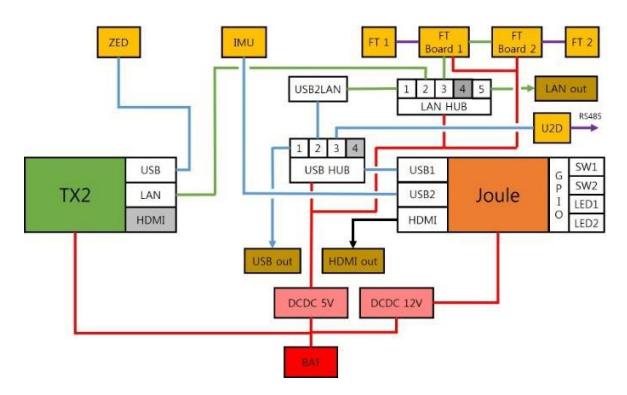
DIANA's electrical system consists of NVIDIA TX2, which performs image processing, and Intel's Joule board, which performs other operations. The stereo camera ZED is connected to the TX2 and the FT sensors and IMU sensor are connected to the Joule. To control Dynamixel, USB2Dynamixel which transmits RS-485 serial signal is also connected to Joule. TX2 and Joule are connected to LAN and perform real time operation. Figure 3 shows a detailed layout of the Diana electrical system.
3 Vision
Current Diana uses a flag recognition vision algorithm for skiing. However, it is the same way of recognizing the ball and the goal of a soccer game. Therefore, I want to show that DIANA has the ability to recognize the ball and the goal of the soccer game by explaining how to recognize flags of the ski game.
3.1 Deep learning algorithm
DIANA must recognize the flag first to be able to take Alpine skiing. This is like recognizing a ball or goal in soccer. DIANA used a deep learning method of a machine learning to recognize the flag of a ski game. Figure. 4 shows the Caffe Deep Learning Framework used by DIANA.

3.2 Flag detection
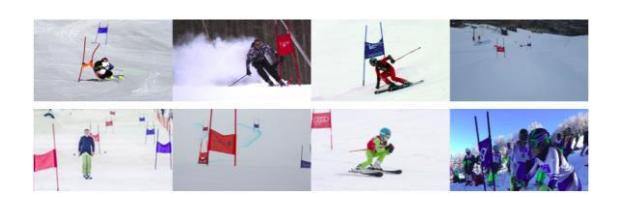
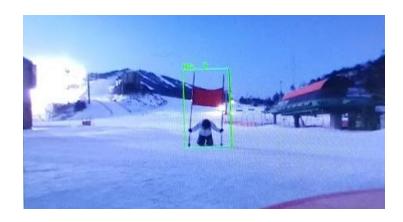
For the recognition of flags, a data set was made with several tens of thousands of photographs as shown in Figure 5. The format was adapted to Detectnet. In addition, the ski record, ski player, crowd, and billboard were labeled in kitti dataset label format. The data set consisted of train data 80% and validation data 20%.
As a result, we recognized the target with an accuracy of 80% for the ski flags, ski players, spectators, and advertisements within 20 meters. Fig. 6 shows the result of the flag recognition.
4 Control
4.1 Framework
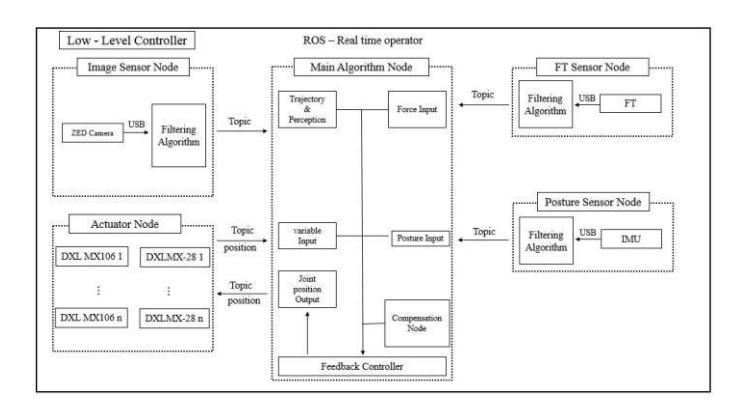
DIANA is basically based on ROS system. Various sensors and devices send and receive data through ROS topic. Also, behavior control commands were generated in the main algorithm node. Figure 7 shows DIANA's overall framework.
4.2 Motor control and pattern generation
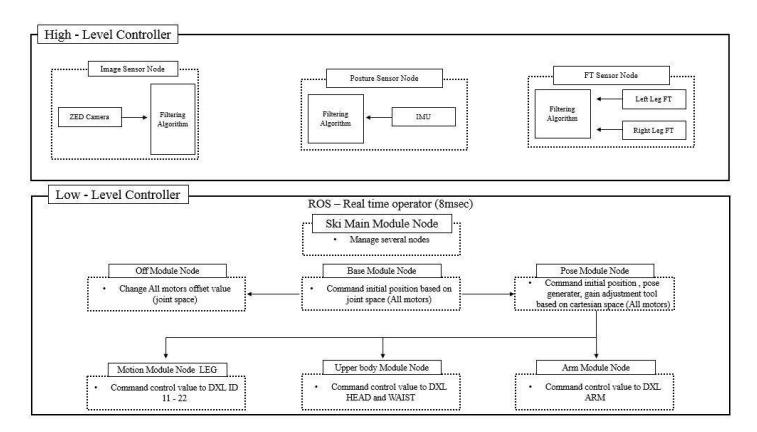
To move DIANA, a foot patterns need to be generated. The pattern command of a given foot is generated by inverse kinematics and inverse dynamics calculation, and the angle and angular velocity commands of each servo motor are generated. Upper body movements are created by playing motion already stored in a given situation. Figure 8 shows how to create motion.
4.3 Compensation
Two compensation methods are used to improve the stability of the robot. The first method is compensation using an FT sensor. It is a method to predict the COP by measuring the force and moment through the FT sensor and move the foot finely in real time and move the upper body in order to place the COP in the center of the support polygon. The second is the elimination of disturbance by the IMU sensor. To cope with instantaneous disturbances, an IMU sensor located on the pelvis measures the angular velocity and then changes the angle to the backward, pelvis, knee, and ankle in the opposite direction. This achieves the effect of realizing the D control and reducing the disturbance at high speed.
5 Conclusion
Team HERoEHS is only one year old team and has developed a humanoid robot for Alpine skiing, but is preparing for a RoboCup with the enthusiasm for RoboCup Humanoid Adult Size League. We are ready to contribute to the RoboCup from 2018 centered on Dr. JK Han who was the leader of Team CHARLI that won the 2011 Louis Vuitton Best Humanoid Award. Team HERoEHS hope to have the opportunity to interact and collaborate with many teams in Canada.