The Sweaty 2018 RoboCup Humanoid Adult Size Team Description
Meyrem Sena Akbas, Martin Burkart, Klaus Dorer, André Friedrich, Lena Higel, Ulrich Hochberg, Nils-Malte Jahn, Rudi Kirn, Mathias Niederhofer, Michael Sattler, Manuel Scharenberg, Lucas Schickl, Rico Schillings, Steen Schmidt, Fabian Schnekenburger, Michael Wülker
University of Applied Sciences Oenburg, Germany
Abstract This paper describes the Sweaty II humanoid adult size robot trying to qualify for the RoboCup 2018 adult size humanoid competition. Sweaty came 2 nd in RoboCup 2017 adult size league. The main characteristics of Sweaty are described in the Team Description Paper 2017 [1]. The improvements that have been made or are planned to be implemented for RoboCup 2018 are described in this paper.
1 Introduction
The major research goal with Sweaty is the improvement of bipedal walking algorithms eventually allowing the robot to run [1]. During RoboCup 2017 in Nagoya several weaknesses could be identied which are now focus of our work.
- The self-localization of Sweaty was unstable, especially when when goal posts could not be detected or when other landmarks were not detected correctly. In this cases a false self-localization resulted in a loss of orientation.
- The game strategy can be improved. Sweaty tried to score a goal even when the opponent was between the goal and Sweaty.
- The motion pattern can still be improved.
- The communication with the game controller in the nal game was poor.
- The time between the decision to shoot and the shot was to long.
- Sweaty could not identify his own feet, as a consequence the shot was not precise.
- The control was in an inecient way.
- Push recovery is not satisfying and can be improved.
2 Robot
(empty)
2.1 Mechanical design
The mechanical design is described in detail in a former team description paper [1]. The following modications are introduced:
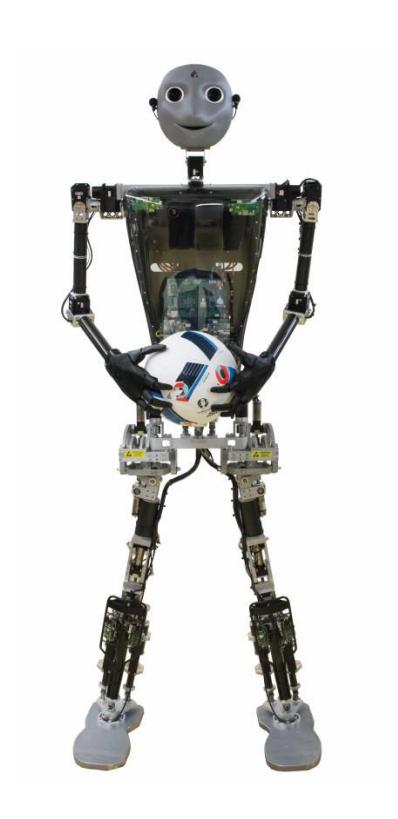
- The number of ngers has been reduced to 8. Four ngers per hand are sucient to grasp objects if the ngers are actuated separately. Sweaty can pick up and hold a ball as well as a bouquet of owers just with four ngers Fig. 1. It can even play rock-paper-scissors.
- A degree of freedom in the neck has been removed. A roll of the head is not necessary, it can just be used to express emotions.
2.2 Electrical layout
The electrical layout is described in detail in a former team description paper [1]. The BLDC motor controllers are lightweight without additional inductance with low ESR capacitors [2]. As a consequence the inductivity of the power supply cables are not negligible and power supply cables together with the capacitors of the motor controller built a resonant circuit that could destroy step-downcontrollers of the power supply units. Therefore the power supply units were redesigned.
3 Vision
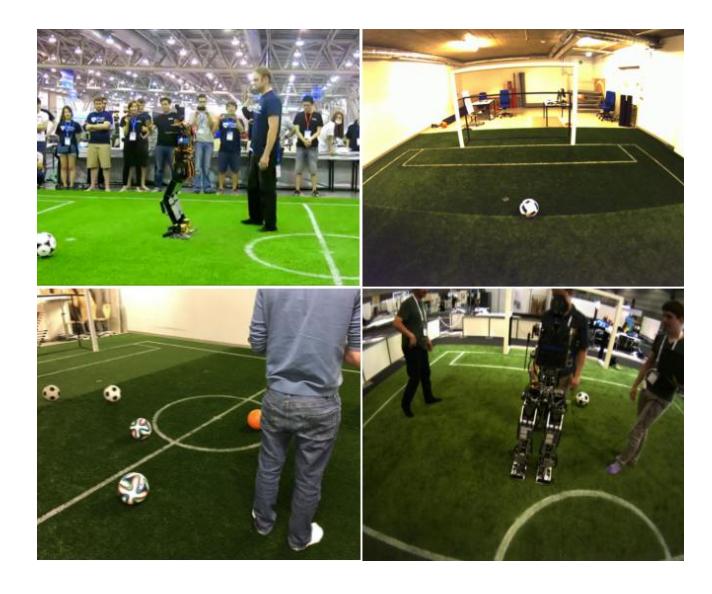
The vision was subject to a redesign. OpenCV is not used any more. A Fully Convolutional Neural Network (FCNN)) is now used to identify ball, opponent and landmarks [3]. The camera image is downscaled and normalized. The results of the FCNN - computations are heatmaps for the objects to be identied. These heat maps are subject to maxima searches to preceive those areas, where the probability of presence of the objects is high, Fig. 2. The network has an encoderdecoder design similar to [4]. Training data were collected on our training eld of play Fig. 3 as well as from Youtube videos of prior RoboCup competitions. To increase the variance of the pictures random modications like rotations and brightness adjustments were applied.

4 Software
The structure of the software is not changed [1]. The generic software witten by the magmaOenburg team is used for the higl level part as well as for visualization and simulations.
5 Work in Progress
(empty)
5.1 Self-localization
The self-localization which is actually solely done by triangulation of landmarks will be supported by integration of the data gathered from the gyros and by odometry. A loss of localization can than be detected and corrected until landmarks are clearly identied again.
5.2 Game strategy
Several standard situations will be dened and behaviors for those situations will be elaborated. Hopefully Sweaty will than start tripping after a kick-o until there is no opponent betwenn Sweaty and the goal.
5.3 Motion pattern
We intend to improve Sweaty's gait. We will start with the existing gait and try to implement more controller to stabilize Sweaty.
5.4 Communication with the game controller
During the next RobCup German Open April 27-29 we will monitor WLAN trac and signal strength to identify the problems we encountered during the last nal in Nagoya and suggest improvements.
5.5 Feet identication
We will generate an additional net to localize Sweaty's feet with our CNN.
5.6 Control
The communication protocol between the motion control software and the motor controllers will be extended to enable a fuzzy-type switch between admittance and impedance control. This might help reduce the jerks which occure when the robot places a foot on the ground.
5.7 Push recovery
As a precondition for an eective push recovery the trajectory of the center of mass as well as a prediction for this trajectory must be calculated. This will be done with Matlab/SIMULINK.
6 Formals
- Referee: According to the rules our team will make a person with sucient knowledge of the rules available as a referee.
- Previous Achievements: Sweaty II came 2 nd place in RoboCup 2016 and 2017. Sweaty I participated in RoboCup 2014 humanoid adult size league reaching 5th place.
- Use of Software: The software for decision making, modeling the environment and some tools are used from our own 3D soccer simulation team magmaOenburg.
- Use of Hardware: We thank maxon motor GmbH, Becker & Müller GmbH and HOBART GmbH for their sponsorship.
References
- Sweaty-Team, The sweaty 2017 robocup humanoid adult size team description, Jan. 2017.
- M. Scharenberg, F. Schnekeburger, U. Wülker, Michael nad Hochberg, N.-M. Jahn, and K. Dorer, A new Motor Controller for Overloading BLDC-Motors of Low Inductivity, Lightweight and Ready of Admittance and Imepdance Control, Proceedings of the 12th Workshop on Humanoid Soccer Robots, IEEE-RAS International Conference on Humanoid Robots, Birmingham, November 2017.
- F. Schnekeburger, M. Scharenberg, U. Wülker, Michael nad Hochberg, and K. Dorer, Detection and Localization of Features on a Soccer Field with Feedforward Fully Convolutional Neural Networks (FCNN) for the Adult-Size Humanoid Robot Sweaty, Proceedings of the 12th Workshop on Humanoid Soccer Robots, IEEE-RAS International Conference on Humanoid Robots, Birmingham, November 2017.
- V. Badrinarayanan, A. Kendall, and R. Cipolla, Segnet: A deep convolutional encoder-decoder architecture for image segmentation, CoRR, vol. abs/1511.00561, 2015. [Online]. Available: http://arxiv.org/abs/1511.00561