RoMeLa Team Description Paper for RoboCup 2019 Humanoid League
Min Sung Ahn, Taoyuanmin Zhu, Dennis Hong
University of California, Los Angeles, Los Angeles CA 90066, USA
Abstract This paper details the hardware and software design of Team RoMeLa's humanoid platform for participating in the Humanoid League at RoboCup 2019 to be held at Sydney, Australia. Team RoMeLa is using a platform that competed in RoboCup 2015 (Hefei, China) and RoboCup 2014 (Joao Pessoa, Brazil), and are 5 time world champions in the humanoid division, winning the Louis-Vuitton Cup multiple times.
1 Introduction
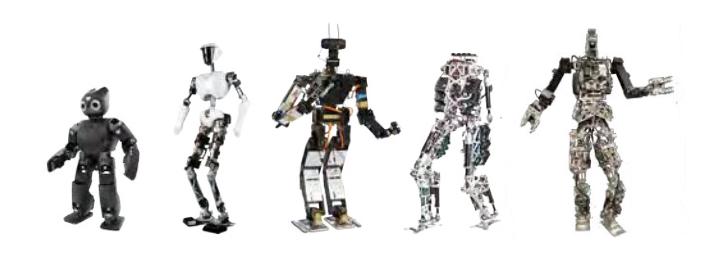
RoMeLa (Robotics and Mechanisms Laboratory) at the University of California, Los Angeles is a research lab with extensive experience in humanoid robots, as seen in some of the humanoids shown in Figure 1. Famous for releasing DARwIn-OP (Dynamic Anthropomorphic Robot With Intelligence-Open Platform), an open-source humanoid platform now sold by ROBOTIS, and building CHARLI (Cognitive Humanoid Autonomous Robot with Learning Intelligence), the first humanoid robot in the United States which also competed in RoboCup, RoMeLa has also tackled applications such as fire suppression and disaster response with various in-house built humanoid robots such as SAFFiR (Shipboard Autonomous Fire-Fighting Robot), THOR (Tactical Hazardous Operations Robot), and more recently, THOR-RD (Tactical Hazardous Operations Robot-Rapid Deployment) [6].
THOR-RD is 1.47 m tall, weighs 49 kg, and has 31 degrees of freedom (DOF), with all joints being powered by Dynamixel PRO servo actuators, with the knee joint using two synchronized actuator setup. It is highly modular because of its reliance on off-the-shelf components. The software architecture is also modular, with multiple control nodes which includes a platform independent graphical user interface (GUI) for operators and a hybrid locomotion controller [7].
RoboCup 2019 will be the third time that this family of robots will be competing in the competition, after two successive championship runs in 2014 and 2015 [5]. In the past, we have collaborated with GRASP Lab at the University of Pennsylvania to compete with DARwIn-OP and CHARLI in the kid and adult size leagues respectively. The software architecture that is used is motivated by our software on DARwIn-OP, which is our three-time champion platform.
2 Scientific Aspects and Research Interests
2.1 Hardware
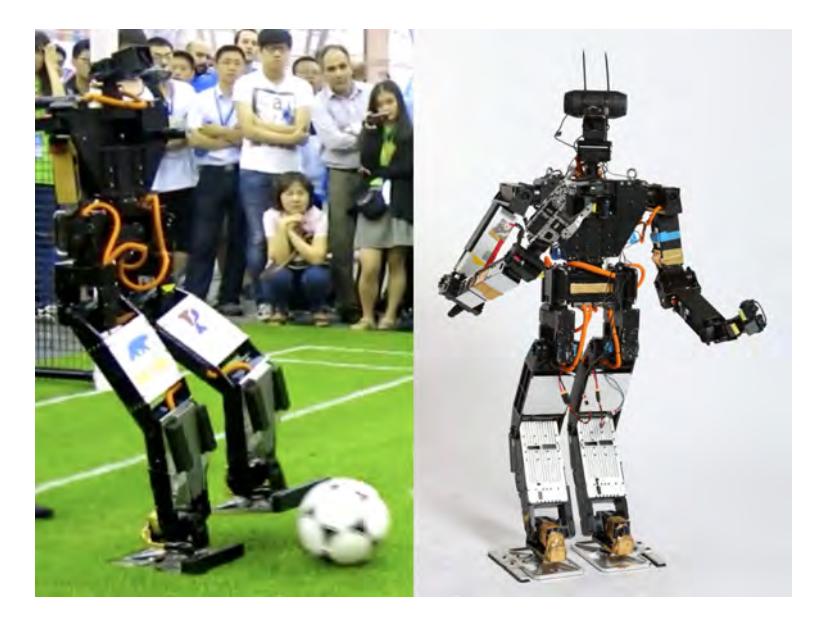
THOR-RD consists of 31 degrees of freedom, with 7 in the arm, 6 in the legs, 2 in the torso, 2 in the head, and 1 in the chest. It is 1.47 m tall and weights 49 kg with a wingspan of roughly 1.95 m. The hardware is designed to be robust to falls, with compliant paddings for shock absorption in the arms and legs, as well as a roll cage at the upper body to further protect sensitive sensors and computing units positioned inside the chest. A full shot of THOR-RD playing in RoboCup 2015 and THOR-RD in the DARPA Robotics Challenge form is shown in Figure 2
The specific actuators used are from ROBOTIS, where H42-20-S300-R, H54- 100-S500-R, and H54-200-S500-R are the models used, with higher power actuators used at joints that require relatively higher torque. A single USB to RS-485 interface board is used to communicate with the actuators, which are divided into four independent RS-485 chains. During locomotion, 3DM-GX4-45 from LORD MicroStrain is the inertial measurement unit (IMU) used for active balancing. For ball detection and other general perception, THOR-RD solely relies on Logitech C920 HD webcam. THOR-RD is run using a single Intel NUC computer to perform everything from high-level computation and vision processing to communicating with the different connected hardwares. All the actuators are powered by two 6-cell 11 A LiPo batteries, while the computer and its peripheral sensors are run under a separate 6-cell 3.25 A LiPo battery.
2.2 Software
THOR-RD uses a modular software design which showed success in RoboCup 2015, the DARPA Robotics Challenge, and previous RoboCup championship runs using DARwIn-OP [4], [3]. A modular design allows different modules to function discretely, which allows rapid deployment, and when assembled in a proper hierarchy, can function as an application.
THOR-RD's software architecture is modularized in the following way. Firstly, there are independent processes which are dedicated to communicating with the different physical hardwares that are used (e.g. actuators, webcam, IMU, joystick/keyboard). This exact process is also compatible with the simulation model, which allows no need for code modification when switching from simulation to hardware. Secondly, there is an application programming interface (API) that converts high-level commands to the robot into robot specific commands (e.g. kinematics, dynamics) and their corresponding motor packets. This allows us to easily adapt new robots into this architecture as long as the robot conforms to the aforementioned API. Thirdly, an independent state machine process is run per limb (i.e. each arm and legs) as well as for the head and the torso. An overview of our previous approach is shown in Figure 3 [2].
To interface the different processes, shared memory is used along with ZeroMQ message queues [1]. UDP messages are also available for the operator to remotely receive information on the state of the robot. A combination of a scripted language (Lua) for high-level behaviors is used with C/C++ for kinematics and state estimation computation.
![Fig. 3. THOR-RD's software architecture overview from [2]](/tdps/soccer_humanoid_adult__2019__RoMeLa/_page_3_Figure_1.jpeg)
2.3 Prior Performances and Achievements
Some members from Team RoMeLa have experience being a part of championship teams and Louis-Vuitton Cup winning teams with Team THORwIn, Team DARwIn, and Team CHARLI. Team THORwIn won the Adult Size championship in RoboCup 2014 and 2015, while Team DARwIn won the Kid Size League for RoboCup 2011, 2012, and 2013 using the DARwIn-OP platform. TEAM CHARLI also won the Adult Size competition in RoboCup 2011 and 2012 with CHARLI. In 2019, Team RoMeLa is led by Dr. Dennis Hong and his students from the University of California, Los Angeles (UCLA).
2.4 Enhancements
While the aforementioned hardware and research is primarily focused on THOR-RD, if possible, Team RoMeLa is currently developing a completely new humanoid that it hopes to take to RoboCup 2019 if ready by Summer 2019. A lot of the software codebase comes from the already existing code from THOR-RD, except actively using Python and ROS such that other RoboCup teams and humanoid researchers can easily use our code written in a popular language and framework. The hardware is completely revamped which we believe will raise RoboCup's bar significantly.
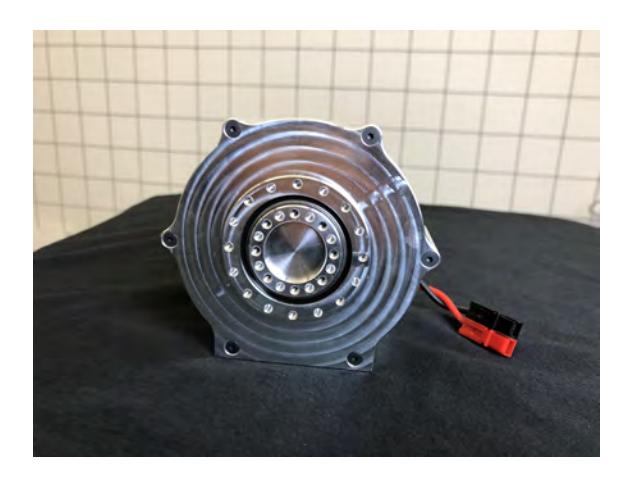
ARTEMIS (Advanced Robotic Technology for Enhanced Mobility and Improved Stability) is a new humanoid platform that Team RoMeLa is currently developing that it hopes to participate in RoboCup with. Currently it is in a manufacturing state. This humanoid does not use off-the-shelf actuators such as Dynamixel's, but uses an in-house built custom actuator called BEAR (Backdrivable Electromagnetic Actuator) shown in Figure 4, which is a BLDC motor with a low-gear ratio that allows the transmission to be "transparent". Thus, instead of relying on force-torque sensors and position control, ARTEMIS uses proprioceptive actuation to do locomotion using force control.
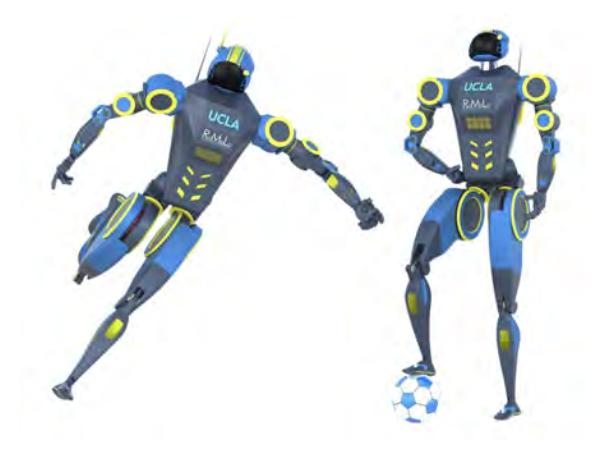
In terms of research, while THOR-RD relied on a hybrid locomotion controller, ARTEMIS will be run using Model Predictive Control (MPC) that optimizes for a ground reaction force (GRF) profile that the legs are to apply to the ground to achieve dynamic locomotion. The dynamics will be modeled as a spring loaded inverted pendulum (SLIP) to push ARTEMIS to run, which is defined as having a flight phase, rather than walk, which is the dominant form of locomotion currently in RoboCup. A rendering of ARTEMIS is shown in Figure 5. Although we are not finished with manufacturing, we have already applied these algorithmic ideas onto a non-anthropomorphic bipedal platform, NABi (Non-Anthropomorphic Biped), and a multi-modal quadrupedal platform, ALPHRED (Autonomous Legged Personal Helper Robot with Enhanced Dynamics) to make the platforms do motions such as dynamic jumping that would be impossible for long durations if using conventional high-gear ratio actuators [8].
We hope to book a place in the competition through this team description paper proving our past achievements and algorithmic capabilities, but hope to take part with ARTEMIS if the platform is ready by then.
3 Conclusion
Team RoMeLa is excited at potentially competing in Sydney, Australia and take part in an important step towards robots defeating humans at the most competitive level of soccer. We are especially hopeful of promoting our new actuation technology in humanoid soccer, as we believe implementing this fundamental technology in humanoids will open another set of doors in terms of mechanical design and algorithms relevant to robot soccer. While we are excited about competing with THOR-RD, we hope this team description paper can book us a spot such that if ARTEMIS is ready, we can compete with it.
References
- zeromq, http://zeromq.org/
- McGill, S., Yi, S.J., Hong, D., Lee, D.: Team description for humanoid adultsize league of robocup 2015
- McGill, S.G., Brindza, J., Yi, S.J., Lee, D.D.: Unified humanoid robotics software platform. In: The 5th Workshop on Humanoid Soccer Robots (2010)
- McGill, S.G., Yi, S.J., Yi, H., Ahn, M.S., Cho, S., Liu, K., Sun, D., Lee, B., Jeong, H., Huh, J., et al.: Team thor's entry in the darpa robotics challenge finals 2015. Journal of Field Robotics 34(4), 775–801 (2017)
- Missura, M., Yi, H., Ahn, M.S., Cho, S., Liu, K., Hong, D., Lee, D.D.: Robocup 2015 humanoid adultsize league winner. RoboCup 2015: Robot World Cup XIX 9513, 132 (2016)
- Muecke, K.J., Hong, D.W.: Darwins evolution: Development of a humanoid robot. In: Intelligent Robots and Systems, 2007. IROS 2007. IEEE/RSJ International Conference on. pp. 2574–2575. IEEE (2007)
- Yi, S.J., Hong, D., Lee, D.D.: A hybrid walk controller for resource-constrained humanoid robots. In: Humanoid Robots (Humanoids), 2013 13th IEEE-RAS International Conference on. pp. 88–93. IEEE (2013)
- Yu, J., Hooks, J., Zhang, X., Ahn, M.S., Hong, D.: A proprioceptive, forcecontrolled, non-anthropomorphic biped for dynamic locomotion. In: Humanoid Robots (Humanoids), 2018 IEEE-RAS 16th International Conference on. IEEE (2018)