Tsinghua Hephaestus 2019 AdultSize Team Description
Mingguo Zhao, Haitao Wang, Rongge Zhang, Chi-Lun Wang
Tsinghua University, Beijing, China
Abstract This document introduces the technical specifications and functions of the hardware and software of the humanoid robot Walker developed jointly by the Robot Control Laboratory of Tsinghua University and UBTECH Robotics Cooperation. The robot is a platform for studying biped motion planning and control, SLAM and human-robot interaction. The robot will be used by Tsinghua Hephaestus Team to participate in AdultSize competition in Humanoid League of RoboCup 2019, Sydney. At present, our design focuses on Walker's electromechanical control system and gait. We hope that in the next few years we can provide a low-cost, mature and reliable business platform for RoboCup teams and ultimately promote the development of the humanoid league.
1 Introduction
The Tsinghua Hephaestus is a RoboCup Humanoid League team running at Dept. of Automation, Tsinghua University, China, since July 2006. UBTech Cooperation has sponsored our team since 2016 and jointly developed the humanoid robot Walker as our hardware platform. Our current research interest is focused on gait planning and control for bipedal robot [1] [2] [3] [4] [5] and robot self-localization [6] [7]. Since 2007, Tsinghua Hephaestus team has participated in the RoboCup humanoid league and won the second place in the teenSize and AdultSize. In recent years, we have focused on participating in the AdultSize competition, and tested our robot's locomotion ability through the competition. This year, we improved and optimized the hardware platform of the robot, and added state estimation and feedback control in the gait algorithm to make the robot more adaptable to the requirements of RoboCup 2019 rules.
Walker is a prototype of a biped robot based on UBTech Intelligent Motion Control Modules, which composed by Harmonic gearbox, PMSM servo motors, and absolute position and velocity sensors. This year's main improvement is to add waist rotation joints and use the real-time control system and improve the filtering algorithm for centroid motion estimation through gyroscope and six-dimensional torque sensor on the foot. In order to obtain a stable and fast biped walking gait, we introduce a virtual support point (VSP) based on the linear inverted pendulum (LIPM) model. The motion capture system collects human motion data as the reference goal of gait planning. The stable and smooth Zero Moment Point(ZMP) is achieved by controlling the motion divergence component (DCM) and virtual support point (VSP). This paper will give a general introduction to the robot, especially on robust gait control on turf and pushing in the competition.
2 The Robot Design
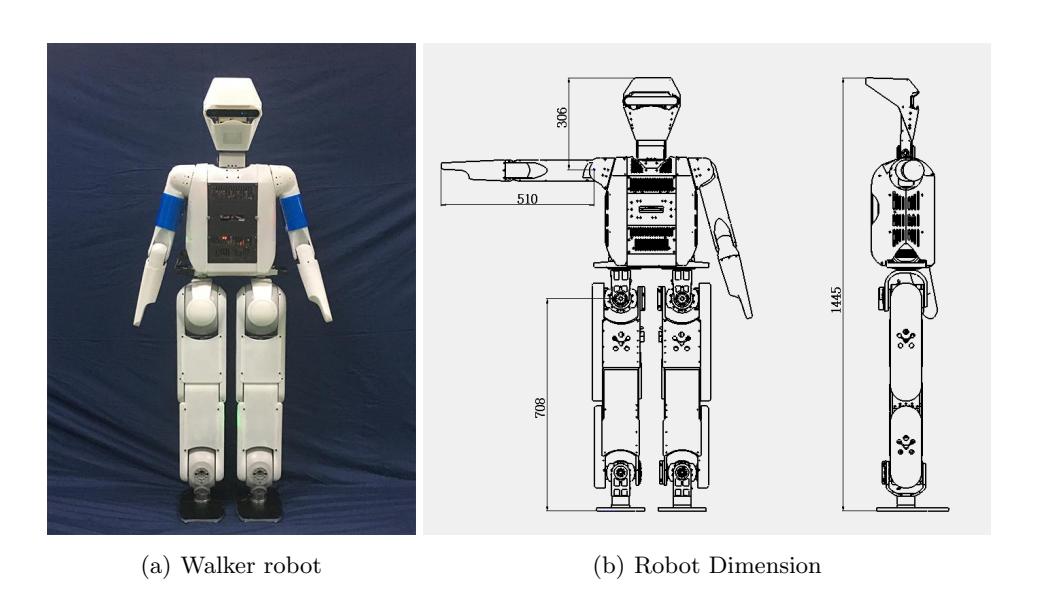
Fig 1 (a) shows the robot Walker we will use in Robocup2019. It has a height of 1445mm, and weights about 50kg, including batteries. The detailed dimensions of the final version are shown in Fig. 1-(b). The robot has 22 DOFs: 6 in each leg, 3 in each arm, 3 in the head and 1 in the waist. For Walker, two kinds of UBTech Intelligent Motion Control Module(60Nm and 30Nm peak torque) are used as actuators for the waist and 12 leg joints. Servo motors with small torque are used to make 3-DOF head and two 3-DOF arms. An ORIENTUS Advanced Navigation Gyro is mounted on the torso to measure the attitude of the torso. A ZED stereo camera and another gyro are mounted on the head of the robot, combining the three degrees of freedom of the head, the robot can keep a stable head and track the object of interested. A six-axis force/torque sensor is installed under both feet of the robot to measure the real-time zero moment point (ZMP) when walking. ZMP data, gyro data, and joint angle data are used as inputs to the center of mass(CoM) state estimation filter.
The controller is a real-time computer with EtherCAT bus. All the driving units, gyros, and sensors are connected with the controller through the EtherCAT bus. There are two kinds of a control loop in the controller, one is the servo control of the joint once milliseconds, the other is the real-time gait planning and control per 5 milliseconds. A small state machine is used to maintain swing legs that fall ahead or behind due to environmental uncertainties. This factor is often omitted or omitted when walking in the air. Because of the simple model with an analytic solution such as a linear inverted pendulum, gait planning, optimization and control can be completed in real time on the control computer, and only takes up less than 40% of the computing resources.
3 Software Architecture
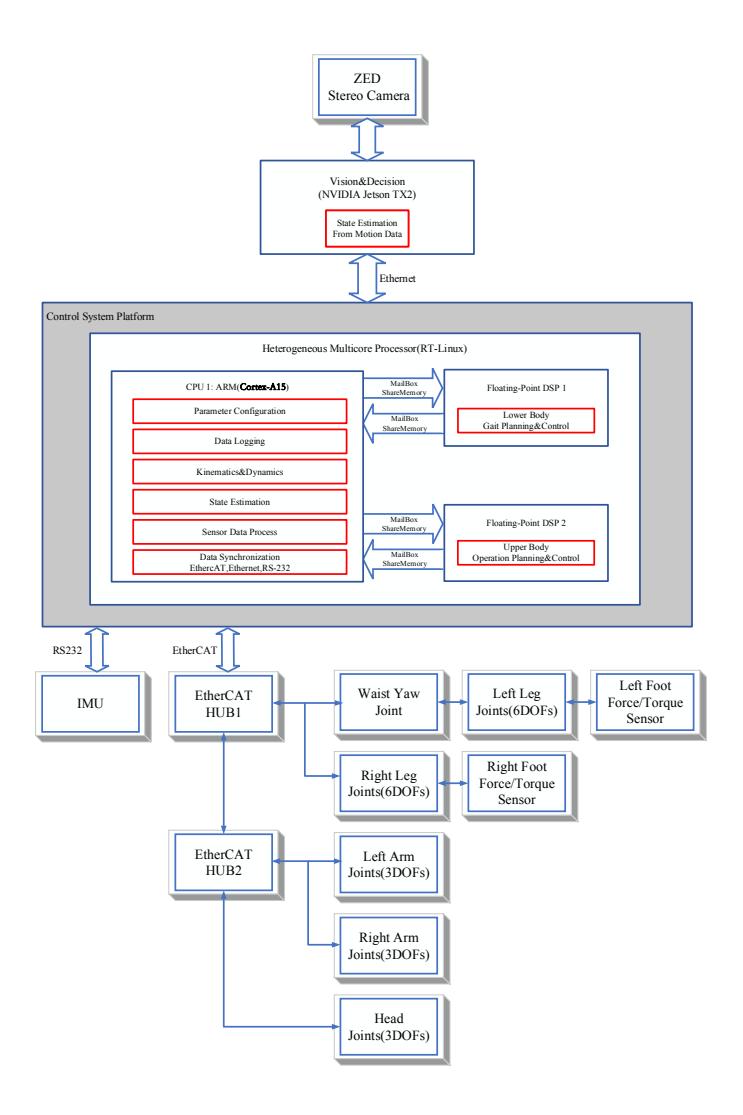
Module configuration of our software and data flows are shown in Fig. 2. The Vision&Decision part is developed on Robot-Operating-System(ROS) with NVIDIA Jetson TX2 and the Motion Control part is realized on an UM572X real-time platform using heterogeneous multicore processor with EtherCAT bus under 1ms cycle time.
The motion control system is running in three separate CPUs. The ARM core is dedicated running at 1000 Hz and DSP cores are running at 200Hz in the hard real-time loop. The EtherCAT master is realized in the ARM to synchronize all the incoming data from Joints and Sensors and send out the commands. The modules of sensor data process , state estimation, kinematics, dynamics are realized in the ARM to sent to the DSP cores for motion planning and control. The ARM core uses mailbox and share memory to communicate with DSP core for motion data exchange. The DSP has two cores, one is for upped body and the other one is for lower body. The DSP cores task is Path Planning, Foot prints Planning, Gait Planning and Balance Control.
Because the Vision&Decision and Motion Control parts are running in a different platform, the data exchange is through Ethernet using ROS messages.
4 Vision
The visual perception system depends on the input of a head-mounted StereoLabs Zed 2 stereo camera. Compared with last year's camera system, this year's vision system has a wider field of view and anti-illumination ability.Compared with last year's camera system, this year's vision system has a wider field of view and anti-illumination ability. We still use deep neural network for object recognition on the field. The difference is that we use YOLOV3 running on TX2. The process of building and recognizing the neural network is similar to that of RoboCup 2017[16], but through optimizing and accelerating the network, we can achieve 25FPS recognition speed for objects and markers on the field. YOLOv3 is a state-of-the-art, real-time object detection system, optimized end-to-end directly since the whole detection pipeline is a single network. So as to boost the training process, we use our original dataset to fine-tune the pre-trained model on COCO dataset. We train our CNN offline given series of labeled images collected in RoboCup since 2017 in various scales, viewing angles and lighting conditions. The resulting CNN can reliably differentiate among categories, providing bounding boxes and class probabilities.
5 Localization and Behavior Control
We implement an algorithm of localization based on a Particle Filter (Monto Carlo Localization)[13]. Every time we get new Vision, Gyro and Odometry provided data, the likelihood of each particle is updated. A specific Hierarchical State Machine is designed for the Robocup HL Game using the XABSL(Extensible Agent Behavior Specification Language) as we used before[13].
6 Motion Control
For motion control, we implement joint angle control with two different Timed Loops through the RT-Linux supplied by UBTECH. The overall control system in Fig. 3 is detailed explained in [3]. In 5ms Timed Loop, we update the state estimation of the robot and replan the gait online according to DCM optimization algorithm[4] and higher level command. In 1ms Timed Loop, we read from sensors and calculate the compensation current (torque) for gravity and friction of each joint. These data are sent to Elmo motor driver to implement the position servo control. An admittance control also added to the ankle joints to realize a robust walking when touched uneven ground.
6.1 Gait Planning
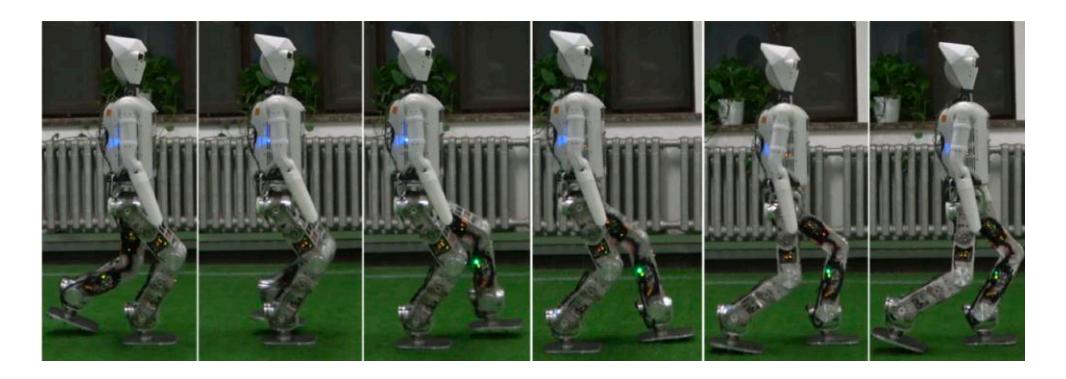
We use a reduced order model which is known as Linear Inverted Pendulum(LIPM) [8] and control the Divergent Component of Motion(DCM)[9, 14] as the gait engineering. For the reference gait, We collect human walking data and use it as a reference for gait planning. We use the same 6-axis force-torque sensors as those on the robot, including the same sole structure. Ten fixed footprints are drawn on the floor in advance, while the participants only need to wear the special shoes to walk along the preplanned path. Meanwhile, another motion capture system is used to capture the swing foot trajectory, which is not modeled in reduced-order model we utilize. We realize a stable walking with large steps both in simulation and hardware. The leg length of our robot is about 0.7m and the footprint length is 0.22m, we achieve 0.6m/step in simulation and 0.4m/step on hardware experiment, with Tstep = 1.1s, DSP = 25%. Fig. 4 shows the snapshot of walking in 4 fps. We have tried Heel-to-Toe(HT) strategy in our gait generator to extend the step length, the DSP of Human data is about 40%, and the range of HT is ∆X = 0.07m,∆Y = 0.03m.
6.2 Stability Control
We adopt a DCM tracking controller, a ZMP position-based controller and a stabilizer based on DCM re-planning. The position-based ZMP control is mainly achieved by changing the damping parameters of the ankle joint. Therefore, robots can walk on artificial turf.
6.3 Path Planning
We arrange a Path Planning module in the Motion Control to calculate the next 3 footprints our robot will step on, and our gait is being replanned in each 5ms cycle according to current status and behavior command. We define foot-center point as the middle of two feet while robot standing. Then we generate the position and orientation of footprint in next N steps by command message [∆Lforward, ∆Lside, ∆θ] compatible with speed mode.
7 Conclusion
Our AdultSize robot Walker is a completely autonomous humanoid robot, with 1 camera, 2 gyros and 22 actuators integrated on body, controlled by RT-Linux and Jetson TX2, it can overcome the odds (soft grass field, other robot pushing and long time walking) and behave like a real strong man when shooting and blocking the ball. In this paper, we present the specifications and functions of Walker with the work of gait planning and control.
7.1 Team Members
Tsinghua Hephaestus commits to participate in RoboCup 2019 in Sydney and to provide a referee knowledgable of the rules of the Humanoid League. Currently, the Tsinghua Hephaestus AdultSize soccer team consists of the following members:
Team Leader: Mingguo Zhao
Team members: Rongge Zhang(Preferred Referee), Haitao Wang, Chi-lun Wang.
References
- Deng K, Zhao M, Xu W, Bifurcation gait suppression of a bipedal walking robot with a torso based on model predictive control, Robotics & Autonomous Systems, vol. 89, pp. 27-39, 2017.
- Deng K, Zhao M, Xu W, "Passive dynamic walking with a torso coupled via torsional springs", International Journal of Humanoid Robotics, 2017, vol.14, No.01, 1650024.
- Haitao Wang, Zhongyuan Tian, Wenbin Hu, Mingguo Zhao, Human-like ZMP Generator and Walking Stabilizer based on Divergent Component of Motion, IEEE International Conference on Humanoid Robots, pp. 82-87, 2018.
- Haitao Wang, Mingguo Zhao, A Robust Biped Gait Controller Using Step Timing Optimization with Fixed Footprint Constraints, IEEE International Conference on Robotics and Biomimetics, pp. 1787-1793, 2017.
- H. Dong, M. Zhao and N. Zhang, High-speed and energy-efficient biped locomotion based on Virtual Slope Walking, Autonomous Robots, vol. 30, no. 2, pp. 199-216, Jan. 2011.
- Stasinopoulos S, Zhao M, Zhong Y, "Simultaneous localization and mapping for autonomous bicycles", International Journal of Advanced Robotic Systems, 2017, 14(3):172988141770717.
- Mingguo Zhao, Sotirios Stasinopoulos and Yongchao Yu, "Obstacle Detection and Avoidance for Autonomous Bicycles", CASE2017, pp1310-1315
- S. Kajita et al., "Biped walking pattern generation by using preview control of zero-moment point," IEEE International Conference on Robotics and Automation, vol. 2, pp. 1620-1626, 2003.
- J. Pratt, J. Carff, S. Drakunov and A. Goswami, "Capture Point: A Step toward Humanoid Push Recovery," 2006 6th IEEE-RAS International Conference on Humanoid Robots, Genova, 2006, pp. 200-207.
- Silvela, Jaime, and Javier Portillo, "Breadth-first search and its application to image processing problems," in IEEE Transactions on Image Processing vol. 10, no. 8, pp. 1194-1199, Aug 2001.
- RoboCup Rules Draft for 2019, https://www.robocuphumanoid.org/materials/rules/, 2018.
- LeCun, Yann, Yoshua Bengio, and Geoffrey Hinton, "Deep learning." Nature 521.7553 (2015): 436-444.
- M. Zhao, Kaiyuan Xu and Qingqiu Huang, "Tsinghua Hephaestus 2016 AdultSize Team Description," Humanoid League Team Descriptions, Robocup 2016, Leipzig,July. 2016.
- J. Englsberger, C. Ott, "Integration of vertical COM motion and angular momentum in an extended Capture Point tracking controller for bipedal walking," in ,12th IEEE- RAS International Conference on Humanoid Robots, IEEE, 2012, pp. 183-189.
- Redmon, Joseph and Farhadi, Ali,"YOLOv3: An Incremental Improvement," arXiv,2018
- Mingguo Zhao, Haitao Wang, Rongge Zhang, Xueheng Zhang, Zhongyuan Tian, Qilun, Wang, Wenbin Hu, "Tsinghua Hephaestus 2018 AdultSize Team Description"