ZJLabers Extened Abstract Paper Humanoid Adult-Size League of Robocup 2020
Yun Liu, Sumian Song, Te Li, Yuehua Li, Haihui Yuan, Ruilong Du, Fangyan Shen, Wei Li, Jianjun Gu
Intelligent Robot Research Center, Zhejiang Lab, Hangzhou, China
Abstract This paper first summarized some lessons from participating in RoboCup 2019 Teen-Size League. After that, some challenges and solutions were introduced when preparing for the Adult-Size League in RoboCup 2020.
1 Lessons from the Teen-Size League in Robocup 2019
In RoboCup 2019, We, the ZJLabers, took the 2nd place in Teen-Size League, and some lessons could be listed as follows. The robots walking was not stable enough. The goal was not well recognized. The filtering of the IMUs data could not meet with the need for yaw orientations when using the integrated gyro measurements. The robot spent too much time when deciding to kick.
2 Challenges in Adult-Size League in Robocup 2020
In RoboCup 2020, there are only two kinds of sizes in the Humanoid League, and we would like to take part in the Adult-Size League. We would like to build two types of robots for the Adult-Size League, which could walk dynamically and get to a very accurate position. Some challenges arise when preparing for the upcoming competition.
3 Major changes
To overcome the challenges, we have come up with some solutions listed as follows.
Mechanic and Electric: We have built a new robot named ZBigger, whose details could be found in the Specifications. The ZBigger was learned from NimbRo's trunk, leg and gear structures[1]. Apart from that, a new robot would be built with torque motors driving the legs so that the robot could adapt to a more dynamic walking algorithm.
Vision: More pictures of the goal would be used to train the new Yolo-like deep learning model to make the vision algorithm robust enough for outdoor scenes where lighting condition varies[2]. Besides, a preprocessing module would be added on the top of the algorithm, which could adjust the filter thresholds based on the ambient brightness.
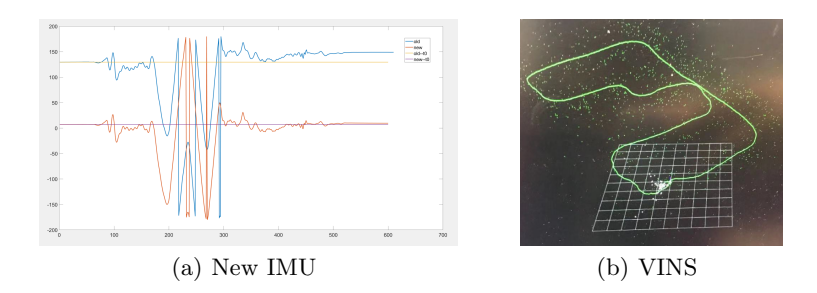
Localization: A new kind of IMU, the XSENS MTI 300, would be used in the robot for reducing the deviations of the yaw orientations with respect to time. An odometer algorithm would be adopted to get the robots current location, which could predict the robots displacement between two consecutive frames through the VINS method with the stereo camera and the IMU[3].
Walking: The IMUs data would be used as feedback for real-time walking gait planning and control. Additionally, we would explore the gesture estimation and the gait planning based on the capture point following [4] and [5], and a simulation platform would be established for testing the new walking algorithm.
Behavior: New strategies for improving the reaction ability would be put forward using the simulation platform of behaviors.
4 Current progressn
We have made some progress by the time of submitting this paper. A robot with parallel structures has been built, and the new IMU has been used in the robot. The deviation could be observed reduced by an order of magnitude as depicted in Fig.1 (a). Apart from that, we have successfully run the VINS method, which could be observed in an accurate positioning as depicted in Fig.1 (b).
References
- Diego Rodriguez, Hafez Farazi, Grzegorz Ficht, Dmytro Pavlichenko, Andre Brandenburger, Mojtaba Hosseini and Sven Behnke. NimbRo AdultSize Team Description Paper 2019.
- Redmon, Joseph and Farhadi, Ali. YOLOv3: An Incremental Improvement. arXiv, 2018.
- Qin Tong, Li Peiliang, Shen Shaojie. VINS-Mono: A Robust and Versatile Monocular Visual-Inertial State Estimator[J]. IEEE Transactions on Robotics:1-17.
- Pratt J, Carff J, Drakunov S, et al. Capture point: A step toward humanoid push recovery[C]//2006 6th IEEE-RAS international conference on humanoid robots. IEEE, 2006: 200-207.
- Missura M, Behnke S. Omnidirectional capture steps for bipedal walking[C]//2013 13th IEEE-RAS International Conference on Humanoid Robots (Humanoids). IEEE, 2013: 14-20.