Team Description Paper: Darmstadt Dribblers & Hajime Team (KidSize) and Darmstadt Dribblers (TeenSize)
Martin Friedmann, Jutta Kiener, Robert Kratz, Sebastian Petters, Hajime Sakamoto, Maximilian Stelzer, Dirk Thomas, Oskar von Stryk
Technische Universität Darmstadt, Department of Computer Science, Germany; Hajime Research Institute, Ltd., Japan
www.dribblers.de · www.hajimerobot.co.jp
Abstract This paper describes the hardware and software design of the three humanoid robot systems of the Darmstadt Dribblers and Hajime Team in KidSize and TeenSize. The robots are used as a vehicle for research in control of locomotion and behavior of humanoid robots and robot teams with many degrees of freedom and many actuated joints. The Humanoid League of RoboCup provides an ideal testbed for such aspects of dynamics in motion and autonomous behavior as the problem of generating and maintaining statically or dynamically stable bipedal locomotion is predominant for all types of vision guided motions during a soccer game. A new modular software architecture has been developed for efficient and effective implementation and test of modules for sensing, planning, behavior, and actions.
1 Introduction
The RoboCup scenario of soccer playing legged robots represents an extraordinary challenge for the design, control and stability of bipedal and quadrupedal robots. In a game, fast motions must be planned autonomously and implemented online which preserve the robot's stability and can be adapted in real-time to the quickly changing environment. Existing design and control strategies for humanoid robots can only meet these challenges to some extent.
In RoboCup 2005 the Darmstadt Dribblers and Hajime Team took part as independent teams. Hajime Team became third in the 2 versus 2 soccer games and reached the semi-final of the penalty kick competition (KidSize). The Darmstadt Dribblers reached the quarter final in 2 versus 2 games in KidSize and took part in the semi-final penalty kick of the MediumSize (now TeenSize).
In RoboCup 2006 the Darmstadt Dribblers & Hajime Team plan to participate in the KidSize competition with two robots as a joint German-Japanese team using among others a newly designed robot HR18 which is equipped with onboard vision, perception and planning capabilities and is based on previous experiences. In the TeenSize competition the Darmstadt Dribblers plan to participate with a completely new designed robot whose legs are actuated by bundles of smart material wires as bio-analogue, artificial muscles.
All robot systems are equipped with Pocket PCs as onboard computers, cameras and partly gyroscope and accelerometer. The control architecture for autonomous behavior and high level functions is embedded in a new software framework with exchangeable modules.
In the following sections a short overview of the hardware and software concepts of the Darmstadt Dribblers and Hajime Robot is given.
2 Hardware
(see figure and tables below)
2.1 KidSize
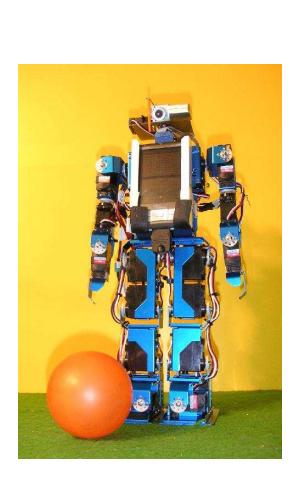
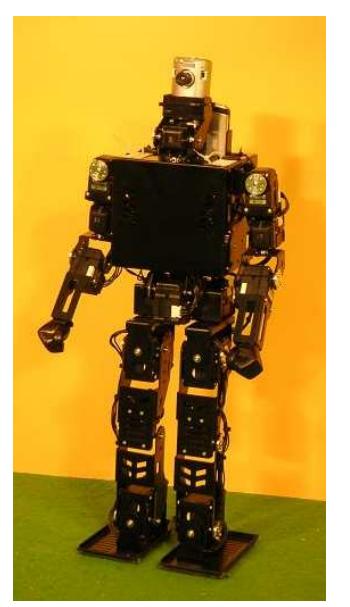
The two investigated humanoid robots differ in size, sensor equipment and number of DOF (see Table 1 for more details). The locomotion hardware of the smaller robot Mr. DD Junior 2 (left in Fig. 1) is produced by the Japanese company iXs and in our group since April 2005, the larger robot Mr. DD HR18 (middle in Fig. 1) is produced by Hajime Robotics Ltd. The hardware design of Mr. DD HR18 is based on robot designs developed by Hajime Team and already used in RoboCup 2005.
Table 1. Technical data of both KidSize humanoid robots.
| Robot system: | Mr. DD HR18 (HR 18) | Mr. DD Junior 2 (YDH-EZA) |
|---|---|---|
| Height [cm]: | 55 | 37.5 |
| Weight [kg]: | 4.5 | 1.5 |
| Walking speed [m/s]: | 0.2 | 0.05 |
| Running speed [m/s]: | - | - |
| Actuators: | Servo Motor DX-117 | Servo Motor KRS-2350 ICS Red Version |
| Torque [kg-cm] | 33.0 | 29.5 |
| Speed [sec/60°] | 0.126 | 0.13 |
| Degrees of freedom: | 24 in total with 6 in each leg, 4 in each arm 2 in waist, 2 in neck | 22 in total with 6 in each leg, 4 in each arm, 2 in neck |
| Camera | Philips ToUCam Pro | HP PhotoTraveller |
| Resolution | 320 x 240 | 160 x 120 |
| Color space | YUV | RGB |
| Frame rate [fps] | < 10 | < 10 |
| Angle [°] | 35 resp. 90 | 35 |
| Joint Angle Encoder | 24 | 21 |
| Accelerometer | Crossbow, CXL04LP3, 3 axes rate 10 ms | n/a |
| Gyroscope | SSSJ, CRS03-04, 3 axes rate 10 ms | n/a |
| Control frequency [ms] | 10 | 40 |
| Micro Controller Board: | ||
| Manufacturer | Hajime Research Institute Ltd. Kondo | |
| Processor | 32bit µC SH2/7145 | ? |
| Speed | 50 MHz | ? |
| Onboard PC: | ||
| Manufacturer | Acer n50 Premium | Fujitsu Siemens Pocket PC 420 |
| Processor | Intel PXA-272 | Intel PXA 255 |
| Speed | 512 MHz | 400 MHz |
| Operating system: | Windows CE | |
| Network: | Wireless LAN | |
| Batteries: | Li-Po 14.8 V, Ni-MH 6 V | Li-Po 7.2 V |
2.2 TeenSize
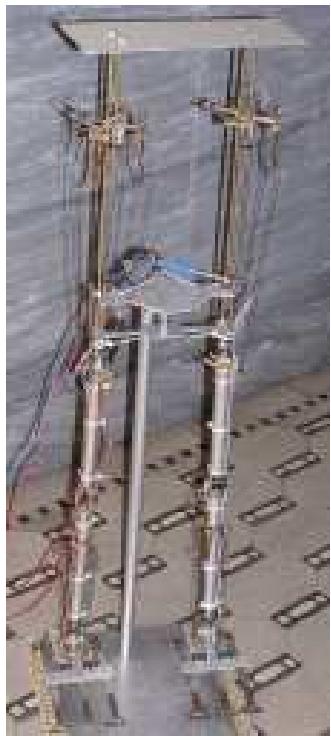
Mr. DD SMA (Darmstadt Dribbler Shape Memory Alloy, for details see Table 2) is actuated by newly developed macroscopic shape memory alloy actuators scalable in force and length instead of motors. Prestrainend shape memory alloys change their length when heated above their transformation temperature. To ensure a short cool down time to guarantee a high frequency of contraction/stress cycles it is planned to integrate a cooling system into the robot.
The use of the novel actuators allows arranging the point of actuation in any direction. This allows generating joint movements without the common restrictions holding for electric motors as on the point of actuation and results in a more human-like bipedal robot walking. The use of the new actuator also necessitates a novel control approach [1]. A model to describe the actuators behavior has been developed and experimentally verified [2]. It offers the possibility of using the resistance of the actuator as a linear position encoder and provides a basis for the control approach of the actuator.
At the moment 26 actuators are integrated to allow the bipedal walking. Walking optimizations are performed in simulation to gain information about ideal placement of the muscles and to gain information on how to control the muscles for fast locomotion. For first numerical results, the robot was modeled as a 2-dimensional robot and the torques that may be applied to the joints are estimated by lower bounds of the torques. In the real robot (and in the next simulation model which will be used for optimization) the torques depend on the joint angles and the current states (temperature, length) of the artifical muscles.
Table 2. Technical data of TeenSize robot Mr. DD SMA.
| Robot system: | Mr. DD SMA | |
|---|---|---|
| Height [cm]: | 120 | |
| Weight [kg]: | 4.5 | |
| Walking speed [m/s]: | 0.5 m/s (in simulation) | |
| Running speed [m/s]: | n/a | |
| Actuators: | newly developed shape memory alloy actuators, 2 servo motors for head control | |
| Torque [Nm] | 1.8 (accumulted muscles in hip joint) | |
| Speed [sec/60°] | 60 | |
| Degrees of freedom: | 16 in total with 6 in each leg, 1 in each arm 2 in neck | |
| Sensors: | ||
| Camera | Philips ToUCam Pro | |
| Resolution | 320 x 240 | |
| Color space | YUV | |
| Frame rate [fps] | 10 | |
| Angle [°] | 35 resp. 90 | |
| Joint Angle Encoder | linear position encoder in each muscle | |
| Accelerometer | Crossbow, CXL04LP3, 3 axes (planned) | |
| Gyroscope | SSSJ, CRS03-04, 3 axes (planned) | |
| Control frequency [ms] | 10 | |
| Micro Controller Board: | ||
| Manufacturer | newly developed board based on two Atmels (planned) | |
| Processor | ATMEL 32 | |
| Speed | 8 MHz | |
| Onboard PC: | ||
| Manufacturer | Acer n50 Premium | |
| Processor | Intel PXA-272 | |
| Speed | 512 MHz | |
| Operating system: | Windows CE | |
| Network: | Wireless LAN | |
| Batteries: | Li-Po 14.8 V, Ni-MH 6 V |
3 Software
(see subsections below)
3.1 Framework and Architecture
The base of the robot control software is the object oriented and platform independent framework RoboFrame. It has been developed to match the special requirements in small sized light-weight robots, both legged and wheeled. The framework provides flexible communication connections between the data processing parts of the applications, the so called modules. Currently packet and shared memory based communication is possible. The connections are established during runtime with very little overhead, thus allowing to change the layout of the application very fast. Very different behavior control paradigms may be realized on the basis of RoboFrame.
For debugging and surveillance, a graphical user interface based on the platform independent GUI toolkit QT is available. With the GUI it is possible to visualize any kind of data by extending to provided API. TCP based data connections to multiple robots are possible.
A more complex description of the architecture, the framework and the modules is given in [3].
3.2 Current modules
At the moment mainly four interacting modules developed with the framework described above are used: vision, model, behavior and motion.
Vision. Since the robots in our team are using different cameras with different color spaces, the vision module should be as flexible as possible. This is achieved by choosing a highly object oriented approach which allows rapid prototyping of new image processors while providing the possibility for high speed optimizations. Image processing is split into two parts: a common pre-processing stage and several exchangeable modules for object recognition. Object recognition, done by so called perceptors, can work with multiple image types, such as preprocessed segmented or gray scale images, or unprocessed raw image. This way, depending on the object and underlying recognition algorithms, the proper level of abstraction can be used by each perceptor while keeping the pre-processing efforts at the required minimum. The perceptors developed up to now detect field lines, line crossings, the ball, goals and poles.
Model. The model uses the detected percepts from the vision module to update a world model. One part of the world model is a self localization, which is accomplished by Markov localization with particle filtering [4]. All percepts calculated by the world model are used not only on the robot, but also exchanged between all robots in the scenario via wireless LAN. For inter robot communication a fast, but unreliable UDP broadcast is used.
Behavior. The data provided by the model module is used to plan a more complex behavior such as playing soccer. The main task is separated into subtasks until they can be described as a set of atomic actions. This is done by a hierarchical state machine described in XABSL [5]. The basic actions are transfered to and interpreted by the motion module.
Motion. The current motion module is mainly used to calculate walking trajectories using an inverse kinematics model and to control the neck joint(s) with 1 or 2 DOF depending on the robot type. The control of the other joints in the arms is also possible, but used mainly for balancing aspects. For walking the inverse kinematics engine takes three 6-dimensional reference points for pose (one in each foot, one in the hip) at a given time and calculates a 6-dimensional vector of joint angles for each leg. The engine can be fine tuned by several parameters (e.g. different length and time variations during one stride) which can be altered at runtime.
4 Conclusion
At the moment in our group three different humanoid robot systems are investigated with respect to participation in RoboCup 2006. They agree in six DOF in leg and a camera as main environment sensor. The robot systems in the KidSize differ mainly in height (small: 37.5 cm, large: 55 cm in KidSize). The robot system in TeenSize is driven by a new developed actuation concept. So different aspects of movement in varying large humanoid walking systems can be investigated.
The robot systems are equipped with Pocket PCs as onboard computers. A newly developed general software framework is implemented on PCs with the capability of fast communications of software modules on one robot and PC, between several PCs and between several robots.
We expect the newly developed robots HR18 (KidSize) and Mr. DD SMA (TeenSize) to be highly competitive challengers in the RoboCup 2006. Further information including publications and videos is presented on our homepages (www.dribblers.de and www. hajimerobot.co.jp).
References
- R. Kratz, M. Stelzer, O. v. Stryk: Design, Measurement Experiments and Application of a Macroscopic Shape Memory Alloy Actuator System. 10th International Conference on New Actuators, Bremen, 2006. Accepted.
- R. Kratz, M. Stelzer, O. v. Stryk: Design and Measurement Experiments of a Macroscopic Shape Memory Alloy Actuator/Sensor System. 4th IFAC-Symposium on Mechatronic Systems Heidelberg, Germany, 2006. Submitted.
- M. Friedmann, J. Kiener, S. Petters, D. Thomas, O. v. Stryk: Teams of heterogenous cooperative robots with modular software components. International Conference on Intelligent Robots and Systems. Submitted
- D. Fox, W. Burgard, F. Dellaert, and S. Thrun: Monte Carlo localization: Efficient position estimation for mobile robots. Proc. of the National Conference on Artificial Intelligence, 1999.
- M. Lötzsch, J. Bach, H.-D. Burkhard, M. Jüngel: Designing Agent Behavior with the Extensible Agent Behavior Specification Language XABSL. RoboCup 2003 International Symposium (Robot Soccer World Cup VII).