NiciCo Humanoid Robot Robocup2006
Hossein Nezamabadi-pour, Moahammad Arabnezhad, Mohammad-ali Nikouie Mahani, S.Rasul Ataee, Kave Nooraee, Morteza Iranmanesh, S.Mehdi Alavi, Hamed Haji Rezaei, Morteza Fadaee
National Iranian Copper Industries Company International Center for Science, High Technology and Environmental Science, Kerman, Iran; Shahid Bahonar University of Kerman, Kerman, Iran; Islamic Azad University, Kemran, Iran; Islamic Azad University, Bardsir, Iran; University of Applied Science and Technology, Zahedan, Iran
Abstract In this paper technical description, design criteria and implementation of NiciCO robot system have been presented. The robot has been designed as part of our sustained program of simulation of human movements based on the functionality of the mechanism. The research has been focused on the similarities between and humanoid movements, as well as the vision. Using computer vision and Advanced Image processing techniques, the robot can detect and recognize the ball in the captured color image. We have implemented a rule-based inference system as an expert system to increase robot flexibility. In addition, Fuzzy controller has been used to control the stability of the robot.
Introduction
The NiciCO team currently consists of students and researchers from the different two academic centers: Shahid Bahonar University of Kerman and International Center for Science, High Technology and Environmental Science (HI-TECH). The team was formed in 2002. we participated in RoboCup 2005 Osaka, humanoid Kid Size competition by the name of NiciCO team.
The NiciCO Research group, we are following a converged research program on development of a fully automated walking pair of legs for disables. Based on our previous prototypes and experiments [1], we have focused our research on development of a simple mechanism of movement of various past of the body with maximum similarity to that of human movements, and at a reasonably high speed. Our approach was analyzing sampled photographs of a human body while moving. Based on displacement of Center Of Mass (COM) of each part, and the body itself, we have developed a very flexible, parametric flowchart that can move the robot without engaging too much in dynamic equations. For the robust object detection, our vision system uses the shape information besides the color information of ball. However, the NiciCO team project includes many aspects of mechanics, electronics and software development.
The rest of the paper contains a summarized description of each component of the NiciCO. Hardware architecture is described in section two. Section three presents the proposed software structure. Finally a conclusion is given in section 4.
Hardware Architecture
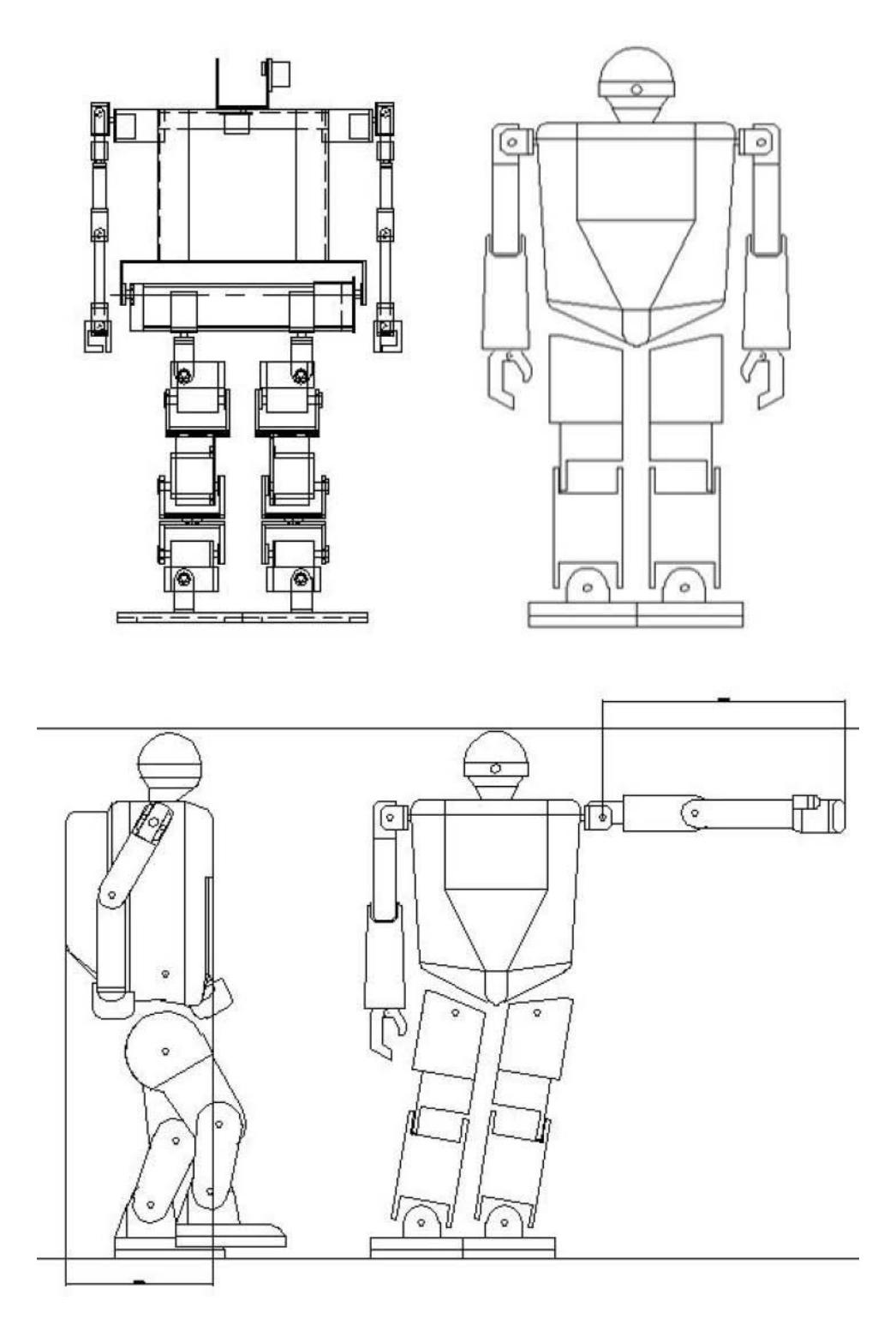
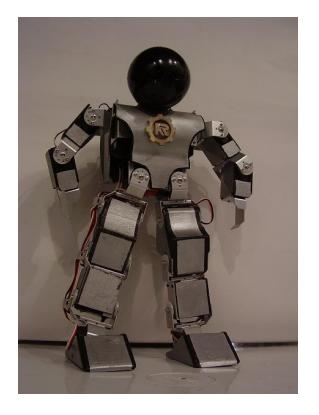
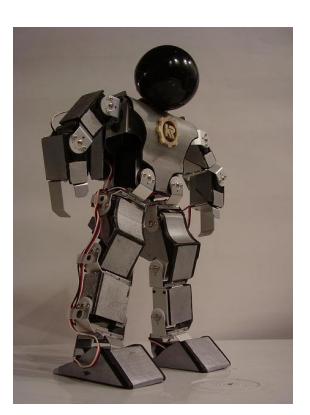
Fig.1. shows our soccer robot, NiciCO. NiciCO includes motion mechanism, Shooting and dribbling mechanism. This is designed to have a multi-purpose capability. This robot is equipped with Industrial control board, omni-directional vision sensor, other balancing sensors, microcontroller boards, servo motors and etc. Fig. 2 shows picture of the robot.
Central Processing Unit
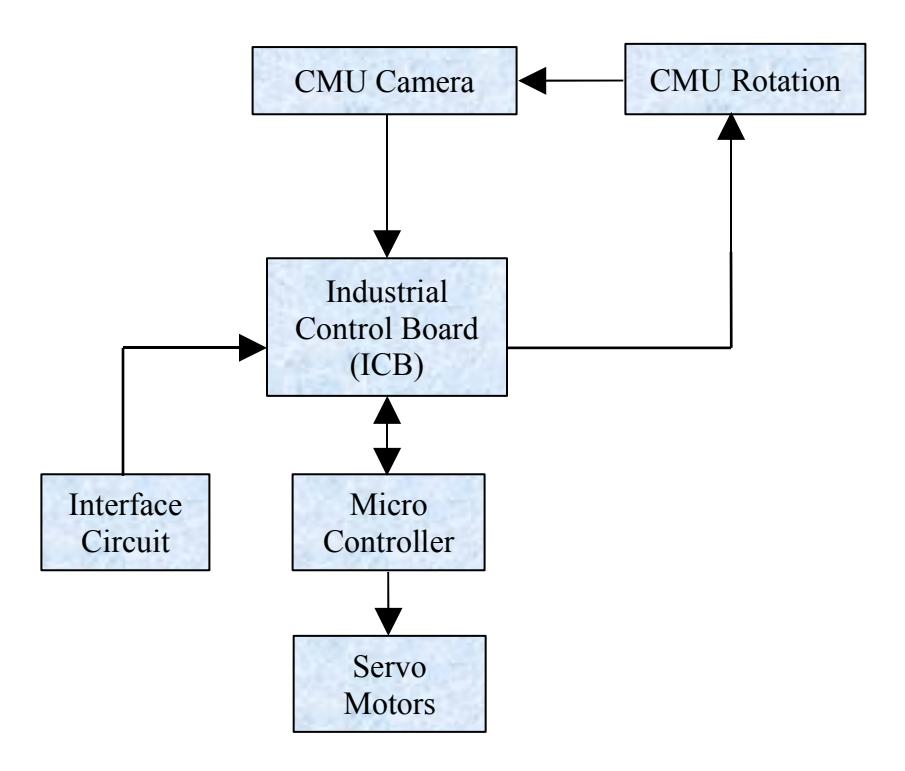
The central processing system of NiciCO is an industrial control board (ICB) to make the robot light and consume less power for image processing. Some of image processing procedure is done by CMU's processor. CMU is an advanced camera which has internal hardware image processing unit in order to simplify the task of main image processor which is inside the ICB. We selected an AVR microcontroller with internal Ram as main processor of ICB. Total functions of the robot are controlled by ICB. Fig.3 shows the hardware interaction of NiciCO components.
Microcontrollers
The processing sensor's signal including CMU camera, decision making and ordering high level commands like "walk", "Turn left" or "shoot" are preformed by central ICB. To achieve high level reliability we used two microcontrollers which control walking procedure. Input signals of these microcontrollers come from central processor unit and these small processors interpret the high level commands produced by central unit and generate suitable signals to move robot, control the position of COM to maintain stability and control the view angel of CMU camera.
Actuators
With the aid of 18 servomotors, NiciCO moves smoothly, having 18 degrees of freedom. All servos, equipped with internal position and speed control, have been selected from KONDO Co., which are characterized for maximum torque and minimum weight and minimum size.
Vision
A CMU camera has been connected to the ICB directly. Detection of ball, goals and other markers are performed by interaction of CMU and ICB, developed by our own team. In this year we equipped our robot to "CMU cam2" which has a good characteristic and suitable for robotic applications. Some of manifest characteristics CMU cam2 are [3]:
- Track user defined color blobs at up to 50 Frames Per Second (frame rate depends on resolution and window size settings)
- Track motion using frame differencing at 26 Frames Per Second
- Up to 176 x 255 Resolution
- Find the centroid of any tracking data
- Gather mean color and variance data
- Gather a 28 bin histogram of each color channel
- Process Horizontally Edge Filtered Images
- Transfer a real-time binary bitmap of the tracked pixels
So we can have a real time image processing procedure using these utilities.
Power supply
A 3.7 V, 4Ah batteries has been used for supplying ICB, microcontroller and a 6V, 600mA battery as the power supply of servo motors.
Specifications
We can finalize the hardware specifications of NiciCO as follows:
Name of robot: NiciCO
Height: 43 cm
Width: 18 cm
Walking/running speed: 0.45 m/s
Number of degrees of freedom (DOF): 18
Actuators: We have used 18 servo motors which have similar chracteristics as follows:
Manufacturer, model: KONDO, KRS-768 ICS
Size: 41x35x21 cm
Torque: 8.7 Kg/cm
Speed: 0.17 sec / 60 degree
Sensors: As mentioned above (Section 2.5)
Processing boards:
Manufacturer, model: Atmel, ATMega 128
Speed: 16 MHz
Software Architecture
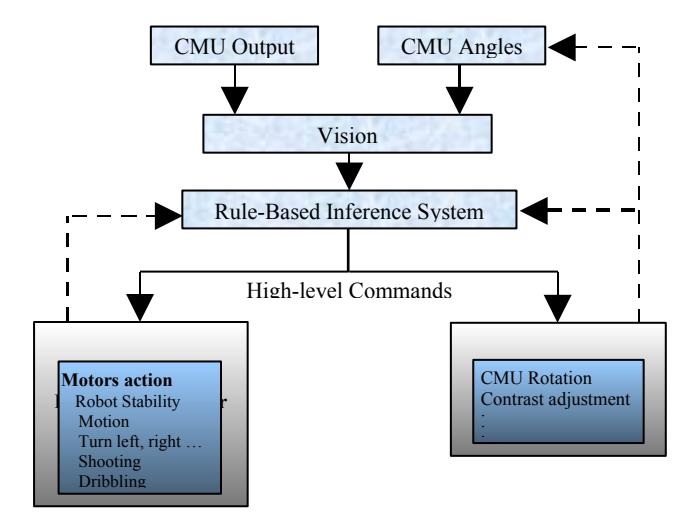
The software of NiciCO is divided into 4 task-oriented modules which are vision, rule-based inference system, (RBIS) behavior control and CMU controlling. Fig.4. shows the software relational NiciCO components. Fig.4. shows the software relation NiciCO components.
Vision
The vision module receives two low level inputs which are the raw image from the robot's camera and state angles from the robot motor controllers of the heads. The output of vision module includes a list of relevant game field objects which recognized into the color image, and is transmitted to the rule-based interface system module. For each detected object an estimate of their camera–relative and robot-relative coordinates are provided. Some of image processing procedures are done by CMU camera. Therefore, this year our robot has drastic changes compared to Robocop 2005.
Rule-Based Inference System (RBIS)
RBIS module receives information from the vision, behavior control and CMU controller modules and process them using a set of rules. This module is the main section of software. We have tried to design RBIS as an advanced system using artificial intelligent (AI) and fuzzy techniques [4]. The proposed rules for RBIS have been turned by various experiences and they are independent of game field conditions. The output of this module is a set of high level commands that send to Behavior control and CMU controller modules. Some of high level commands which are produced by RBIS module are:
- Go to ball with some orientation
- Shooting ball
- Turn camera's view angle with some orientation
Behavior Control
This module receives information (high level commands) as a code from RBIS module and robot stability information from related sensors. Here, we have used a microcontroller. Total functions about Robot Behavior such as stability motors actions, shooting, dribbling, motion and etc are controlled in this section.
CMU Controller
Controlling of the CMU camera is performed by ICB. This module receives information from RBIS module and controls the camera's view angle. Also it is possible to adjust the contrast and other camera parameters in the same way.
Conclusions
In this paper, we present the details of NiciCO robot. We have implemented a rule-based inference system as an advanced system to increase robot flexibility and by the aid of CMU camera and its helpful internal image processing unit our main processor has less tasks to do, so total power consumption and weight are decreased; making the robot more stable and reliable as the result of our researchs. With respect to our pervious work, in this year we prepare an improved robot. Also, we are working on the hardware simulation of human pelma.
References
[1] H. Nezamabadi-pour, M. Iranmanesh, M. Alavi, M.Nikouie Mahani, S.R. Ataee, H.H. Rezaei, M. Arabnezhad, P. Hosseini, " Persia B Team Description 2005 Robocup ",The International Symposium and Competitions on Robocup, Osaka Japan, 2005. [2] http://www.atmel.com/ [3] http://www.cs.cmu.edu/~cmucam2/index.html [4]. J.S.R.Jang, C.T.Sun and E.Mizutani, Neuro-Fuzzy and soft computing, Prentic-Hall, 1997.