Team Description 2006 for Team RO-PE A
Chew Chee-Meng, Samuel Mui, Lim Tongli, Ma Chongyou, Estella Ngan
National University of Singapore
Abstract This paper is a brief description of one of a series of kid-size robots, RO-PE-V, developed by the RO-PE research team of the Legged Locomotion Group in the National University of Singapore. Technical details on its design philosophy as well as the hardware and software implementation are provided. Comparisons with previous generations of robots in this series are made to highlight the various improvements in RO-PE-V.
1 Introduction
RO-PE (RObot for Personal Entertainment) is an ongoing humanoid robot project by the Legged Locomotion Group (LLG) from Control & Mechatronics Lab (COME Lab) of National University of Singapore (NUS). In tandem with the growing interest in humanoids amongst the robotics research community in recent years, this project was initiated in 2001 with the aim of building a series of small humanoid robots (so far, we have RO-PE-I through RO-PE-V) which acts as a test bed for research in bipedal walking and artificial intelligence. Results of our RO-PE research team have thus far been highly encouraging. In 2004, RO-PE-II made its maiden appearance in the RoboCup humanoid league. It was ranked 5th overall and 2nd in the H80 Category, among 13 participating robots. Since then, RO-PE can boast of many other achievements including being ranked 2nd in Penalty Kick and overall 3rd in the kid size category in RoboCup 2005, with each generation of robot exhibiting greater dexterity and intelligence. This year's promising line up for RoboCup will include the brand new and improved RO-PE-V. With much blood, sweat and innovation poured into the tweaking and building of the robots, RO-PE is set to break new grounds and set its own new high in this year's competition.
2 SPECIFICATIONS OF RO-PE-V
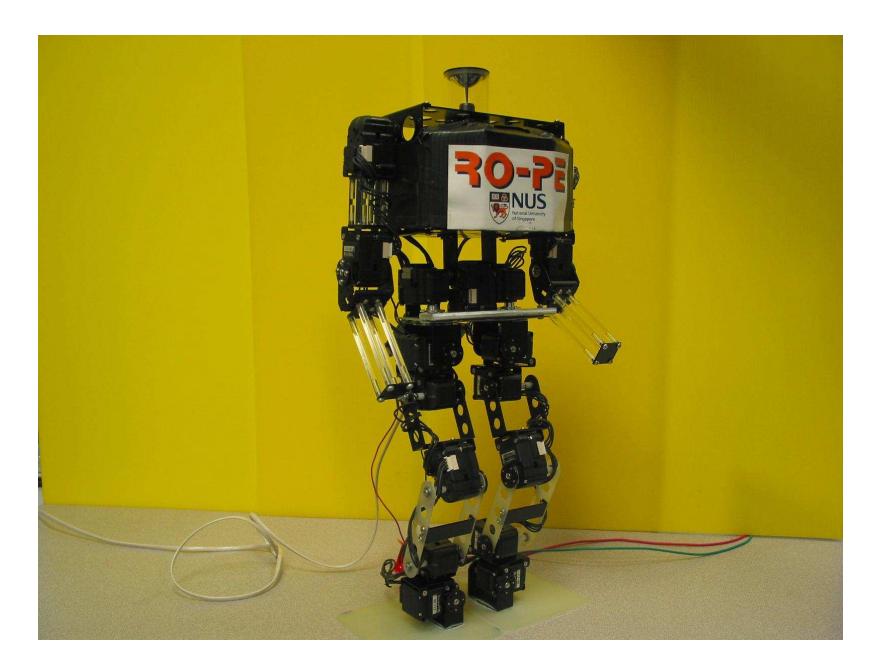
RO-PE-V is a fully autonomous humanoid with 17 degrees of freedom. Like many other robots [1]-[2], it has six degrees of freedom on each leg, anything less that that would deny the robot from achieving some basic human actions [3]. It weighs 2.9kg and has a physical height of 53cm. The main structure of RO-PE-V consists of both aluminum alloy and G-10 glass-epoxy laminates, together with motors purchased from Robotis. Fig. 1 shows RO-PE-V in its standing position.
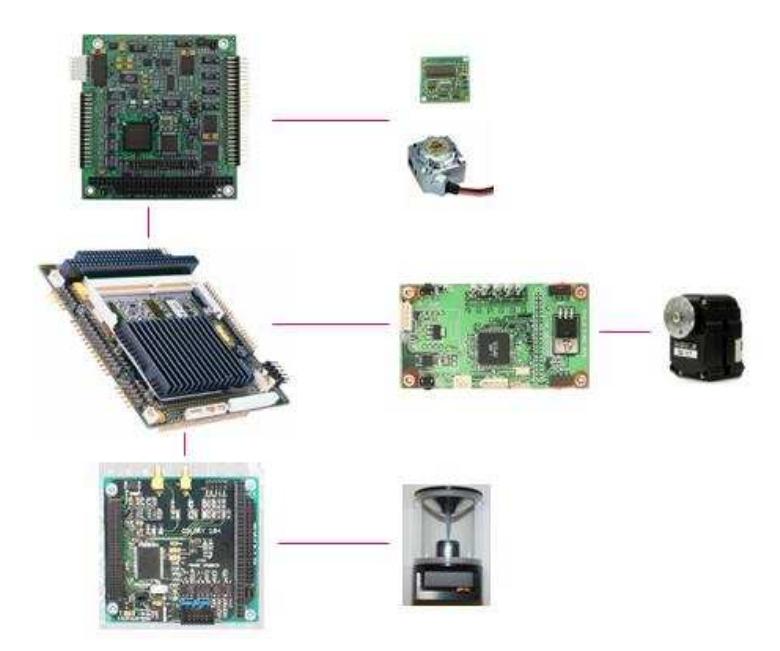
For a robot to be fully autonomous, it has to contain its own processing unit and sufficient sensors to identify the surroundings. The primary sensor for RO-PE-V is its omni-directional vision system purchased from Vstone, which allows the robot to see in 360 degrees without the help of any actuators at the neck of the robot. Fig. 2 shows the components on RO-PE-V while Fig. 3 shows the connections between these components.
3 RESEARCHES THROUGH RO-PE-V
RO-PE-V is a humanoid built by the LLG as a platform for research on multiple areas. These areas include mechanical design, machine vision, walking gaits generation and motor control.
3.1 Mechanical Design - Material
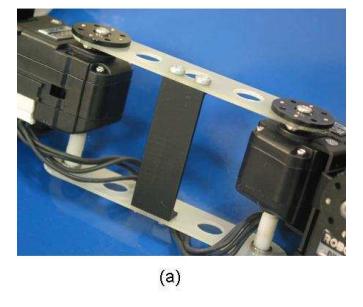
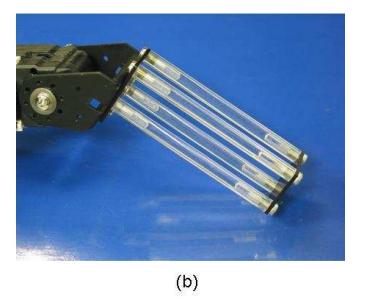
One of the main differences in the mechanical design of RO-PE-V compared to the rest of the robots in the RO-PE series is the use of materials other than aluminum alloy. More specifically, G10 plates and Perspex rods are used. The key advantage in using G10 and Perspex instead of aluminum alloy is the reduction in weight. However, the trade off is that the strengths of these two materials are not as good as aluminum alloy. Also, for G10 plates, bending and screwthread tapping are not feasible. This would thus limit the design of the robot.
As such, G10 and Perspex are only employed at locations where the strength of the material is not critical or could be reinforced by other means. Table 1 compares the key properties of these three materials while Fig. 4 shows the use of G10 and Perspex on RO-PE-V.
Table 1. Components on RO-PE-V.
| Aluminum Alloy | G10 (Glass-epoxy laminates) | Perspex | |
|---|---|---|---|
| Density (Kg/m³) | 2700 | 1800 | 1200 |
| Tensile Strength (MPa) | 400 | 310 | 69 |
3.2 Machine Vision
A lot of focus is placed on the robot's vision. This is the first time our team is working on an omni-directional vision system.
Hardware
The omni-directional vision system is of the model VS-C14N, purchased from Vstone Corporation, Japan. The image captured by an attached CCD camera is passed to a frame grabber to be digitized before further processing. The frame grabber purchased is of the model Colory, from Arvoo, the Netherlands.
Image Processing
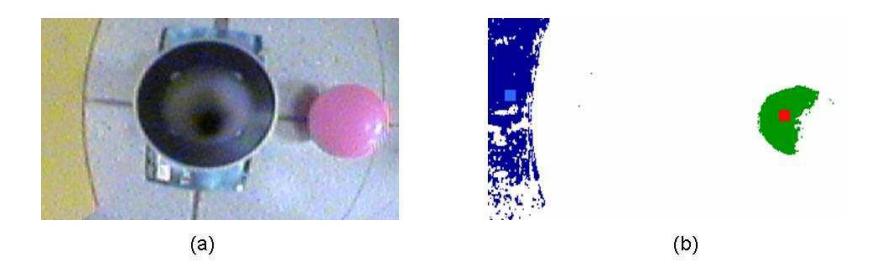
After the image is passed to the frame grabber, it is converted from the analog format to the digital format via the ADC (Analog Digital Converter). After obtaining the digitized image, further processing can take place. In the Robocup competition, it is essential for the robot to be able to track certain distinctive colours to distinguish structures such as that of the ball and the goal post. To do this, the digitized image is scanned from left to right and top to bottom to search for the specified colour value. The colour model used is in the RGB format. Given a range of values for R, G and B respectively, specified colours can be detected. Instead of the ability to detect only 1 colour as with the former CMU (Carnegie Mellon University) camera, multiple colour tracking is now possible. This gives the robot greater flexibility to detect objects such as the ball and the goal post simultaneously. After detecting the desired colours, further processing is done to retrieve the centroid value. This is calculated to be the central value of the threshold image. Returning a value of the centroid to the robot will allow necessary motors to be triggered for further action. Similarly, multiple centroid values can be returned to allow the robot to detect multiple objects at the same time. Fig. 5 shows the original image from the camera and the processed image with two centroids identified.
Given the nature of the omni-directional image, the obvious tendency would be to use polar coordinates to determine the position and direction of the desired object. Using the x and y coordinates of the calculated centroid, theta and r of the polar coordinates can be calculated using the following formulae:
$$r = \sqrt{x^2 + y^2}$$
$$\theta = \tan^{-1} \frac{y}{x}$$
With the value of theta, the robot is able to identify the direction in which the ball is located. r is only able to give a rough gauge of the distance of the ball as the omni-directional image is not linear in nature, but distorted.
3.3 Motor Control
Unlike its predecessors, RO-PE-V employs a new type of actuator that is able to feedback to the computer system several states of the motor, which include the motor's position and torque. RO-PE-V's movements are controlled with the help of these information.
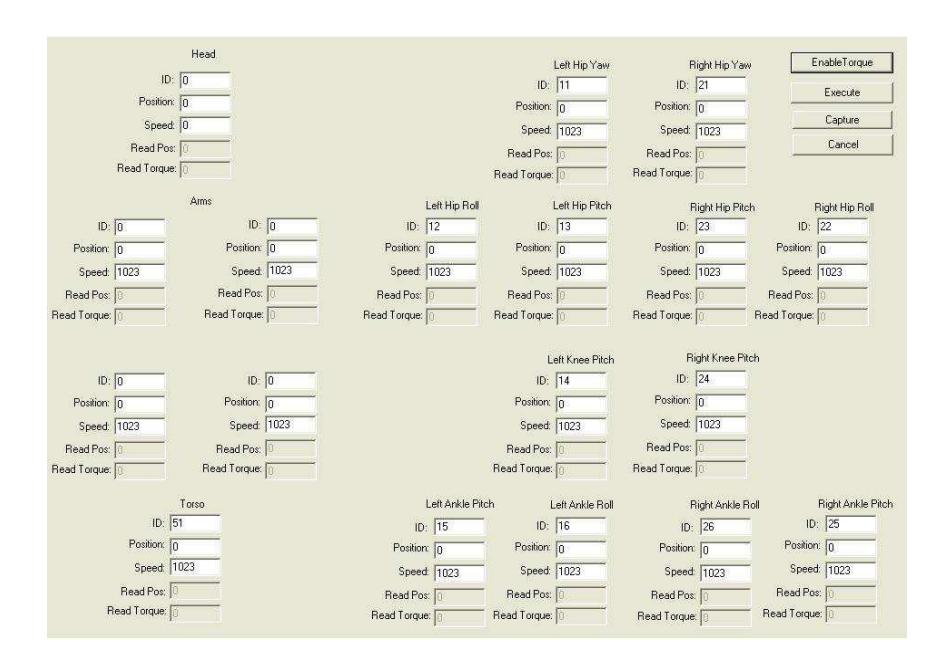
To obtain feedbacks from the motors more conveniently, LLG has developed its own user friendly software, 'DX-Control', using Microsoft Visual C++. With 'DX-Control', all the joints on RO-PE-V can be controlled independently. This program not only allows users to enter individual motor's desired position, it also reads and displays the position and torque feedbacks from all the motors which are then used for calibration and RO-PE-V's movements control. Fig. 6 shows the user interface of 'DX-Control'.
4 CONCLUSIONS
Significant improvements are made in the latest generation robot of the RO-PE series. These include the introduction of lighter materials (for weight reduction) and a new vision machine capable of 360 degrees viewing and the simultaneous identification of multiple objects (for greater vision flexibility). A new userfriendly program which enables the independent control of every joint was also developed. With the help of position and torque feedback provided by the program, calibration and movement control is greatly simplified. The reduction in time consumption of these activities will allow for more focused and in-depth research and development in other interesting and important aspects of humanoid engineering.
References
- K. Hirai, M. Hirose, Y. Nakamura, and T. Takenaka: "The Development of Honda Humanoid Robot," in Proc. IEEE Int. Conf. Robotics and Automation, 1998, pp. 1321-1326.
- T. Ishida, Y. Kuroki and J. Yamaguchi: "Mechanical Systems of a Small Biped Entertainment Robot," in Proc. IEEE Int. Conf. Intelligent Robots and Systems, 2003, pp. 1129-1134.
- L.S. Tay: "Design and Fabrication of a 3D Bipedal Robot," B. Eng. Thesis, National University of Singapore, Singapore, 2003.