UChile RoadRunners 2009 Team Description Paper
Javier Ruiz-del-Solar, Isao Parra, Luis A. Herrera, Javier Moya, Daniel Schulz, Daniel Hermman, Pablo Guerrero, Javier Testart, Paul Vallejos, Rodrigo Asenjo
Department of Electrical Engineering, Universidad de Chile
http://www.robocup.cl/humanoid.htm
Abstract Our robotics group has teams in three leagues: humanoid, SPL, and @home. Taking advantage of this, we want to contribute to the transfer of relevant developments between the different RoboCup leagues. Our developments for the humanoid league include: (i) the design and construction of a new (hardware) controller to be used in our 3 robots, (ii) the construction of an innovative battery protection hardware, (iii) a new methodology for designing fall sequences that diminish the damage in the robot's joints, and (iv) the proposition of new methodologies to be used in the vision system of our robots (task oriented active vision and context-based perception).
Introduction
The UChile robotics team is an effort of the Department of Electrical Engineering of the University of Chile in order to foster research in robotics [1]. The main motivation of the team is the participation in international robotics contests that provide standard problems to be solved, where a wide range of technologies can be integrated and examined. Through the participation in these contests, the team can share knowledge with other research groups, and test the quality of the developed technology. The participation in contests complements other scientific activities of the group (papers' publishing, industrial projects, etc.). The group has also developed several educational programs with children using robots [2].
The UChile team was created in 2002, and it has participated in all RoboCup world-competition with its former four-legged team since 2003. In 2007 and 2008 the group also participated in the humanoid and @home leagues (in the RoboCup world competitions). Among the main scientific achievements of the group, it is worth to mention the obtainment of two important RoboCup awards:
- RoboCup 2004 Engineering Challenge Award for the article "UCHILSIM: A dynamically and visually realistic simulator for the RoboCup four legged league", where our realistic simulator of robots was described; and
- RoboCup 2007 @Home Innovation Award and RoboCup 2008 @Home Innovation Award, which honor outstanding technical and scientific achievements as well as applicable solutions in the RoboCup @Home league, for the development of the personal robot Bender.
As a RoboCup research group, we believe that our contribution to the RoboCup community is not restricted to our participation in the RoboCup competitions, but that we should also contribute with new ideas to the community. In this context, our team has been one of the teams that has presented more articles in the RoboCup symposia since our first participation in 2003. Table 1 summarizes the papers that have been accepted for oral and poster presentations in these symposia. In addition, we have presented soccer-related articles in other conferences and journals (some of these works are available in our website [1]). It is our intention to continue contributing to the RoboCup symposia, by reporting our new developments in the humanoid league.
Table 1. UChile articles in RoboCup Symposia.
| RoboCup Articles | 2003 | 2004 | 2005 | 2006 | 2007 | 2008 | 2009 |
|---|---|---|---|---|---|---|---|
| Oral | 1 | 2 | 1 | 1 | 2 | 3 | 2 |
| Poster | 1 | 1 | 1 | - | 3 | 2 | 0 |
As a group having teams in both, the humanoid and the SPL league, we can build bridges between both leagues, for transferring some of the developments in distributed control of networked robot from the SPL league to the humanoid league. One of the major ideas behind dividing RoboCup soccer among several leagues was to address specific problems in each league, which later could benefit all leagues. In this line of thought, we intend to integrate some of the solutions already developed in the SPL league with the hardware and robot control developments of the humanoid league. Moreover, in the SPL there are high standards of soccer control software, which can also be transferred into the humanoid league. It is important to mention that our SPL team is one of the 16 that already classified for the RoboCup 2008 worldcompetitions.
This year our developments include: (i) the design and construction of a new (hardware) controller to be used in our 3 robots, (ii) the construction of an innovative battery protection hardware, (iii) a new methodology for designing fall sequences that diminish the damage in the robot's joints, and (iv) the proposition of new methodologies to be used in the vision system of our robots (task oriented active vision and context-based perception).
This team description paper is organized as follows. In sections 2 and 3 our hardware platform and software library, are described. Finally, in section 4, some new developments of the team that could be of high interest for the humanoid league, are outlined.
Hardware
Our team uses two different robot platforms: modified Hajime HR18 robots as field players, and the UCH H1 robot as goalie player. We have made two main modifications to the HR18 robot: (i) we have replaced the original Hajime controller by a controller based on the TMS320F28335 DSP (see figure 2), and (ii) we have included a battery protection and balance circuitry. Both hardware modules have been completely designed and constructed by ourselves. The UCH H1 robot has also been designed and built in our lab. We are using a Fujitsu Siemens n560 Pocket PC running Windows Mobile as main processor, and a Philips ToUCam III - SPC900NC camera as main visual sensors for the robots. The technical specifications of our hardware components are shown in table 2.
The development of an own low-level controller for our robots (see figure 2) was intended to have a more powerful and flexible platform for controlling the motors. Main advantages of this new controller are: higher processing speed than previous platform (150 Mhz), better synchronization between low-level and high-level motion orders, availability of a debugging interface, DSP advantages, and availability of 3 different buses (RS-485 multi-drop) for controlling and reading information from motors.
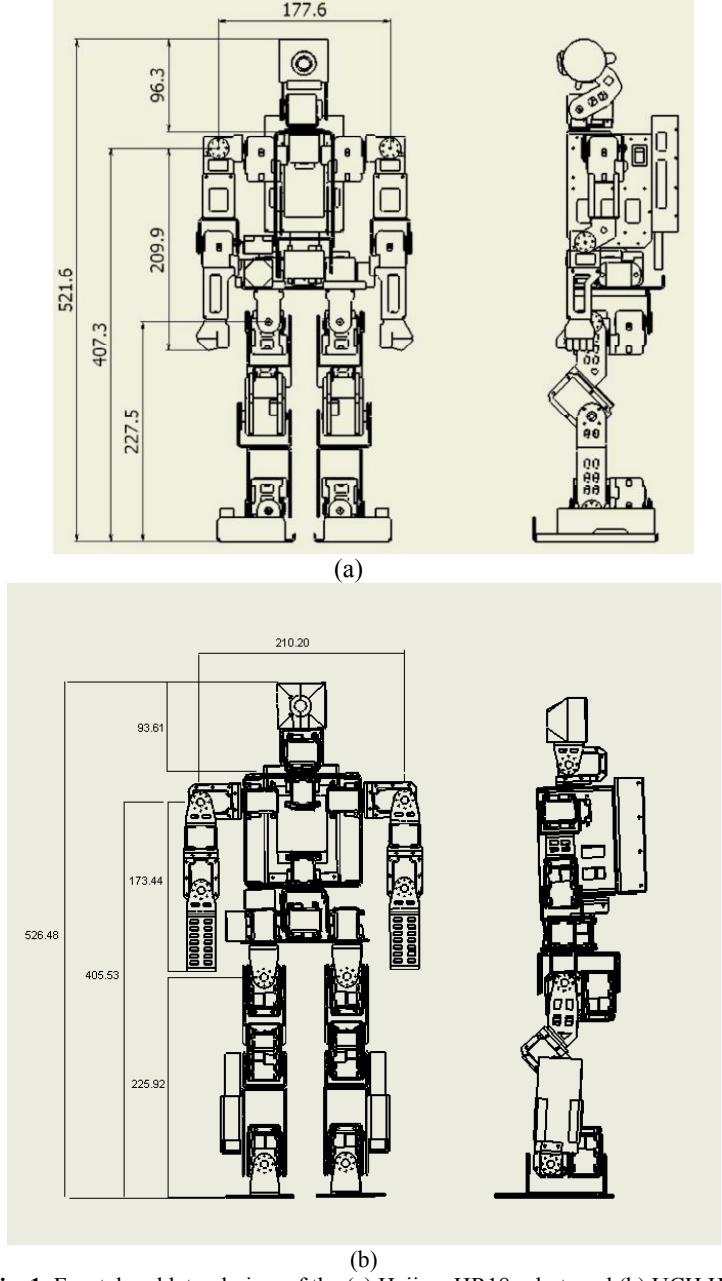
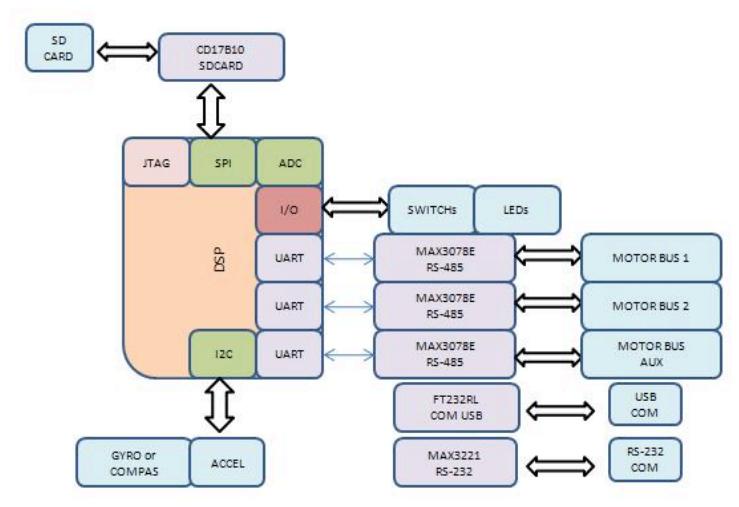
Table 2. Hardware specifications.
| Player | Field Players (2) | Goalie Player (1) |
|---|---|---|
| Robot | Hajime HR18 | UCH H1 |
| Height | 522 mm | 526 mm |
| Weight | 3.3 kg | 3.04kg |
| Servo Motors | 18x DX-117 | 22x RX-28 |
| Dynamixel Robot Actuator | 3x RX-64 | |
| Degrees of freedom | 21 | 22 |
| leg: 6x2 | leg: 6x2 | |
| arm: 3x2 | arm: 3x2 | |
| waist: 1 | waist: 2 | |
| neck: 2 | neck: 2 | |
| Batteries | 2x Li-Po 7.4V, 1500mAh | 2x Li-Po 7.4V, 1500mAh |
| Internal Sensors | ||
| Joint Angle Encoder | 21 | 22 |
| Accelerometer | Crossbow, CXL04LP3, 3 axes, rate 10 ms | Triple Axis Accelerometer - LIS3LV02DQ |
| Gyroscope | SSSJ, CRS03-04, 3 axes, rate 10 ms | SSSJ, CRS03-04, 3 axes, rate 10 ms |
| Camera | Philips ToUCam III - SPC900NC | Philips ToUCam III - SPC900NC |
| Sensor | CCD | CCD |
| Interpolated snapshot resolution | 1.3 Mpixels | 1.3 Mpixels |
| Max. frame rate | 90 fps | 90 fps |
| Lens | F2.2, D55° | F2.2, D55° |
| White balance | 2600 – 7600 k | 2600 – 7600 k |
| Min. illuminance | < 1 lux | < 1 lux |
| Colour depth | 24 bit | 24 bit |
| PC Link: | USB 1.1 | USB 1.1 |
| Control | Autonomous at frecuency 10 ms | Autonomous at frecuency 10 ms |
| Internal Controller | 32bit DSP TMS320F28335 150MHz | 32bit DSP TMS320F28335 150MHz |
| Pocket PC | Fujitsu Siemens Pocket LOOX N560 | Fujitsu Siemens Pocket LOOX N560 |
| Processor | Intel® PXA270 624 MHz based on Intel® XScale™ microarchitecture | Intel® PXA270 624 MHz based on Intel® XScale™ microarchitecture |
| Memory | System memory (RAM) 64 MB, Flash memory (ROM) 128 MB | System memory (RAM) 64 MB, Flash memory (ROM) 128 MB |
| Wireless LAN | Integrated, 802.11 b/g | Integrated, 802.11 b/g |
| Bluetooth V1.2 | Integrated | Integrated |
| Operating system | Microsoft® Windows MobileTM 5.0 Premium Edition | Microsoft® Windows MobileTM 5.0 Premium Edition |
| Interfaces | 1x built-in microphone, 1x speaker, USB 1.1 (slave) via sync cable, USB 1.1 (host) via sync cable, Serial (RS232) via sync cable, Stereo Audio Out on cradle connector | 1x built-in microphone, 1x speaker, USB 1.1 (slave) via sync cable, USB 1.1 (host) via sync cable, Serial (RS232) via sync cable, Stereo Audio Out on cradle connector |
Software Architecture
As already mentioned, our software architecture is based on the robot control library developed for our four-legged team (see detailed description in [3]), which was ported to Windows Mobile and used in our humanoid robots. The control library is divided into four task-oriented modules: vision, localization, strategy, and motion control (actuation). The vision and motion control modules operate in each robot locally. The localization module is distributed, it operates in each robot, and a global estimate of the overall ball localization is generated in a distributed fashion. The strategy module is also distributed; it allows the sharing of global information among the robots. In our current implementation (Windows Mobile) these four task-oriented modules run, in each robot, in two different processing platforms: the Fujitsu Siemens n560 Pocket PC (vision, localization, and strategy) and our new hardware controller (motion control). The modules running in the pocket PC are implemented using Windows threads. The main features of our software library are described in our 2008's TDP [4].
New developments of potential high interest for the Humanoid League
The management of falls – e.g. how to avoid an unintentional fall, how to fall without damaging the body, how to achieve fast recovering of the standing position after a fall - is an essential ability of good soccer players. Given the fact that one of the RoboCup main goals is allowing robots to play soccer as humans do, the correct management of falls in legged robots, especially in biped humanoid robots, which are highly unstable systems, is a very relevant matter. However, to the best of our knowledge this issue has almost not been addressed in the RoboCup community. Having this motivation, we have developed a methodology for the analysis and design of fall sequences of robots that minimize joint/articulation injuries, as well as the damage of valuable body parts (cameras and processing units). These fall sequences can be activated/triggered by the robot in case of a detected unintentional fall or an intentional fall, which are common events in humanoid soccer environments. The idea is to take control of the fall, as soon as the robot detects it. The proposed methodology is human-based and requires the use of a realistic simulator, as a development tool. This methodology has been validated in simulated and real humanoid robots [5][6].
A mobile robot has always some degree of uncertainty about its world model. The reduction of this uncertainty is very hard, and depends on the tasks that the robot is accomplishing. This is especially true in robot soccer where the robot must pay attention to landmarks in order to selflocalize, and at the same time to the ball and robots in order to follow the status of the game. In [7], an explicitly task oriented probabilistic active vision system is proposed. The system tries to minimize the most relevant components of the uncertainty for the task that is been performed and it is explicitly task oriented in the sense that it explicitly considers a task specific value function. As a result, the system estimates the convenience of looking towards each of the available objects. As a test-bed for the presented active vision approach, we selected a robot-soccer attention problem: goal covering by a goalie player.
Robust vision in dynamic environments using limited processing power is one of the main challenges in humanoid robot vision. This is especially true in the case of biped humanoids that use low-end computers (e.g. Pocket PCs). Techniques such as active vision, contextbased vision, multiresolution and sampling are currently in use to deal with these high-demanding requirements. Thus, having as a main motivation the development of robust and high performing robot vision systems that can operate in dynamic environments, we have proposed a spatial-temporal context integration framework that improves the visual perception of a mobile robot [8][9]. This framework considers the coherence between current detections and (i) past detections, (ii) the physical context, (iii) a holistic characterization of the image, and (iv) a so-called situation context. In addition a bayesian model that integrates all these information sources is included. We have chosen as a first application of this context integration framework the detection of static objects in the RoboCup SPL and Humanoid leagues. The proposed system has been validated using real video sequences.
Acknowledgements
This research was partially supported by FONDECYT (Chile) under Project Number 1090250.
References
[1] UChile Official Website: http://www.robocup.cl/ [2] Ruiz-del-Solar, J., and Aviles, R. (2004). Robotics Courses for Children as a Motivation Tool: The Chilean Experience. IEEE Trans. on Education, Vol. 47, Nº 4, 474-480, Nov. 2004. [3] Ruiz-del-Solar, J., Guerrero, P., Palma-Amestoy, R., Arenas, M., Dodds, R., Marchant, R., Herrera, L.H.. (2008). UChile Kiltros 2008 Team Description Paper, RoboCup Symposium 2008, July 15 – 18, Suzhou, China (CD Proceedings). [4] Ruiz-del-Solar, J., Vallejos, P., Parra, S., Testart, J., Asenjo, R., Hevia, P., Vélez, C., Larraín, F. (2008). UChile RoadRunners 2008 Team Description Paper, RoboCup Symposium 2008, July 15 – 18, Suzhou, China (CD Proceedings). [5] Ruiz-del-Solar, J., Palma-Amestoy, R., Vallejos, P., Marchant, R., Zegers, P. (2009). Designing Fall Sequences that Minimize Robot Damage in Robot Soccer. Lecture Notes in Computer Science 5399 (RoboCup Symposium 2008) pp. 271-283. [6] Ruiz-del-Solar, J., Palma-Amestoy, R., Marchant, R., Parra-Tsunekawa, I., and Zegers, P. (2009). Learning to Fall: Designing Low Damage Fall Sequences for Humanoid Soccer Robots. Robotics and Autonomous System (Special Issue on Humanoid Soccer Robots), (in press). [7] Guerrero, P., Ruiz-del-Solar, J., Romero, M. (2009). Explicitly Task Oriented Probabilistic Active Vision for a Mobile Robot. Lecture Notes in Computer Science 5399 (RoboCup Symposium 2008) pp. 85-96. [8] Palma-Amestoy, R., Guerrero, P., Ruiz-del-Solar, J., Garretón, C. (2009). Bayesian Spatiotemporal Context Integration Sources in Robot Vision Systems. Lecture Notes in Computer Science 5399 (RoboCup Symposium 2008) pp. 212-224. [9] Ruiz-del-Solar, J., Guerrero, P., Palma-Amestoy, R. (2008). Context Integration in Humanoid Robot Vision. Proc. Cognitive Humanoid Vision Workshop, in Humanoids 2008, Daejeon, Korea, Dec. 1, 2008 (CD Proceedings).