VT DARwIn (Team VT DARwIn)
Jaekweon Han, Robert Schafrik, KyungBok Lee, Dennis Hong, Robert Nguyen
Virginia Polytechnic Institute and State University, Blacksburg, VA 24061, USA
Abstract This paper details the hardware, software, and electrical design of the humanoid robot DARwIn (Dynamic Anthropomorphic Robot with Intelligence)–a robot family designed as a platform for researching bipedal motions. The DARwIn family has been the first and only US entry into the humanoid division of RoboCup.
Introduction
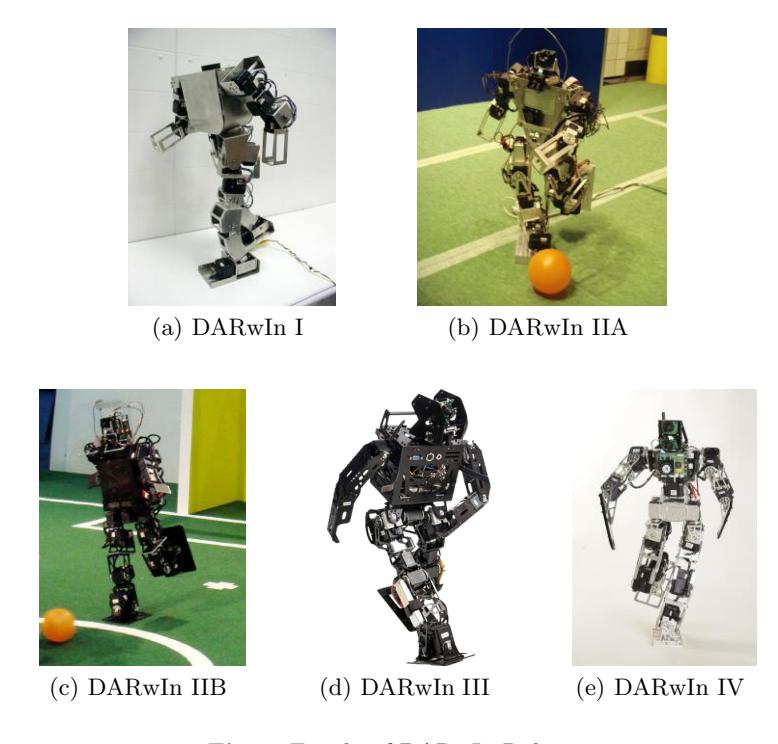
The DARwIn (Dynamic Anthropomorphic Robot with Intelligence) series robot is a family of humanoid robots capable of bipedal walking and performing human-like motions (Fig. 1). DARwIn is a research platform developed at the Robotics and Mechanisms Laboratory (RoMeLa) at Virginia Tech for studying robot locomotion and sensing. It was also utilized as the base platform for Virginia Tech's first entry to the humanoid division of 2007 RoboCup [1, 2].
The 560 mm tall, 3.6 kg robot (the latest version of DARwIn) has 20 degreesof-freedom (DOF) with each joint actuated by coreless DC motors via distributed control with controllable compliance. Using a computer vision system and accelerometer, DARwIn can implement human-like gaits while navigating obstacles and will be able to traverse uneven terrain while implementing complex behaviors such as playing soccer.
The first version of the robot series was DARwIn I (Fig. 1(a)). The objective of DARwIn I was to investigate the possibility of designing and fabricating a small scale humanoid robot to walk with two legs, while keeping the robot within human proportions, range of motion, and kinematic configuration. The next version, DARwIn IIa (Fig. 1(b)), based on the concept of DARwIn I, was enhanced by adding sensors and intelligence to be able to operate autonomously. DARwIn IIb (Fig. 1(c)) improved on its predecessor by adding more powerful actuators and modular computing components. DARwIn III (Fig. 1(d)) was designed in order to develop an affordable, low cost version with a focus on ease of manufacturing so that the robotics community will be able to use it as an open humanoid robot platform for education and research. DARwIn IV is designed for performance in the RoboCup competition.
Research
The DARwIn family serves as a research platform for studying dynamic gaits and walking control algorithms. With few exceptions (i.e. the Honda ASIMO, the Sony QRIO, and the KAIST HUBO [3–7]), most legged robots today walk using static stability criterion. The static stability criterion is an approach to prevent the robot from falling down by keeping the center of mass of its body over the support polygon by adjusting the position of its links and pose of its body very slowly to minimize dynamic effects [5]. Thus at any given instant in the walk, the robot could "pause" and not fall over. Static stability walking is generally energy inefficient since the robot must constantly adjust its pose in such a way to keep the center mass of the robot over its support polygon, which generally requires large torques at the joint actuators (similar to a human standing still with one foot off the ground and the other supporting leg's knee bent). Humans naturally walk dynamically with the center of mass rarely inside the support polygon. Thus human walking can be considered as a cycle of continuously falling and catching its fall; a cycle of exchanging potential energy and kinetic energy of the system like the motion of an inverted pendulum. Humans fall forward and catch themselves with the swinging foot while continually progressing forward. This falling motion allows the center of mass to continually move forward, minimizing the energy that would reduce the momentum. The lowered potential energy from this forward motion is then increased again by the lifting motion of the supporting leg.
One natural question that arises when examining dynamic walking is how to classify the stability of the gait. Dynamic stability is commonly measured using the Zero Moment Point (ZMP), which is defined as the point where the influence of all forces acting on the mechanism can be replaced by one single force without a moment term [8]. If this point remains in the support polygon, then control its motion by applying force and/or torque to the ground. Once the ZMP moves to the edge of the foot, the robot is on the verge of stability and can do nothing to recover without extending the support polygon (planting another foot or arm). Parameterized gaits can be optimized using the ZMP as a stability criterion or stable hyperbolic gaits can be generated by solving the ZMP equation for a path of the center of mass. Additionally, the ZMP can be measured directly or estimated during walking to give the robot feedback to correct and control its walking. DARwIn is developed and being used for research on such dynamic gaits and control strategies for stability [5, 9].
Hardware
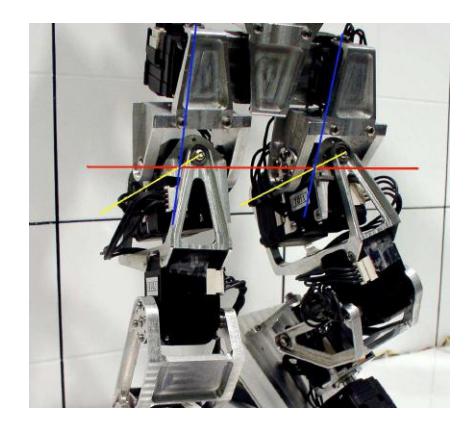
Since the results of testing and experimentation using DARwIn would be compared with actual human data, it was necessary to design the robot to physically mimic a human as closely as possible. Using human proportion data, DARwIn IV's links were designed to be in proportion to its height, and its joints designed to follow the range of motion of an average male human. Many humanoid robots being developed at research labs today and/or marketed as hobbyist toys are often made just to "look" like a human. However, great care was taken to design DARwIn IV's proportions to be nearly identical to that of a human's. Not only is DARwIn IV scaled similarly in dimension, its primary joints are kinematically equivalent in range and motion to those of humans. For instance, humans have a ball and socket joint at the shoulders and hips, allowing three axes of rotation about a single point. Although DARwIn does not have a ball and socket joint, it approximates the kinematics with three motors' axes of rotation nearly intersecting at a single point (Fig. 2)– making it approximately a ball and socket joint. Not only does this make the kinematic configuration closer to a human's, it also simplifies the mathematics involved in creating and controlling the motion of the robot.
DARwIn IV has 20 degrees of freedom (six in each leg, three in each arm, one in the waist, and one in the head). The robot's links are fabricated out of aluminum. The robot uses Robotis' Dynamixel EX-106, RX-64, and RX-28 motors for the joints [10]. The motors operate on a serial RS485 network, allowing the motors to be daisy chained together. Each motor has its own built-in potentiometer (with the exception of the EX-106 which has an optical encoder) and position feedback controller, creating distributed control. The computers, sensors, electronics, and computer ports are distributed about DARwIn's upper torso.
Electronics
DARwIn IV's electronic system provide power distribution, communication buses, computing platforms, and sensing schemes aimed at making sense of a salient environment. DARwIn's power is provided by two 8.2V (nominal) lithium polymer batteries wired in series providing a total of 16.4V to the joint actuators and electronics. These batteries provide 2.1 Ah, which gives DARwIn a little over 10 minutes of run time.
DARwIn's computing architecture is designed to use a distributed control scheme. Two 600 MHz Gumstix Verdex Pro XL6P with 128 Megs of RAM provide high-level behavior and path planning, running under OpenEmbedded OS. Ethernet and Wireless communication are used for behavior and motion planning and control. Serial communications (RS485 and RS232) are used for the motor control. The 3-axis IMU/compass communicating via the RS-485 bus allows the robot to detect which direction it is facing and whether it is falling.
Two custom cameras, attached to a panning head, were designed to be used with the DARwIn IV robots. This vision system, named 'VT-Cam', uses a 600 MHz dual core Blackfin DSP chip which receives image information (768x506 pixel) from a pair of HDR (High Dynamic Rage) custom CMOS sensors at a frame rate of up to 60 frames per second. Each of the processor cores execute several object recognition algorithms that are optimized for embedded systems. These algorithms use concurrent detection of HSI color LUT with edge information in order to perform object tracking, object classification, and localization. The VT-CAM consumes less than 200mW and has physical dimensions of 75x55 mm. The system can handle a wide range input power (8-45 V), can communicate over a variety of communication buses (Ethernet, RS485/232, USB, CAN) and has many additional features such as voice synthesis.
Software
DARwIn IV uses a software architecture which utilizes a distributed hierarchical behavior-based control scheme for high level behaviors, such as playing soccer autonomously. Once generalized motor controls are developed and tested, they can be combined into sequences of motor controls to create motion. These motion sequences can then be declared a behavior. Several behaviors can be combined serially, or in parallel, resulting in higher-level behaviors.
Vision processing is performed on a dedicated DSP. Various algorithms run concurrently to detect the ball position, player positions, and perform DARwIn localization. The DSP collects images from two high-dynamic range cameras. After processing these images in parallel, the resulting positions and location are communicated to the behavior modules.
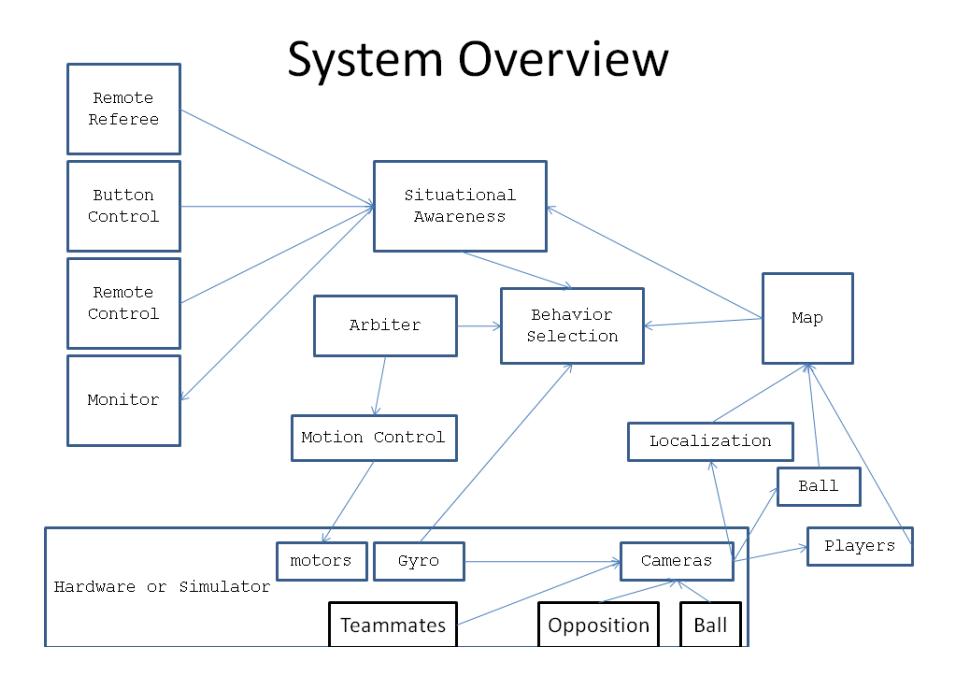
The overall software architecture of DARwIn IV is illustrated below in Fig. 3.
DARwIn IV's system architecture pushes low-level responsibilities down to the sensing or actuating components. This frees up the computing resources to focus on the larger picture, or the situational awareness. For instance, there are no PID control loops in the behavior modules. Each physical motor manages its own position, velocity, and torque. The camera does not send images to the behavior modules, it sends the position of the ball, other robots, or localization information. This distribution allows experts in image processing, localization, SPOI, or other fields to develop and test their algorithms independently of the behavior selection.
Conclusion
The combination of DARwIn's hardware, electronic, and software design should prove to be very powerful and make DARwIn a formidable opponent at RoboCup while still maintaining its primary purpose as a research platform for studying robot humanoid motions. Building on previous research and RoboCup experience, DARwIn IV represents the evolution of hardware and software.
References
- D. Hong. Biologically inspired locomotion strategies: Novel ground mobile robots at romela. 3rd International Conference on Ubiquitous Robots and Ambient Intelligence, Seoul, S. Korea, October 2006.
- K. Muecke and D. Hong. Darwin's evolution: Development of a humanoid robot. Proc. IEEE/RSJ Int. Conf. on Intelligent Robots and Systems, pages 2574–2575, October-November 2007.
- K. Hirai. The development of honda humanoid robot. IEEE Int. Conf. on Robotics nd Automation, (Leuven, Belgium):1321–1326, 1998.
- T. Ishida. A small biped entertainment robot sdr-4x ii. Proc. IEEE Symposium on Comp. Intelligence in Robotics and Automation, pages 1046–1051, July 2003.
- J. Kim. On the Stable Dynamic Walking of Biped Humanoid Robots. PhD Thesis, Korea Advanced Institute of Science and Technology, Daejeon, South Korea, 2006.
- et al S. H. Collins. A three-dimensional passive-dynamic walking robot with two legs and knees. Int. Journal of Robotics Research, 20(2):607–615, 2001.
- T. McGeer. Passive dynamic walking. Int. Journal of Robotics Research, 9(2):62– 82, April 1990.
- M. Vukobratovic. Zero-moment point–thirty five years of its life. Int. Journal of Humanoid Robotics, 1(1), 2004.
- Q. Huang, K. Yokoi, and et al S. Kajita. Planning walking patterns for a biped robot. IEEE Trans. on Robotics and Automation, 17(3):280–289, June 2001.
- K. Kim, Y. Son, and P. Kim. Construction of small humanoids with a new joint actuator module. Proc. 2004 IEEE Int. Conf. on Robotics and Automation, pages 4510–4514, April 2004.