Bogobots-TecMTY humanoid kid-size team 2010
Guillermo Villarreal-Pulido, Erick Cruz-Hernández, Alejandro Aceves-López
Tecnológico de Monterrey, Campus Estado de México, Carr. Lago de Guadalupe Km. 3.5 Col. Margarita Maza de Juarez, 52926, Atizapán, México
http://www.lynxmotion.com · http://www.hobbyhorse.com/hitec_servo · http://www.cmucam.org/ · http://www.robot-electronics.co.uk/acatalog/Compass.html · http://www.electrifly.com/
Abstract This paper describes the specifications and capabilities of the humanoid robots developed by the Bogobots-TecMTY Humanoid Team at Tecnologico de Monterrey, Campus Estado de Mexico for Robocup 2010 competition. It presents our current version of robot capabilities in which we are working. The main research of the team focuses on LAN communication between robots, stable and smooth ball-approximation walking engine and robust perception systems.
1 Introduction
The Bogobot-TecMTY research project was started in 2004 at Tecnologico de Monterrey, Mexico. The goal is to have full-autonomous humanoid robots with efficient walking abilities, high-sensitive perceptions systems, multiple manipulationskills and learning-abilities. The team is composed mostly by a group of 15 students from mechatronic major and postgraduate students, supported by faculty members.
In the previous two years, we had the opportunity to participate in the RoboCup 2008 and Robocup 2009 with rewarding results. We learned a lot and we could identify our improvement areas. For that reason, we come again with an improved version of our Bogobot-TecMTY humanoid robots, which main features are the robust mechanical design, a parameterized walking engine, a dedicated processor unit for perception, and a central processor unit for high-level decision.
2 Mechanical-Electronic Design
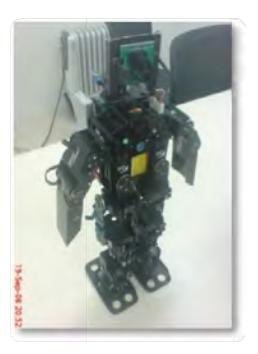
Bogobot-TecMTY kid-size humanoids are built with aluminum brackets. The kinematic chains are powered by high-torque servomotors. Each leg has 6 DOF and each arm has 3 DOF [1]-[2].
To provide tilt and pan motions to our vision system [3], we use an aluminum mechanism powered by two servomotors directly controlled by the camera, providing object tracking independently from leg or arm motions.
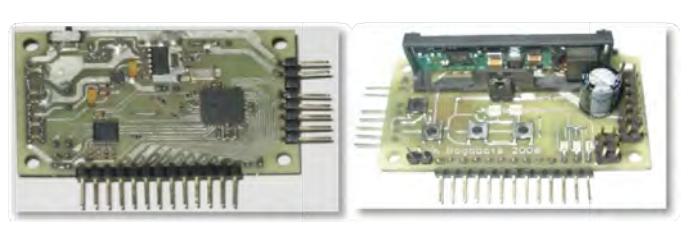
The Bogobot-TecMTY's electronic architecture was custom-built and considers a main processor based on DSPic30f4013 with:
- a PWM servocontroller card communicated by RS232 [1].
- CMUcam3 camera connected by RS232 [3],
- IMU electronic device connected in 5 analog inputs,
- Switched power supply connected to two Lithium-Polymer batteries [5].
The servocontroller card receives all requested angular positions of joints from the main processor and sends electrical PWM signals to servomotors.
Object recognition and ball-tracking are processed on the CMUcam3 camera system and information about recognized object is sent to main processor for decision-making algorithms.
One of our main achievements is the development of a robust mechanical structure that allow Bogobot-TecMTY robot to absorb moderate impacts that normally comes in Robocup games. Robots are continually tested in our lab in conditions similar of humanoid soccer games in order to improve mechanical and electrical designs.
3 Motion algorithms
The movements are implemented in two ways: predefined motion pattern and real-time trajectory computation with inverse kinematics and Zero-moment point algorithms. The first kind is based on interpolated key-frames composed by motor's angles that are off-line specified by programmer and in-line interpolated with numerical methods. This approach is mainly used for instinctive movements like kicks, blocks, recovering from falling down, smooth-walking, or transitions among static-postures. The second kind of movements is based on run-time parametric walking-pattern generator that allows robot to walk in different styles, speeds and directions [6]-[9].
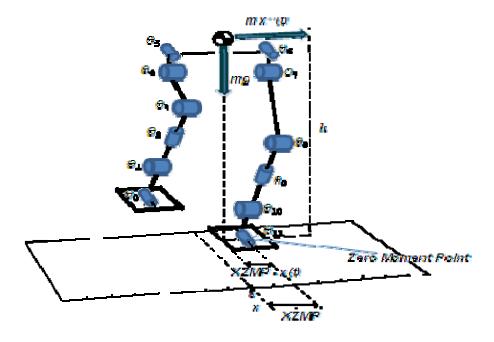
This second kind of movement is performed in 3 steps. The first one consists in compute feet paths keeping global momentum always zero by using ZMP techniques. These ZMP-based trajectories are computed with the projection of the Center of Mass on the XY plane, see Figure 3. The second step is computing the angular position of the leg's servomotors (joints). Fortunately, this can be done very fast because we solved the inverse kinematics analytically. The third step uses information provided by gyroscope unit, which is filtered by a Kalman filter, to compensate angular position of specific servomotor that helps robot to keep itself in standup posture regardless disturbances by unlevel floor, small bumps, and collisions.
Feet trajectories can have different shapes (e.g. rectangle, ellipse, half-ellipse, etc.) and are defined by a set of parameters (e.g. foot center, step height, maximum forward/sideward step size). The phases of the two legs should shifted by half a phase in order to guarantee that one foot is in contact with ground while the other foot is flying over.
With this basic idea, we modeled our robot as being a two-wheeled vehicle where we could vary its direction and speed. This idea proved to be very simple and versatile regarding the kind of walks we could achieve.
2010 Humanoid rules come with some new regulation on robot's dimensions that Bogobot-TecMTY must verify. This forces us to reconsider robot's chest dimension. Therefore all walking abilities should be reviewed.
We are now adjusting all developed algorithms of locomotion to the new mechanical structure in order to guarantee successful walking, kicking and blocking abilities. We are also working on some path planning strategies for better approach the ball given different circumstances and perform different kinds of actions depending on specific situation of robots on the field.
4 Vision algorithms
The vision algorithms of the robots are programmed using the vision system CMUcam3, in which we have programmed features like color segmentation algorithms, object recognition, distance estimation, self-localization and object tracking.
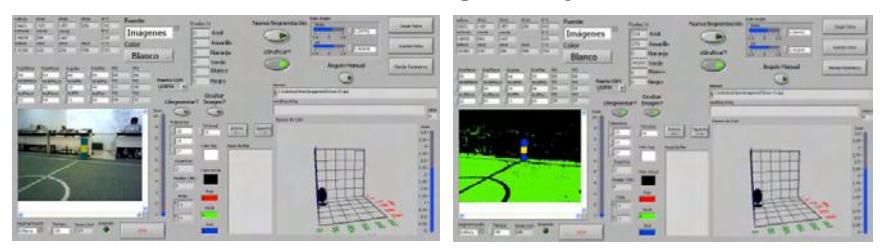
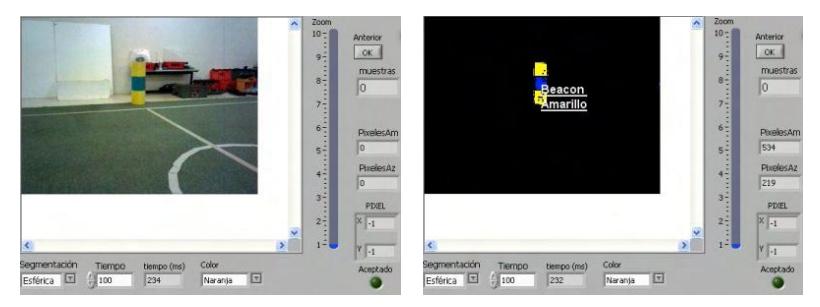
On past two years we implemented basic off-line algorithms of color segmentation in cubic classes and we used on-line color-based algorithm for object identification [10]. This year we are using our own LabView® based tool for image segmentation that allow us more complex image treatments. This GUI works as follow. We acquire real-time images from the robot's camera. Then the segmentation algorithm generates an automatic ellipsoidal color region in RGB space for each specified color. Ellipsoidal regions seemed to better classify pixels than cubic regions with a similar algorithm complexity allowing us to perform object identification almost at the same rate than previous years. Moreover, the new GUI allows user to adjust by hand ellipsoid parameters for a better color fit. Then, accurate color segmentation is obtained in just a few seconds, even in high-noise color situations. The GUI of the segmentation tool, based on Labview® platform is shown on Figure 4. Ellipsoid parameters are saved and downloaded as a single text file in the CMUcam3, which perform the vision algorithms during the match.
Ball-tracking is implemented also in CMUcam3 and provides estimation of relative distance of objects to robot. These estimated distances are sent to main processor for decision of motions towards ball or for robot positioning on field.
We are capable of identify the different objects on the field (Figure 5) and with this information we are developing self-localization algorithms by classic triangulation methods. Basically, we infer robot position on field by the recognition of two or three landmarks and their relative distance respect to robot. The location of ball on the field is based on relative distance and orientation of ball with robot's position.
We will also implement localization algorithms based also on field lines or edges of static objects as landmarks for localization. We are also researching algorithms for color segmentation robust to variant light conditions and noise.
5 Decision Algorithms
The main processor performs three tasks: (1) the generation of walking-pattern using the analytical inverse kinematics of legs and a parameterized leg-path generator allowing omni-directional walking, (2) some simple motions like standup, kick and block are developed with frame-based motion, and (3) off-line decision-making algorithms are run to produce individual player's behaviors.
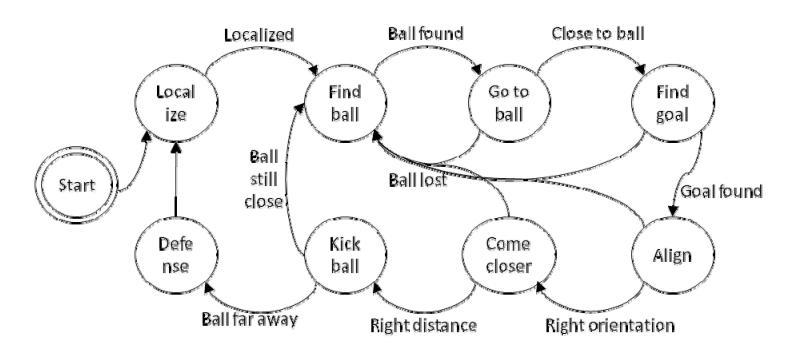
On-line decision-making algorithms are run to produce individual player's behaviors. For example, a player behavior sequence is: (1) find the ball, (2) go close to the ball, (3) get control of the ball, (4) find opponent goal or pass the ball to a teammate, (5) aligning to opponent goal, (4) shoot towards, (5) keep defensive posture. A summarized graphic version of our decision algorithm is presented in Figure 6.
6 Communication
This year we are focusing in the communication between robots on game and with the Game Controller. For RoboCup 2010 we will include WI-FI communication between the robots and Game Controller to be able to start and stop them (referee box). Communication between the robots will also be developed in order to improve the team playing and to prevent collisions between the robots.
7 Conclusion and Future Work
In this paper, we showed the present work of Bogobots-TecMTY team. We take advantage of our previous research results on biped robots to implement them on our humanoids team. Some research done in our Institution about vision systems was also implemented.
This is the third time our team intends to participate in the RoboCup humanoid kidsize league. Our first participation was in Suzhou China 2008, and then in Graz 2009 we improve our level reaching the quarter finals, now in 2010 we expect to continue with the team progress and have an outstanding participation during the competition.
References
- Lynxmotion Robot Kits, http://www.lynxmotion.com
- Hitec servomotors, http://www.hobbyhorse.com/hitec_servo
- CMUCam3 vision sysytem, http://www.cmucam.org/
- Magnetic Compass,http://www.robot-electronics.co.uk/acatalog/Compass.html
- ElectriFly Lithium-Polymer Bateries. http://www.electrifly.com/
- González-Nuñez, E., Aceves-López, A., Ramírez-Sosa, M.: Control para el seguimiento de trayectoria de movimiento de un bípedo con fase: Pie de soporte – Pie en movimiento. Primer Encuentro Internacional de Investigación Científica Multidisciplinaría, ITESM Campus Chihuahua, México (2007) (in spanish)
- González-Nuñez, E., Aceves-López, A., Ramírez-Sosa, M.: Análisis Cinemático de un Bípedo con fases: Pie de soporte-Pie en movimiento, IEEE 5º Congreso Inter. en Innovación y Desarrollo Tecnológico CIINDET, Cuernavaca, México, (2007) (in spanish)
- Meléndez. A., Aceves-López A.: Human Gait Cycle Analysis for the Improvement of MAYRA's Biped Foot", 37 Congreso de Investigación y Desarrollo del Tecnológico de Monterrey, México, pp. 60-67, ISBN 968-891-111-9 (2007)
- González-Núñez, E.: Modelado y control de las dinámicas del caminado del bípedo MAYRA, Master thesis, Tecnológico de Monterrey, México (2007) (in spanish)
- Alvarez, R., Millán, E., Aceves-López, A., Swain-Oropeza, R.: Accurate color classification and segmentation for mobile robots, Book Chapter, "Mobile Robots: Perception & Navigation", ISBN 3-86611-283-1, Verlag (2007).