PIONEROS MEXICO Team Description Paper ROBOCUP 2010 Singapore
Roberto Carlos Ramírez Márquez, Efraín Hernández Franco, Jonathan Alcántar Márquez, Eduardo Alejandro Duenas Matínez, Diego Preciado Barón, Germán Quiñónez Félix, Juan Pablo Capdevila Ponce de León, Armando Garcín Vergara
Universidad Panamericana Campus Guadalajara
http://www.up.mx · http://www.pionerosmexico.org · http://www.robotis.com/ · http://www.fit-pc.com/web/ · http://www.cmucam.org/ · http://www.ocean-server.com/compass.html
Abstract Here we describe the design and realization of humanoid robots designed and manufactured by students, able to play soccer and make several tasks as walking, identifies objects like a soccer ball and approaches to it and kicks it. Also there will be described not only its primary functions, but all the constraints presented along and characteristics of our design like sizes, components, specifications and design of the structure and electronic system. We are presenting two robots, the player and the goal keeper as second player. This could be the forth time we participated in this League with redesigned and improved robots.
Introduction
From the beginnings of robotic men had been trying to emulate the movements of human beings. The actual challenge of robotic is to equal the mobility of the human beings, making movements of great complexity and precision. With this project we pretend to develop prosthesis with the objective and possibility that an invalid person could walk again and recover great part of mobility.
Because of the necessity of automation, technology and control have been developed because a lot of tasks or processes are performed via robots, replacing men and keeping always the simplest and most comfortable way to do things, many ideas can be achieved thanks to these machines.
As robots are flexible enough to develop many or specific challenges, it's design, manufacturing and testing are important points to take care of.
Images Of The Robots
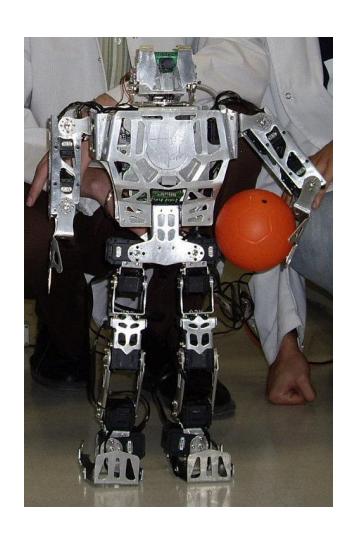
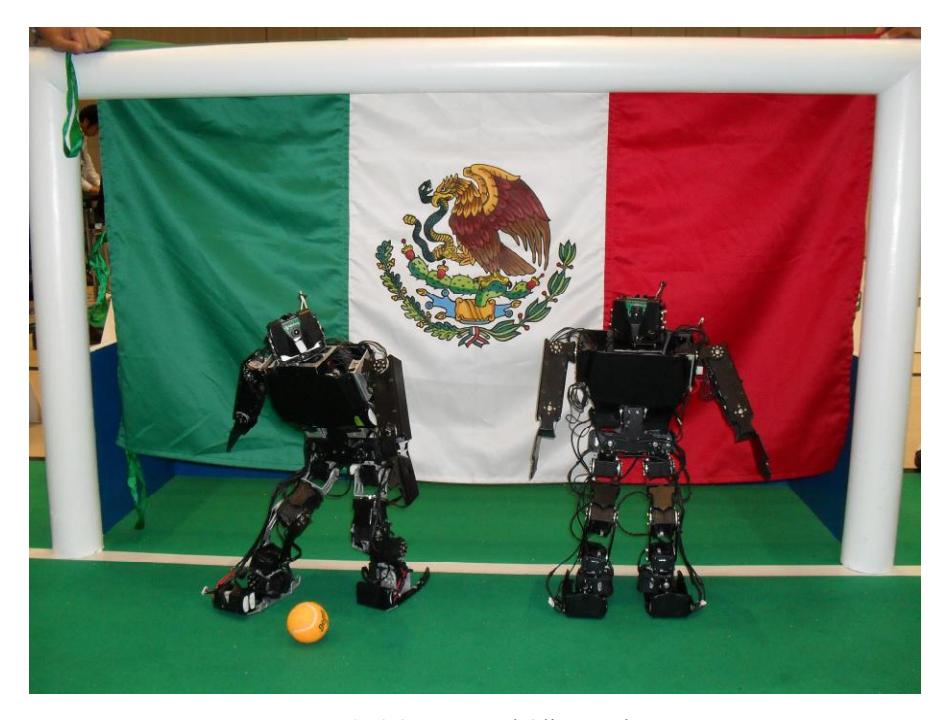
Mechanical Design
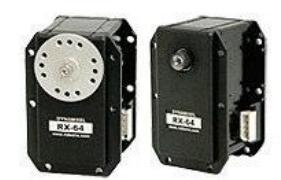
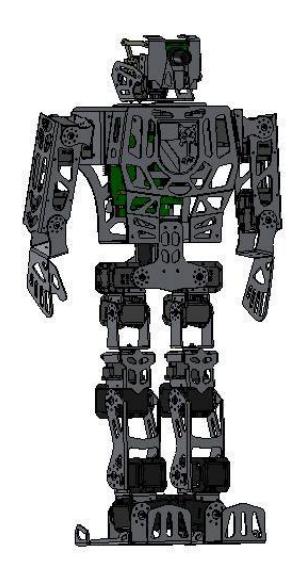
Our robots are build with CAD designed custom-made aluminium parts, powered by Dynamixel [1] servomotors. Each robot has twenty one degrees of freedom:
Head: 2 servomotors, therefore we have 2 (DOF).
Arm: 3 servomotors in each arm, therefore we have 6 (DOF).
Waist: 1 servomotor, therefore we have 1 (DOF). Ingle: 3 servomotors, therefore we have 6 (DOF).
Knee: 1 servomotor in each knee, therefore we have 2 (DOF). Ankle: 2 servomotors in each ankle, therefore we have 4 (DOF).
Electronic Specifications
Control system
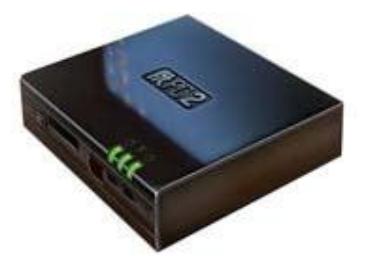
Turco and Oliver are controlled by a Fit-PC [2], see Fig.4.1. with a Windows Xp® embedded operative system, designed specifically for this application.
The features of the Fit-PC2 are:
- Full-featured PC single board computer, tiny and power saving
- Intel Atom Z530 CPU @ 1.6 GHz
- Intel US15W chipset
- 1GB DDR2
- Hard disk interface
- 1000 BaseT Ethernet port
- 802.11b/g/n WiFi
- Six USB 2.0 ports
- IR receiver
- Watchdog
- GPIOs
- LPC and I2C extension buses
- Single 12V supply, 6-9.6W, fanless operation
- Dimensions 104 x 100.7 x 22.9 mm
Camera system
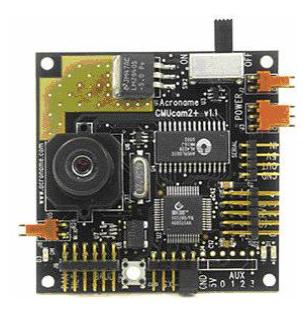
The main sensor placed on the robot's head is the camera CMUcam2 [3] and it consists of a SX52 microcontroller interfaced with an OV7620 Omnivision CMOS camera on a chip that allows simple high level data to be extracted from the camera's streaming video, see Fig. 4.3. The board communicates via a RS-232 or a TTL serial port and has the following functionality:
- Track user defined color blobs at up to 50 Frames Per Second
- Track motion using frame differencing at 26 Frames Per Second
- Find the centroid of any tracking data
- Gather mean color and variance data
- Gather a 28 bin histogram of each color channel
Digital compass
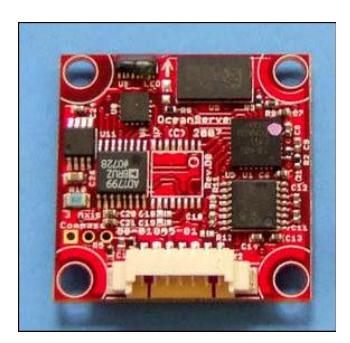
We also are using a Solid State Tilt Compensated 3 Axis Digital Compass that provides information about the orientation of the robot and acceleration in 3 axis, so it can knows at all time were the opposite goal is in a soccer field. This sensor provides information that helps the robots in orientation, to keep them in balance and to detect when a robot falls down. We are using the OS5000-US 3 axis digital compass [4] designed by "OceanServer", see Fig.4.4.
Conclusions
In our last participation in the tournament, Robocup 2009, we realized that we could improve mechanical, electronic and control features. The result of those improvements is Turco and Oliver reloaded. We began its development in 2009, and we are ready to achieve in Singapore a better result.
This project made us realize the great complexity of the human nature, not only in its body, but also in its behavior. Trying to emulate a human person has been a great challenge. We gain experience in many science fields like: mathematics, electronics, control and mechanics. It let us discover our different capabilities as well as our weaknesses.
The teamwork is our better strength because we had a lot of problems along the project that we had to solve sometimes briefly, and the way we solved them, which we consider the best one, was the teamwork, since although we were divided in three parts; control system, electronics and mechanics; we helped each other in difficult situations and we never forgot that we were a team. This is not an easy project and it demands many time and sacrifice.
It also help us to understand more about development of prosthesis and the advantages that this offers to does people that need to recover their movements. A very important thing is the fact that we received complete support from our University, part of the budget was supported by them and other resources like electronics and tool labs, computers, software. Another part of the budget was support by some sponsors.
References
[1] Dynamixel servomotors, http://www.robotis.com/ [2] Fit-PC2 Single board PC, http://www.fit-pc.com/web/ [3] CMUCam2 vision system, http://www.cmucam.org/ [4] Ocean Server digital compass, http://www.ocean-server.com/compass.html